


From SIPs to ETFs, REITs to PMS and AIFs, India’s investors have seen it all as each investment option has reshaped the way wealth is built. While SIPs made wealth-building simple, ETFs brought low-cost diversification, and REITs opened real estate to all, while PMS and AIFs unlocked advanced strategies for high-net-worth investors. Now comes the Specialized Investment Fund India.
SEBI officially launched the Specialized Investment Fund (SIF) framework on April 1, 2025. This new category bridges the gap between mutual funds and PMS/AIFs, providing investors with access to advanced strategies within a regulated framework.
What is Specialized Investment Fund?
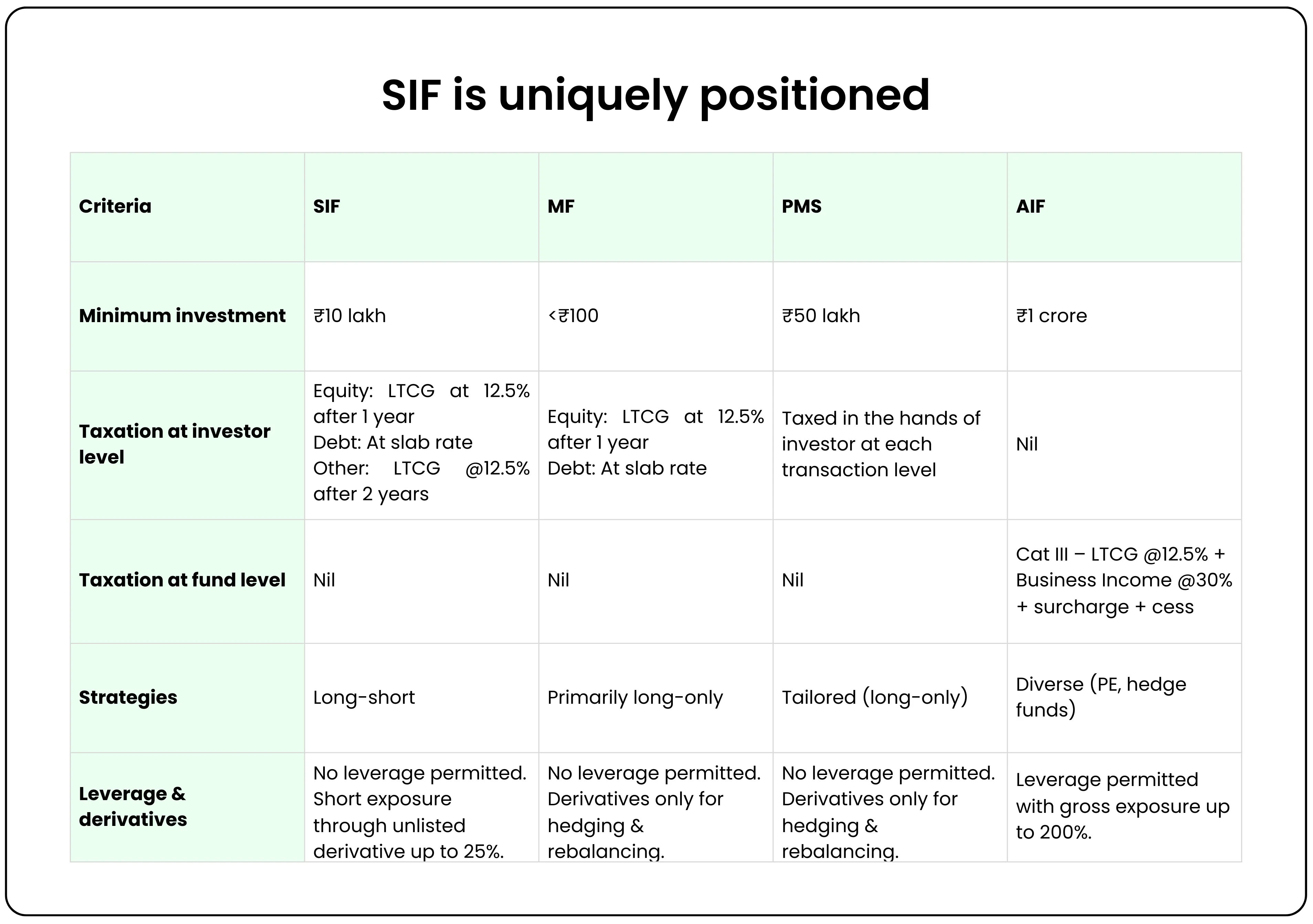
A Specialized Investment Fund (SIF) investment funds is a newly introduced category of investment option in India. It combines the accessibility and tax efficiency of mutual funds with the flexibility and advanced strategies of Portfolio Management Services (PMS) and Alternative Investment Funds (AIFs). Unlike traditional mutual funds that follow a ‘long-only’ approach, SIFs can take both long and short positions, use derivatives more actively, and adapt dynamically to different market conditions. In short, they are designed to give retail investors access to sophisticated investment strategies without the high entry barriers that come with PMS or AIFs.
Why do we need SIFs?
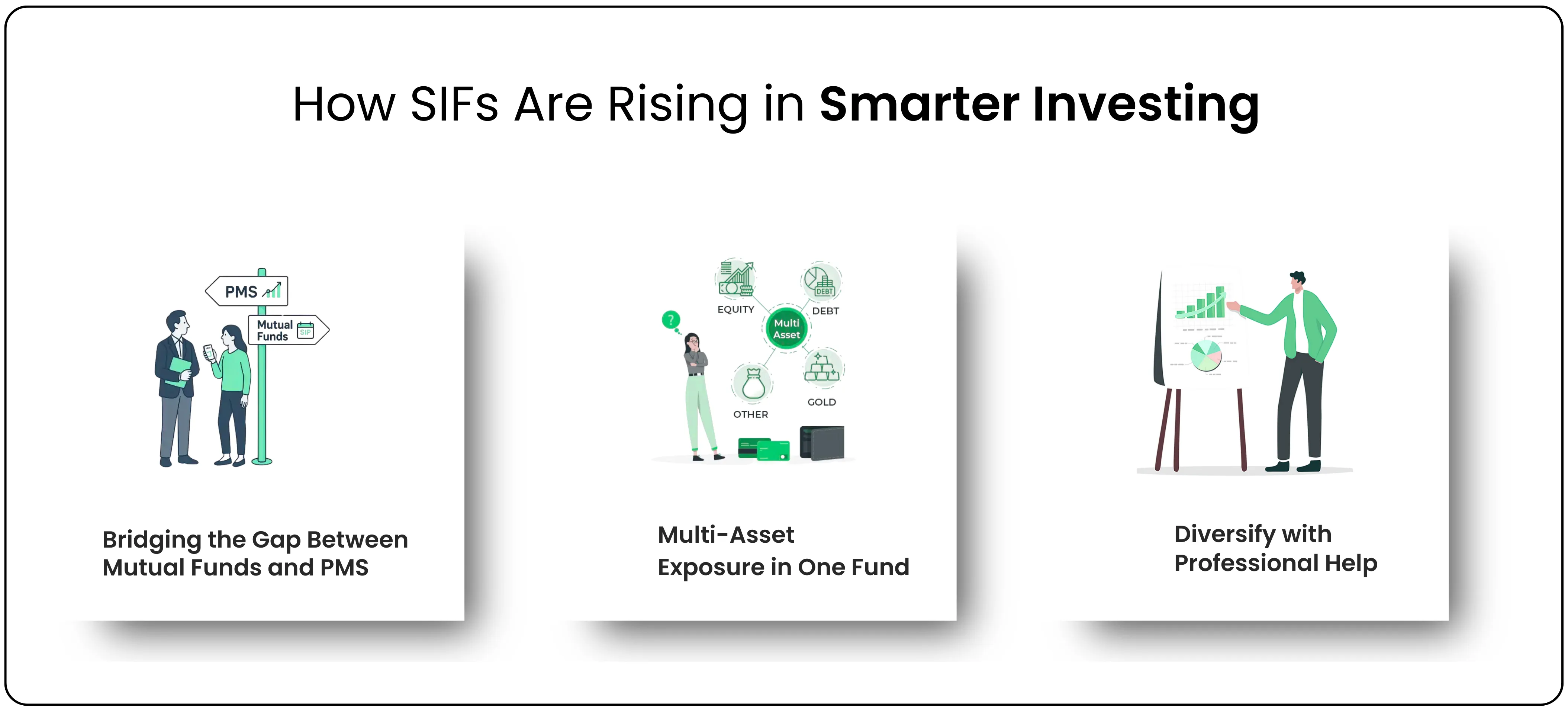
Mutual funds have long been the go-to investment vehicle for Indian retail investors. They are simple, well-regulated, and accessible with minimum investments starting as low as ₹100. But they come with one big limitation: they are ‘long-only’ instruments. In other words, they can only buy stocks in the hope that markets go up.
Want to know how Mutual Funds Earn and Impact Your Returns? Read here
This approach works well in a bull market, but during market corrections or sideways phases, returns often stagnate. PMS and AIFs, on the other hand, allow fund managers the flexibility to use more advanced playbooks including short-selling (profiting from falling stocks), leverage (borrowing to amplify positions), and thematic concentration (focusing heavily on one sector or idea). But the high entry barriers, ₹50 lakh for PMS and ₹1 crore for AIF, keep these strategies out of reach for most investors.
This is where SIF investment in India 2025 steps in. Strategic Investment Funds (SIFs) are designed to bridge this gap. They offer access to sophisticated investment strategies at a lower ticket size, while still retaining the transparency and investor protection that mutual funds offer.
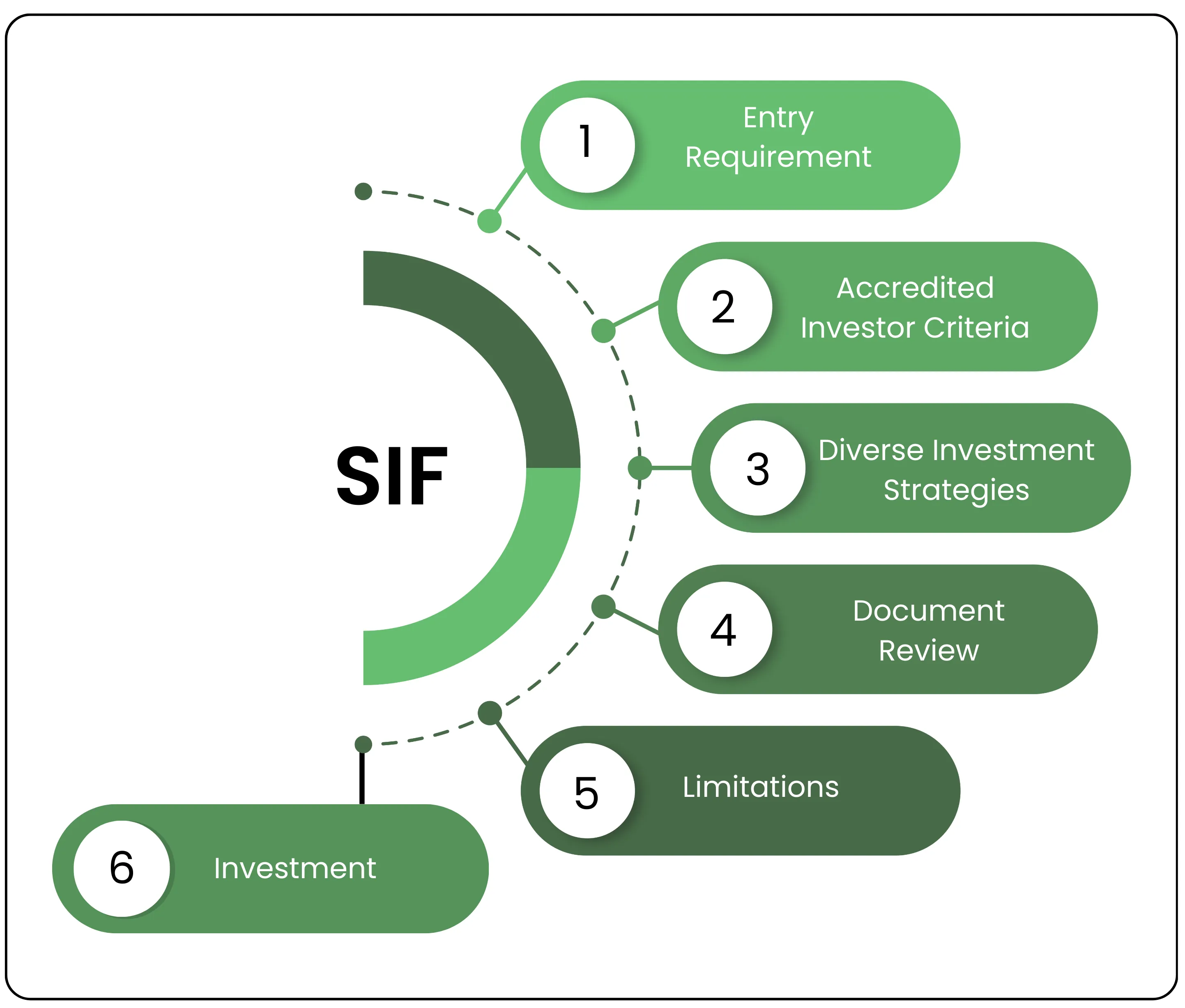
What is the Minimum Investment Threshold?
Investors need to maintain a minimum investment of ₹10 lakh per PAN across all SIF strategies.
This limit is separate from any regular mutual fund investments made under the same AMC.
Systematic plans such as SIP, SWP, or STP can be used, as long as the overall investment stays above the minimum level.
AMCs are required to monitor compliance daily to ensure the threshold is maintained.
If the value falls below ₹10 lakh due to market movements, it isn’t treated as a violation. However, investors must redeem their remaining holdings if the investment stays below the required amount.
Specialized Investment Fund strategies
What can SIFs do that mutual funds can’t?
Profit in falling markets
Mutual funds usually struggle in bear markets. SIFs, however, can short-sell, meaning they can benefit when stock prices decline.
Use of derivatives
While mutual funds use derivatives mainly for hedging, SIFs can use them more actively to generate alpha.
Higher flexibility in allocation
SIFs can tilt heavily toward certain sectors or even individual companies if the fund manager sees strong potential.
Risk management through balance
By combining long and short bets, SIFs can potentially deliver more stable returns with lower volatility, unlike the all-in, long-only strategies.

How SIFs work in stock market
The standout feature of SIFs is their adaptability across market phases:
- Bull market: They can buy stocks to participate in the rally.
- Bear market: They can short stocks to benefit from falling prices.
- Range-bound market: Strategies like derivatives and arbitrage can help generate alpha.
- Volatile market: SIFs can combine long and short bets, cushioning downside risks while still keeping upside potential for gains.
This level of flexibility is valuable because traditional mutual funds often struggle during market corrections or volatile phases, where holding-only strategies may not deliver consistent returns.
Practical example
Imagine a scenario where technology stocks are booming, but the automobile sector is under pressure due to weak demand. A traditional equity mutual fund may continue to hold positions in both sectors due to its broad market mandate.
A SIF, however, can take a more dynamic approach, going long on technology stocks while shorting auto stocks, effectively benefiting from both the winners and the laggards. This dual approach can reduce overall portfolio volatility and provide smoother, consistent returns.
Risks of Specialized Investment Funds
Higher complexity: These funds use derivatives and short positions, which can backfire if markets move unpredictably.
Cost structure: Fees could be higher than plain mutual funds due to the active management style.
Limited liquidity: Exit windows may not always be as flexible as mutual funds. Some SIFs allow exits only a few times a week.
Investors should evaluate their own risk appetite and investment horizon before committing to SIFs.
Who should consider SIFs?
SIFs are not for every investor. They may be suitable if you:
- Already have a solid base of mutual fund SIPs or index funds.
- Are willing to accept higher risk for the potential of smoother returns across market cycles.
- Want exposure to strategies usually available only to wealthy investors.
- Understand that short-term volatility can be higher in such products.
On the other hand, if you are just starting your investment journey or prefer simplicity and predictability, traditional mutual funds remain the best starting point.
While investors wait for more SIF options to launch, Our app already gives you elite ways to invest. Open your Cubplus account today and stay ahead.
Disclaimer: The information provided in our blogs is for informational purposes only and should not be construed as financial, investment, or trading advice. Trading and investing in the securities market carries risk. Always conduct your own research and consult with a qualified financial advisor before making any investment decisions. Past performance is not indicative of future results. Copyrighted and original content for your trading and investing needs.
© 2025 — Tradejini. All Rights Reserved.
.webp%3Falt%3Dmedia%26token%3D0ead9799-20bc-4d1e-ae8f-d75ab18921b5&w=3840&q=75)


