Imagine a typical trading day in the financial markets where a piece of unexpected negative news triggers a wave of panic selling and extreme volatility. Within minutes, a particular stock or an entire index movement starts plummeting sharply. If the freefall continues unchecked, it could cause systemic risks and lead to market crashes. To prevent market crashes, prevent panic selling, and allow the market to cool down, the stock exchange relies on a built-in safety mechanism known as a trading curb or circuit breaker system.
This mechanism is widely recognized as a circuit breaker in stock market operations.
What Are the Circuit Breaker Rules in Stock Markets?
A circuit breaker is a regulatory measure implemented by a stock exchange to temporarily halt trading when a stock price or a broad market indices move beyond a pre-defined limit within a single trading session. The Securities and Exchange Board of India (SEBI) mandates circuit breaker rules in Indian markets to control excessive volatility.
Stock market circuit breakers can be applied to individual stocks (and individual securities) as well as benchmark indices like the National Stock Exchange's Nifty 50 and the Bombay Stock Exchange's Sensex. When circuit breakers are triggered, trading halts for a specific duration, giving investors time to process information. These trading pauses serve the same purpose across global markets: to reduce panic and prevent emotional trading.
How Circuit Breakers Work to Protect Investors from Market Volatility
The primary function of circuit breakers is to preserve market integrity and protect investors. Unrestricted price movements can lead to sudden liquidity dry-ups and potential price manipulation. By halting trading, the circuit breaker system acts as a speed bump against irrational buying or panic selling. This gives buyers and sellers a chance to evaluate the fundamental reasons behind the market volatility rather than reacting purely out of fear. This is exactly how circuit breakers work to stabilize trading activity during wild market conditions.
Also read: Think Like a Turtle | Trading with Rules, Not Emotions
Understanding Market Wide Circuit Breakers
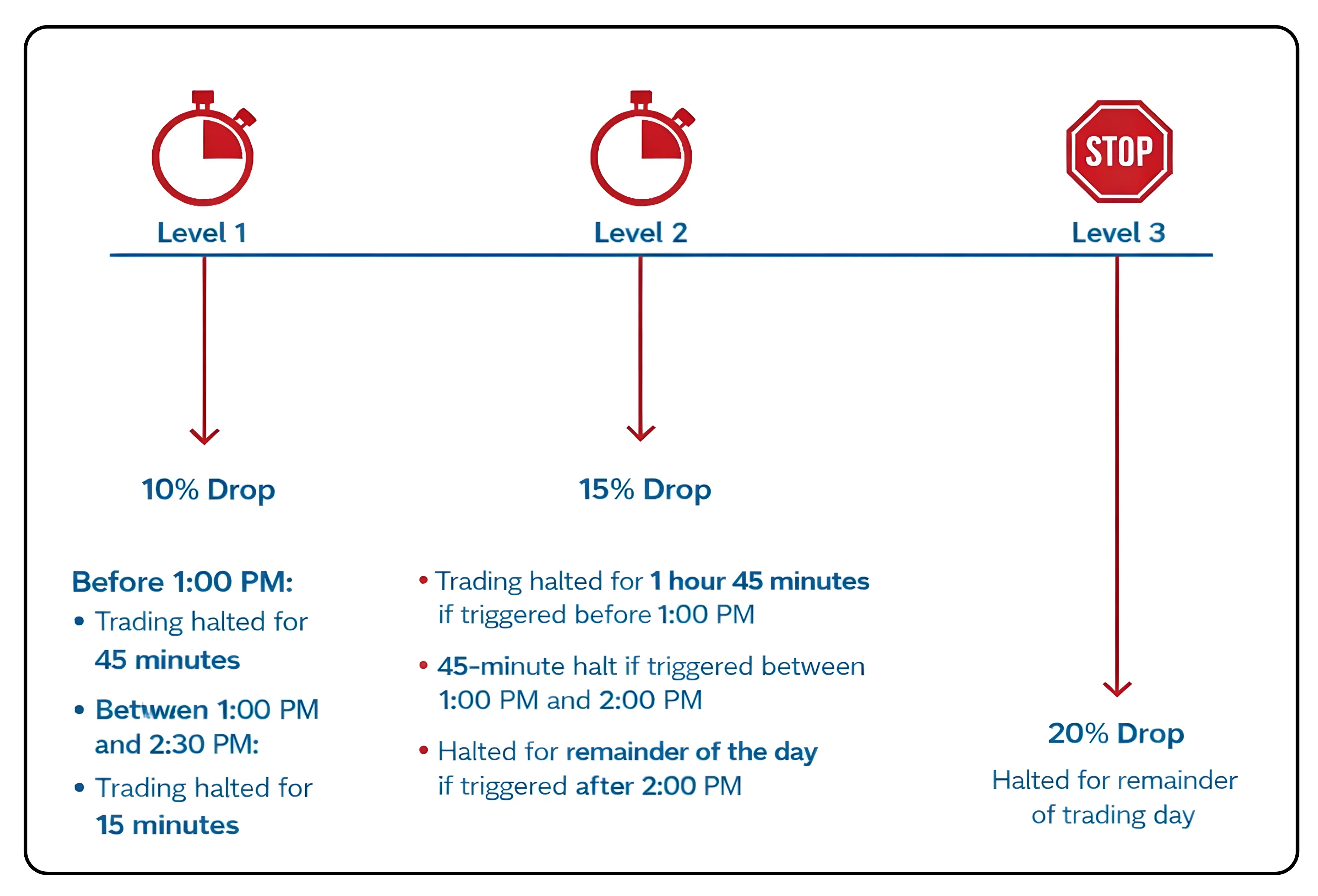
In Indian markets, market wide circuit breakers are triggered at three specific circuit breaker levels of index movement: 10%, 15%, and 20%. These market wide percentages are calculated based on the previous day's closing level (or previous day's closing value) of the Nifty 50 or Sensex.
At the 15% level, a market halt occurs for 1 hour 45 minutes if triggered before 1:00 PM, for 45 minutes if triggered between 1:00 PM and 2:00 PM, and for the entire day if triggered after 2:00 PM. At the 20% level, trading is suspended for the remainder of the day regardless of the time of occurrence.
Once the halt ends, trading resumes with a pre open call auction session to discover the average price before normal trading restarts. Exchanges often use their own systems to monitor these limits seamlessly.
Upper Circuit vs Lower Circuit in Individual Stocks
At the particular stock level, a stock exchange uses price bands, sometimes referred to globally as limit up limit down rules, to manage extreme volatility among other stocks.
An upper circuit is the maximum upper limit a stock price is allowed to reach in a single trading day. When a stock hits its upper circuit, sell orders are unavailable at that price, and buyers queue up at the maximum permitted level.
Conversely, a lower circuit is the minimum price a stock can fall to in a single day. When this is hit, the order book will display only sellers and no buyers. Standard price bands for individual stocks in India are set at 2%, 5%, 10%, and 20%, depending on the stock category and regulatory classification relative to its reference price.
Also read: Converting SIP Savings into Steady Monthly Income Through an SWP
Circuit Limits in F&O
Stocks in the F&O segment and select exchange traded products do not have fixed static price bands like cash-segment stocks. Instead, they operate under dynamic circuit limits, and trading pauses may occur if limits are breached. However, they remain fully subject to overarching market wide circuit breakers.
What Causes Circuit Breakers to Trigger?
Circuit breakers are triggered during periods of extreme uncertainty in the financial markets. Market-wide trading halts can be caused by unexpected macroeconomic data, geopolitical events, sudden shifts in global markets, or major domestic policy changes. For individual securities, price bands are often hit following significant corporate announcements, quarterly earnings reports, or regulatory actions that drastically affect a stock price.
Handling Circuit Breakers During Regular Trading Hours
When a market wide circuit breaker system triggers a market halt, trading activity is paused, and orders cannot be executed during regular trading hours. Investors should use their time to stay informed and objectively review the negative news driving the market conditions. Instead of reacting emotionally to the sudden price freeze, it is a period to reassess whether the underlying fundamentals of the investments have changed.
Maintaining discipline and understanding the regulatory mechanisms of the exchange board helps investors navigate periods of high market volatility effectively.
Disclaimer: The information provided in our blogs is for informational purposes only and should not be construed as financial, investment, or trading advice. Trading and investing in the securities market carries risk. Always conduct your own research and consult with a qualified financial advisor before making any investment decisions. Past performance is not indicative of future results. Copyrighted and original content for your trading and investing needs.
© 2026 — Tradejini. All Rights Reserved.
.webp%3Falt%3Dmedia%26token%3D0ead9799-20bc-4d1e-ae8f-d75ab18921b5&w=3840&q=75)