

You may have seen our articles on fundamental analysis of stocks in the Jiniversity section. We share these analyses to help investors understand how to evaluate businesses before making investment decisions.
Want to read one of our fundamental analysis blogs? Read it here.
But what exactly is fundamental analysis?
In simple terms, fundamental analysis is the process of studying a company in detail, its business, financials, and long-term prospects to decide whether it’s worth investing in. Instead of just following price movements or tips, you are looking at the company’s true value.
Importance of fundamental analysis in stock market
Why does fundamental analysis matter?
Imagine you are evaluating two coaching institutes for your child. One is always crowded, but you don’t really know much about the teachers or the results. The other may not advertise much, but when you dig deeper, you find that their teachers are highly experienced, past students have cracked top exams, and the institute’s reputation is solid.
Which one would you trust? That’s the difference between surface-level observation and doing deep research, the heart of fundamental analysis.
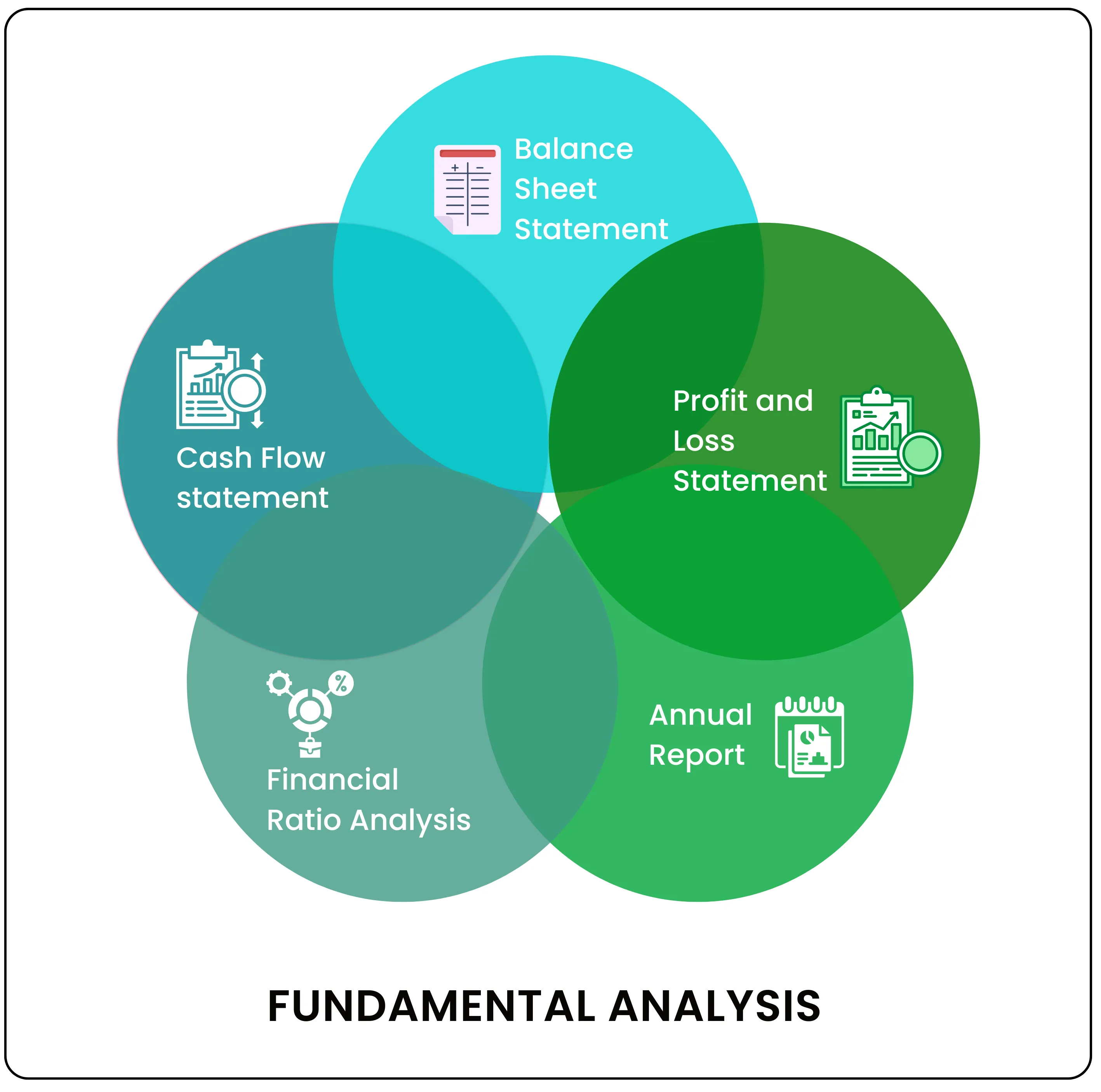
SO, how to evaluate companies before investing?
Qualitative factors:
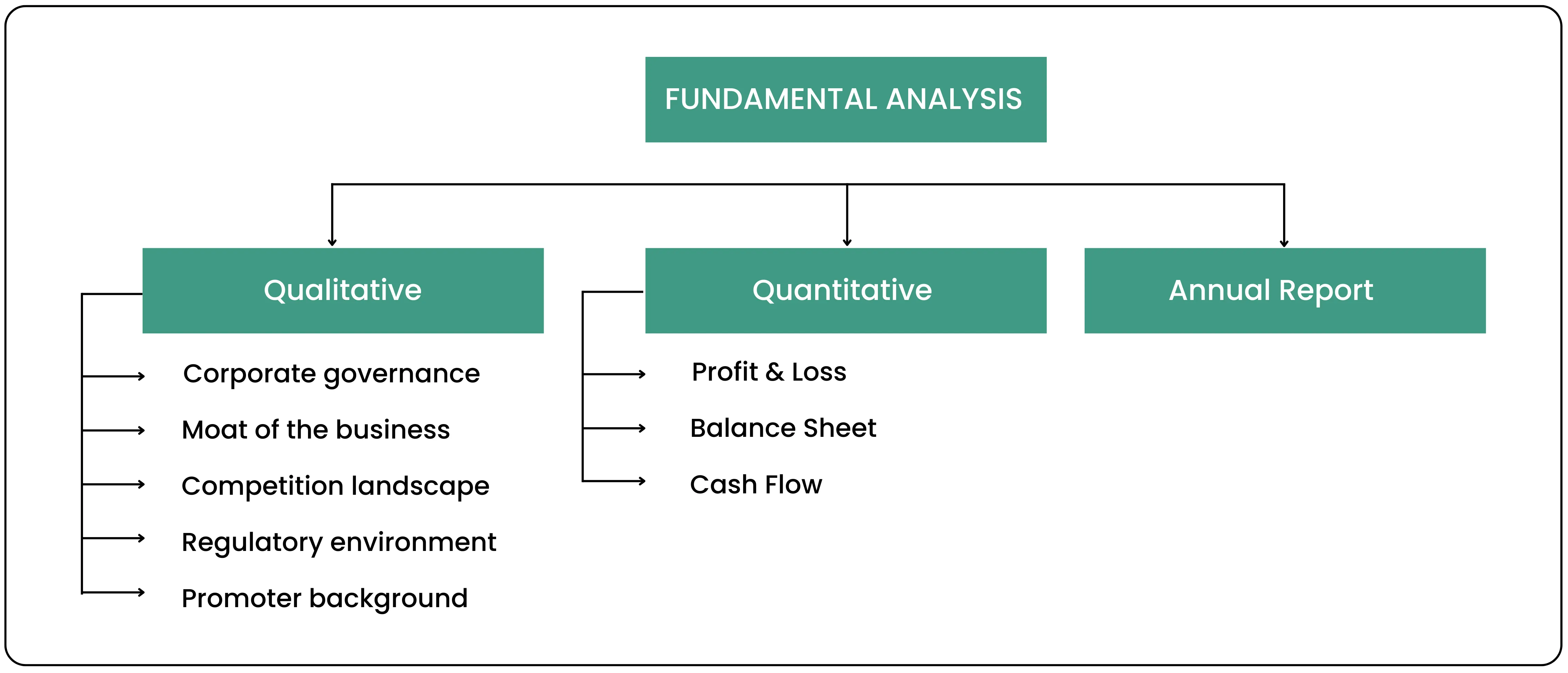
There are qualitative and quantitative analysis in stocks. In qualitative, you can’t always measure with numbers, but it plays a big role in long-term performance. Some key questions to consider are:
- How ethical and capable is the company’s management?
- Does the business have a strong moat (for example, IRCTC in online railway ticketing)?
- Who are its competitors, and how tough is the market?
- What regulations govern the industry (like SEBI rules for brokers or RBI guidelines for banks)?
Quantitative factors:
These are measurable financial metrics that are usually available in a company’s reports. Key indicators include revenue growth, profit margins, debt levels, cash flows, and return ratios. Looking at these numbers gives you a clear picture of the company’s financial health.
By combining these with qualitative aspects, you can make a more informed judgment about the company’s true strength, which is the essence of company financial analysis for investors.
Wondering where to find fundamental analysis on CubePlus? Read our blog about CubePlus Fundamentals
Sector-Wise Approach
While the core principles of financial analysis remain the same, every industry has its own unique characteristics. For instance, manufacturing companies are capital-intensive, so metrics like debt levels, capacity utilisation, and operating margins become crucial. In contrast, technology companies often focus more on scalability, R&D expenses, and recurring revenues. Similarly, banks and other financial institutions are evaluated differently, with emphasis on capital adequacy, non-performing assets (NPAs), and regulatory compliance.
Understanding these sectoral differences ensures that your analysis is not just number-crunching but context-driven, giving you a more accurate picture of a company’s financial health.
Fundamental analysis tools for beginners
Annual Report: A complete guide to a company’s financial health and management insights that helps you learn how to analyze stocks using annual reports.
Industry Data: Helps you compare performance against peers and sector benchmarks.
News Updates: Keeps you aware of key developments, market trends, and company announcements that may impact long-term prospects.
The wise investing
Fundamental analysis for investors is not about predicting where a stock's price will be tomorrow. It’s about understanding the business behind the stock and making rational, long-term investment decisions.
If you get into the habit of looking beyond tips and headlines, studying management quality, industry strength, and financial stability, you will avoid common investor mistakes and start building wealth on solid ground.
Still confused? Follow our step-by-step guide to fundamental analysis on CubePlus.
Disclaimer: The information provided in our blogs is for informational purposes only and should not be construed as financial, investment, or trading advice. Trading and investing in the securities market carries risk. Always conduct your own research and consult with a qualified financial advisor before making any investment decisions. Past performance is not indicative of future results. Copyrighted and original content for your trading and investing needs.
© 2025 — Tradejini. All Rights Reserved.
.webp%3Falt%3Dmedia%26token%3D0ead9799-20bc-4d1e-ae8f-d75ab18921b5&w=3840&q=75)