Spotting where liquidity and institutional money are flowing can make all the difference in trading. The “Active by Volume” and “Active by Value” dashboards on Tradejini CubePlus trading tool gives a live view of institutional money flow and market participation — helping traders spot high-volume price action in real time.
These aren’t just stats on a screen. They’re real-time signals of sentiment, momentum, and money flow.
Here’s how to read and trade with them effectively.
1. Understanding the Two Key Metrics
A. Active by Volume - Tracking Market Participation
The Active by Volume tab ranks stocks by the total number of shares traded in a session, making it easier to spot high-volume price action and crowd participation across Nifty, BankNifty, and mid-cap segments.
It helps traders see where activity and liquidity are building up, a useful cue for short-term momentum.
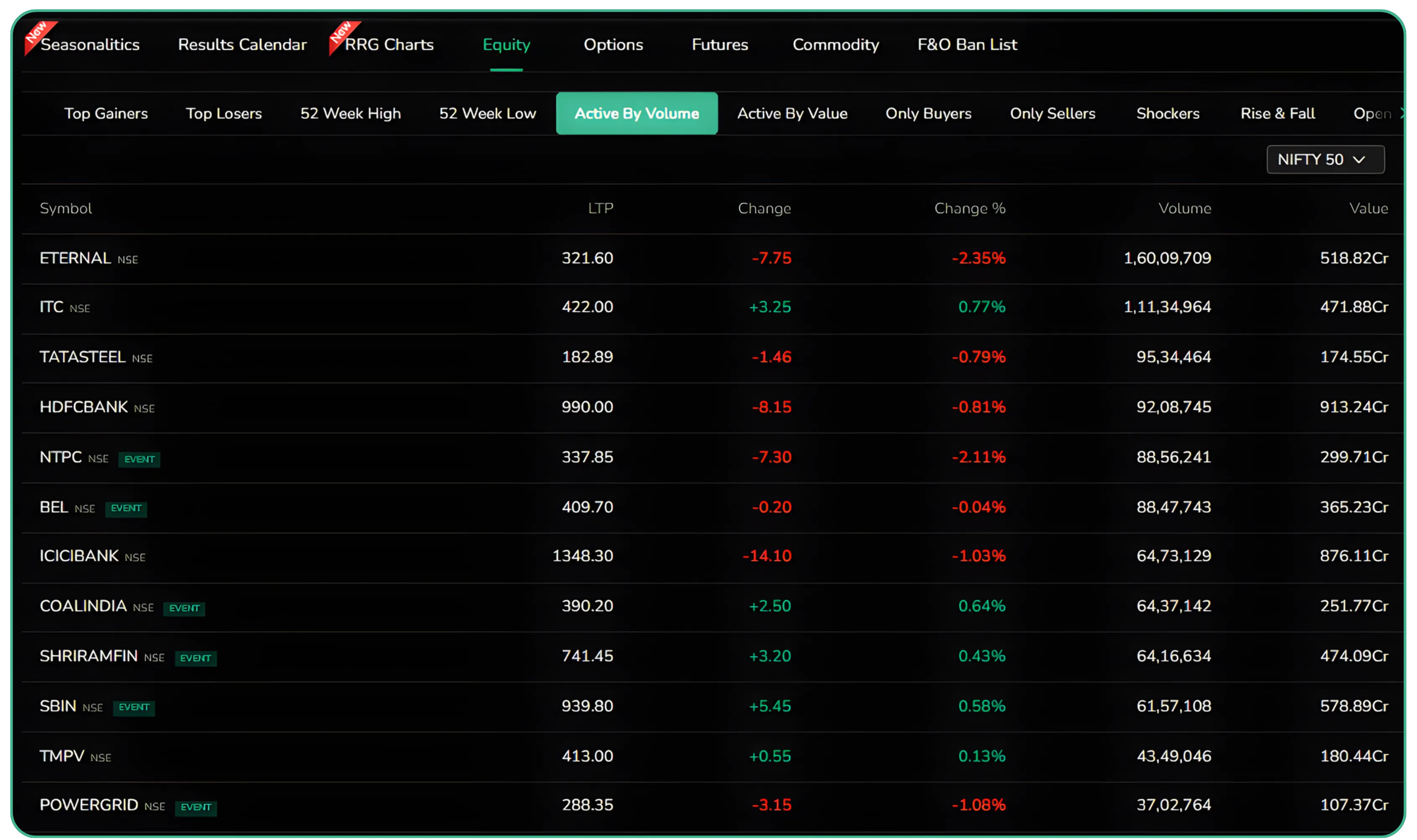
From the dashboard, ETERNAL, ITC, HDFCBANK, NTPC, and TATASTEEL showed the highest trading volumes.
Even if price moves are small, heavy volumes signal strong liquidity, making entries and exits smoother for intraday trades.
How to read it:
- Rising price with high volume → bullish confirmation (accumulation phase)
- Falling price with high volume → bearish confirmation (distribution phase)
- Flat price with high volume → possible buildup before a breakout
####B. Active by Value - Following the Money Flow
The Active by Value tab highlights stocks with the highest turnover (price × volume).
This shows where large capital inflows or outflows are happening often a telltale sign of institutional activity.
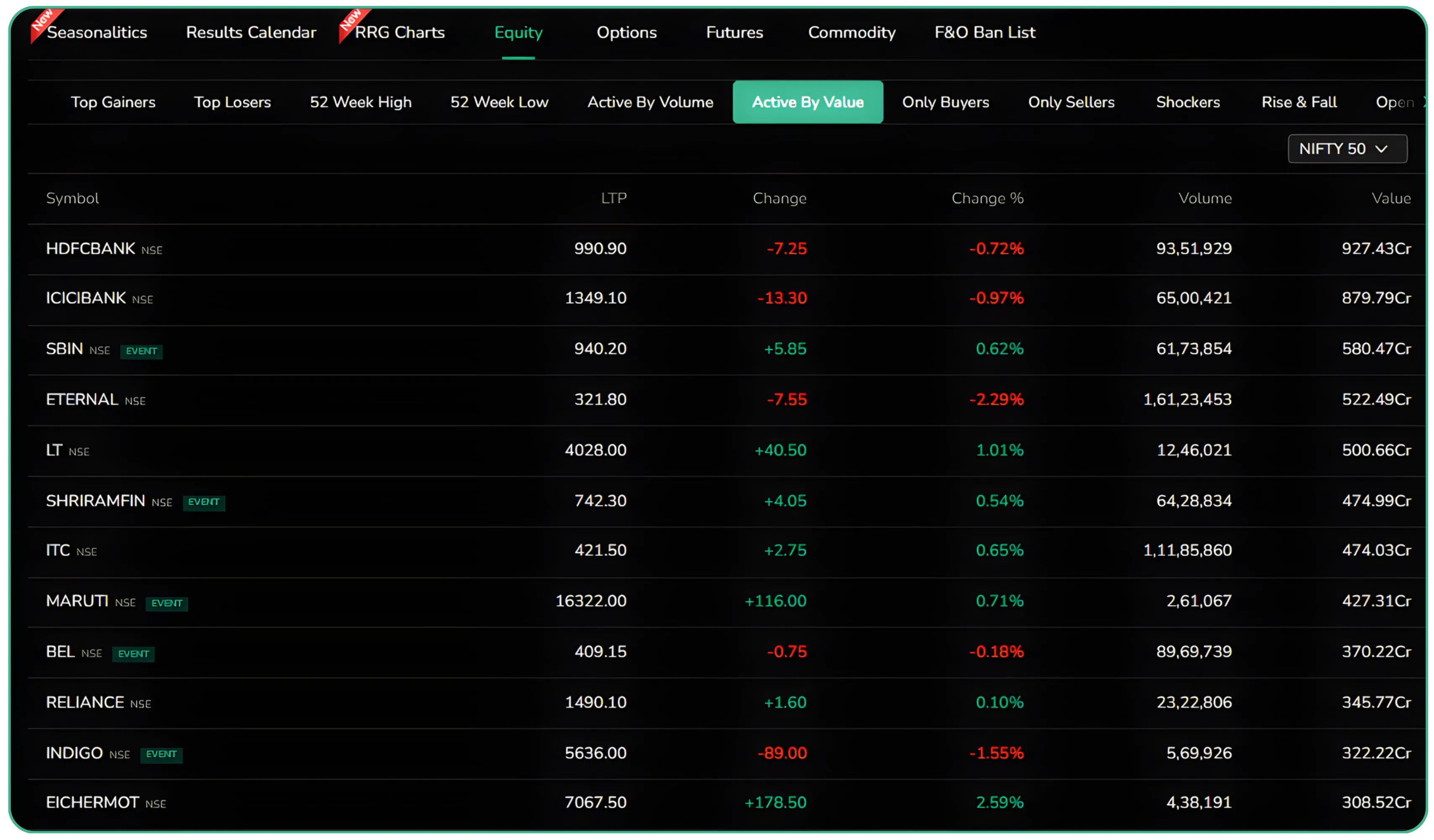
In the data snapshot, HDFC Bank (₹855 Cr), ICICI Bank (₹816 Cr), and SBI (₹514 Cr) led the charts, pointing to strong institutional participation in banking.
How to read it:
- High value turnover → institutional interest
- High value and high volume together → genuine directional strength, not just retail noise
2. Filtering by Index Segment - NIFTY, BANKNIFTY, and Beyond
A major edge with the Tradejini CubePlus trading tool is the ability to filter active stocks by segment, Nifty, BankNifty, or Midcap, allowing more focused tracking of Active by Volume and Active by Value stocks within each basket.
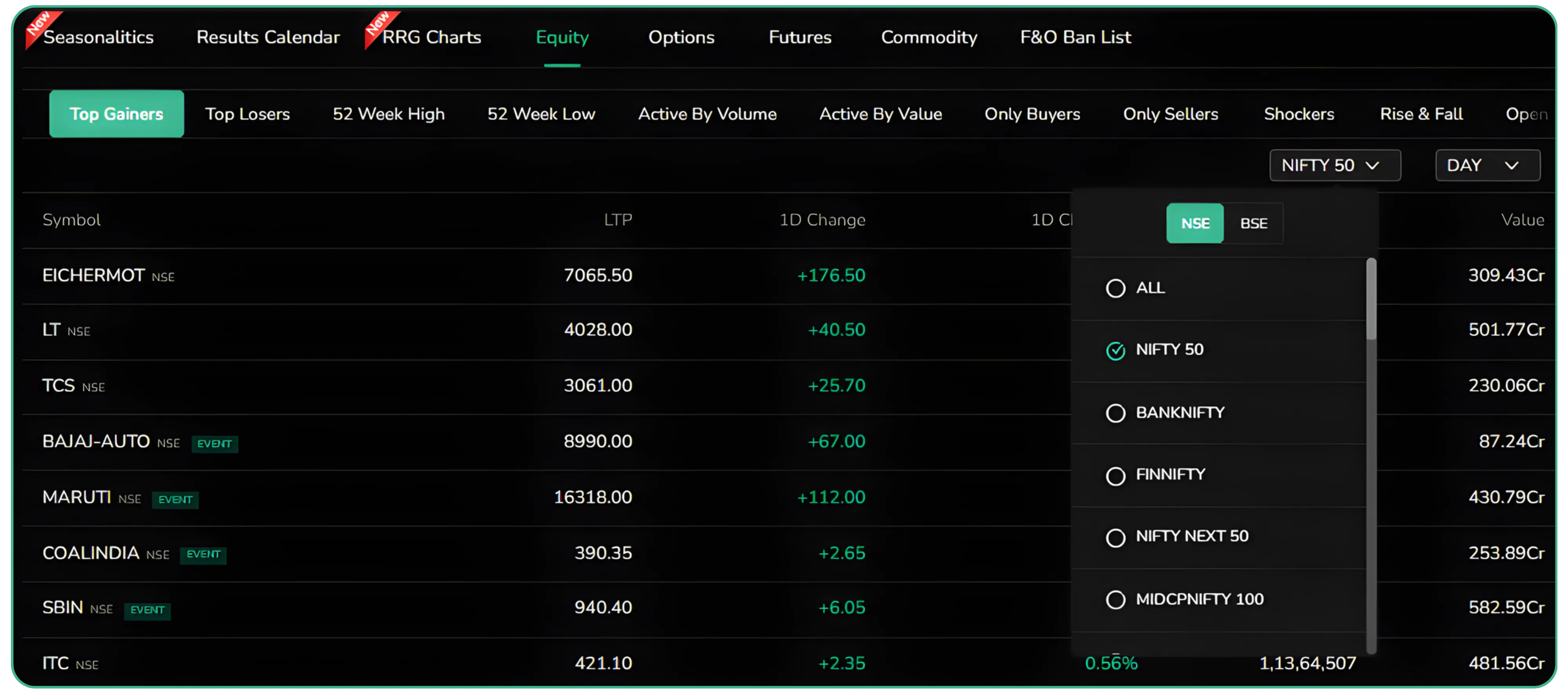
| Filter | Focus Area | Ideal For |
|---|---|---|
| All | All NSE-listed stocks | Broad market screening |
| NIFTY 50 | Large-cap index stocks | Index traders, ETF investors |
| BANKNIFTY | Top banking & financial names | Sectoral or BankNifty traders |
| FINNIFTY | Diversified financials (banks, NBFCs, insurance) | Sector rotation analysis |
| NIFTY NEXT 50 | Emerging large caps | Swing or mid-term investors |
| MIDCPNIFTY 100 | Mid-cap segment | High-beta, momentum traders |
For instance, selecting NIFTY 50 filters the view to the most liquid and institutionally tracked names, making it easier to sync stock trades with index moves or futures action.
Also Read: How to apply for an IPO on CubePlus website by Tradejini
3. Practical Trading Framework
Seasoned traders combine both metrics, Active by Volume and Active by Value, to structure trades around institutional money flow tracking and confirm high volume price action interpretation before entry.
A. Market Open (9:15 AM – 10:00 AM): Spot Early Volume Leaders
- Watch for sudden volume spikes with clear price movement
- Ignore high volume stocks with flat or random price action
Goal: Build a shortlist of momentum candidates for intraday setups
B. Midday (11:00 AM – 1:30 PM): Track Value Leaders
- Shift focus to Active by Value, see where institutional orders are landing
- Look for steady inflows or outflows
Goal: Align trades with institutional direction, big money usually drives closing trends
C. Post-Lunch (2:00 PM – 3:15 PM): Confirm Trend Continuation
- Cross-check morning volume leaders with afternoon value leaders
- If a stock appears in both and continues the same direction, it’s likely to close strong
Example:
When HDFCBANK and ICICIBANK top both lists, it signals sustained institutional momentum, ideal for short-term trend trades or index-linked plays like NIFTY/BANKNIFTY.
4. Decision-Making Matrix
| Market Behavior | Interpretation | Trading Approach |
|---|---|---|
| High Volume + Price Rising | Accumulation | Go long / buy on dips |
| High Volume + Price Falling | Distribution | Short or avoid longs |
| High Value + Flat Price | Institutional buildup | Wait for breakout |
| Rising Volume & Value Together | Strong directional conviction | Trend-following trades |
| Volume Spike + Low Value | Retail-driven move | Stay cautious; avoid chasing |
5. Technical Confirmation
Once your watchlist is ready:
- Use VWAP or Vortex Indicator to validate intraday trend direction
- Apply Fibonacci retracement or support/resistance to plan entries
- Check index alignment, for instance, strong value action in banking can directly impact BANKNIFTY
6. Key Takeaway
Combining Active by Volume and Active by Value data gives a sharper view of short-term moves, helping traders align with institutional money flow and make better decisions based on turnover and segment activity.
Volume shows interest. Value shows conviction.
When both align, you’re looking at the highest-probability trade setups.
| Step | Action | Objective |
|---|---|---|
| 1 | Open Market Scan → Equity | Access liquidity and activity data |
| 2 | Use Active by Volume | Spot high-participation stocks |
| 3 | Switch to Active by Value | Identify institutional money flow |
| 4 | Apply Index Filter (NIFTY / BANKNIFTY / MIDCAP) | Focus on relevant market segment |
| 5 | Confirm with Technicals | Align with broader trend before entry |
Also Read: The CubePlus Guide to Mutual Fund Investing
Disclaimer: The information provided in our blogs is for informational purposes only and should not be construed as financial, investment, or trading advice. Trading and investing in the securities market carries risk. Always conduct your own research and consult with a qualified financial advisor before making any investment decisions. Past performance is not indicative of future results. Copyrighted and original content for your trading and investing needs.
© 2025 — Tradejini. All Rights Reserved.

%252FCubePlus_Shield_Part%25203%2520Blog%2520Thumbnail.webp%3Falt%3Dmedia%26token%3Da5581624-5761-476f-8451-40c157b54840&w=3840&q=75)
%252FShield%2520on%2520Cubeplus%2520part2.webp%3Falt%3Dmedia%26token%3D252a5b48-a580-4e8d-b939-c82d4696eaef&w=3840&q=75)