Traders frequently encounter difficulty in determining the exact number of shares to sell when partially booking profits or managing losses. To address this, Tradejini has introduced a feature that allows positions to be exited based on percentage change rather than manual calculation of share quantities. This enhancement simplifies position management and improves execution efficiency for traders across experience levels.
The traditional approach to selling stocks required traders to manually calculate the number of shares corresponding to their desired exit percentage. For instance, if a trader held 1,000 shares and wanted to exit 25% of the position, they would need to multiply 1,000 multiplied by 0.25 to arrive at approximately 250 shares. While this calculation seems straightforward, it becomes cumbersome when managing multiple positions simultaneously or when making quick decisions in volatile market conditions. Moreover, the mental arithmetic involved can lead to errors, especially during high-stress trading situations when every second counts.
Navigate to the Holdings section in the top menu bar, hover over the desired stock, select the three-dot icon, and click Exit.
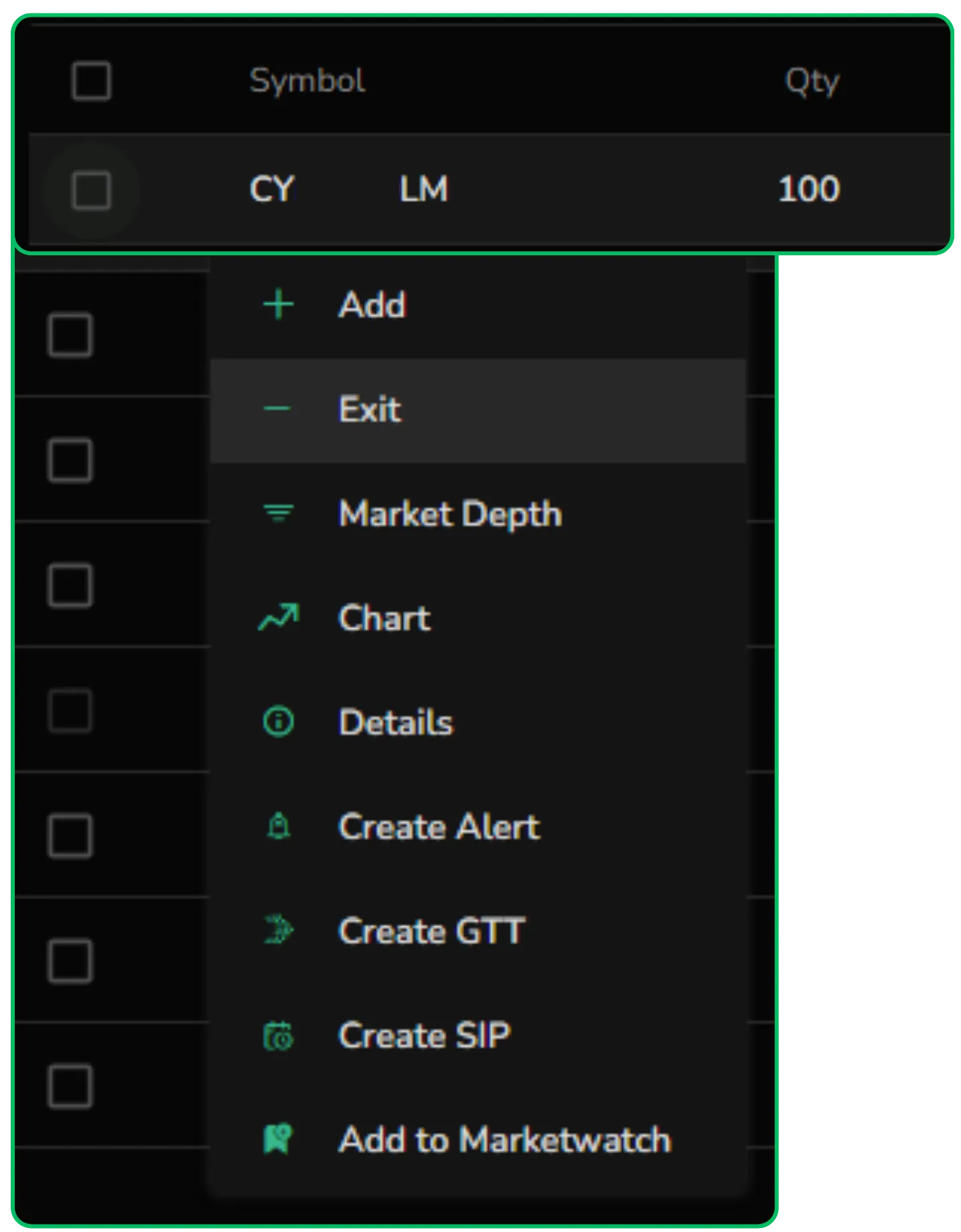
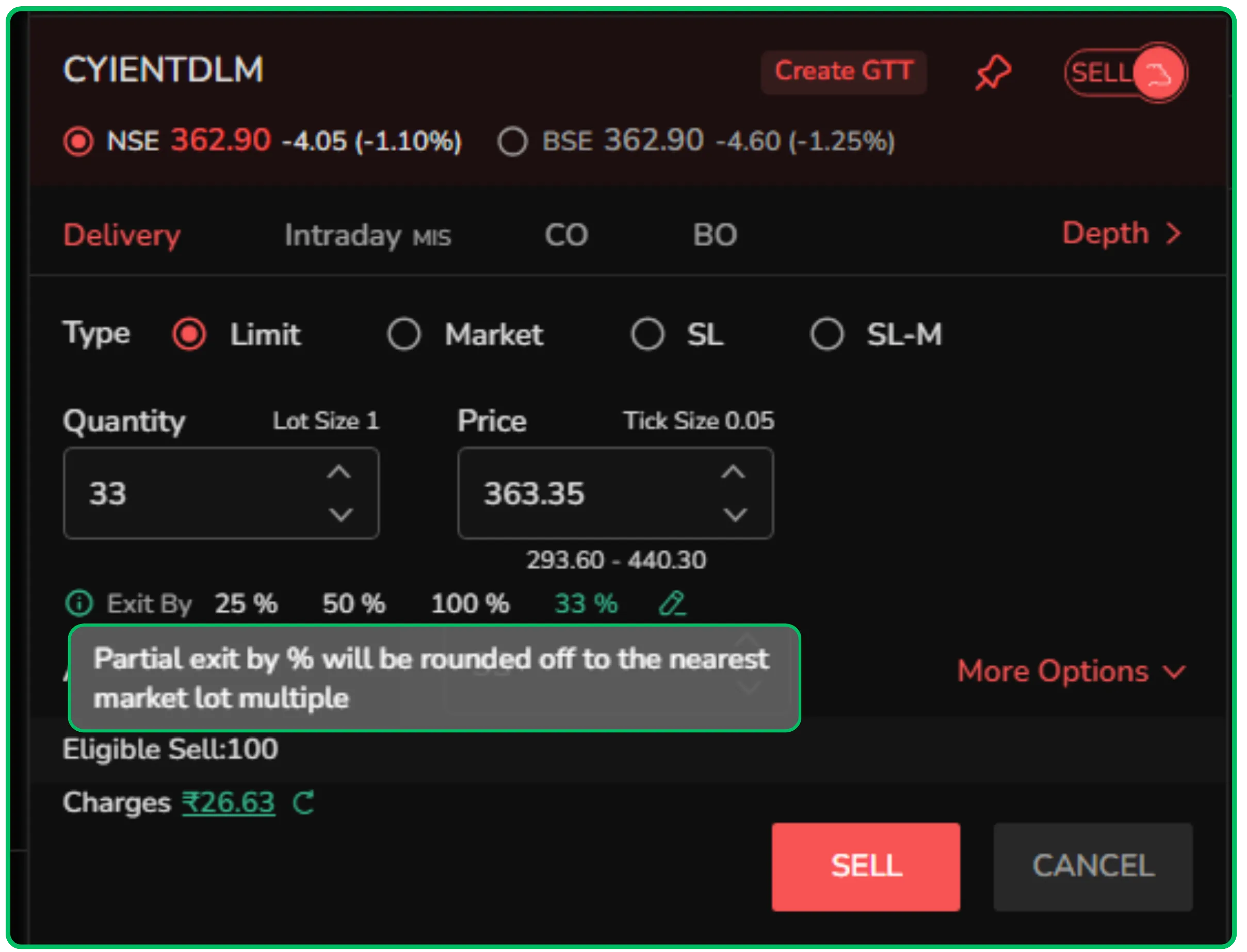
Within the Exit By section, select from the default allocations (25%, 50%, or 100%) or select the Edit icon to input a custom percentage. The system will automatically calculate the quantity, rounding to the nearest market lot multiple.
Understanding the Exit by Percentage Mechanism
Tradejini's Exit by Percentage feature fundamentally transforms how traders manage their positions. When accessing the holdings section of the platform, traders can view all their current investments along with key metrics such as invested amount, current value, and profit or loss figures. Upon selecting a stock for exit, the platform presents an order placement interface with several preset percentage options: 25%, 50%, and 100%, along with the ability to input custom percentages. The system automatically calculates the corresponding number of shares based on the selected percentage, eliminating the need for manual computation entirely.
The implementation is remarkably straightforward.
As shown in the case the user is holding CYIENT 100 shares, when a trader clicks on the 25% button, the quantity field automatically populates with 25 shares. Similarly, selecting 50% fills in 50 shares, while 100% enters the full holding quantity. For traders who require more precise control, the platform also allows custom percentage inputs, such as 33% or any other specific value, with the system calculating the exact share quantity in real-time will display 33. This flexibility ensures that traders can implement their exit strategies with precision, whether following predetermined profit-taking rules or adapting to evolving market conditions.
Why Percentage-Based Exits Matter in Real Trading
The percentage-based exit feature simplifies one of the most error-prone parts of trading: deciding how much to exit. Instead of manually calculating share quantities, traders can exit a fixed percentage of a position instantly saving time, reducing mistakes, and improving discipline.
Practical Use Across Trading Styles
Position traders can partially book profits (e.g., exit 30%) after a rally while staying invested for further upside without calculations.
Day and swing traders can execute scaled exits (e.g., 33% at each target) smoothly, even across multiple positions, reducing cognitive load.
Portfolio rebalancing becomes effortless trimming a stock from 18% back to 10% of a portfolio is as simple as entering ~44%.
Options and hedging strategies benefit from precise exposure control, ensuring correct hedge ratios and smoother adjustments.
Also Read:
Stronger Risk Management
Percentage exits make it easier to follow predefined rules like :’Exit 50% at 20% gains’ In fast markets, this speed can materially improve execution prices. The feature also supports advanced tactics like scaling out or pyramiding without tracking individual lots.
Better Decisions Under Pressure
Volatile markets amplify stress and execution errors. By removing mental math:
Traders stay focused on price action, not arithmetic
Execution mistakes (wrong quantities, typos) are largely eliminated
Discipline improves, as plans are easier to follow in real time
Efficiency for Active & Retail Traders
Retail traders can manage positions quickly during work breaks.
Active intraday traders save minutes every session, adding up to hours over a year.
Swing traders can implement progressive profit-taking more consistently.
Seamless Strategy Integration
Percentage exits work with:
Limit, market, and stop orders
Multi-timeframe technical strategies
Systematic investing and portfolio rebalancing
Rounding to whole shares (due to Indian market constraints) has negligible impact for most use cases.
Bigger Picture
This feature reflects a broader design philosophy: reduce friction, improve discipline, and support better trading behavior. What seems like a small convenience often delivers outsized benefits in execution quality, risk control, and mental clarity.
By focusing on such practical innovations, Tradejini addresses real trader pain points, helping beginners avoid mistakes and enabling advanced traders to execute complex strategies cleanly.
Bottom line: Percentage-based exits turn intent into action faster, safer, and with less stress.
Enjoy seamless trading experience with CubePlus by Tradejini
Disclaimer: The information provided in our blogs is for informational purposes only and should not be construed as financial, investment, or trading advice. Trading and investing in the securities market carries risk. Always conduct your own research and consult with a qualified financial advisor before making any investment decisions. Past performance is not indicative of future results. Copyrighted and original content for your trading and investing needs.
© 2026 — Tradejini. All Rights Reserved.

%252FCubePlus_Shield_Part%25203%2520Blog%2520Thumbnail.webp%3Falt%3Dmedia%26token%3Da5581624-5761-476f-8451-40c157b54840&w=3840&q=75)
%252FShield%2520on%2520Cubeplus%2520part2.webp%3Falt%3Dmedia%26token%3D252a5b48-a580-4e8d-b939-c82d4696eaef&w=3840&q=75)