Concalls
 Annual reports
Pine Labs was listed in November 2025, making it a relatively young company in stock market terms. Yet, in just two quarters, something curious happened in its shareholding pattern.
Domestic institutions (DIIs) owned less than 12% of the company in March 2026, but increased their holding to about 25% by June 2026. This happened even as the stock fell from a high of ₹284 to around ₹167, a drop of more than 40% from its peak.
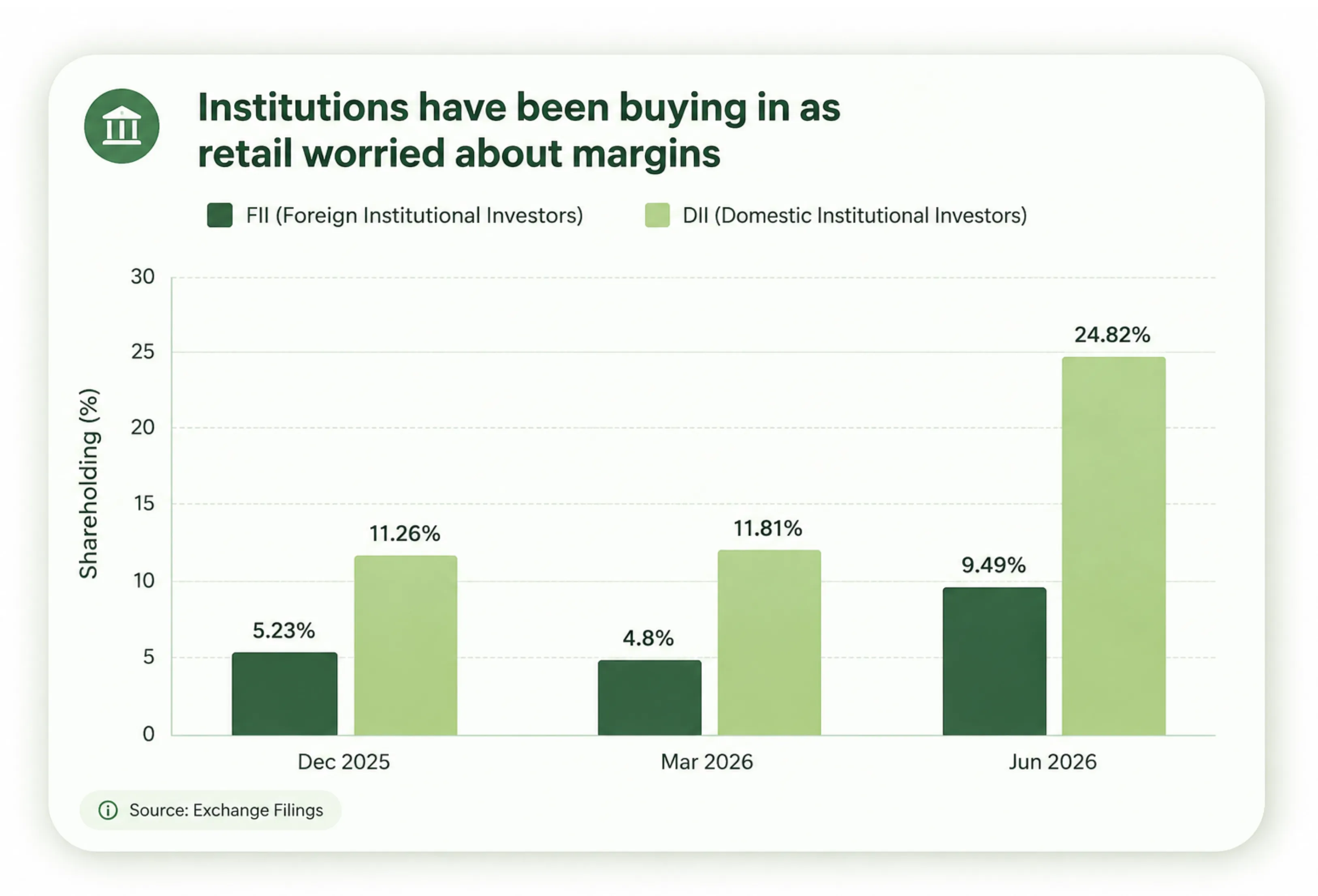
Institutions saw the bigger picture and bought. So, what were they reading right?
Based on the company’s recent earnings calls, investor presentations, and full financial history since incorporation, this is what we found.
What does Pine Labs actually do?
Most people who have swiped a card or scanned a QR code at a shop counter have used Pine Labs without knowing it. But calling Pine Labs a “card machine company” is like calling a city’s water board a “tap company”. The tap is just the visible bit. Underneath it lies an entire network of pipes carrying water from the source to your home.
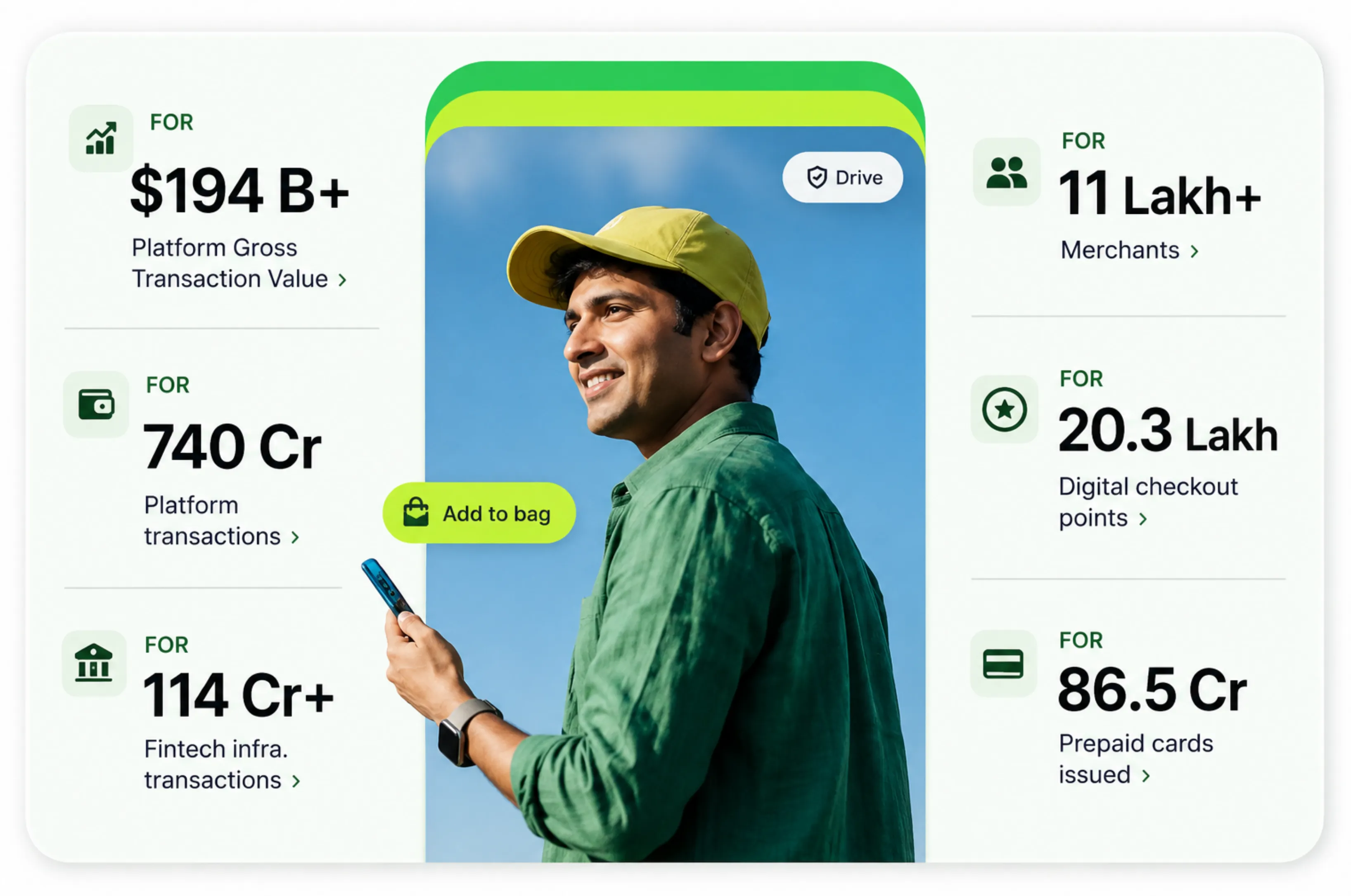
Pine Labs has built exactly this kind of network, except what flows through its pipes is money, not water. A customer taps a card or scans a QR code at a shop. Behind that single tap, Pine Labs’ pipes move the money safely from the customer’s bank to the shop’s bank, in seconds. The company earns from this pipe network in three separate ways, and understanding these three ways is the key to understanding the whole business.
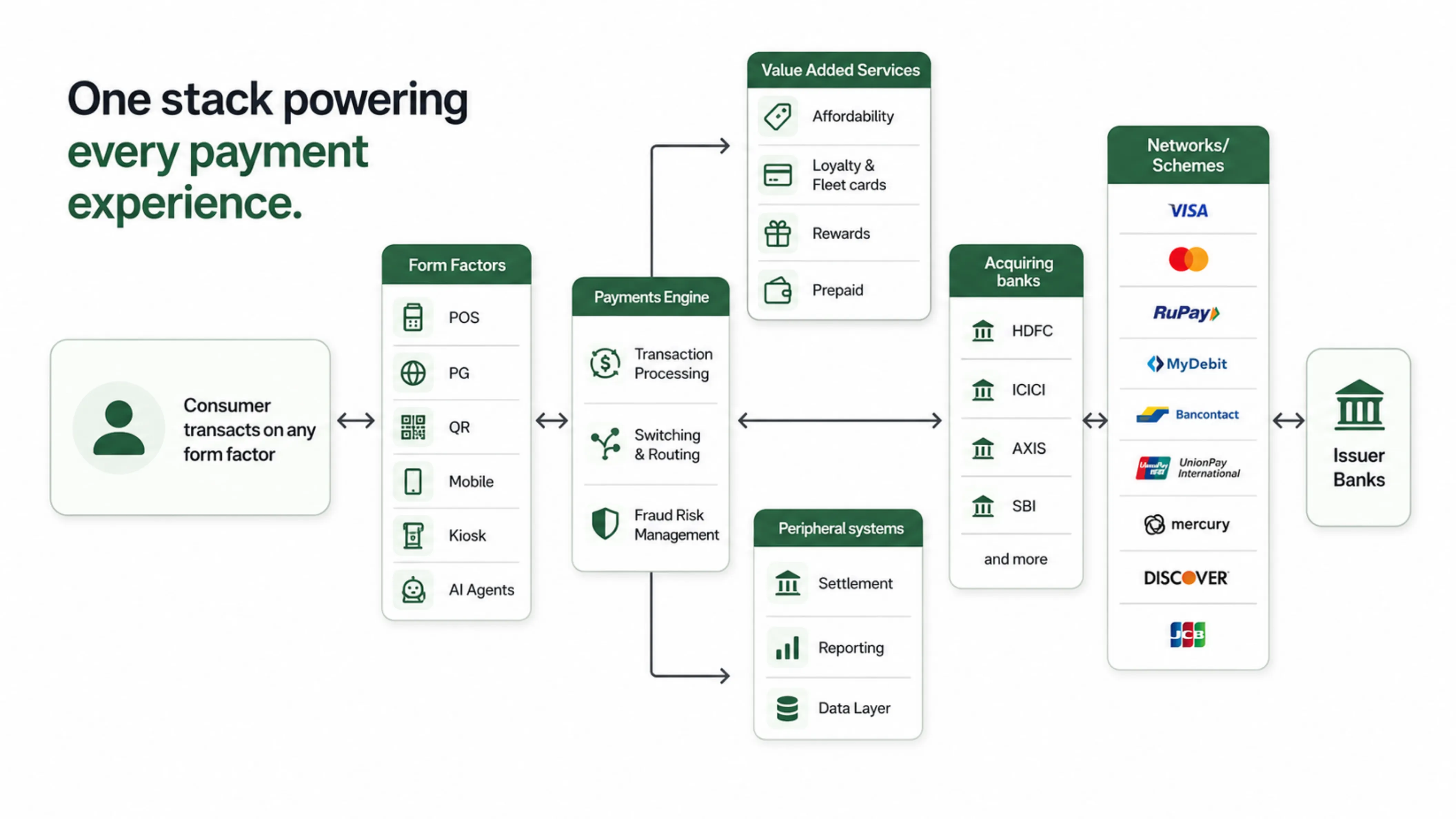
1. Rent for the pipes — the infrastructure business
Every shop that uses a Pine Labs card machine, or its online equivalent (a “payment gateway”) pays a subscription or a small fee for using PINELAB infrastructure. This is the oldest and most familiar part of the business; what the company calls its Digital Infrastructure and Transaction Platform, or DITP. Think of it as the monthly rent a shop pays for having Pine Labs’ pipes fitted at its counter.
2. A Small Share of Every Transaction
Once the pipes are in place, Pine Labs earns a small fee every time money actually flows through them. This includes UPI payments, card payments, and one of its biggest and fastest-growing lines: "affordability" the EMI schemes that let a shopper buy something and pay for it over a few months, often at 0% interest. Every time a shopper converts a purchase into an EMI, Pine Labs earns a fee from the bank or the brand for making that possible. The more money that flows through the pipes, the more Pine Labs earns from this second layer, regardless of the rent it collects in the first.
3. Reading the flow — data and AI-led services
This is the newest and, for now, the smallest layer, but it is the one management talks about most. Pine Labs sees an enormous amount of information flow through its pipes every day: who is buying what, how often, and how much. It has begun charging banks and brands to make sense of this information.
One product, called SignalIQ, helps banks decide whether to extend credit to a shopkeeper or small business by studying the transaction patterns Pine Labs already has visibility into. Another, GrowthHub, helps small merchants run marketing campaigns based on the same data. This is Pine Labs moving from being paid for moving money to also being paid for understanding it.
A fourth business: building the vault, not just the pipes
Alongside the three DITP layers sits a separate, sizeable business called the Issuing and Acquiring Platform, or IAP, about a third of total revenue. Here, instead of moving money for other people's payment instruments, Pine Labs builds and manages the instruments themselves: gift cards, prepaid cards, and even credit lines, on behalf of brands, banks, and retailers. If a company like Nykaa wants to launch a gift card programme, Pine Labs is often the one building the technology behind it, distributing the cards, and processing every transaction made on them.
How does Pine Labs actually make money?
In its most recent quarter (April–June 2026), Pine Labs earned ₹737 crore in revenue. Of this, after paying the direct cost of processing each transaction, it was left with a Contribution Margin of 72.3%. In plain terms: for every ₹100 a merchant or brand paid Pine Labs, ₹72.30 was left over before the company paid for its own salaries, technology, and other running costs.
After those company-wide costs are taken out, what remains is called Adjusted EBITDA: the operating profit before interest, tax, depreciation, and amortisation (EBITDA). In Q1 FY27, this stood at ₹126 crore, or an Adjusted EBITDA Margin of 17.1%. So, of that same ₹100 of revenue, about ₹17 was left as operating profit once every other cost of running the company was accounted for. A year earlier, that number was ₹20. This four-rupee difference (small in absolute terms, but a real slippage in percentage terms) is exactly the point that worried some investors and is worth understanding properly (we get to why, shortly).
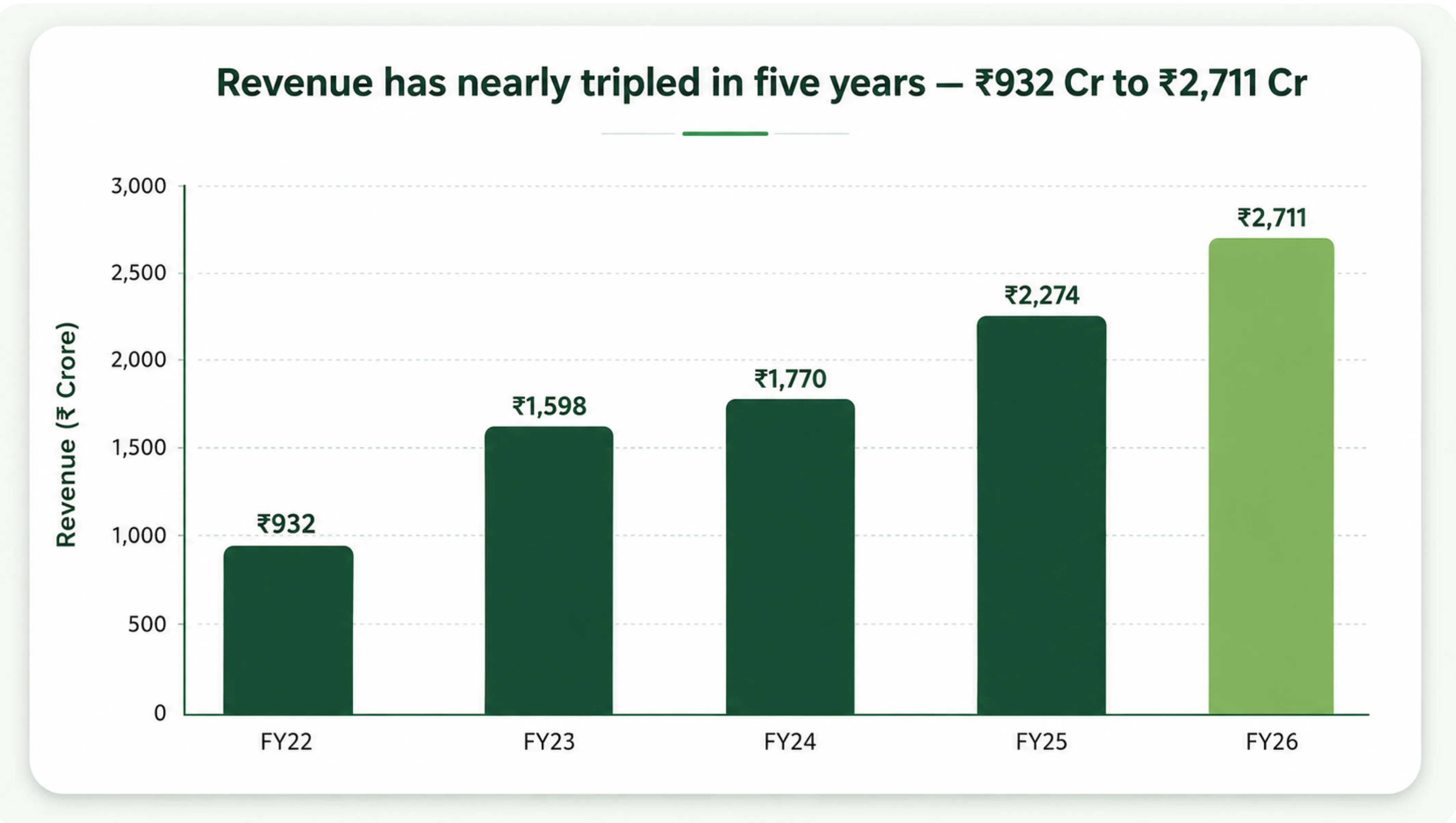
The Financial Story: from heavy losses to first profit
Pine Labs is not a young business (it was incorporated back in 1998) but as a public company, its financial history tells a clear turnaround story. For years before its listing, the company invested heavily and ran up large losses: ₹23 crore in FY22, swelling to ₹265 crore FY26 was the turning point. Revenue that year grew 19% to ₹2,711 crore & Pine Labs closed the year with a net profit of ₹113 crore.
Reported EBIT (earnings before interest and tax) swung to ₹222 crore in FY26 from a loss of ₹57 crore in FY25.
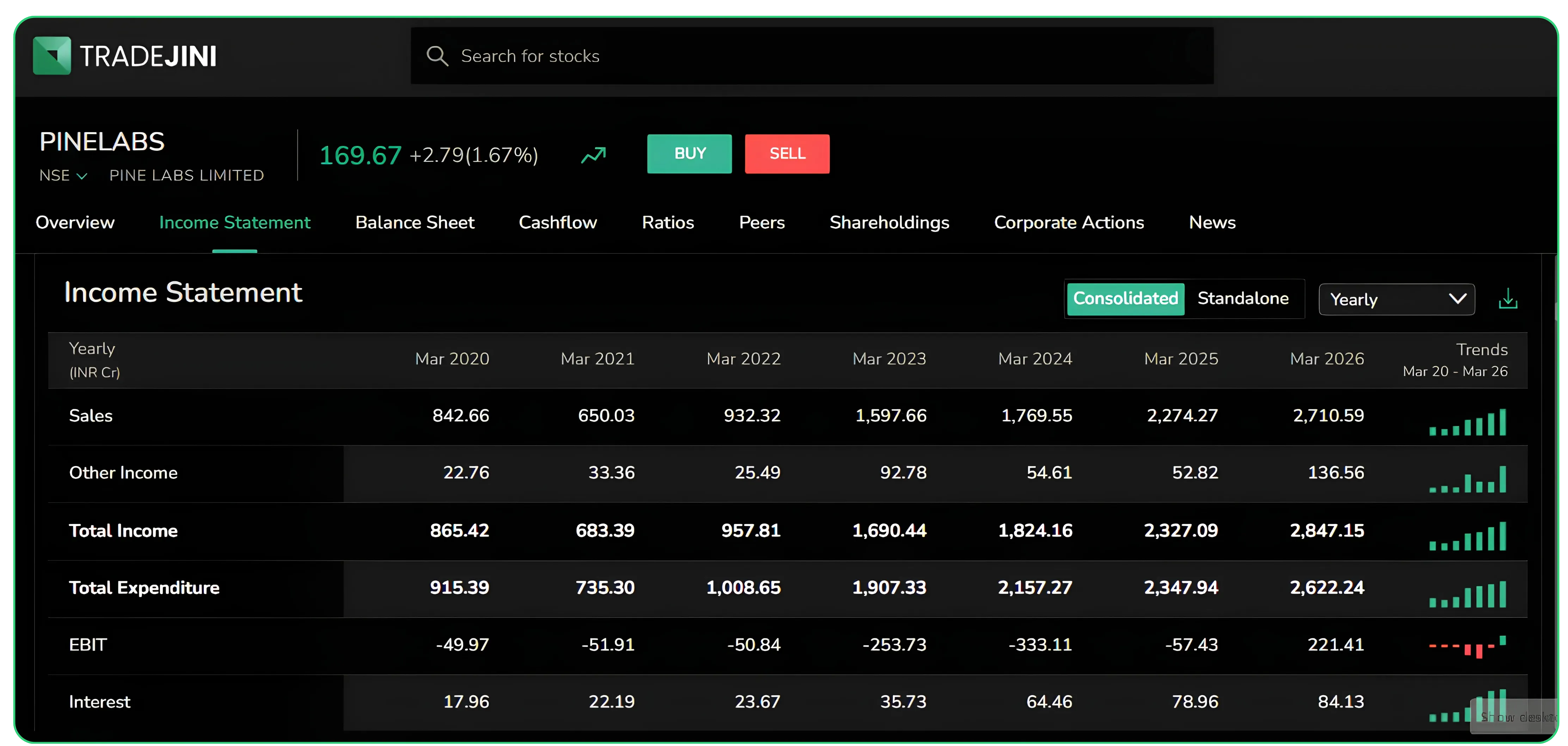
Reported EBIT (earnings before interest and tax) swung to ₹222 crore in FY26 from a loss of ₹57 crore in FY25
Why margins have been sliding, and why Q1 FY27 was the sharpest drop yet
Contribution Margin has in fact been easing for four straight quarters, from 78% in Q1 FY26 to 77%, 74% and 73% through the rest of FY26, before falling further to 72.3% in Q1 FY27. Adjusted EBITDA Margin moved less predictably over the same period, from 20% in Q1 FY26 to 19%, 23% and 21%, before dropping to 17.1% in Q1 FY27. On the call, management gave three specific, honest reasons. Each one tells you something different about how the business actually works.
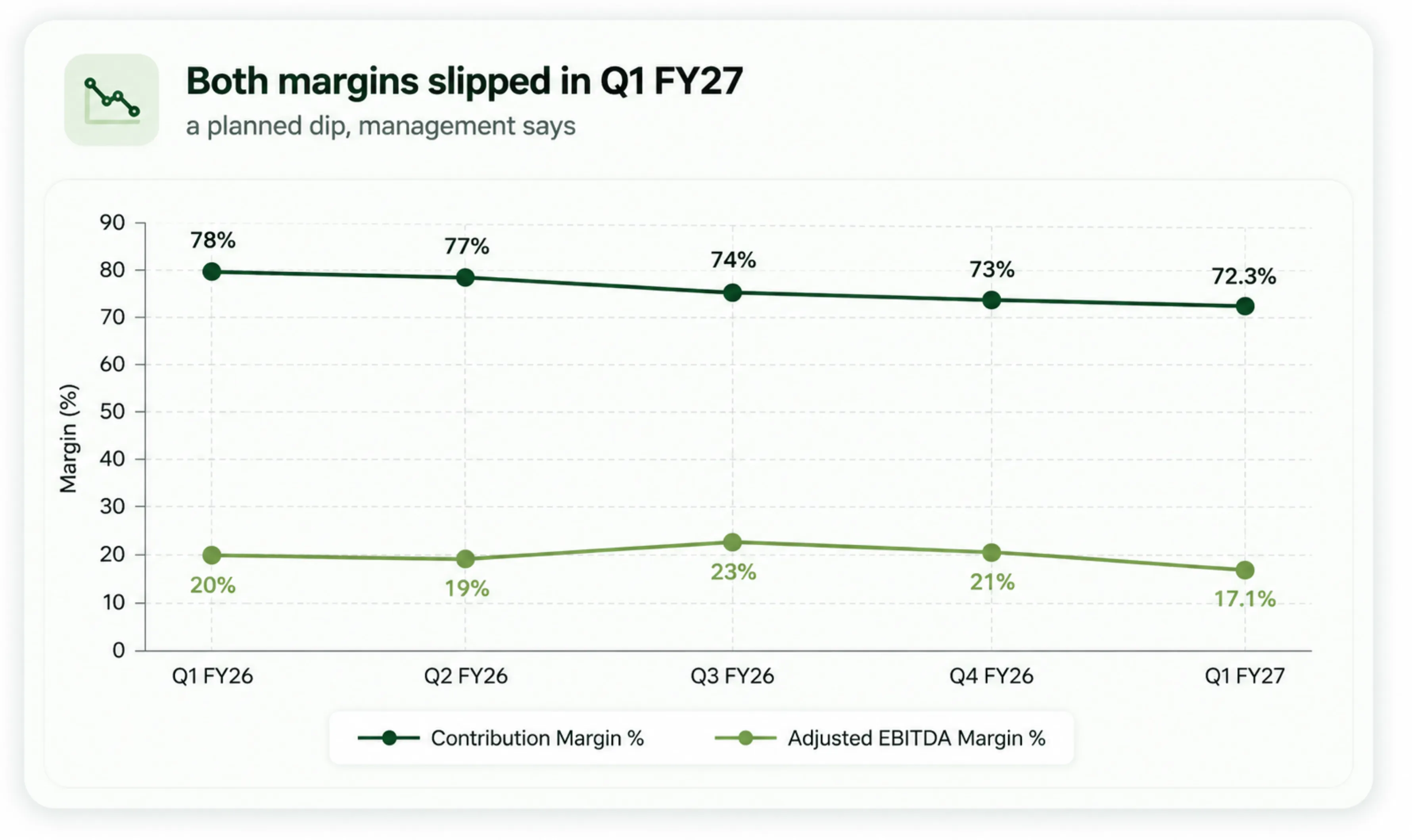
Margins have slipped for four quarters running. The question is whether that is temporary or structural
Reason one: selling machines upfront, on purpose
For years, Pine Labs kept its card machines on its own books and simply charged merchants rent for using them. Recently, for about a quarter of new deployments, it has started asking merchants to buy the machine upfront instead. This looks like a lower-margin sale in the accounts. But it solves two problems at once: it reduces the depreciation cost from Pine Labs’ books. A merchant who has paid for their own machine is far less likely to switch to a competitor. Management called this a deliberate trade of near-term margin for long-term stickiness, not a sign of weaker demand.
Reason two: winning new countries the cheap way first
In new markets like Malaysia, Singapore, and Dubai, Pine Labs enters by first offering the low-margin part of the business simple card and voucher distribution because it is the easiest way to get a foot in the door with a big local brand or bank. Once established, it then sells the far higher-margin processing and technology services on top. Processing carries almost 100% contribution margin; distribution carries only 30–40%. Because international revenue is growing faster than the older, more mature Indian business, this mix shift alone pulls the average margin down, even though nothing about pricing has changed.
Reason three: spending on Manpower (Sales) & cloud computing
Pine Labs added around 500 new salespeople in India over the past six months, and increased its spending on cloud computing and network infrastructure (this rose from ₹48 crore to ₹64 crore in the quarter). Management said a new salesperson typically takes six to twelve months to become fully productive, so this cost has already been paid, but the revenue it should generate is still to come. The same applies to the technology spend, some of which is described as one-time (upgrading to a new cloud contract, for instance) and some of which will recur.
Taken together, none of the three reasons points to Pine Labs charging its customers less for the same service. They point to a company reshaping itself for a bigger, more international, more sticky future at the cost of a temporarily lower margin today.
Management has told the market it expects Contribution Margin to move back toward 73-74% in the second half of FY27, and has said Adjusted EBITDA Margin should not fall below last year's 21% full-year level, as these investments start paying off.
Where is growth coming from?
Three areas stood out clearly across the presentation and the calls.
Going abroad, the India way
Pine Labs now operates in more than 22 countries. In the Philippines, it has partnered with GCash, that market's largest consumer payments app, and deployed around 30,000 terminals there over the last nine months, entirely on a software and transaction processing basis rather than hardware it owns. In Malaysia it has become the single largest installment-payments provider. It has also signed British Airways and Romania’s TAROM for gift-card programmes, and won a mall-card contract in Singapore. International revenue was about 16% of the total in Q1 FY27 and grew 21% year-on-year.
AI and “agentic payments”
Pine Labs says close to 90% of new code it writes today is generated using AI, and it has begun testing what it calls “agentic payments”, where an AI assistant is given a set of rules by a consumer and then completes a purchase automatically within those rules, without a human clicking “pay” each time. An early example management gave: an AI agent that watches gold prices and buys automatically once a target price is hit. This is still a very small, early business today, but it is the kind of optionality that costs little now and could matter more later.
Petrol pumps and government contracts
Pine Labs has been rolling out card machines and loyalty programmes across India's oil marketing companies' petrol pumps, a slow, unglamorous but large opportunity, since close to three-quarters of its target deployment (around 90,000-100,000 out of a planned 125,000-130,000 machines) has already gone live. Because these contracts are typically priced on transaction volume rather than a fixed rental, revenue from them should keep building through FY27 as the pumps ramp up usage, rather than showing up all at once.
What can go wrong?
No business is without risk. Here is our honest read of what could go wrong here, graded by how much it could matter.
Major: profitability is still thin, and it is early days
Return on Equity over the last three years is still negative (–2.93%), and Return on Capital Employed is only 4.16%; both signs that, despite the FY26 turnaround, Pine Labs has not yet proven it can consistently earn a strong return on the capital invested in it. The company's effective tax rate was also unusually high in Q1 FY27, at 46%, because several of its overseas businesses are not yet profitable enough to offset their losses against the profitable Indian business for tax purposes. Management expects this to settle to 28–30% for the full year, and closer to 25–26% only from FY28, once those overseas units turn profitable on their own. Early-warning signal to watch: if the effective tax rate is still stuck near 40%+ two quarters from now, that would suggest international losses are taking longer to turn around than management expects.
Medium: the distribution-first playbook could keep pressuring margins
The same low-margin-entry, high-margin-later strategy that is working in new countries could keep pulling the blended margin down for longer than expected, if international expansion accelerates faster than the higher-margin processing business can be layered on top. Early-warning signal: contribution margin failing to recover toward the 73–74% range management has guided to, over the next two quarters.
Medium: competition is not standing still
Global payment giants such as Stripe and Adyen are increasingly interested in emerging markets, even as they remain focused on the US for now. At the same time, in India, Pine Labs’ own scale (it says it wins almost every processing deal it competes for domestically) could attract more well-funded challengers over time, particularly in the online and mid-market segments where competitive intensity tends to be highest.
Low but real: one-off client losses and supply shocks
In Q1 FY27, one client in the bill-payments business moved its transactions in-house, which alone explained a chunk of the softness in that segment’s volumes. Separately, the global chip shortage that delayed machine deployments in Q4 FY26 is a reminder that hardware supply chains outside the company’s control can still bite. Neither looks structural today, but both show the business is not immune to external shocks.
What the market is pricing today
As of 26th August 2026, Pine Labs traded at ₹167, with market capitalisation of ₹19,249 crore, the stock trades at a Price-to-Earnings (P/E) ratio of about 149 and at roughly 3.25 times its Book Value (the value of the company's net assets per share =₹51.3).
The more useful question for an investor to ask is not "is 149 a high number" in isolation, but whether Adjusted EBITDA which grew 57% in FY26, keeps compounding at a similar pace as the international and AI-led businesses scale up.
If it does, today's P/E could look very different a few years from now; if margin pressure persists longer than management expects, it could look expensive for a while yet. This is a scenario for each investor to weigh for themselves, not a call this article is making for them.
Disclaimer: The information provided in our blogs is for informational purposes only and should not be construed as financial, investment, or trading advice. Trading and investing in the securities market carries risk. Always conduct your own research and consult with a qualified financial advisor before making any investment decisions. Past performance is not indicative of future results. Copyrighted and original content for your trading and investing needs.
© 2026 — Tradejini. All Rights Reserved.