The battery industry is often discussed as if every company will benefit in the same way from the growth of electric vehicles and energy storage. That is not the case.
A battery recycler, a replacement-battery manufacturer, a lithium-ion cell maker and a company producing battery chemicals operate in very different businesses, with different costs, risks and growth prospects.
For investors, the first step is to understand a company's business model. Only then should we compare its margins, capital expenditure, growth prospects and valuation.
This article examines five broad business models within the battery and energy-storage industry.
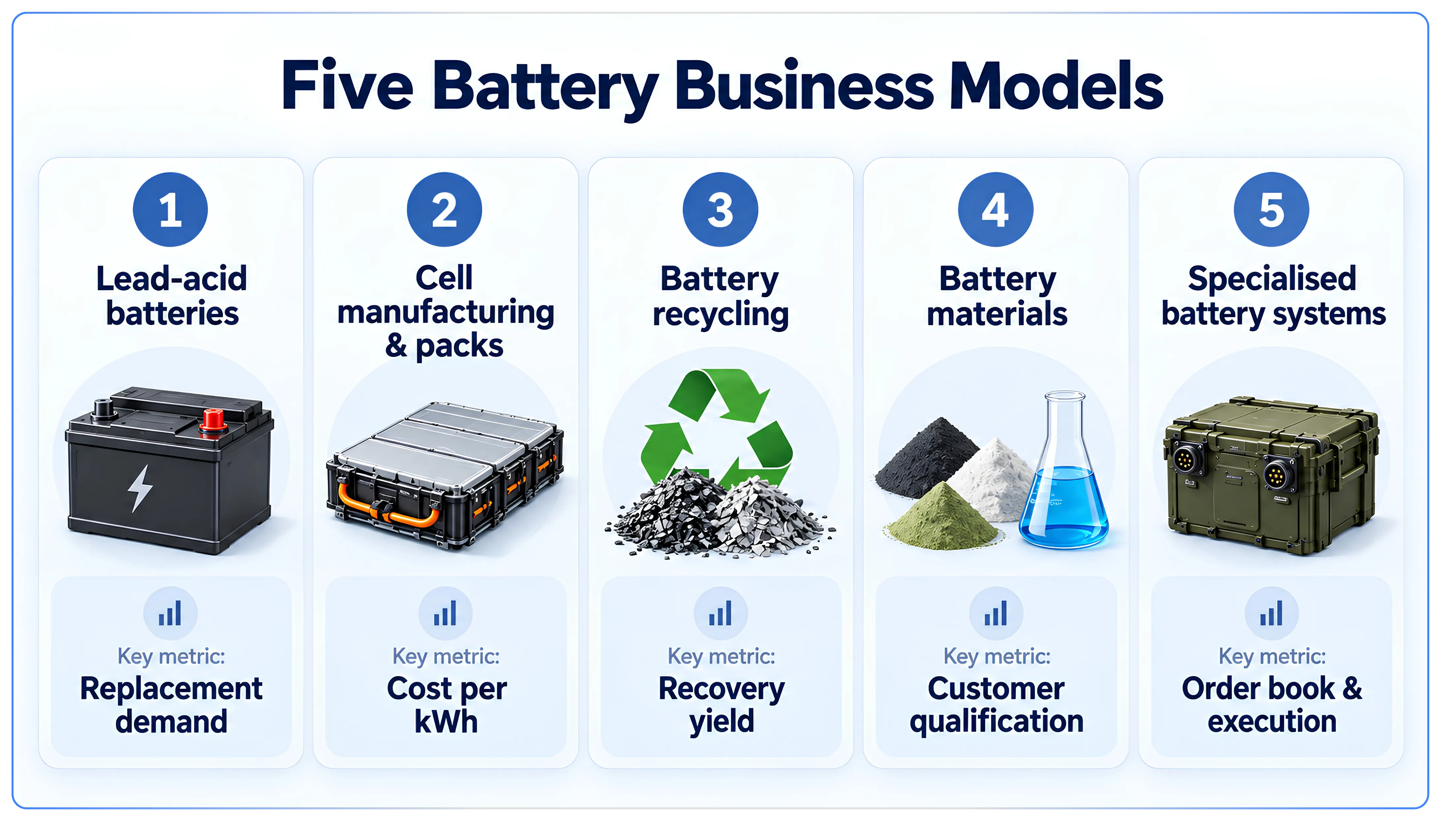
An established lead-acid battery manufacturer may generate healthy cash flow, while a new cell manufacturer may report losses for years due to high initial investment and low capacity utilisation. Comparing their operating margins without considering their different stages of development can be misleading.
Important Point About Battery Exposure
A company investing in battery technology does not necessarily derive a significant portion of its current earnings from batteries.
For example, Tata Chemicals remains primarily a soda ash business, while Gujarat Fluorochemicals' financial performance is still heavily influenced by its established fluorochemical and polymer businesses.
Investors should therefore examine separately disclosed battery revenue, margins, capacity and capital expenditure rather than applying a battery-sector valuation to the entire company.
Understanding the Main Battery Chemistries
Battery technologies differ in energy density, cost, cycle life and reliability. Energy density is particularly important for electric vehicles, where battery weight and driving range matter. For stationary energy storage, cost, cycle life and reliability often carry greater weight.
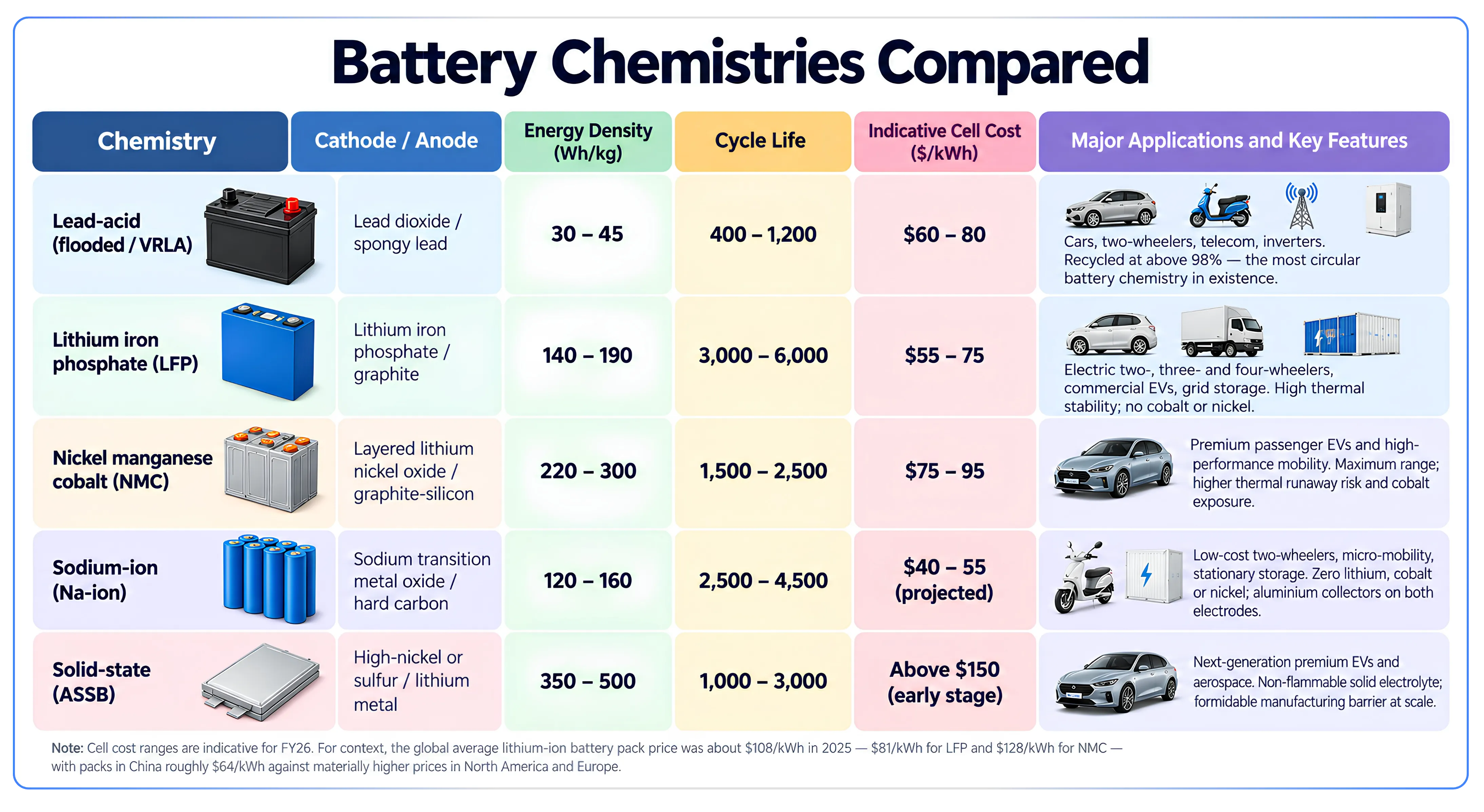
LFP batteries are widely used in mass-market EVs and energy storage, while NMC batteries offer higher energy density for applications where range and weight are important. Sodium-ion batteries are also attracting interest because they avoid the need for lithium, cobalt and nickel, although their lower energy density can limit their suitability for some applications.
Why Manufacturing Yield Matters
For battery cell manufacturers, installed capacity alone does not indicate whether a factory is economically viable. New plants may initially face high rejection rates as production processes are refined, affecting costs and profitability.
Investors should look beyond announced capacity and examine how much capacity has been commissioned, actual utilisation rates and the proportion of cells meeting quality standards. Improvements in manufacturing yield can significantly influence a cell factory's economics.
1. Legacy Lead-Acid and Industrial Batteries
Examples: Exide Industries, Amara Raja Energy & Mobility and Eveready Industries
This is the most established segment of the battery industry. Companies such as Exide and Amara Raja manufacture lead-acid batteries for automobiles, telecom infrastructure, industrial applications and inverters.
A major source of demand is the replacement market. When a vehicle battery reaches the end of its life, it generally needs to be replaced, creating a recurring source of demand.
What Investors Should Track
Aftermarket versus OEM sales
Supplying batteries to automobile manufacturers can generate large volumes, while replacement-market sales can offer better economics.
Lead prices and pass-through
Lead is a major raw material. Delays in passing higher input costs on to customers can put pressure on margins.
Recycled lead
Access to recycled lead can help reduce raw-material costs and improve supply security.
Investment in lithium-ion
Exide and Amara Raja are investing in newer battery technologies. Investors should assess these investments separately from their established lead-acid businesses, which may generate cash today while the newer businesses require significant capital before contributing meaningfully to earnings.
Key Advantages and Risks
Established companies benefit from distribution networks, brand recognition, dealer relationships and recycling ecosystems.
The longer-term risks include the gradual replacement of lead-acid batteries by lithium-ion systems in certain applications, as well as execution risks associated with investments in new battery technologies.
2. ACC Gigafactories and EV Battery Pack Integrators
Examples: Ather Energy, Ola Electric and Kabra Extrusion Technik Ltd
This segment involves manufacturing advanced battery cells or integrating cells into battery packs for electric vehicles. Cell manufacturing is highly capital-intensive, requiring substantial investment in equipment, specialised infrastructure and formation systems.
What Investors Should Track
Cost per kWh
Indian manufacturers must produce cells at competitive costs to compete with imported alternatives and achieve attractive margins.
Capex per GWh
Compare the capital invested with the actual production capacity created.
Scrap and defect rates
New factories take time to improve manufacturing yields. A declining scrap rate can indicate better production efficiency and lower costs.
Actual capacity versus announced capacity
Distinguish between announced capacity, capacity under construction, installed capacity, commissioned capacity and actual production. These represent different stages of execution.
Profitability without subsidies Government incentives can support demand and investment. Investors should also assess whether the business can achieve sustainable profitability without heavy dependence on subsidies.
Key Risks
Major risks include rapid changes in battery technology, falling global cell prices, manufacturing problems and warranty liabilities. Delays in scaling production or achieving competitive manufacturing costs can also affect profitability. Companies investing heavily in a particular battery chemistry may face additional risks if competing technologies become more commercially attractive.
3. Battery Recycling and Urban Mining
Examples: Gravita India, Pondy Oxides & Chemicals and Nile Limited
Battery recycling involves recovering materials such as lead and, increasingly, materials from lithium-ion batteries. These recovered materials can then be supplied to manufacturers, reducing dependence on primary raw materials.
What Investors Should Track
Value-added products
Selling specialised alloys, oxides or refined materials can offer better margins than selling basic recovered metals.
Scrap sourcing
A strong local collection network can provide advantages in sourcing costs, working capital and logistics compared with dependence on imported scrap.
Recovery yield
In lithium-ion recycling, the proportion of usable material recovered from battery scrap is a key factor in determining profitability.
Metal-price risk
Metal-price movements can affect earnings, particularly when companies do not adequately manage their exposure.
Lead Recycling Versus Lithium Recycling
Lead recycling is an established commercial business in India, while lithium-ion recycling is still at an earlier stage of development. Investors should therefore distinguish between an operating recycling business and its potential future lithium-recycling operations.
Before assigning value to that potential, examine the capacity commissioned, capital invested, material processed and revenue generated. A pilot plant should not be valued in the same way as a large commercial operation.
4. Battery Chemicals and Active Materials
Examples: Tata Chemicals, Gujarat Fluorochemicals, Himadri Speciality Chemical and Neogen Chemicals
Battery manufacturing depends on specialised chemicals and materials, including electrolyte materials, lithium salts, binders and graphite. Suppliers can develop long-term relationships with cell manufacturers, but entering the supply chain can take considerable time.
What Investors Should Track
Customer qualification
Battery materials must undergo testing and qualification before a cell manufacturer approves them for use. This process can take 18–36 months or longer, depending on the product and customer. Once a supplier is qualified, switching can be difficult because consistency and quality are critical.
Purity and moisture control
Battery materials often require high levels of purity. Contamination or excess moisture can affect cell performance and safety.
Power costs
Energy-intensive materials processing, such as synthetic graphite production, can make electricity costs an important factor in profitability.
Separate battery revenue
For diversified companies, investors should examine separately disclosed battery-related revenue, margins, capacity and capital expenditure rather than assuming the entire business benefits from battery demand.
Key Risks
Competition from established global suppliers, particularly Chinese manufacturers, can put pressure on prices. Domestic cell-manufacturing delays can also leave new battery-material facilities underutilised.
5. Defence, Railway and Specialised Battery Systems
Examples: HBL Engineering and High Energy Batteries
This segment supplies batteries and power systems for defence, railways, aviation and other applications where reliability is critical. Products may include batteries for submarines, aircraft and railway systems. Although the market is smaller than the automotive battery market, technical requirements and certification processes can create high entry barriers.
What Investors Should Track
Order book versus revenue
A large order book can provide revenue visibility, but investors should assess how quickly orders are converted into sales.
Government contract exposure
Defence and railway contracts can support demand, but revenue depends on government budgets, approvals and project timelines.
Execution capability
Winning an order is only the first step. Companies must have the technical capability and manufacturing capacity to deliver on time.
Customer concentration
Dependence on a government department or a small number of large customers can provide established relationships but also create concentration risk.
Key Advantages and Risks
High entry barriers, supported by technical requirements, certifications and proven performance, can limit competition.
However, delays in orders, budget approvals and project execution can affect revenue, particularly for companies dependent on a limited number of customers.
How Investors Should Analyse Battery Companies
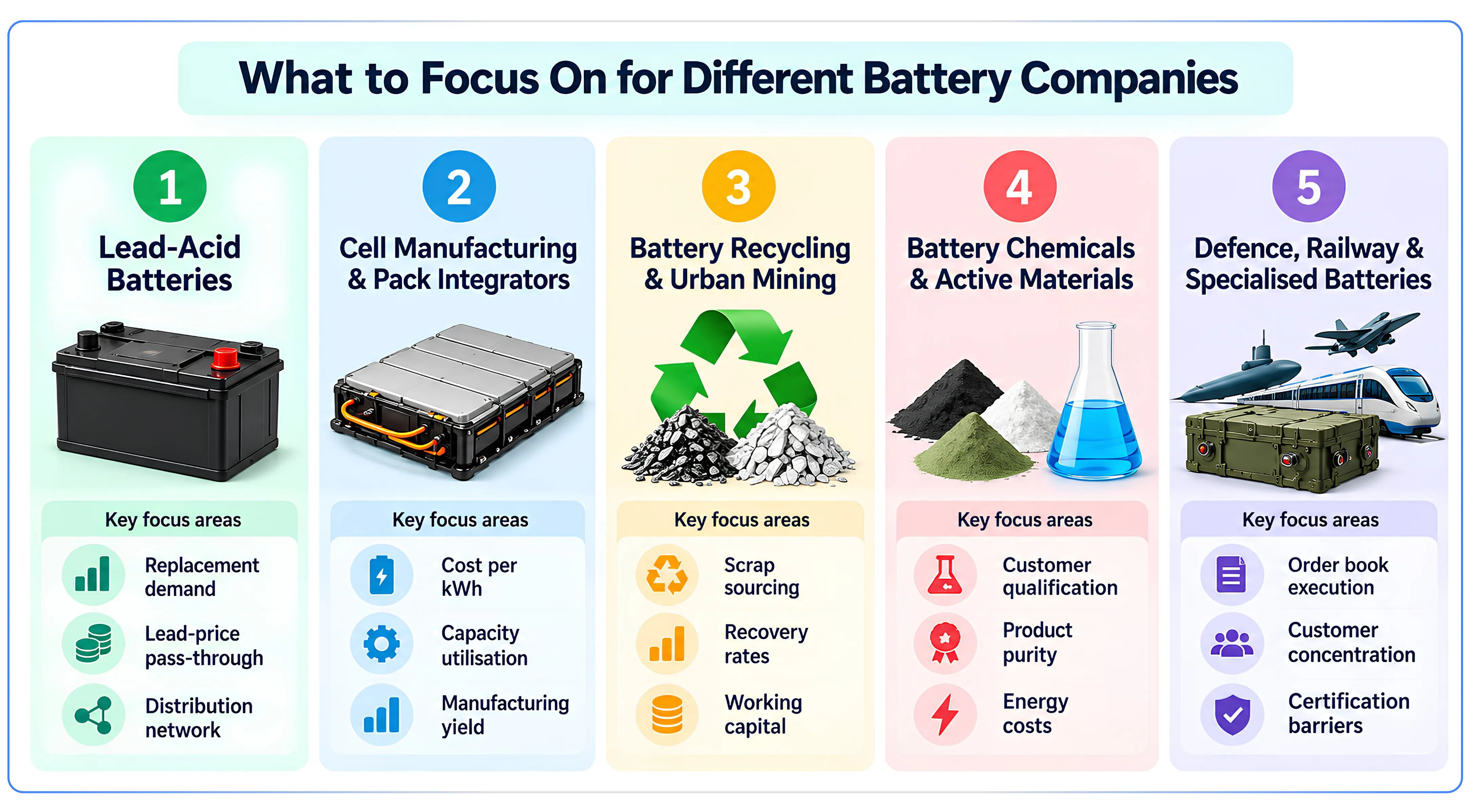
The battery industry should not be analysed as a single sector. Investors should first identify a company's business model, then examine its financials, competitive position, capital allocation and ability to convert investment into earnings.
A mature battery manufacturer generating cash today, a company investing in a gigafactory and a chemical supplier awaiting customer qualification are at different stages of development. Understanding these differences provides a more appropriate starting point for assessing their growth prospects and valuations.
Also Read: A Fundamental Study of Epack Durable Ltd
Disclaimer: The information provided in our blogs is for informational purposes only and should not be construed as financial, investment, or trading advice. Trading and investing in the securities market carries risk. Always conduct your own research and consult with a qualified financial advisor before making any investment decisions. Past performance is not indicative of future results. Copyrighted and original content for your trading and investing needs.
© 2026 — Tradejini. All Rights Reserved.