We had previously covered SAMHI Hotels Ltd in our fundamental analysis, where we examined its acquisition-led turnaround strategy, operating performance, debt position, and the potential for long-term value creation as the company upgrades its portfolio. With SAMHI now reporting its Q1 FY27 results, this article revisits the company to assess how the turnaround is progressing and whether the key investment triggers we identified earlier are beginning to play out. In this update, we look at SAMHI's Q1 FY27 financial and operational performance, its ongoing up-segmentation strategy, the proposed ₹750 crore capital raise, and the opportunities that could shape its earnings trajectory from here.
Unlike traditional hotel developers who buy expensive land and wait 5 to 7 years to build greenfield properties, SAMHI Hotels Limited operates a high-velocity acquisition-led turnaround engine.
SAMHI identifies underperforming, distressed, or under-leveraged business hotels in prime micro-markets across India (such as Bengaluru, Hyderabad, NCR, Pune, and Ahmedabad), acquires them at a discount to replacement cost, renovates them, and re-flags them under top-tier global operators like Marriott (representing 56%–66% of inventory), Hyatt, and IHG. Today, SAMHI stands as one of India’s largest hotel ownership platforms with 31 operating hotels comprising 4,904 keys across 14 major business cities. SAMHI HOTELS OPERATIONAL SNAPSHOT
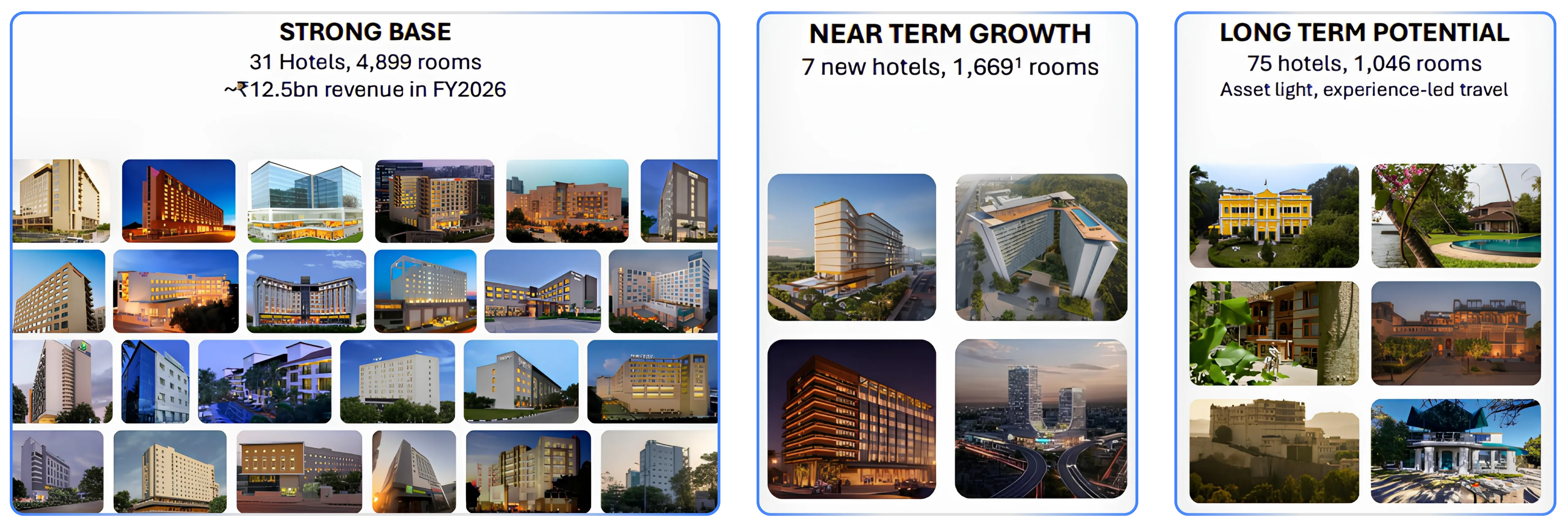 • Global Operator Partners: Marriott (Courtyard, Fairfield, Renaissance), Hyatt, and IHG (Holiday Inn Express)
• Primary Business Markets: Bengaluru, NCR (Gurgaon/Noida), Hyderabad, Pune, Ahmedabad, Chennai
• Global Operator Partners: Marriott (Courtyard, Fairfield, Renaissance), Hyatt, and IHG (Holiday Inn Express)
• Primary Business Markets: Bengaluru, NCR (Gurgaon/Noida), Hyderabad, Pune, Ahmedabad, Chennai
2. Q1 Financial & Screener Snapshot: Operational Momentum
SAMHI's latest quarterly numbers (Q1) and balance sheet metrics reflect solid operational demand across India's corporate travel corridors:
| Financial / Operational Metric | Q1 Performance | YoY Change / Comparison | Screener / Strategic Context |
|---|---|---|---|
| Total Revenue / Income | ₹308.3 Crore | +10.8% YoY | Driven by corporate travel recovery in Tier-1 tech hubs. |
| Profit After Tax (PAT) | ₹24.9 Crore | +12.0% YoY | Bottom-line expansion supported by operating leverage. |
| RevPAR (Revenue Per Avail Room) | ₹5,219 | +9.6% YoY | Sustained pricing power across business hotel keys. |
| Occupancy Rate | 79.3% | +510 bps (vs 74.2% YoY) | High-capacity utilization across core commercial markets. |
3. The Core Challenges: Debt Burden & The ₹750 Cr AGM Dilution Proposal
While SAMHI's top-line and operating metrics are firing on all cylinders, the company faces two distinct structural hurdles:
Challenge A: The Legacy Debt & High Interest Drag
Historical aggressive acquisitions (including the ACIC portfolio of 6 hotels and 962 rooms) left SAMHI with a heavy debt burden. While FY26 reported EBITDA reached ₹462.6 crore, a substantial portion of operating cash flows gets consumed by finance costs and debt servicing, dampening net profit margins.
Challenge B: The ₹750 Crore AGM Capital Dilemma
SAMHI Hotels convened its 16th Annual General Meeting on August 31, 2026 to seek shareholder approval for raising up to ₹750 crore through equity or convertible instruments.
The Paradox for Investors:
- Short-Term Risk: Equity dilution for existing shareholders as new shares are issued.
- Long-Term Reward: If the ₹750 crore proceeds are utilized primarily to pay down high-cost debt, interest expenses will drop dramatically, unlocking a massive bottom-line net profit explosion.
4. The Opportunities: 4 Engine Catalysts for Re-rating
1. The Up-Segmentation Strategy (Midscale to Upper-Upscale): Management is actively shifting the portfolio mix toward higher-yielding Upper Upscale and Upscale properties. By upgrading midscale assets to premium brands, SAMHI aims to increase upscale inventory from 41% to 60% by FY30, driving average daily rates (ARR) from ₹5,219 toward ₹7,500–₹8,000+.
2. De-leveraging Turning Point: If the proposed ₹750 crore capital raise successfully pays down debt, SAMHI's interest coverage ratio will strengthen substantially, converting strong EBITDA directly into free cash flow and net profit.
3. Dual-Branded IKEA (Ingka) Noida Project: SAMHI has partnered with IKEA's parent group (Ingka) to develop a new 162-room dual-branded hotel integrated into Noida's mega commercial retail hub, creating a high-margin recurring income asset.
4. Global Capability Center (GCC) Expansion in India: Over 1,600+ MNC Global Capability Centers are expanding in India (especially in Bengaluru, Hyderabad, and Pune). As business travel demand surges, SAMHI’s high occupancy rate (79.3%) provides immediate operating leverage and room rate pricing power.
5. Conclusion & Investor Outlook
SAMHI Hotels presents a classic high-operating-leverage turnaround case. The operational machine is executing exceptionally well, evidenced by 79.3% occupancy, ₹5,219 RevPAR (+9.6% YoY), and ₹308.3 crore Q1 revenue. The key monitorable for investors over the coming quarters is the outcome of the August 31, 2026 AGM: if SAMHI effectively deploys the ₹750 crore capital raise to slash debt, the resulting interest savings could turn SAMHI into a major earnings compounder in the Indian hospitality sector.
Disclaimer: The information provided in our blogs is for informational purposes only and should not be construed as financial, investment, or trading advice. Trading and investing in the securities market carries risk. Always conduct your own research and consult with a qualified financial advisor before making any investment decisions. Past performance is not indicative of future results. Copyrighted and original content for your trading and investing needs.
© 2026 — Tradejini. All Rights Reserved.