India crossed 300 GW of non-fossil power capacity by the end of July 2026, already past 60 % of the government's 500 GW target for 2030. Solar and wind projects get most of the attention when this number comes up. Less visible are the businesses that keep those projects running once they are built, and the ones that supply water to the power plants still running on coal and gas. These businesses sit lower down the value chain, away from the headlines, but they matter to anyone trying to understand India's energy build-out beyond the solar and wind developers themselves.
Why maintenance is its own business
A wind turbine's manufacturer warranty usually runs out within two to five years of installation. After that, someone has to inspect the gearbox, fix blade erosion and keep the machine generating power, typically under a contract running five to twenty years. This work is called operations and maintenance, or O&M, and in India it has grown into a business separate from the company that built the turbine.
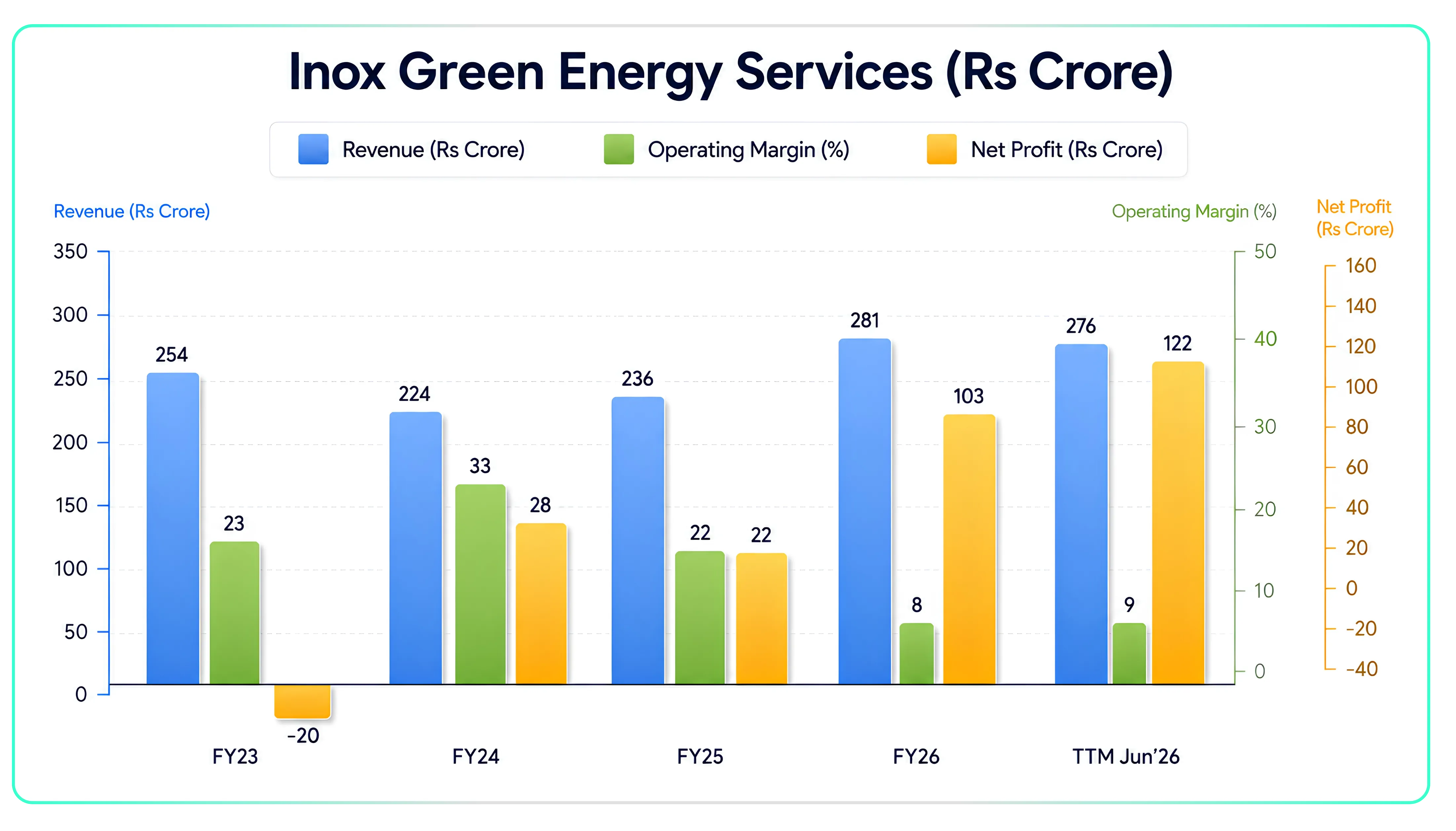
Inox Green Energy Services, listed on the NSE since November 2022, is India's only listed company built entirely around this work. As of June 2026, its managed portfolio stood at 13.3 GWp, split between 10 GW of wind assets and 3.3 GW of solar. The company is also awaiting regulatory clearance to acquire close to 4.5 GW of wind O&M assets from Wind World India, formerly Enercon India, a deal management expects to close in the July to September quarter of FY27. Machine availability across the portfolio, the share of time turbines were actually able to generate power, stood at 96.3% in the June 2026 quarter.
The company's own numbers show a business in transition. Revenue has grown, but operating margin has fallen sharply as Inox Green has taken on more equipment supply work, which carries lower margins, alongside its higher-margin pure maintenance contracts. Management has stopped disclosing standalone O&M margins on their own, guiding instead to a combined EBITDA above Rs 600 crore for FY27 once parent Inox Wind and Inox Green are consolidated after the pending acquisition.
Why power plants need a water business
Coal and gas power plants need large volumes of water, mainly for cooling. India's environment ministry caps water use for coal plants at 3.5 cubic metres per megawatt hour for older plants and 3 cubic metres for those built after January 2017, though compliance across the sector has been inconsistent. Green hydrogen adds a newer source of demand. Producing one kilogram of hydrogen needs roughly nine litres of pure water at the chemical minimum, and 15 to 25 litres once purification losses and cooling are counted, and that water has to be demineralised to a high standard before it reaches the electrolyser.
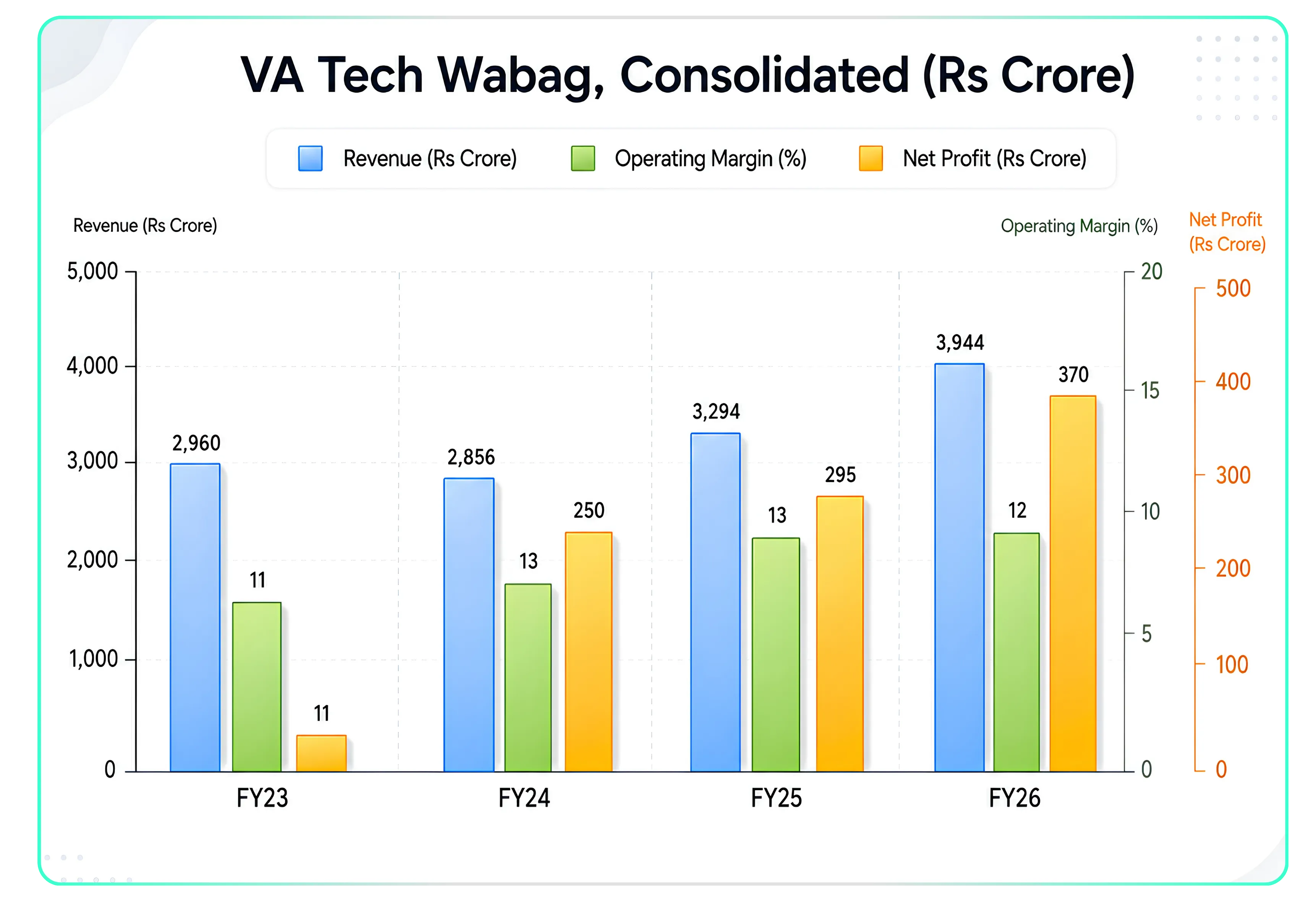
VA Tech Wabag builds and operates the plants that supply this water, alongside municipal and industrial water treatment, desalination and wastewater recycling. The company closed FY26 with a record consolidated order book of Rs 17,234 crore against consolidated revenue of Rs 4,038.5 crore, a coverage of a little over four times revenue. It has been net cash positive for six straight years. The management has guided to revenue growth of 15 to 20%, EBITDA margin of 13 to 15%, and return on capital employed above 20%.
Why gas needs constant pressure
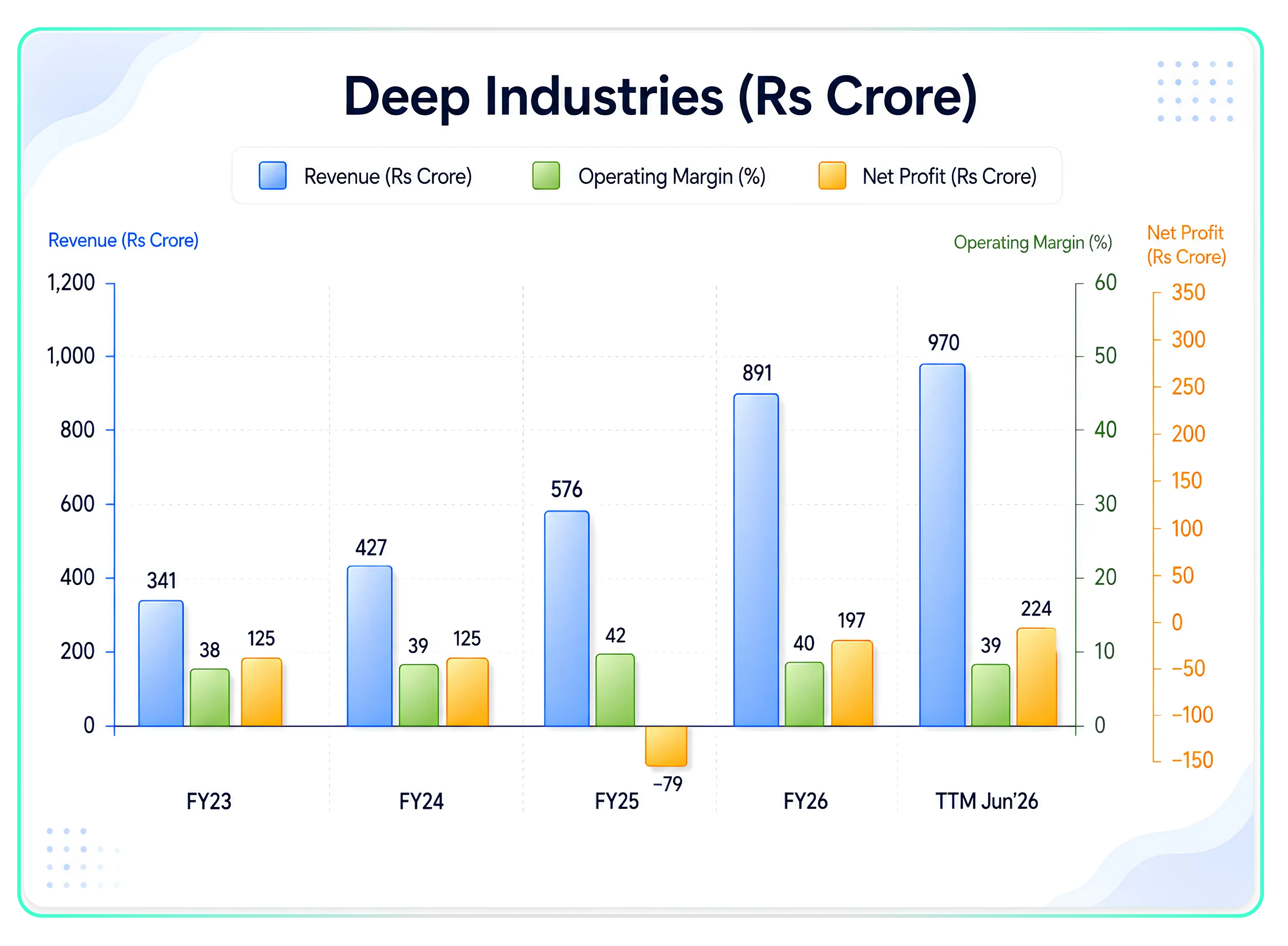
Natural gas moves through pipelines under pressure, and that pressure has to be maintained mechanically across long distances. This matters more as India tries to raise natural gas's share of its primary energy mix from around 6% today to a government target of 15% by 2030, a goal first set in 2016 and one the sector has been slow to close in on. Deep Industries, incorporated in 1991 and listed since 2021, provides gas compression, dehydration, drilling and workover services to ONGC, Oil India, GAIL, Reliance, Vedanta and other operators. Its first contract with ONGC, at Mehsana in Gujarat in 1997, made it the first Indian company to offer natural gas compressors on a charter-hire basis.
The company has since moved beyond simply renting equipment. Recent contracts, including a 15-year, Rs 1,402 crore production enhancement deal with ONGC in the Rajahmundry basin, have Deep Industries taking over an entire gas processing station, from compression through to final delivery into the pipeline grid, rather than just supplying machines.
Why capacity cannot be added overnight
A common assumption is that if demand rises, capital goods suppliers can simply ramp up production. Heavy engineering does not work that way. Forging a large turbine casing or an industrial casting can take a year or more from order to delivery, since the presses, dies and skilled machining capacity involved cannot be created quickly. Water treatment and gas infrastructure projects run on similarly long execution cycles for the same reason. Craftsman Automation, which supplies precision powertrain components, aluminium die-castings and automated storage systems, illustrates the point. Its manufacturing capacity has been built up over four decades, not assembled in response to a single order cycle.
What to actually watch in businesses like these
Three things are worth tracking. An order book tells you how much revenue is already contracted but not yet delivered, so a larger order book relative to current revenue generally means better visibility into future earnings, though it says nothing about when that revenue actually converts to cash. A long working capital cycle, the gap between spending money on a project and getting paid for it, ties up cash and is common in EPC-heavy businesses that work with government utilities. Contracts structured as long-term annuities, like Inox Green's O&M agreements, tend to produce steadier cash flow than one-off project revenue, since the same customer keeps paying year after year instead of a fresh contract having to be won each time.
Closing thought
These three companies sit in different parts of the same supply chain. One keeps turbines spinning, one supplies the water that thermal and green hydrogen plants need, and one keeps gas moving through pipelines at the right pressure. None of them build the power plant that makes the headlines. All three are necessary for one to keep running.
Are state utility receivables still slowing down execution for water and gas EPC companies, or is collection improving. Views welcome in the comments.
Disclaimer: The information provided in our blogs is for informational purposes only and should not be construed as financial, investment, or trading advice. Trading and investing in the securities market carries risk. Always conduct your own research and consult with a qualified financial advisor before making any investment decisions. Past performance is not indicative of future results. Copyrighted and original content for your trading and investing needs.
© 2026 — Tradejini. All Rights Reserved.