

 Concalls
Imagine a state-run power plant shuts down & needs to sell 4,000 tonnes of scrap metal. Or the government wants to auction a coal mine, a batch of 5G airwaves and needs everyone to see the process is fair, so no one can later claim favouritism. Who runs that auction?
In India, the answer is very often the same company: MSTC Limited.
MSTC auctions scrap metal, coal, iron ore, mining blocks, radio spectrum, liquor licenses and abandoned real estate. MSTC is a Mini Ratna Category-I public sector undertaking, set up in 1964 to regulate India’s ferrous scrap exports. The Government of India still holds a 64.75% controlling stake after diluting part of its holding in a March 2019 IPO.
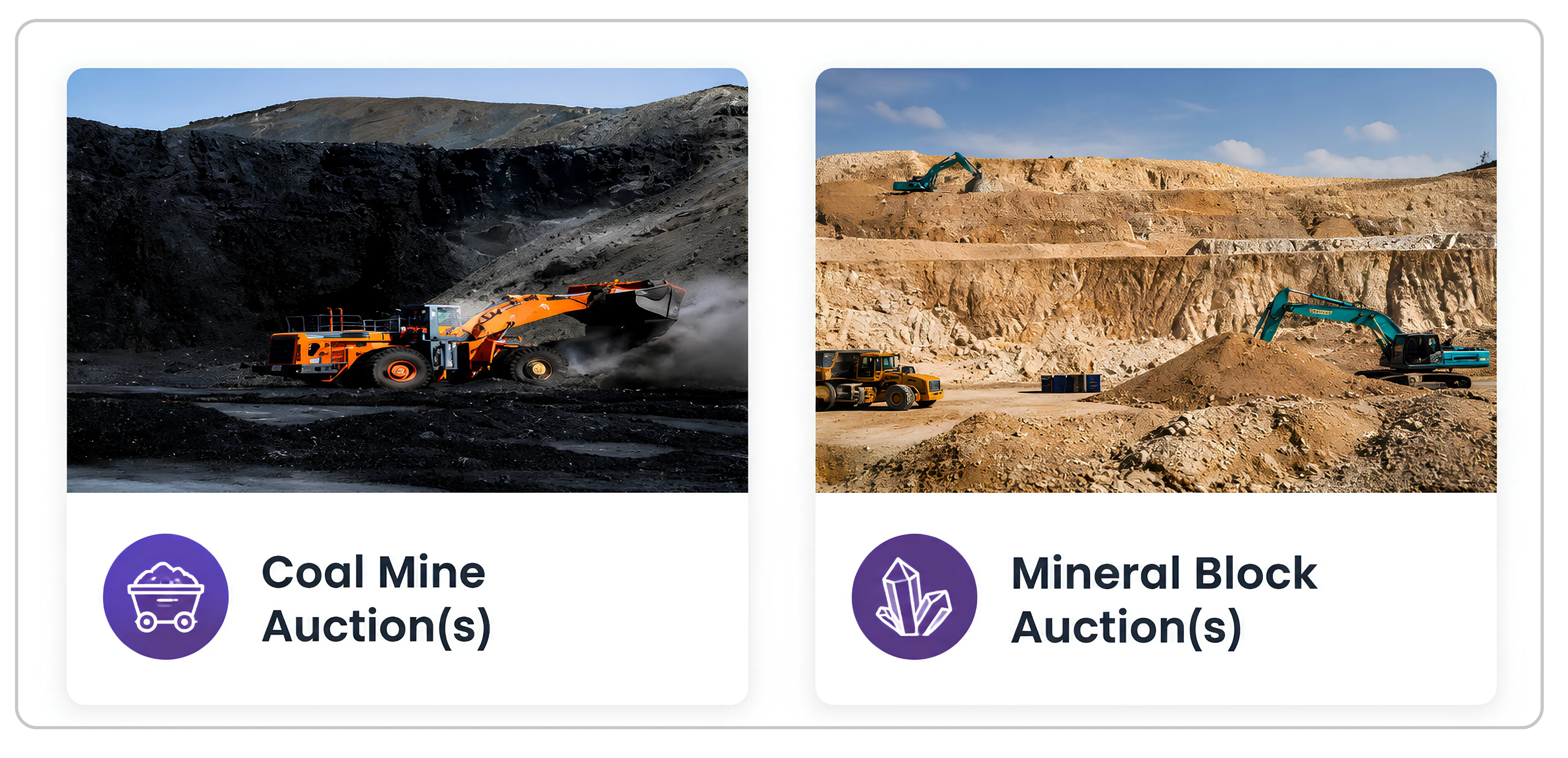
MSTC Limited is that auctioneer, at national scale and with a government mandate behind it. It runs the electronic platforms on which Indian public sector bodies sell things they no longer want and buy things they need. Scrap metal from a steel plant, iron ore from a state mining corporation, coal blocks from the Ministry of Coal, spectrum for the telecom department, surplus land, obsolete equipment, timber from a forest department, and end of life vehicles headed for scrapping all pass through portals MSTC built and operates. The company almost never owns any of it. It earns a fee for making the sale happen cleanly, and that distinction between the value of what crosses the platform and the money MSTC actually keeps is the single most important thing to understand before looking at a single number in its accounts.

How a Fee on Someone Else Sale Becomes Revenue
MSTC operates two businesses. The first is e-commerce: auction and procurement services for government departments and companies. E-sale and e-auction place MSTC as selling agent for an entity disposing of assets; e-procurement runs the same technology in reverse. Both earn a service charge on transaction value.
The second, marketing and trading, worked differently. MSTC procured industrial raw materials on behalf of customers, took the goods onto its own books, and charged a markup secured by a bank guarantee of 110 percent of value. Because it legally bought and sold the material, the full value appeared as revenue.
That accounting difference explains why MSTC's financial history looks strange. Under the fee model, Rs 100 crore of scrap sold produces perhaps Rs 30 to 40 lakh of revenue. Under the trading model, Rs 100 crore of raw material procured produces Rs 100 crore of revenue and a sliver of profit. As trading has wound down, MSTC reports less revenue and more profit, not because margins improved operationally, but because the same fee income is now a larger share of a smaller reported number.
The e-commerce business rests on standing agency roles covering mineral blocks, coal, and end-of-life vehicles, and an appointment as auction service provider for the Department of Investment and Public Asset Management. Beyond those, MSTC has built bespoke portals for Indian Oil Corporation, the Department of Telecommunications for spectrum auctions, the Ministry of Information and Broadcasting, the regional air connectivity scheme, and the Directorate General of Foreign Trade for gold bullion quota allocation.
The cost structure is almost entirely people and software. In FY26, employee costs were Rs 98.73 crore, other expenses Rs 47.72 crore, and depreciation Rs 10.36 crore. There is no factory, no inventory, and no meaningful interest burden.
EPR: Where the Next Fee Pool Could Come From
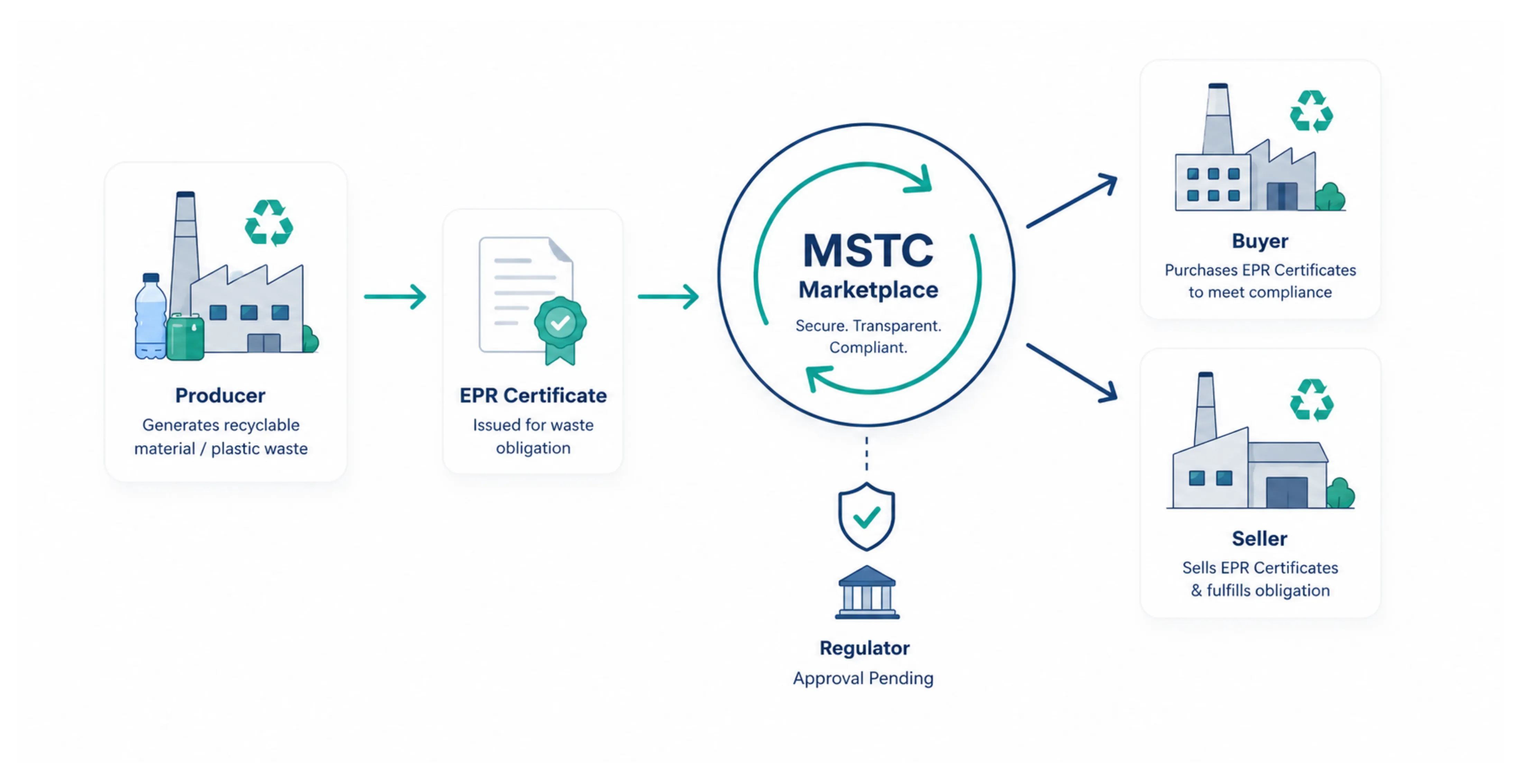
Extended Producer Responsibility, or EPR, makes the company that manufactured a product responsible for ensuring its waste is collected and recycled. Compliance is tracked through certificates, one per unit of waste properly processed, which can be traded between companies that have surplus and those that need more. The government's pollution regulator asked MSTC to build the online marketplace for that trading, and MSTC has built it. It is waiting for formal regulatory approval before trading can begin.
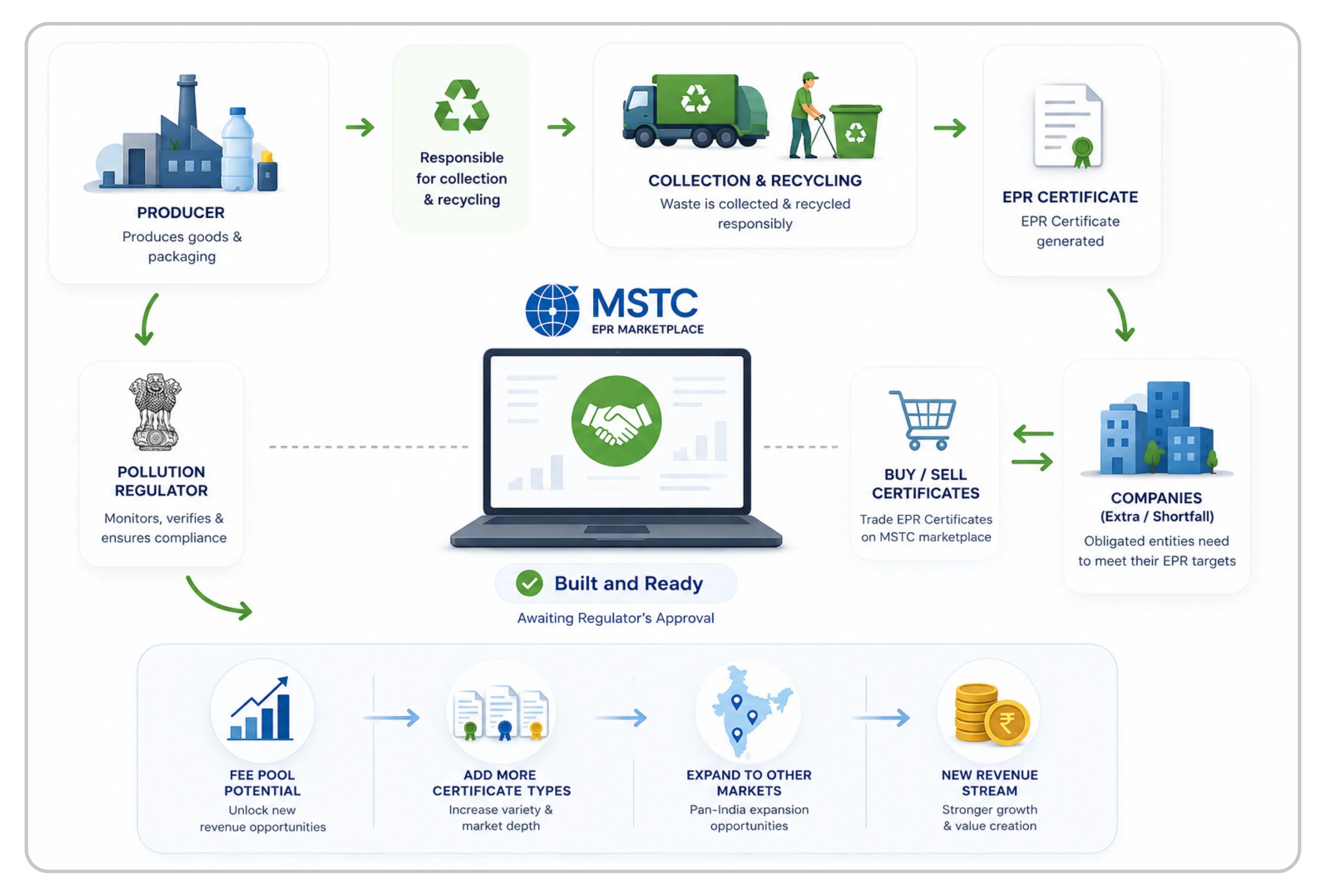
The opportunity is straightforward: the same fee-on-transaction model MSTC already runs, applied to a new category of good. If it works, additional waste categories can be added to the same platform, and MSTC could bid to operate similar marketplaces elsewhere. Management has declined to put a number on it until the platform is open and actual trading volumes are visible.
Five Years Where Revenue Halved and Profit Multiplied
The five years from FY22 to FY26 contain one of the more misleading revenue series on the Indian market. Read alone, the top line describes a company in decline. Read alongside the operating profit line, it describes a company that has been shedding a low-quality business and keeping a high-quality one. Revenue from operations fell from Rs 876 crore in FY22 to Rs 370 crore in FY26, a decline of 58 percent, while operating profit rose from Rs 9 crore to Rs 219 crore and operating margin went from 1.0 percent to 59.2 percent. Almost the entire change is the trading business leaving the accounts.
| Rs Crore, consolidated | FY22 | FY23 | FY24 | FY25 | FY26 |
|---|---|---|---|---|---|
| Revenue from operations | 876 | 721 | 316 | 311 | 370 |
| Operating expenses | 867 | 528 | 234 | 133 | 150 |
| Operating profit | 9 | 193 | 82 | 178 | 219 |
| Operating profit margin (%) | 1.0 | 26.8 | 25.9 | 57.2 | 59.2 |
| Other income | 247 | 158 | 203 | 340 | 83 |
| Depreciation | 21 | 22 | 7 | 9 | 10 |
| Interest cost | 3 | 0 | 0 | 0 | 0 |
| Profit before tax | 233 | 329 | 278 | 508 | 292 |
| Effective tax rate (%) | 15.0 | 26.0 | 41.0 | 20.0 | 25.0 |
| Profit after tax | 199 | 242 | 165 | 407 | 219 |
| Earnings per share (Rs) | 28.28 | 34.37 | 23.44 | 57.82 | 31.03 |
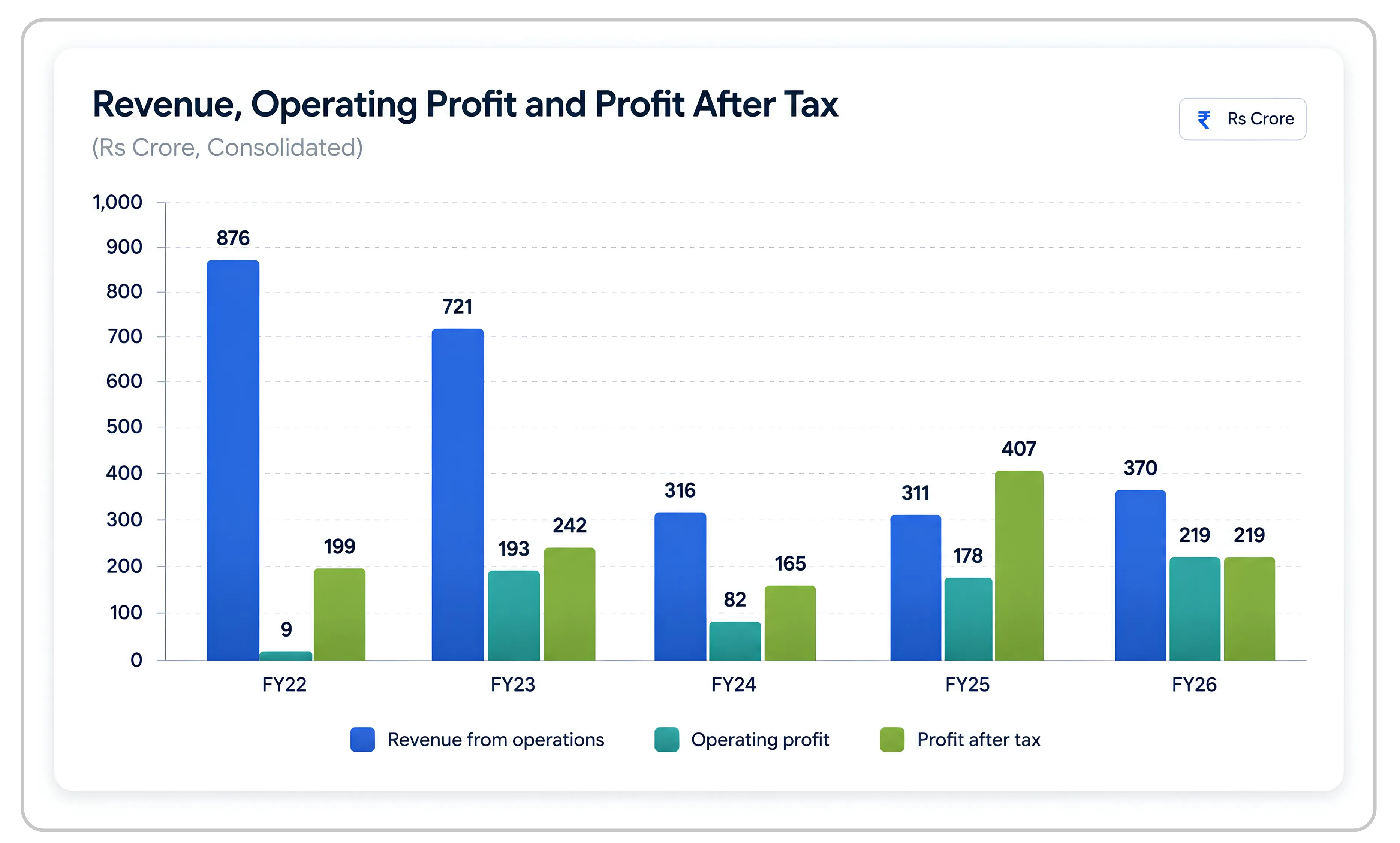
By FY26, marketing and trading revenue had fallen to Rs 1.49 crore, against Rs 1.85 crore in FY25, and management has stated the vertical will be completely exited during FY27. What remains is fee income.
FY25 earnings per share of Rs 57.82 is not a run rate for anything: it contains the Rs 263.19 crore exceptional gain from the disinvestment of Ferro Scrap Nigam Limited. Stripping that out, profit before exceptional items was Rs 183.19 crore in FY25 against Rs 218.43 crore in FY26, a rise of 19.2 percent. That comparison is the one that describes the operating business.
A Platform That Handled Less and Earned More
The value of goods transacted through the platform fell 11.2 percent in FY26, from Rs 89,824 crore to Rs 79,737 crore. E-commerce revenue over the same period rose 17.3 percent, from Rs 281.21 crore to Rs 329.72 crore. Expressed as revenue per rupee of goods passing through, MSTC's take rate moved from 0.31 percent to 0.41 percent, an improvement of roughly a third in a single year.
| Rs Crore, standalone | FY25 | FY26 | Change (%) |
|---|---|---|---|
| Value of goods transacted | 89,824 | 79,737 | -11.2 |
| E-auction and e-sale revenue | 275.78 | 321.29 | 16.5 |
| E-procurement revenue | 5.43 | 8.43 | 55.3 |
| Total e-commerce revenue | 281.21 | 329.72 | 17.3 |
| Marketing and trading revenue | 1.85 | 1.49 | -19.5 |
| Other operating revenue | 27.90 | 38.45 | 37.8 |
| Revenue from operations | 310.96 | 369.66 | 18.9 |
| Revenue as share of goods transacted (%) | 0.31 | 0.41 | NA |
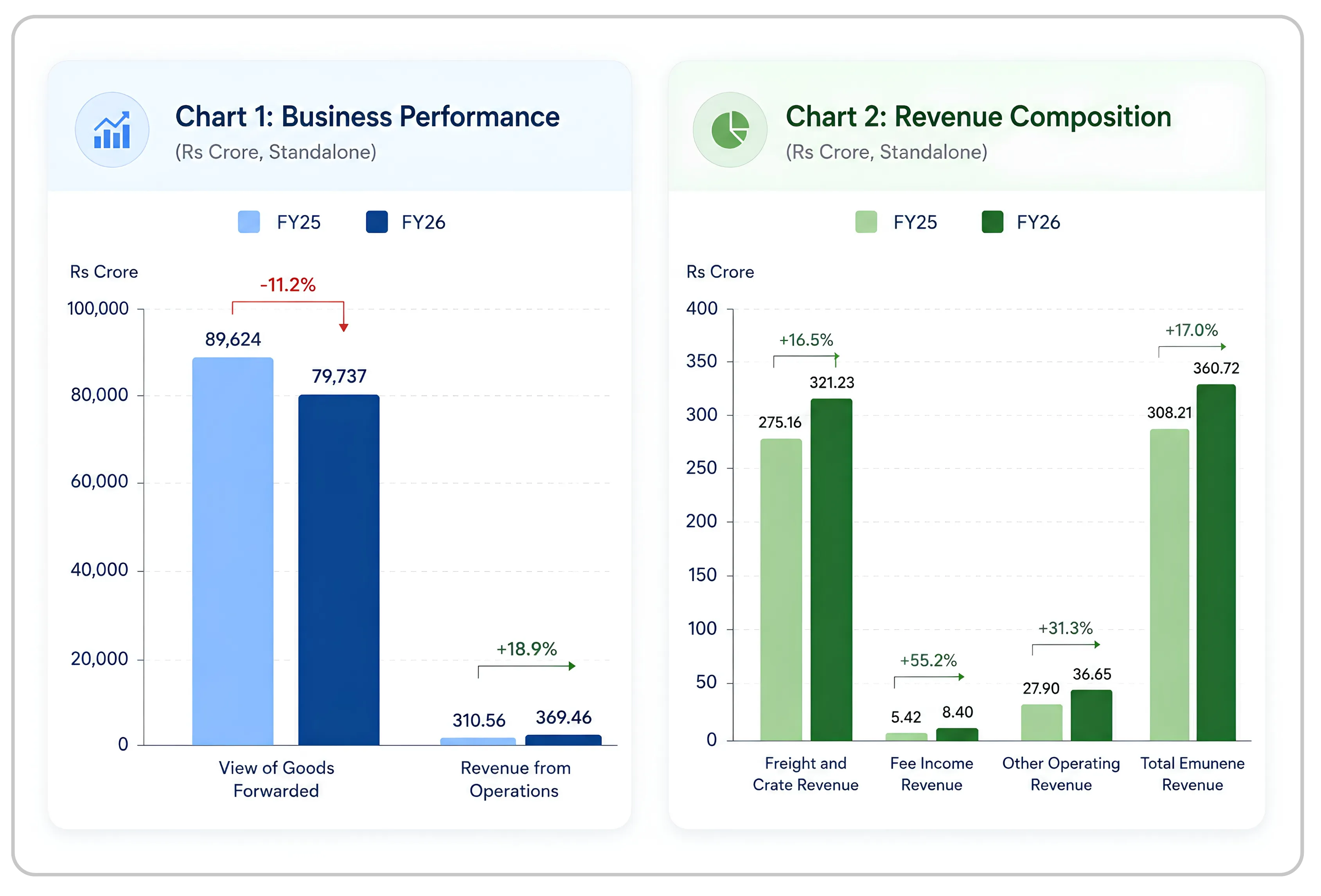
Two things drove it. The first is mix: coal mine completions, major mineral block auctions, and large scrap disposals including end-of-life power plant assets command higher fees than routine bulk volume. The second is e-procurement, small at Rs 8.43 crore but the fastest-growing disclosed segment at 55.3 percent.
| Rs Crore, volume of business | FY24 | FY25 | Change (%) |
|---|---|---|---|
| Coal e-auction | 11,147 | 3,941 | -64.6 |
| E-sale | 52,562 | 27,759 | -47.2 |
| Iron ore e-auction | 18,476 | 23,843 | 29.0 |
| Scrap disposal | 6,523 | 6,437 | -1.3 |
| E-procurement | 52,680 | 27,667 | -47.5 |
| Trading | 199 | 177 | -11.1 |
| Total volume of business | 1,41,587 | 89,824 | -36.6 |
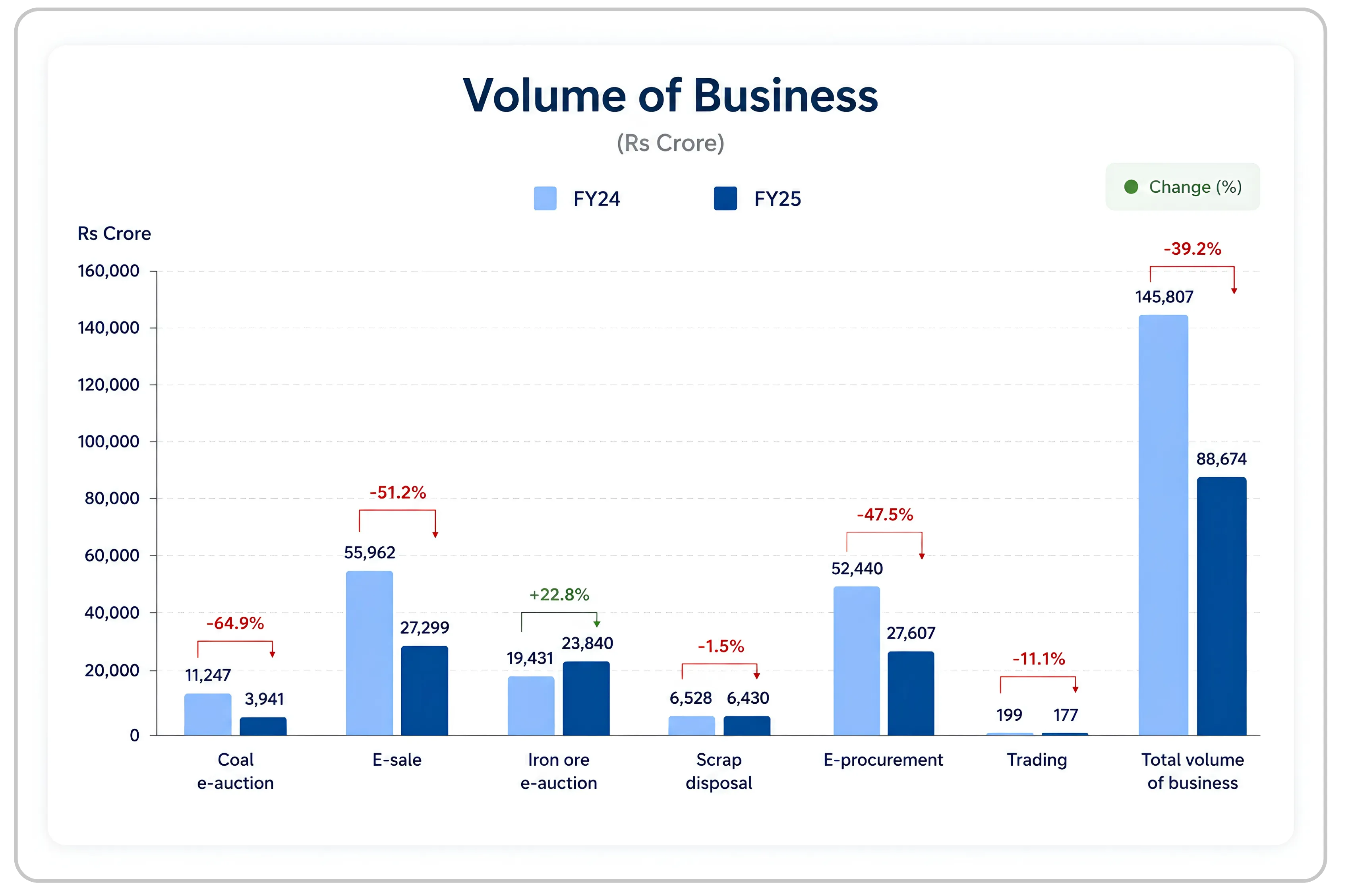
The volume decline itself is not new. Across FY24 and FY25, total business volume fell 36.6 percent, with coal e-auction down 64.6 percent and e-procurement down 47.5 percent, while iron ore e-auction grew 29.0 percent. A further 11.2 percent fell away in FY26, leaving the platform handling 43.7 percent less business by value over two years. Against that, fee revenue has grown. The risk section returns to what happens if the take rate stops rising while volumes keep falling.
Where the Profit Goes When It Does Not Become Cash
| Rs Crore, consolidated | FY22 | FY23 | FY24 | FY25 | FY26 |
|---|---|---|---|---|---|
| Cash from operations | 170 | 844 | -283 | 260 | -28 |
| Capital expenditure | 22 | 33 | 107 | 24 | 22 |
| Free cash flow | 148 | 811 | -390 | 236 | -50 |
| Cash from investing | -72 | -551 | -272 | 165 | 257 |
| Cash from financing | -98 | -119 | -96 | -289 | -54 |
| Profit after tax | 199 | 242 | 165 | 407 | 219 |
| Debtor days | 228 | 235 | 366 | 363 | 224 |
In FY24, MSTC reported profit after tax of Rs 165 crore and negative cash from operations of Rs 283 crore. In FY26, its best operating year on the profit line at Rs 219 crore, cash from operations was again negative at Rs 28 crore, producing negative free cash flow of Rs 50 crore. FY23 and FY25 swung the other way, delivering Rs 844 crore and Rs 260 crore of operating cash flow respectively. The swings are far larger than the profit movements that supposedly drive them.
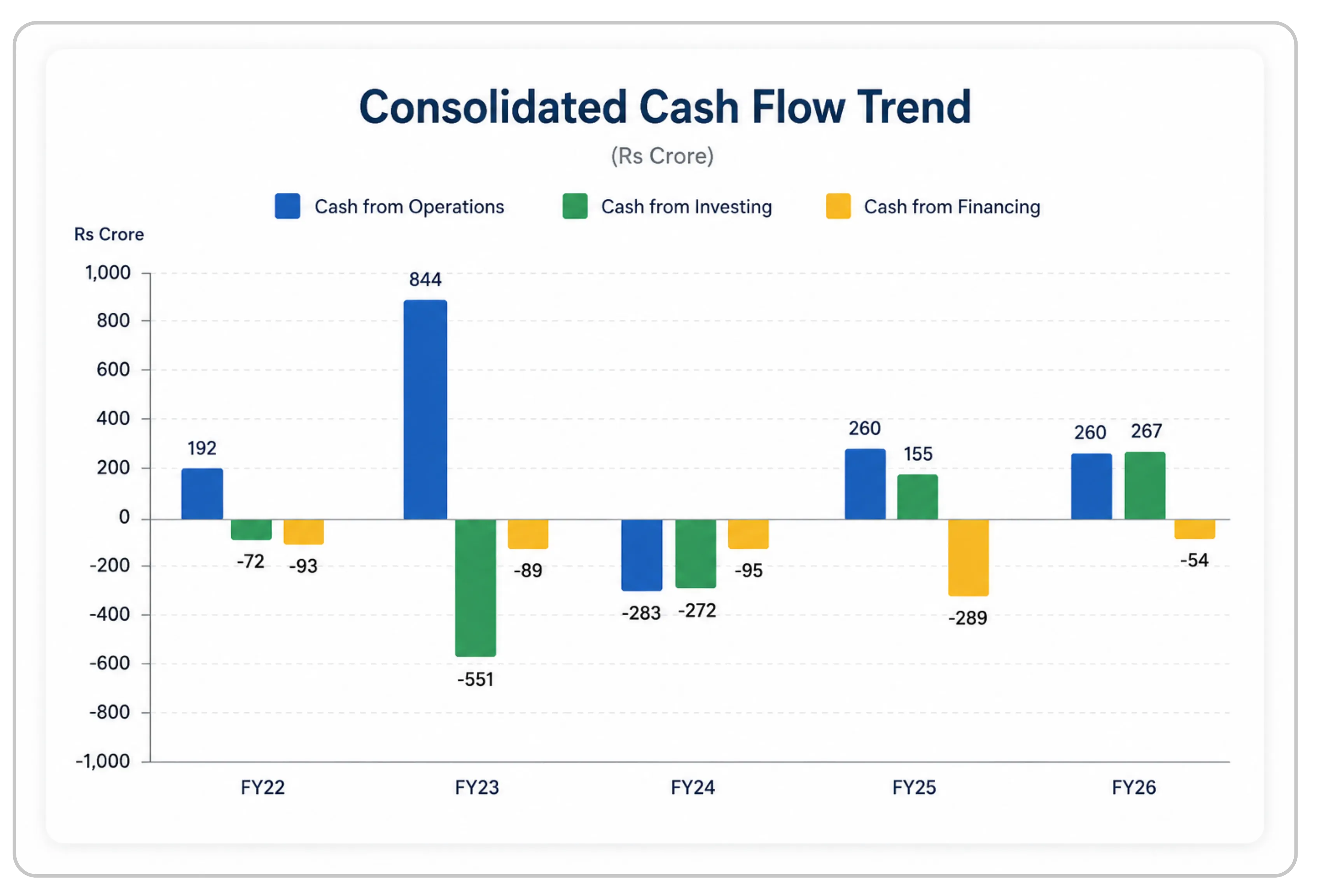
Debtor days explain most of it. They rose from 235 in FY23 to 366 in FY24, held at 363 in FY25, then fell to 224 in FY26. An auction platform sits in the middle of money moving between third parties, holding bidder deposits and collections on behalf of sellers, and those balances move with auction timing rather than profitability. The FY26 improvement is meaningful, but the pattern across the five years means cash conversion cannot be read from the profit line alone.
Capital expenditure has run at Rs 22 crore to Rs 33 crore in four of the five years, with FY24 the exception at Rs 107 crore. For a business generating Rs 219 crore of operating profit, the maintenance cost of keeping it running is low.
A Balance Sheet Where Most of the Assets Are Not Explained
| Rs Crore, consolidated | FY22 | FY23 | FY24 | FY25 | FY26 |
|---|---|---|---|---|---|
| Fixed assets | 142 | 141 | 68 | 65 | 206 |
| Investments | 21 | 19 | 28 | 12 | 12 |
| Other assets | 1,853 | 2,529 | 1,725 | 2,042 | 1,792 |
| Total assets | 2,015 | 2,690 | 1,822 | 2,118 | 2,011 |
| Net worth | 654 | 786 | 647 | 738 | 904 |
| Borrowings | 150 | 145 | 145 | 145 | 145 |
| Other liabilities | 1,211 | 1,758 | 1,030 | 1,235 | 962 |
| Debt to equity (x) | 0.23 | 0.18 | 0.22 | 0.20 | 0.16 |
| Return on capital employed (%) | 31.0 | 38.0 | 32.0 | 29.0 | 30.0 |
| Return on equity (%) | 30.4 | 30.8 | 25.5 | 55.1 | 24.2 |
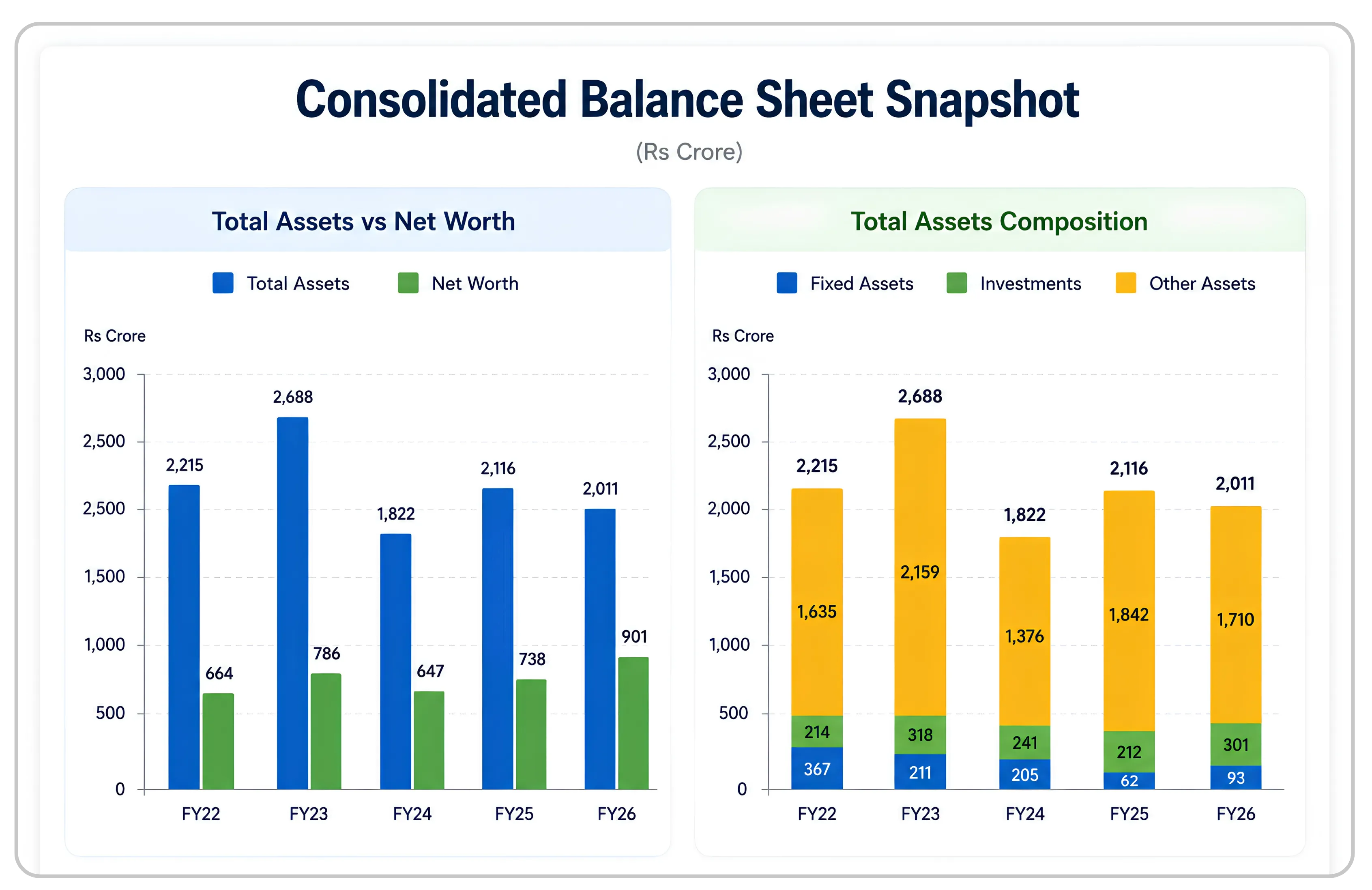
Borrowings have been flat at Rs 145 crore since FY23, against net worth that has grown to Rs 904 crore in FY26. Debt to equity is 0.16 and interest cost was nil in FY26. Debt is not part of this story and requires no further attention.
What does require attention is the shape of the rest. Fixed assets are Rs 206 crore, investments Rs 12 crore, and other assets Rs 1,792 crore, or 89 percent of the balance sheet. On the other side sit other liabilities of Rs 962 crore against net worth of Rs 904 crore. Neither of those large balances is broken down anywhere in the available disclosure.
Fixed assets also jumped from Rs 65 crore to Rs 206 crore in FY26 on capital expenditure of roughly Rs 22 crore and depreciation of Rs 10.36 crore.
Return on capital employed has held between 29 and 38 percent across all five years, including FY22 when operating margin was 1.0 percent.
Capital Allocation Under a State Owner
MSTC is a Government of India enterprise, and strategic decisions of consequence involve the owner as much as the board. The clearest recent illustration is the Extended Producer Responsibility platform, where management stated on the FY26 earnings call that confirming a launch date was not a decision MSTC could make unilaterally.
The capital allocation record over the last two years is one of deliberate subtraction. Ferro Scrap Nigam Limited was divested at the end of FY25, producing the Rs 263.19 crore exceptional gain. The trading vertical is being closed and will be out of the accounts during FY27. Against those exits, losses in the fifty-fifty recycling joint venture with Mahindra have been contained: MSTC's share of joint venture loss narrowed from Rs 5.97 crore to Rs 4.70 crore, and the impairment charge on that investment fell from Rs 10.06 crore to Rs 1.44 crore.
Dividend payout ran between 44 and 70 percent of profit from FY22 to FY25, then fell to 26 percent in FY26. The elevated FY25 payout was struck on a profit that included the disinvestment gain, so the trailing yield at current prices overstates what the recurring business supports.
One cost line reads as a signal. Other expenses rose 34.0 percent in FY26, which management attributed to opening a corporate office in New Delhi to be closer to the mandates it is pursuing.
Where the Auction Mandate Comes From
MSTC does not operate in a conventional competitive market with a measurable size and a share to be won. Its addressable opportunity is created by policy decisions that require public assets to be sold transparently, and it expands or contracts as those decisions are made. The relevant question is not how large the market is, but how firmly the mandates are held and how many new ones the policy direction is likely to create.
The direction has been consistent. Government procurement has been progressively digitised, mineral block auctions have opened a window the company has pursued through agreements with most state governments, and the end-of-life vehicle policy named MSTC as the agency for government department disposals. Management noted that the broader thrust toward transparency and fair price discovery across sectors is what enables platforms of this kind.
Two qualifications belong here. The scrappage ecosystem has developed more slowly than originally envisaged, as it depends on individual states putting regulations and facilities in place, and management was explicit that MSTC would not be its primary driver.
A Position Granted Rather Than Won
The strongest advantage MSTC holds is nomination. It is the nominated agency for e-auction of all major and minor mineral blocks across states and union territories, and the nodal agency for end-of-life vehicle sales from central and state government departments. These are not contracts won against competing bidders each year. They are positions conferred by policy, which makes them unusually durable against ordinary commercial competition and also means they can be altered by the same authority that granted them. The advantage and the central risk are the same fact viewed from two sides.
The second is accumulated technical range. MSTC has been running coal e-auctions since 2004 and has extended across minerals, non-performing bank assets, immovable property, timber, and forest produce. Its procurement platform carries multi-currency bidding, quality and cost-based selection tendering, and linked events. Building an auction platform is not difficult. Building one that the Department of Telecommunications will use for simultaneous multi-round spectrum auctions, that Indian Oil will use for petroleum import and export bidding, and that forest departments will use to sell timber, all within the same organisation, is a different proposition.
The third is a buyer base that now extends beyond government. Bharti, GMR, Larsen and Toubro, Tata, Indus Towers, JSW, Reliance Industries, Vedanta, and Jindal Power have used the platform. For a seller, the value of an auction platform is entirely the number of credible bidders it can assemble, which is a genuine network effect and the one advantage on this list that a competitor cannot obtain by winning a tender.
Three Platforms Waiting for a Regulator
Every growth vector MSTC is pursuing shares the same structure: the company builds the platform at modest cost and waits for somebody else to switch it on. That pattern determines both the low capital risk and the unpredictable timing of everything here.
The Extended Producer Responsibility platform, covered above, remains the largest of the three
Two newer platforms are further from the core. MSTC Smart Travel is a business-to-business travel and logistics portal in final testing, where the execution risk is competitive rather than regulatory: MSTC holds no mandate in travel. Upkaran is a national equipment listing and leasing platform aimed at construction, mining, and industrial users, the most speculative of the three and the furthest from anything MSTC has previously operated.
Alongside these, an agreement with SBI Capital Markets covers end-to-end transaction advisory for asset value realisation for public sector undertakings and private entities, closer to the existing business and lower risk. A coal linkage auction order from Coal India was won through competitive bidding, notable because it was obtained in open tender rather than conferred.
Management has guided to double-digit growth in the existing e-commerce business and declined to quantify anything beyond it.
Comparing a Fee Platform to Other Fee Platforms
There is no genuine listed comparable for MSTC in India. The four companies used here were chosen for economic similarity: each earns a fee on transactions it facilitates without owning the underlying asset. None operate in MSTC's industry, and all four are between three and sixteen times its size. Indian Energy Exchange is the closest match on regulatory exposure, IRCTC on ownership structure and mandate, while CDSL and MCX are capital markets infrastructure with a more entrenched statutory position than an auction mandate.
| Company | Market cap (Rs Cr) | Revenue (Rs Cr) | PAT (Rs Cr) | RoCE (%) | RoE (%) | Debt to equity (x) | PE (x) | EV/EBITDA (x) | Dividend yield (%) |
|---|---|---|---|---|---|---|---|---|---|
| MSTC | 4,218 | 370 | 218 | 30.3 | 26.6 | 0.16 | 19.3 | 10.0 | 6.73 |
| Indian Energy Exchange | 11,898 | 624 | 487 | 51.8 | 39.4 | 0.01 | 24.4 | 17.6 | 2.61 |
| IRCTC | 39,588 | 5,215 | 1,381 | 46.1 | 34.6 | 0.02 | 28.7 | 19.1 | 1.73 |
| CDSL | 28,121 | 1,145 | 456 | 32.0 | 24.5 | 0.00 | 61.6 | 41.5 | 0.95 |
| MCX | 69,177 | 2,302 | 1,332 | 71.4 | 56.3 | 0.00 | 51.9 | 37.7 | 0.22 |
Note: all figures as displayed on 29 July 2026. MSTC revenue and profit after tax are FY26 consolidated.
MSTC trades at the lowest earnings multiple and the lowest EV to operating profit multiple in the group, while earning the lowest return on capital employed. The gap is wide: MCX earns 71.4 percent on capital employed and trades at 51.9 times earnings; MSTC earns 30.3 percent and trades at 19.3 times. The market is treating MSTC as a fee platform with a materially less secure franchise than the others, which is a defensible reading given that a mineral auction mandate is a policy instrument and a depository licence is not. Whether the discount is proportionate to that difference is what the rest of this note turns on.
What Could Break the Case
Loss of mandate is the risk that would require the entire investment case to be rebuilt. MSTC earns its auction revenue because policy names it as the agency, not because it won a commercial contest. A decision to reassign the mineral block or end-of-life vehicle mandate, or to open either to competitive tender, would remove revenue that no amount of operational execution could defend. The e-commerce line at Rs 329.72 crore is 89 percent of revenue from operations and effectively all of the operating profit.
A competing coal exchange is the nearest form that risk currently takes. Management confirmed on the FY26 earnings call that a new coal exchange is under discussion, that coal forms a significant part of the revenue stream, and that it is not yet possible to assess the impact. Coal e-auction volume was already in steep structural decline before any competing venue existed.
Continued volume decline without further take rate improvement is the operating risk. The FY26 result depended on a take rate of 0.41 percent against 0.31 percent the prior year, while transaction value fell 11.2 percent. Holding that take rate against another 11 percent volume decline would put e-commerce revenue near Rs 293 crore, with most of the shortfall flowing through to operating profit given the low incremental cost structure.
Cash conversion has failed to normalise across two of the last three years. FY26 free cash flow was negative Rs 50 crore despite Rs 219 crore of reported profit. A return of debtor days toward the 363 to 366 range seen in FY24 and FY25 would pressure the dividend, which for a company with this payout history is a material part of total return.
Contingent liabilities of Rs 395 crore equal 44 percent of net worth of Rs 904 crore. If a material portion crystallised, the impact would fall on net worth and on distributable cash.
Every new vertical requires a decision by somebody other than MSTC before it generates revenue. A prolonged delay would leave the company with the existing e-commerce business at a guided double-digit growth rate and nothing more, a materially different proposition from the one implied by the pipeline.
MSTC’s Valuation: What the Market Is Paying For
The scenarios are built on revenue from operations after the trading vertical exits, so all three start from a base of Rs 368.17 crore, being FY26 revenue less the Rs 1.49 crore of marketing revenue that will not recur. The bull case assumes 18 percent e-commerce growth with the Extended Producer Responsibility platform beginning to contribute within the year. The base case assumes 12 percent growth, consistent with management guidance, with no new vertical contributing. The bear case assumes 3 percent growth as volume decline continues and the take rate flattens.
| Scenario FY27E | Revenue (Rs Cr) | EBITDA (Rs Cr) | EBITDA margin (%) | PAT (Rs Cr) | EPS (Rs) | Implied PE at CMP (x) | Market cap / EBITDA at CMP (x) |
|---|---|---|---|---|---|---|---|
| Bull | 435 | 265 | 60.9 | 257 | 36.6 | 16.4 | 15.9 |
| Base | 412 | 243 | 59.0 | 235 | 33.4 | 18.0 | 17.4 |
| Bear | 378 | 208 | 55.0 | 203 | 28.9 | 20.8 | 20.3 |
Current market price Rs 600 as at 29 July 2026. Market capitalisation Rs 4,218 crore on 7.03 crore shares.
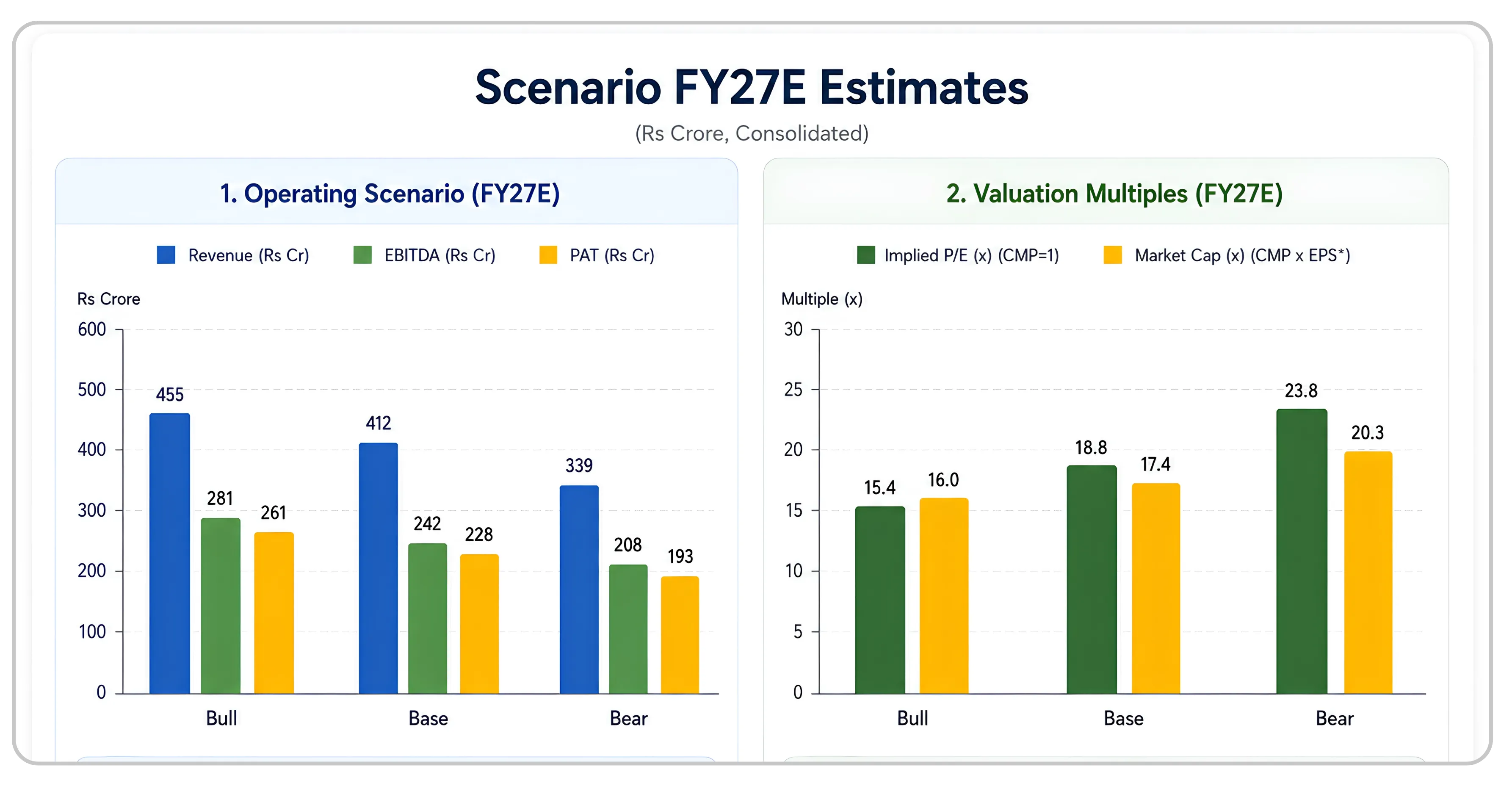
The base case puts the stock at 18.0 times FY27 earnings against 19.3 times trailing. The spread between bull and bear is narrow, from 16.4 times to 20.8 times, which reflects a business whose largely fixed costs mean profit does not swing violently on moderate revenue changes. What is priced in is continuation: growth at the guided rate, margins near current levels, and nothing from the new verticals. An investor at current prices is not paying for the Extended Producer Responsibility platform, the travel portal, or Upkaran.
If Three Things Go Wrong at Once
The stress test assumes three things go wrong together: a competing coal exchange becomes operational and takes material spot coal volume, the Extended Producer Responsibility platform receives no approval during the year, and the take rate compresses back toward the FY25 level of 0.31 percent.
| Rs Crore unless stated | Base case FY27E | Stress scenario FY27E |
|---|---|---|
| Revenue from operations | 412 | 320 |
| EBITDA | 243 | 154 |
| EBITDA margin (%) | 59.0 | 48.1 |
| Other income | 85 | 78 |
| Depreciation | 12 | 12 |
| Share of joint venture loss | -3 | -8 |
| Profit after tax | 235 | 159 |
| Earnings per share (Rs) | 33.4 | 22.6 |
| Borrowings | 145 | 145 |
| Interest cost | 0 | 0 |
The business survives comfortably. Profit after tax of Rs 159 crore on borrowings of Rs 145 crore and nil interest cost is not financial distress. The downside is contained by structure: no debt to service, no inventory, no factory, and a cost base that is mostly salaries. The threshold beyond which survival would come into question is not a revenue level. It would require the simultaneous loss of the mineral block and end-of-life vehicle mandates, removing the recurring franchise entirely rather than reducing its volume. No scenario short of that puts the company in danger.
Numbers That Tell You If This Is Working
| Metric | Why it matters | Threshold |
|---|---|---|
| E-commerce revenue growth | The only revenue line that survives the trading exit, and the one management has committed to growing. | Double digit growth sustained. Below 5 percent for two consecutive years means the platform has stopped compounding. |
| Revenue as a share of goods transacted | Shows whether MSTC is holding pricing power as auction volumes swing. | Holding at or above 0.40 percent. A fall towards 0.31 percent reverses the FY26 gain. |
| Coal e-auction volume | Coal is a significant part of the revenue stream and the segment most exposed to a competing exchange. | Stabilising above the FY25 level of Rs 3,941 crore. Further halving signals structural loss. |
| Cash from operations against profit after tax | FY24 and FY26 both delivered reported profit on negative operating cash flow. | Operating cash flow positive and at least 70 percent of profit after tax across a rolling two year period. |
| EPR platform approval and first revenue | The largest new vertical, built and awaiting an external clearance MSTC does not control. | Formal approval and disclosed platform revenue within FY27. A second full year without approval removes it from the case. |
A Business Getting Smaller and More Profitable
MSTC has done the difficult part of a corporate cleanup with unusual discipline. It has divested a subsidiary, closed a low-quality trading business that once flattered revenue while contributing almost nothing to profit, and improved what it earns per rupee of transaction value at a time when transaction volumes were falling. Operating profit has risen from Rs 9 crore to Rs 219 crore over five years. Very few companies subtract this well.
What remains to be proven is growth. Volume handled across the platform fell 43.7 percent over FY25 and FY26 combined, and the take rate improvement that offset it cannot be repeated indefinitely. The three new platforms are built and cost little, but every one waits on a decision MSTC cannot make. Two of the last three years also produced reported profit alongside negative operating cash flow, and until that pattern settles, the earnings line should be read with the cash flow statement beside it.
The current price contains no visible contribution from any new vertical and sits at a wide discount to every other listed transaction fee platform of comparable economics. That discount reflects the difference between a franchise conferred by policy and one secured by licence, which is a real distinction. Whether it closes depends on approvals that have not yet arrived and mandates that have not yet been tested.
Disclaimer: The information provided in our blogs is for informational purposes only and should not be construed as financial, investment, or trading advice. Trading and investing in the securities market carries risk. Always conduct your own research and consult with a qualified financial advisor before making any investment decisions. Past performance is not indicative of future results. Copyrighted and original content for your trading and investing needs.
© 2026 — Tradejini. All Rights Reserved.


