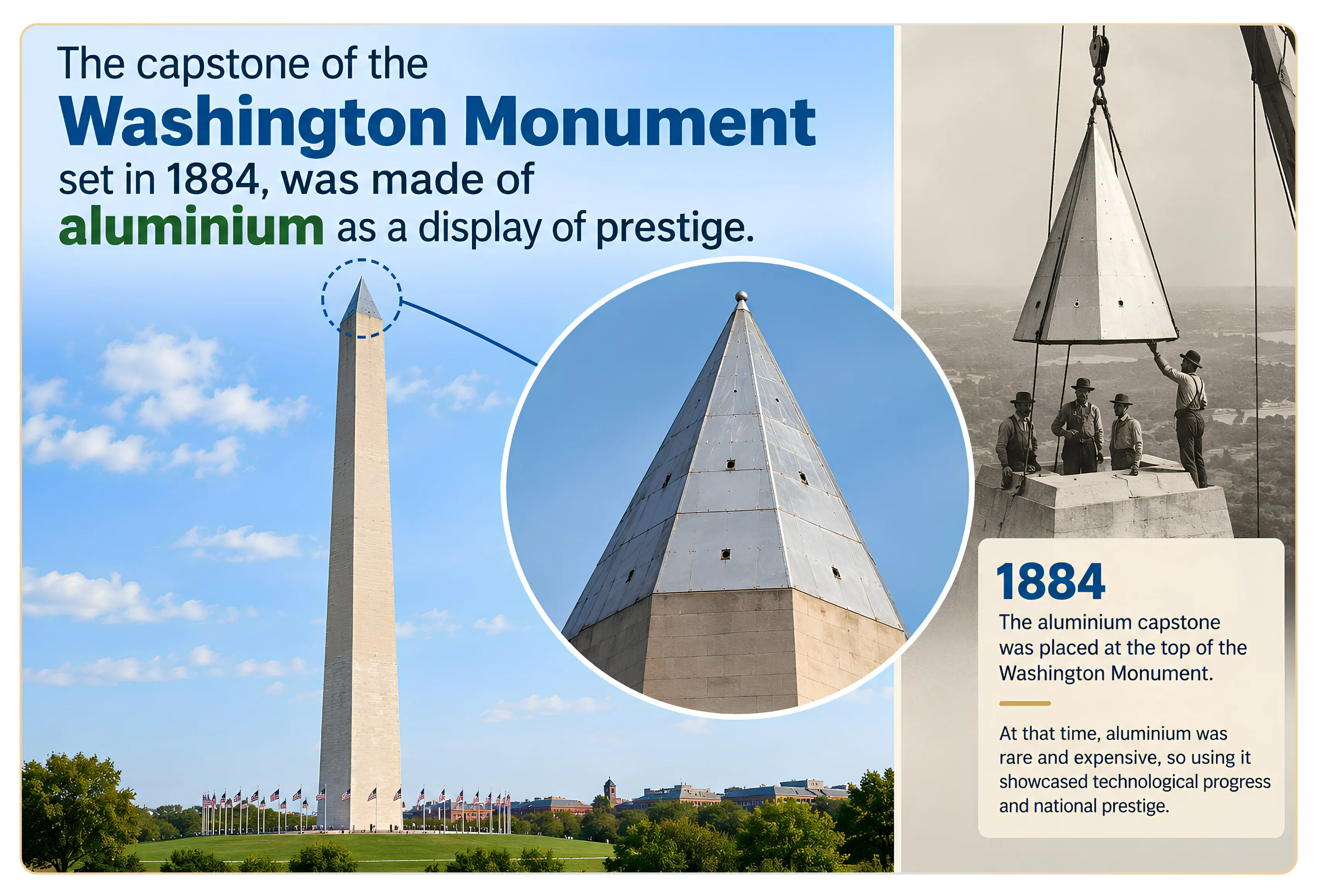
Aluminium is the most widely used metal after steel, but less than two centuries ago it was rarer than gold. In the 1850s it was so hard to extract that Napoleon III reportedly kept aluminium cutlery for his most important guests, while ordinary guests ate with gold. The capstone of the Washington Monument, set in 1884, was made of aluminium as a display of prestige.
That changed in 1886, when Charles Martin Hall in the US and Paul Héroult in France independently found a way to produce aluminium using electricity. Prices fell sharply, and a luxury metal became the material of soft-drink cans, window frames, aircraft and power cables.
Today aluminium is at the centre of three big themes: China's production limits, the cost of electricity, and the shift to lighter vehicles and greener grids. Each of these creates both risk and opportunity for anyone who trades, uses or invests in the metal.
It all starts with bauxite
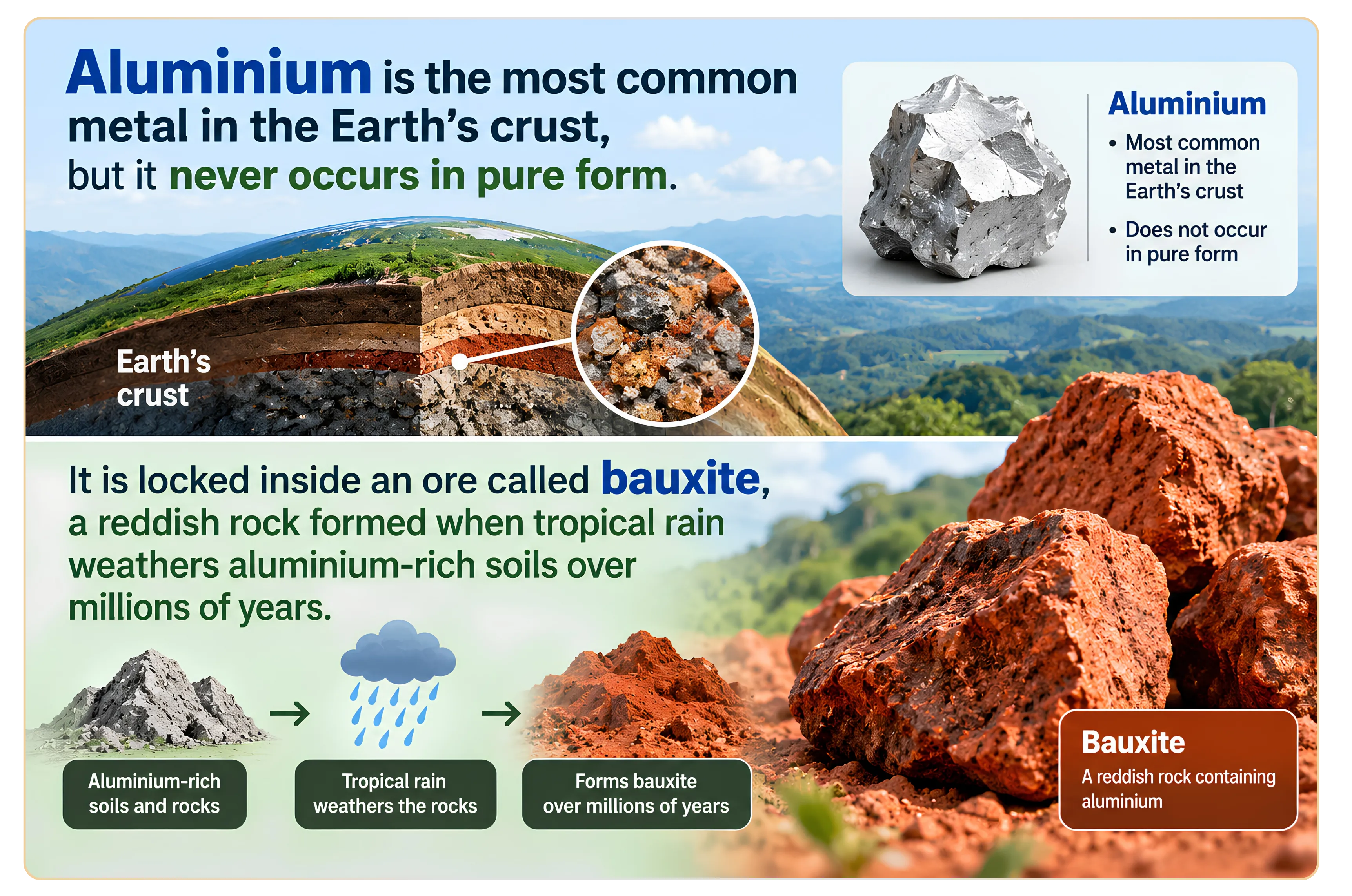
Aluminium is the most common metal in the Earth's crust, but it never occurs in pure form. It is locked inside an ore called bauxite, a reddish rock formed when tropical rain weathers aluminium-rich soils over millions of years. That is why most bauxite lies in a band around the tropics.
- Papua New Guinea holds the world's largest bauxite reserves and is now the biggest exporter, shipping most of its output to Chinese refineries.
- Australia is a long-standing major producer, with large mines in Queensland and Western Australia.
- China, Brazil, Indonesia and India are other important sources.
India has sizeable bauxite deposits in Odisha, Andhra Pradesh and Jharkhand. This gives Indian producers such as NALCO, Hindalco and Vedanta access to local ore, an advantage many smelters elsewhere do not have.
One point worth noting early: having bauxite does not make a country a big aluminium producer. Turning bauxite into metal needs huge amounts of cheap electricity, and that, more than ore, decides where smelters are built.
The global supply landscape
The world produced about 73.8 million tonnes of primary aluminium in 2025, and roughly six of every ten tonnes came from China. Growth was only 1.06%, the slowest in five years.
| Producer | Approx. position | Why it matters |
|---|---|---|
| China | 45.02 Mt in 2025 (about 61% of world output) | Has a self-imposed 45 Mt annual cap, so it can no longer add much supply |
| Gulf (UAE, Bahrain, Qatar, Saudi Arabia, Oman) | About 6.8 Mt, mostly exported | Cheap gas-based power made it the main exporter to the rest of the world |
| India | About 4.3 Mt of smelting capacity; second-largest producer | Exports about 60% of its output; expanding with local bauxite and coal |
| Russia | Rusal is one of the largest producers outside China | Sanctions and tariffs affect where its metal can be sold |
China's cap is the single most important supply fact. Beijing limited annual output to 45 million tonnes to control energy use and emissions. China produced 45.02 Mt in 2025 and 22.34 Mt in the first half of 2026, so it is already at the ceiling. For years, rising Chinese output kept prices in check. That buffer is now largely gone.
The Gulf is the pressure point. Most Gulf smelters sit along the Strait of Hormuz and import much of their alumina through it. In March 2026, Iranian strikes damaged Emirates Global Aluminium's Al Taweelah smelter (1.6 Mt of output in 2025) and hit Aluminium Bahrain. EGA said a full restart could take up to 12 months. Wood Mackenzie estimated 3–3.5 Mt of 2026 output was at risk.
India is a growing supplier. India is now the world's second-largest primary producer, with NALCO, Hindalco, Vedanta and BALCO holding about 4.3 Mt of capacity. The government's Vision 2047 document targets 37 Mt a year by 2047.
Global market dynamics
The aluminium market has moved from comfortable surplus towards deficit. Demand keeps growing while China's cap and the Gulf disruption hold supply back.
Aluminium: one metal, many prices
The price you see on the London Metal Exchange (LME) is only part of what a buyer actually pays. On top of it is a regional premium, which reflects local supply, freight and trade barriers.
United States: Section 232 tariffs on imported aluminium have pushed the US Midwest premium far above other regions, creating a two-tier market
Europe: High power prices have shut or curtailed several smelters. From 2026, the EU's Carbon Border Adjustment Mechanism (CBAM) adds a carbon cost on high-emission imports.
Asia: Premiums rise and fall with Chinese export flows and, this year, with the loss of Gulf shipments. A trader watching only the LME price can miss much of the story.
Primary versus recycled metal
Aluminium can be recycled again and again without losing quality, and recycling uses about 5% of the energy needed to make new metal. Roughly three-quarters of all aluminium ever produced is believed to still be in use.
This creates a second market alongside primary metal. Scrap and recycled (secondary) aluminium is cheaper and far less carbon-intensive, which makes it attractive under carbon rules such as CBAM. Over time, a bigger recycling share can cap how high primary prices go.
Also Read: Understanding the Five Business Models in India's Battery Industry
Demand architecture
Aluminium demand rests on two old pillars, construction and transport, and is being lifted by two new ones, electric vehicles and the power grid.
| Sector | How aluminium is used | Demand trend |
|---|---|---|
| Construction | Window and door frames, facades, roofing, scaffolding | Large but tied to property cycles, especially in China |
| Transport | Car bodies and engine parts, rail coaches, aircraft | Growing as carmakers cut weight; EVs use noticeably more aluminium than petrol cars |
| Electrical and power grid | Overhead transmission lines, cables, transformers | Growing with grid expansion and renewable energy connections |
| Solar energy | Panel frames and mounting structures | One of the fastest-growing uses |
| Packaging | Beverage cans, foil, food containers | Steady; helped by a shift away from plastic |
| Machinery and consumer goods | Machine parts, appliances, electronics casings | Moves with industrial activity |
Why EVs matter. A battery is heavy, so carmakers use aluminium elsewhere in the car to save weight and extend driving range. Battery enclosures, body panels and motor housings are often aluminium.
Why India matters. India uses about 3.4 kg of aluminium per person, against a global average of 8–12 kg. As India builds more power lines, railways, housing and vehicles, its demand has a long runway to grow.
From mine to metal
Roughly 4–5 tonnes of bauxite make 2 tonnes of alumina, which make 1 tonne of aluminium. The journey has three stages.
Mining bauxite. Most bauxite lies close to the surface, so it is dug out by open-cast mining, crushed and washed.
Refining to alumina (the Bayer process). The bauxite is dissolved in hot caustic soda. Impurities settle out as a red mud residue, and a white powder called alumina (aluminium oxide) is recovered.
Smelting to aluminium (the Hall–Héroult process). Alumina is dissolved in a molten salt bath and a strong electric current is passed through it. Pure molten aluminium collects at the bottom of the pot and is cast into ingots, billets or slabs.
The third step is where the money and the risk is. Smelting one tonne of aluminium needs around 14–15 megawatt-hours of electricity, about what an average Indian household uses in more than a decade. Power is typically the largest single cost of a smelter.
That is why smelters cluster where power is cheap and reliable: hydropower in Canada, Norway and Iceland; gas in the Gulf; coal in China and India. It also explains why alumina supply matters. A smelter without alumina, as some Gulf smelters found this year when shipments through the Strait of Hormuz were disrupted, must cut output even if its own plant is undamaged.
Economics and environment
A smelter's profit depends mostly on two things it cannot fully control: the price of power and the price of alumina. Everything else is a smaller share of costs.
Power cost decides who survives a downturn. When prices fall, high-cost smelters (often in Europe or those buying power at market rates) shut first. Smelters with their own coal, gas or hydro plants usually keep running.
Alumina can squeeze margins. If alumina prices jump while aluminium prices stay flat, smelters earn less even though their own product hasn't changed in price.
Restarting is slow and expensive. Once a potline freezes, restarting it can take months. This makes supply slow to respond to higher prices, which can extend price rallies.
The carbon question
Aluminium made with coal power emits several times more carbon dioxide per tonne than aluminium made with hydropower. As a result, the industry is splitting into two kinds of metal:
"Green" or low-carbon aluminium, made with hydro, nuclear or renewable power, or from recycled scrap. Carmakers and packaging companies with climate targets increasingly pay a premium for it.
Conventional coal-based aluminium, which faces growing costs under carbon rules such as the EU's CBAM.
For Indian producers, which rely heavily on coal-based captive power, this is both a risk and a reason for change. Vedanta and Hindalco have both announced renewable power purchases to lower their carbon footprint. China is moving some smelting capacity to hydropower-rich Yunnan province for the same reason, although that makes its output sensitive to droughts and rainfall.
Trading and logistics
Aluminium is the most heavily traded contract on the London Metal Exchange (LME), and Indian traders can take a position on it through MCX.
LME. The LME price, quoted in US dollars per tonne, is the global benchmark. Most physical contracts around the world are priced as "LME plus a regional premium". LME warehouse stocks are watched closely: falling stocks usually signal a tighter market.
SHFE. The Shanghai Futures Exchange reflects Chinese supply and demand. A gap between Shanghai and London prices drives China's imports and exports of aluminium.
MCX. In India, aluminium futures trade on the Multi Commodity Exchange in rupees per kg. The MCX price broadly follows the LME price converted into rupees, plus local costs and duties, so it moves with both the global price and the rupee-dollar exchange rate.
| Specification | Aluminium | Aluminium Mini |
|---|---|---|
| Lot size | 5 metric tonnes | 1 metric tonne |
| Price quote | ₹1 per kg | ₹1 per kg |
| Tick size | ₹0.05 per kg | ₹0.05 per kg |
| Value of one tick | ₹250 per lot | ₹50 per lot |
| Settlement | Physical delivery at expiry, unless squared off | Same as Aluminium |
| Expiry | Last trading day of the contract month | Same as Aluminium |
| Trading hours | About 9:00 AM to 11:30 PM IST (11:55 PM during US daylight saving time) | Same as Aluminium |
Market outlook and strategic analysis
The near-term outlook is neutral to mildly bearish, while the long-term picture remains supportive. 2026 is still a deficit year, but most forecasters expect the market to move towards surplus in 2027 as Gulf smelters recover and Indonesian capacity grows.
Where prices stand. LME aluminium traded at about $2,987 per tonne on 15 October 2026. That is down about 6.7% over the past month but up about 9.5% from a year ago. Prices are roughly 18% below the four-year high reached in June 2026, after the Gulf smelter attacks .
Why prices have eased.
Faster Gulf recovery. EGA's Al Taweelah smelter restarted faster than expected. By late August, 315 of its 1,262 reduction cells were back online, with full output targeted for the first quarter of 2027.
A strong US dollar. Aluminium is priced in dollars, so a stronger dollar makes it costlier for other buyers and tends to push prices down.
New supply from Indonesia. New smelters, many backed by Chinese companies, are expected to add output.
| Forecaster | View |
|---|---|
| Macquarie | 2026 deficit of 820,000 t; 2027 surplus of 410,000 t; average price $3,325/t in 2026 and $3,050/t in 2027 |
| Goldman Sachs | 2027 surplus of about 590,000 t |
| BofA | Deficit in 2026; Indonesia the key swing factor afterwards |
| Trading Economics | About $3,104/t by end of Q4 2026; about $3,275/t in 12 months |
Long term, the floor looks firmer than in the past. China's 45 Mt cap removes the main source of cheap surplus metal that kept prices low through the 2010s. Demand from EVs, solar, power grids and India's infrastructure build-out should keep growing. Dips caused by temporary supply recoveries may therefore be shallower than in earlier cycles, though this is a view, not a certainty.
Key risks and strategic recommendations
Risks to watch
| Risk | What could happen | Likely price effect |
|---|---|---|
| Middle East conflict | Renewed attacks or another Strait of Hormuz closure could halt Gulf output and alumina shipments again | Sharp spike |
| China policy | Any loosening of the 45 Mt cap, or a rise in Chinese exports | Lower |
| Chinese property slowdown | Weaker construction demand in the largest consuming country | Lower |
| Indonesian ramp-up | New smelters arriving faster than expected | Lower |
| Energy prices | Higher power or gas prices force more smelters to cut output | Higher |
| US dollar and interest rates | A stronger dollar or higher rates reduce investor and buyer appetite | Lower |
| Trade barriers | New tariffs, sanctions on Russian metal, or changes to CBAM | Wider gaps between regional prices |
| Rupee moves | A weaker rupee raises MCX prices even if LME is flat; a stronger rupee does the opposite | Changes MCX price only |
For traders
Follow the drivers, not just the chart. Track LME stocks, Gulf restart news, China's monthly output data and the dollar index.
Remember the currency. An MCX position is effectively a bet on both aluminium and the rupee-dollar rate.
Size for event risk. Geopolitical news can move prices overnight while Indian markets are closed. Use stop-losses and avoid oversized positions.
Start with Aluminium Mini. At one-fifth the lot size, it suits smaller accounts and learning.
Avoid accidental delivery. Square off or roll positions before the delivery period starts.
For industrial users
Hedge input costs. Manufacturers of cables, utensils, auto parts or packaging can lock in prices with MCX futures when margins are thin.
Watch premiums as well as the base price. A falling LME price can be offset by a rising local premium.
Plan for the carbon question. Exporters to Europe should check what CBAM means for their aluminium inputs.
For equity investors
Aluminium stocks are leveraged to the price. Hindalco, Vedanta and NALCO earnings move strongly with aluminium prices, power costs and alumina costs.
Integration matters. Companies with their own bauxite, alumina and power plants are usually more resilient in downturns.
Look at the cost curve. In a weak market, low-cost producers keep earning while high-cost ones struggle.
Conclusion
Aluminium has gone from a luxury metal to one the modern economy cannot do without. Its market is now shaped less by how much bauxite is in the ground and more by electricity, carbon rules and politics. Three forces will decide where prices go next: how quickly Gulf smelters return to full output, whether China holds its 45 Mt cap, and how fast demand from EVs, solar, power grids and India grows. In the short term, recovering supply and a strong dollar are weighing on prices. Over the longer term, capped Chinese supply and rising demand offer a firmer base. For traders, that means volatility in both directions; for long-term participants, it means understanding the drivers matters more than predicting the next move.
Also Read: A Fundamental Study of Epack Durable Ltd
Disclaimer: The information provided in our blogs is for informational purposes only and should not be construed as financial, investment, or trading advice. Trading and investing in the securities market carries risk. Always conduct your own research and consult with a qualified financial advisor before making any investment decisions. Past performance is not indicative of future results. Copyrighted and original content for your trading and investing needs.
© 2026 — Tradejini. All Rights Reserved.
Disclaimer: The information provided in our blogs is for informational purposes only and should not be construed as financial, investment, or trading advice. Trading and investing in the securities market carries risk. Always conduct your own research and consult with a qualified financial advisor before making any investment decisions. Past performance is not indicative of future results. Copyrighted and original content for your trading and investing needs.
© 2026 — Tradejini. All Rights Reserved.