Intraday trading is all about timing, control, and precise positioning. One bad exit or a delayed reaction can turn a good setup into a missed opportunity. That’s where Bracket Orders on Tradejini’s CubePlus platform come in; they simplify execution, enhance liquidity management, and bring structure to your trades.
A Bracket Order lets you place a target, a stop-loss, and even a trailing stop-loss in one go. The moment your trade is executed, the system takes over, managing risk, locking in profits, and giving you more breathing room to focus on the market itself rather than constantly watching every tick.
The trailing stop-loss adds another layer of discipline. As the stock moves in your favor, your stop-loss moves up with it, protecting gains without cutting the trade short.
If you're trading intraday, this isn’t just a convenience; it’s an edge. In the next section, we’ll walk through how Bracket Orders work using a live market example and why they’re a smart addition to any serious trader’s toolkit on CubePlus.
What are Bracket Orders?
Imagine placing a trade where your profit target and risk limit are locked in the moment you hit 'buy' or 'sell.' That’s the magic of a Bracket Order. It’s like setting up a safety net and a victory lap at the same time. When you place a BO on CubePlus, the platform automatically creates two opposing orders:
- Target Limit Order: Your ticket to locking in profits at a predefined price.
- Stop-Loss (SL) Order: Your shield against losses, with an optional trigger price to cap your downside.
These orders form a “bracket” around your entry price, ensuring you exit the trade either with a profit or a controlled loss, no emotional second-guessing required. CubePlus takes it up a notch with its one-cancels-the-other (OCO) logic, meaning if your target is hit, the stop-loss is cancelled, and vice versa. It’s like having a disciplined trading partner who never sleeps.
But wait, there’s more! CubePlus also lets you supercharge your Bracket Orders with a Trailing Stop-Loss, a dynamic feature that adjusts your stop-loss level as the market moves in your favour, helping you capture more profits while still protecting your downside. Let’s break it down with a live example.
Also read: Call Ratio Spread Explained Through Real Trades
Step 1: Placing a Bracket Order (Buy Side)
Picture this: It’s a bustling trading day, and you’re eyeing the NIFTY 17JUL 25700 CE (a call option) on CubePlus. You spot an opportunity and decide to go for it. Here’s how it plays out:
- Instrument: NIFTY 17JUL 25700 CE
- Action: Buy 75 Quantity @ ₹4.75
- Order type: Bracket
- Executed at 12:04:35 PM
- Trade value: ₹356.25
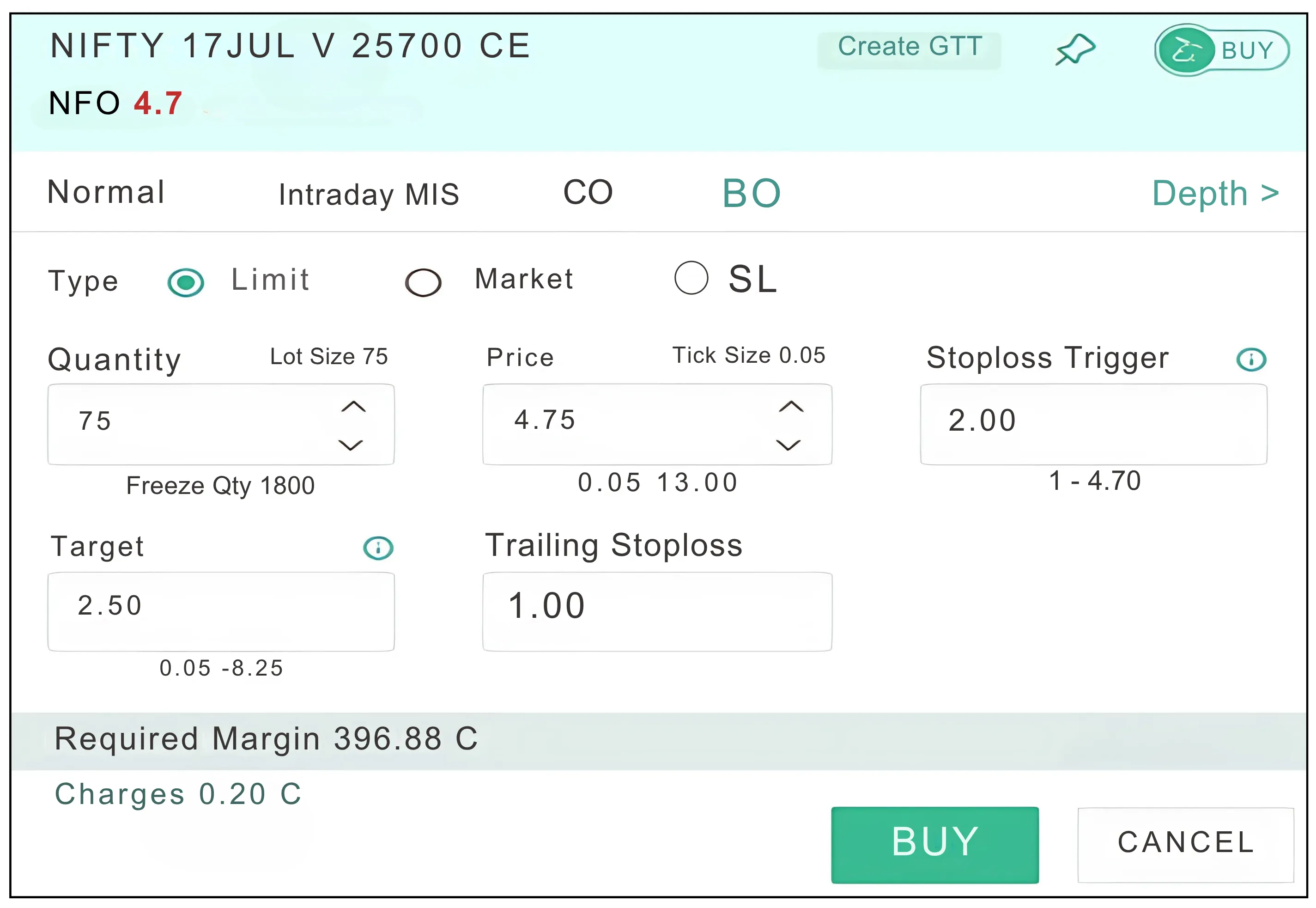
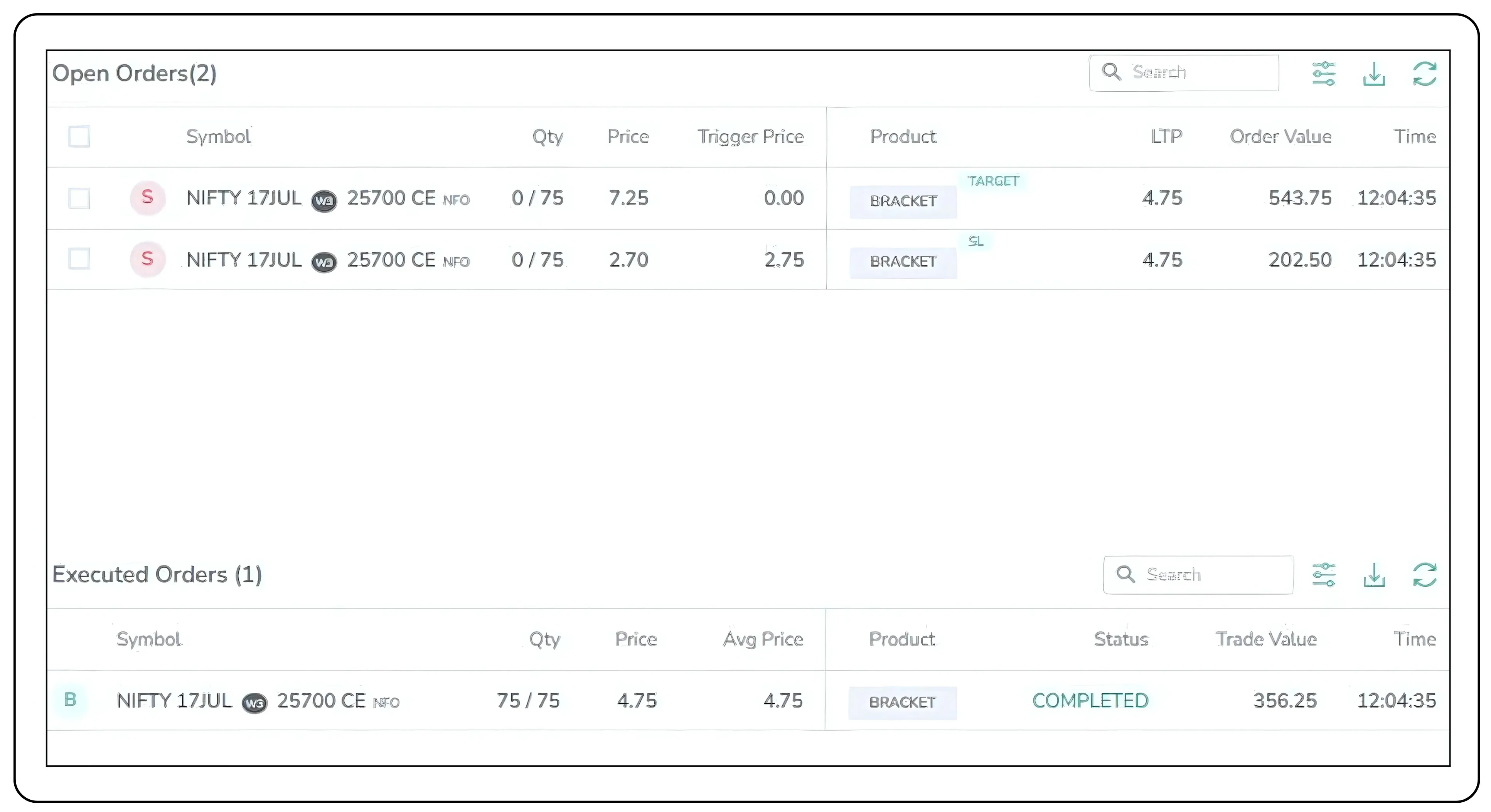
The moment your buy order is executed, CubePlus springs into action, creating two linked sell orders:
- Target Order: Sell at ₹7.25 (aiming for a ₹2.50 profit per lot).
- Stop-Loss Order: Sell with a trigger price of ₹2.75 and a limit price of ₹2.70 (limiting your loss to ~₹2.05 per lot).
These orders are your trading guardrails. If the price rockets to ₹7.25, your target order executes, locking in your gains, and the stop-loss order vanishes. If the price dips to ₹2.75, the stop-loss kicks in, capping your loss, and the target order is cancelled. It’s a set-it-and-forget-it system that keeps your emotions in check and your strategy on track.
Step 2: Adding a Trailing Stop-Loss for extra edge
Now, let’s add some flair with a Trailing Stop-Loss. Unlike a static stop-loss, a trailing SL moves with the market price, locking in profits as the price climbs while still protecting you if the market reverses. In our NIFTY example, let’s say you set a trailing stop-loss with a trail amount of ₹1.00. Here’s how it works:
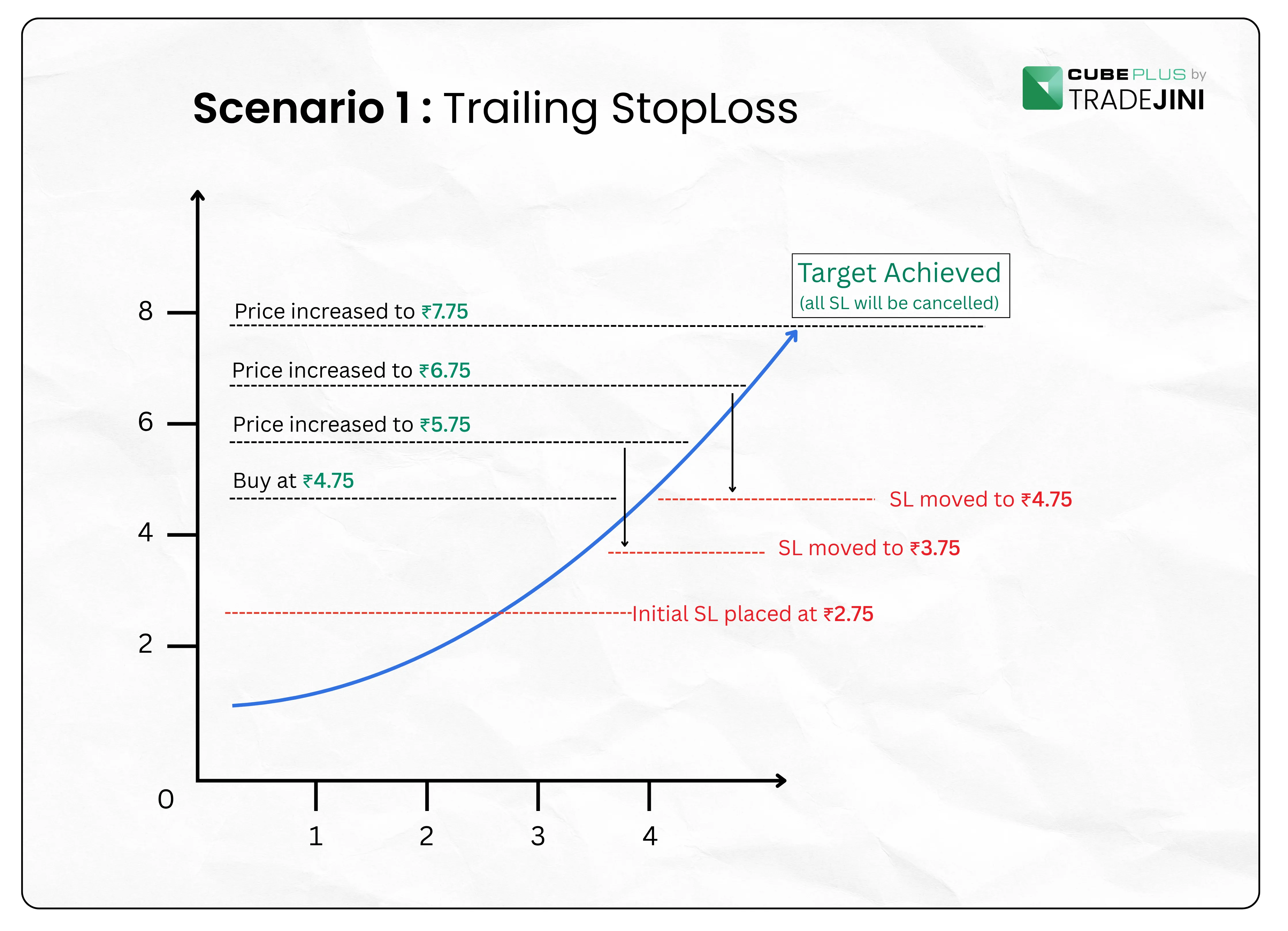
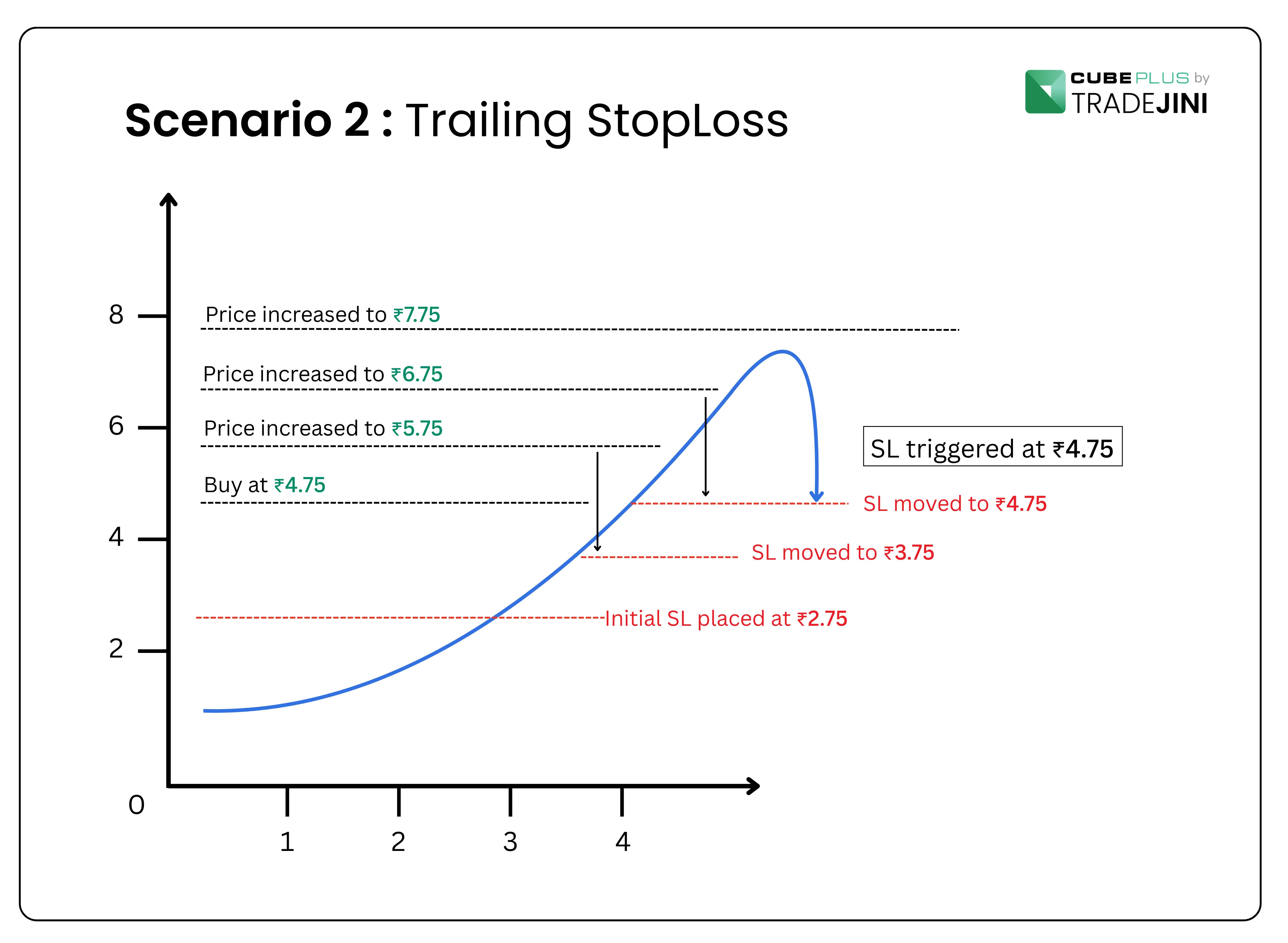
You buy at ₹4.75, with an initial stop-loss trigger at ₹2.75.
If the price rises to ₹5.75, the trailing stop-loss automatically adjusts to ₹3.75 (₹2.75 + ₹1.00).
If the price climbs further to ₹6.75, the stop-loss moves to ₹4.75 (₹3.75 + ₹1.00), ensuring you break even if the market turns.
If the price keeps soaring, the trailing stop continues to adjust, locking in more profit while keeping your risk capped.
Let’s understand Trailing Stop-Loss in two scenarios:
Scenario 1: Trailing Stop-Loss Target Achieved
The price steadily rises, triggering trailing stop adjustments, but ultimately hits the profit target. All stop-loss orders are cancelled once the target is achieved.
Scenario 2: Trailing StopLoss—SL Triggered
Price moves up and adjusts the trailing stop accordingly, but before hitting the target, it reverses and triggers the latest stop-loss level, locking in partial gains.
This dynamic feature is a game-changer for trending markets, letting you ride the wave of a strong move while safeguarding your gains. CubePlus makes it easy to enable trailing stops within the Bracket Order setup, giving you flexibility without complexity.
Step 3: Monitoring your trade in real-time
Once your Bracket Order is live, you can track everything under the Open Orders tab in CubePlus. Here, you will see your two sell orders (target and stop-loss) listed with a quantity of 0 / 75, indicating they are ready to activate based on market conditions. The interface is clean and intuitive, so you always know where you stand.
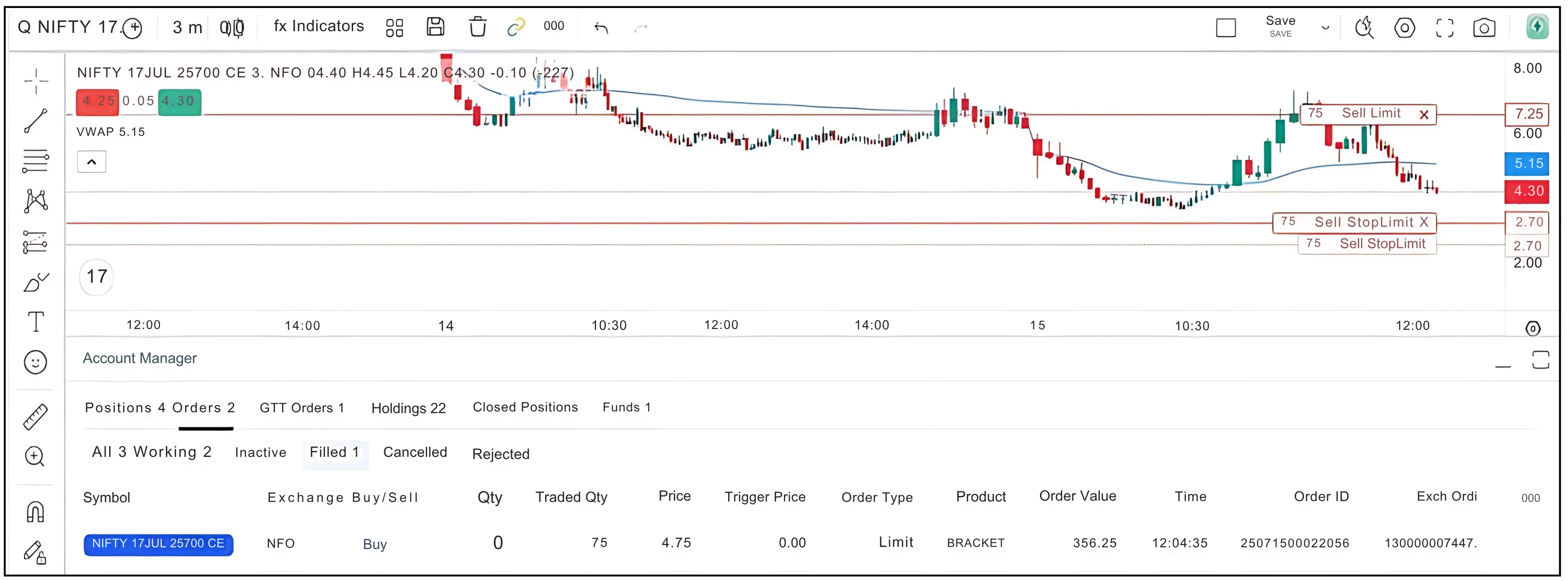
But the real showstopper is Cube Plus’s Trade-on-Chart (ToC) feature. Imagine seeing your trade come to life on a candlestick chart, with your entry, target, and stop-loss levels marked by clear red labels (Sell Limit/Stop Limit). Need to tweak your stop-loss or target? Just drag the labels on the chart, yes, it’s that simple. This visual approach saves time and gives you a crystal-clear view of your trade setup, making it perfect for fast-paced intraday trading.
Also read: Relative Rotation Graph (RRG) Explained
Why Bracket Orders shine
Bracket Orders on CubePlus aren’t just about automation—they’re about trading smarter. Here’s why they’re a must-have for intraday traders:
Precision execution: Set your entry, target, and stop-loss in one go, with no need to manually place multiple orders.
Automated risk management: The OCO logic ensures only one exit order executes, eliminating the risk of overtrading or missed exits.
Trailing Stop-Loss power: Capture bigger profits in trending markets while keeping losses in check.
Emotion-free trading: Once your BO is placed, the system handles the rest, keeping impulsive decisions at bay.
Capital efficiency: With a fixed risk-to-reward ratio (like ₹2.05 risk vs. ₹2.50 reward in our example), you optimize your capital allocation.
Visual clarity with ToC: Adjust and monitor trades directly on the chart, making complex strategies feel effortless.
Whether you’re scalping index options like the NIFTY or executing structured intraday plays, Bracket Orders give you the tools to plan your trade and trade your plan with unshakable confidence.
Pro tips for using Bracket Orders like a boss
Set realistic targets: Analyze historical price movements or volatility to choose achievable targets and stop-loss levels.
Use Trailing Stops wisely: In volatile markets, a wider trailing stop amount can prevent premature exits, while tighter trails work well in steady trends.
Leverage ToC for quick adjustments: If market conditions shift, drag your stop-loss or target on the chart to adapt in seconds.
Practice first: New to Bracket Order? Test them in a demo account to get a feel for the automation and trailing stop features.
Trade with confidence
In intraday trading, every second counts. CubePlus brings together automated profit booking, dynamic trailing stop-losses, and intuitive chart controls to help you trade with confidence. Whether you are a seasoned trader chasing momentum or a beginner looking to stay disciplined, Bracket Orders keep your risk in check and your strategy sharp.
So, sign up in CubePlus, set up your next Bracket Order, and let the platform do the heavy lifting while you trade with confidence.
Happy trading!
Also read: Engineering Defense Growth with CFF Fluid Control Ltd.
Disclaimer: The information provided in our blogs is for informational purposes only and should not be construed as financial, investment, or trading advice. Trading and investing in the securities market carries risk. Always conduct your own research and consult with a qualified financial advisor before making any investment decisions. Past performance is not indicative of future results. Copyrighted and original content for your trading and investing needs.
© 2025 — Tradejini. All Rights Reserved.

%252FCubePlus_Shield_Part%25203%2520Blog%2520Thumbnail.webp%3Falt%3Dmedia%26token%3Da5581624-5761-476f-8451-40c157b54840&w=3840&q=75)
%252FShield%2520on%2520Cubeplus%2520part2.webp%3Falt%3Dmedia%26token%3D252a5b48-a580-4e8d-b939-c82d4696eaef&w=3840&q=75)