Core Mechanics
At its core, the Range Forward Option Strategy is a two-leg bullish structure designed to capture upside potential while minimizing or neutralizing entry cost. It involves buying one Out-of-the-Money (OTM) Call option and selling one OTM Put option, both with the same expiry and equidistant from the At-the-Money (ATM) strike.
Also Read: Put Ratio Spreads Explained Through Real Trades
This combination, Long OTM Call + Short OTM Put, creates an asymmetric payoff:
- Unlimited profit potential if the underlying asset rallies.
- Unlimited loss potential if the asset declines sharply below the sold put strike.
The strategy is also called a Synthetic Risk Reversal, as it mirrors the directional exposure of owning the underlying asset without holding it directly. However, unlike a traditional Risk Reversal (or collar), the Range Forward is purely speculative and not used for hedging an existing position.
Core Mechanics Summary:
- Buy 1 OTM Call (expecting a rise).
- Sell 1 OTM Put (financing the call).
- Both share the same expiry and are typically placed at equal distances from the ATM strike.
The result: a low-cost or zero-cost bullish strategy that benefits from price appreciation in the underlying asset, with exposure to unlimited downside risk from the short put leg.
Structure and Objective
Range Forward (Directional Bullish Strategy)
Market View: Strongly bullish; expecting a sharp move upward in the near term.
Structure:
Net Position:
- Could be a net credit (if put premium > call premium) or net debit (if call premium > put premium).
Objective:
- To profit from a rally above the call strike while minimizing upfront cost.
- Ideal when expecting strong directional movement but unwilling to buy the underlying stock outright.
Risk Profile:
- Unlimited downside risk below the sold put strike.
- Unlimited upside potential above the bought call strike.
Deployment Conditions Table
| Condition | Range Forward Option Strategy |
|---|---|
| Market View | Bullish; expecting strong upside momentum |
| Implied Volatility (IV) | Best deployed when IV is low, allowing cheaper call purchase and manageable short put exposure |
| Use Case | Speculative directional trade without owning the underlying stock |
| Capital Requirement | Margin required for short put exposure |
| Profit Driver | Stock price rising beyond the call strike price |
Read how you can trade volatility: How to Dominate Volatility with Strip and Strap Strategies
Practical Example
Range Forward Example
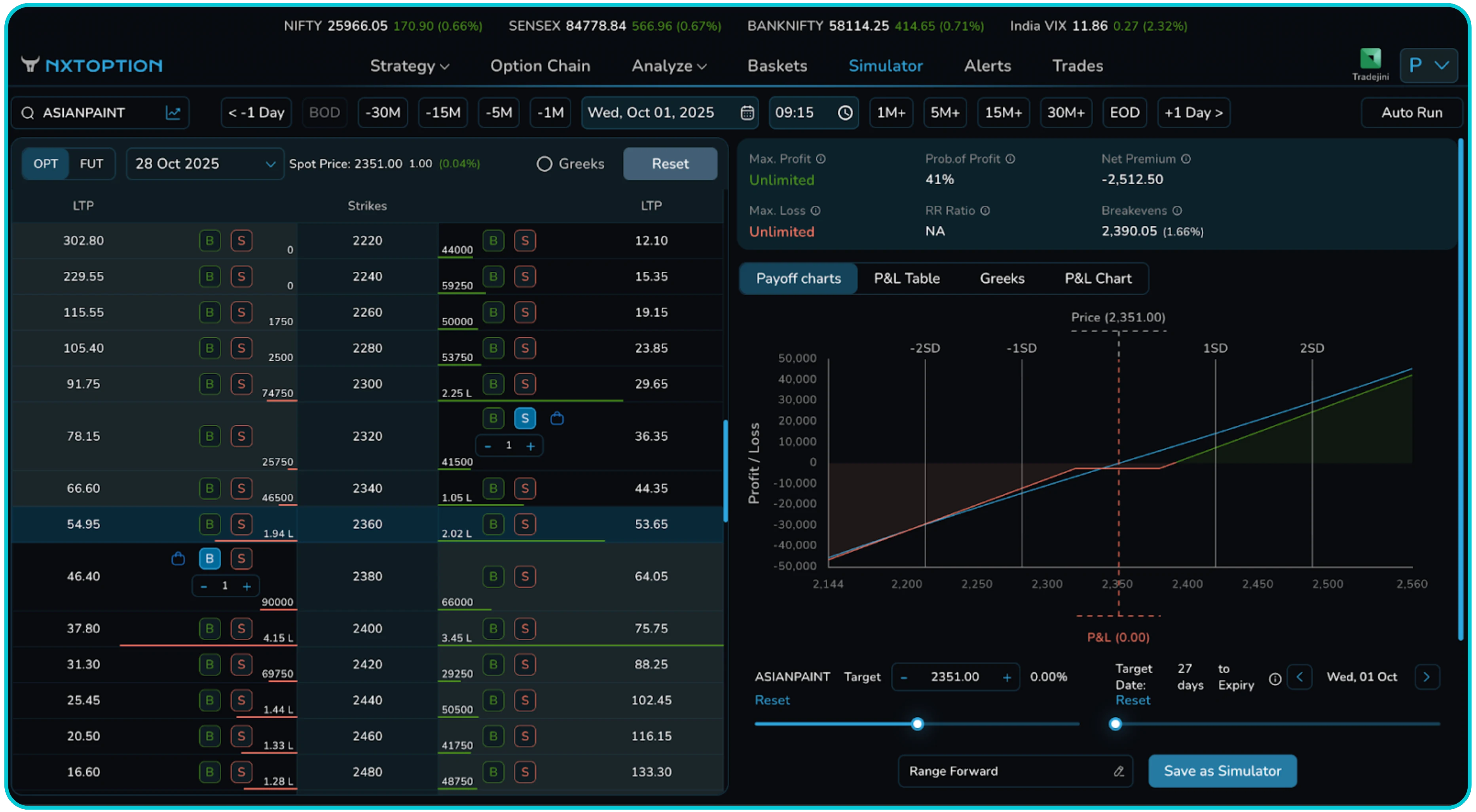
Trade Setup:
- Date of Entry: 1st October 2025
- Stock/Index: ASIANPAINT
- Current Price: ₹2,351.00
Legs of the Strategy:
- Buy 1 OTM 2380 Call at ₹46.40
- Sell 1 OTM 2320 Put at ₹36.35
Trade Metrics:
- Net Debit: ₹2,512.50
- Maximum Profit: Unlimited, as the upside potential continues above ₹2,380
- Maximum Loss: Unlimited, below ₹2,320 due to short put exposure
- Breakeven Point: ₹2,390.05
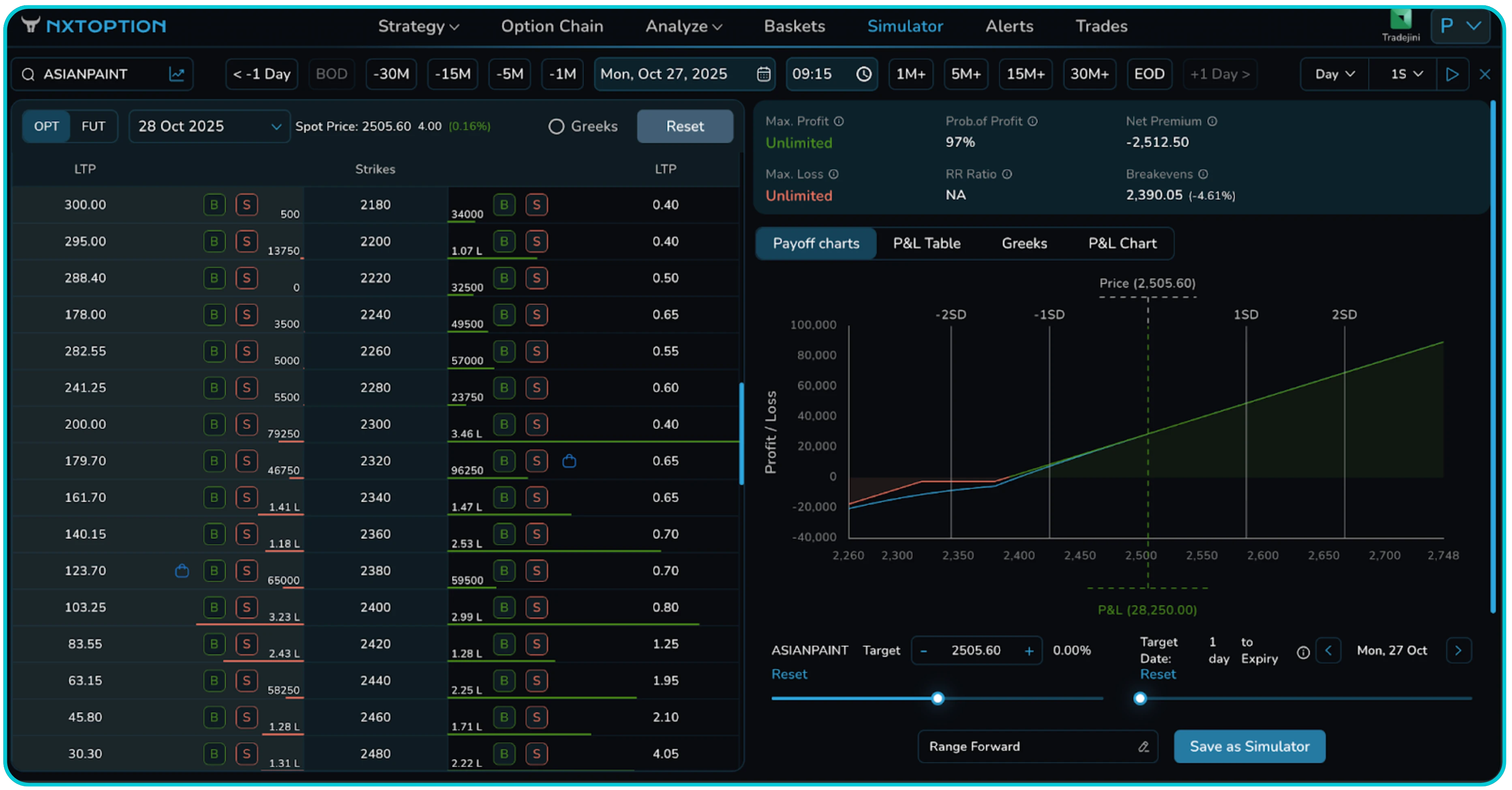
Outcome:
- Expiry Date: 28th October 2025
- Closing Date: 27th October 2025
- Closing Price: ₹2,505.60
- Actual P&L: ₹28,250.00
Analysis:
The Range Forward on ASIANPAINT performed as intended, with the stock price rising sharply from ₹2,351 to ₹2,505.60 by expiry. The move above the breakeven point (₹2,390.05) allowed the strategy to transition into profit territory. The bullish view played out effectively, aided by moderate volatility and the time decay that favored the net long delta structure.
Risk Management
Primary Risk Identification
The main danger in a Range Forward is unlimited downside exposure due to the short put leg. If the underlying falls below the sold strike, losses accelerate rapidly and margin calls can occur.
Mitigation Actions
Strike Selection:
- Maintain balanced strike distances (equidistant from ATM) for stable payoff symmetry.
- Avoid selling deep OTM puts, as losses grow quickly if the underlying declines.
Exit Triggers:
- Close the position if the underlying breaches the put strike by 2–3%.
- Use technical levels (support zones) as stop-loss points.
Position Adjustment:
- Add a protective long put below the short put to cap risk, effectively converting it into a bull spread.
Position Sizing:
- Allocate small capital portions to this strategy; maintain adequate margin buffer for short option exposure.
Volatility and Event Risk:
- Avoid entering before major events (earnings, policy announcements) that may spike volatility unexpectedly.
Market Condition Warnings:
- Should not be used in sideways or bearish markets.
- Avoid when implied volatility is expected to rise sharply post-entry.
Advanced Techniques:
Experienced traders may dynamically delta-hedge intraday exposure or use ratio spreads to reduce downside sensitivity without altering the original payoff structure.
Greeks Interpretation
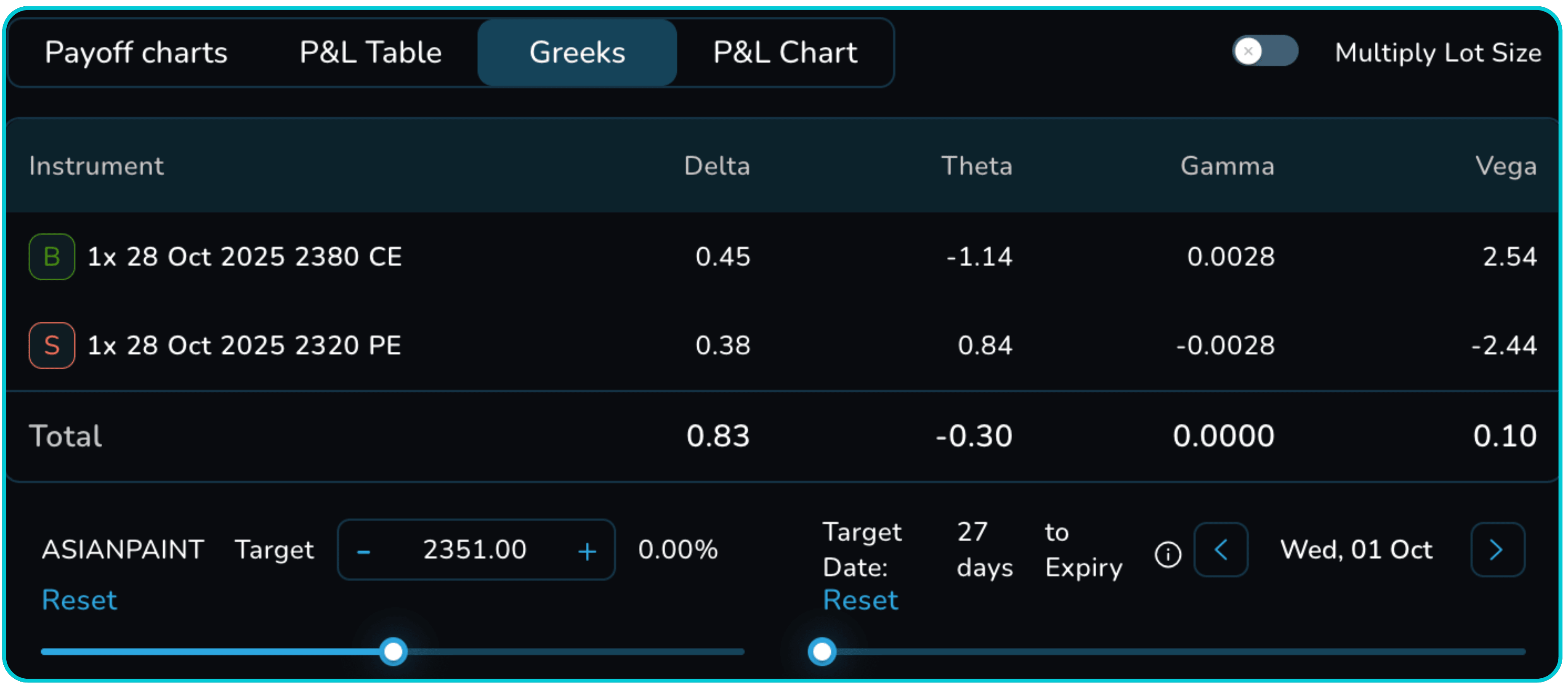
| Greek | Effect on Range Forward |
|---|---|
| Delta | Net positive delta; profits increase as the underlying rises. Traders gain from bullish moves. |
| Theta | Typically negative, as time decay reduces the long call’s value faster than it benefits the short put. |
| Gamma | Positive gamma initially, creating convexity on upward moves; risky if prices fall as delta shifts quickly. |
| Vega | Long vega; benefits from rising volatility since both options gain extrinsic value when IV increases. |
Interpretation:
- Delta amplifies profit in bullish trends.
- Theta works against the position if the price stagnates.
- Gamma and Vega both heighten sensitivity, rewarding sharp upward price or volatility movements but punishing declines.
Understanding the Delta-Gamma-Vega profile is non-negotiable for managing this structure effectively.
Strategic Positioning
The Range Forward Option Strategy is for traders with directional conviction and risk appetite. It sits between outright futures exposure and debit spreads, offering unlimited profit potential without full capital outlay.
Unlike a straddle or strangle, which bet on volatility in either direction, the Range Forward focuses solely on the bullish leg.
It’s best suited for traders seeking to:
- Express a high-confidence bullish outlook.
- Minimize entry cost through the short put leg.
- Trade momentum while leveraging time and volatility dynamics.
This strategy demands discipline and active management, particularly around the sold put strike.
Conclusion
The Range Forward Option Strategy is a powerful bullish tool that enables traders to express directional views efficiently using options instead of outright stock purchases.
Before deploying, ask yourself:
- Can I tolerate unlimited downside risk from the short put?
- Is implied volatility low enough to make call buying cost-effective?
- Do I have exit rules if the market moves against me?
Understanding your Greeks exposure and maintaining clear stop-loss boundaries are essential. This is not a passive strategy it demands precision and vigilance.
Read how you can use the Strategy Builder to use this strategy: NxtOption Strategy Builder: Automate, Analyze, and Execute Complex Options Trades with Ease and Precision.
When executed with discipline, the Range Forward provides high leverage, low-cost participation in bullish trends.
Explore this strategy live on CubePlus by Tradejini to visualize real-time delta, gamma, theta, and vega exposures.
Sign up today and see how advanced option analytics simplify professional-grade decision-making on NXToption.
Disclaimer: The information provided in our blogs is for informational purposes only and should not be construed as financial, investment, or trading advice. Trading and investing in the securities market carries risk. Always conduct your own research and consult with a qualified financial advisor before making any investment decisions. Past performance is not indicative of future results. Copyrighted and original content for your trading and investing needs.
© 2025 — Tradejini. All Rights Reserved.