Taxation is an important, yet often overlooked, part of investing. Many beginners assume that only salaried income is taxed. However, any income earned from stock market activities is subject to tax in stock market transactions, whether through stocks, mutual funds, or dividends In this blog, we’ll break down how taxation works in the Indian stock market in the simplest way possible. Understanding the relationship between the stock market and taxes is essential for better financial planning.
1. Securities transaction tax (STT)
Whenever you buy or sell listed securities (stocks, ETFs, mutual funds), a small tax called Securities Transaction Tax (STT) is automatically charged.
STT Rates:
| Transaction Type | STT Rate | Who Pays | Taxable Value |
|---|---|---|---|
| Equity Share (Delivery – Buy) | 0.1% | Purchaser | Purchase Price |
| Equity Share (Delivery – Sell) | 0.1% | Seller | Sale Price |
| Equity Share (Intraday - Sell) | 0.025% | Seller | Sale Price |
| Equity-Oriented MF Unit (Delivery – Sell) | 0.001% | Seller | Sale Price |
| Sale of equity share or unit of equity-oriented mutual fund | 0.025% | Seller | Sale Price |
| Options – Exercised | 0.125% | Purchaser | Settlement Price |
| Futures – Sale | 0.02% | Seller | Traded Price |
| Sale of Unit to MF (ETFs) | 0.001% | Seller | Sale Price |
Note: The broker collects and pays the government STT. It cannot be refunded or claimed.
Also Read: How Inflation Impacts Your Retirement Corpus Over Time
2. Capital gains tax
When you sell an investment for more than you paid for it, you make capital gains. This is among the most typical methods by which investors pay stock market profit tax, sometimes referred to as share market profit tax. Two variables determine how much tax you must pay on this gain:
- Type of security (Equity or Debt)
- Holding period
2.1 Equity instruments (Stocks, Equity Mutual Funds, Equity ETFs)
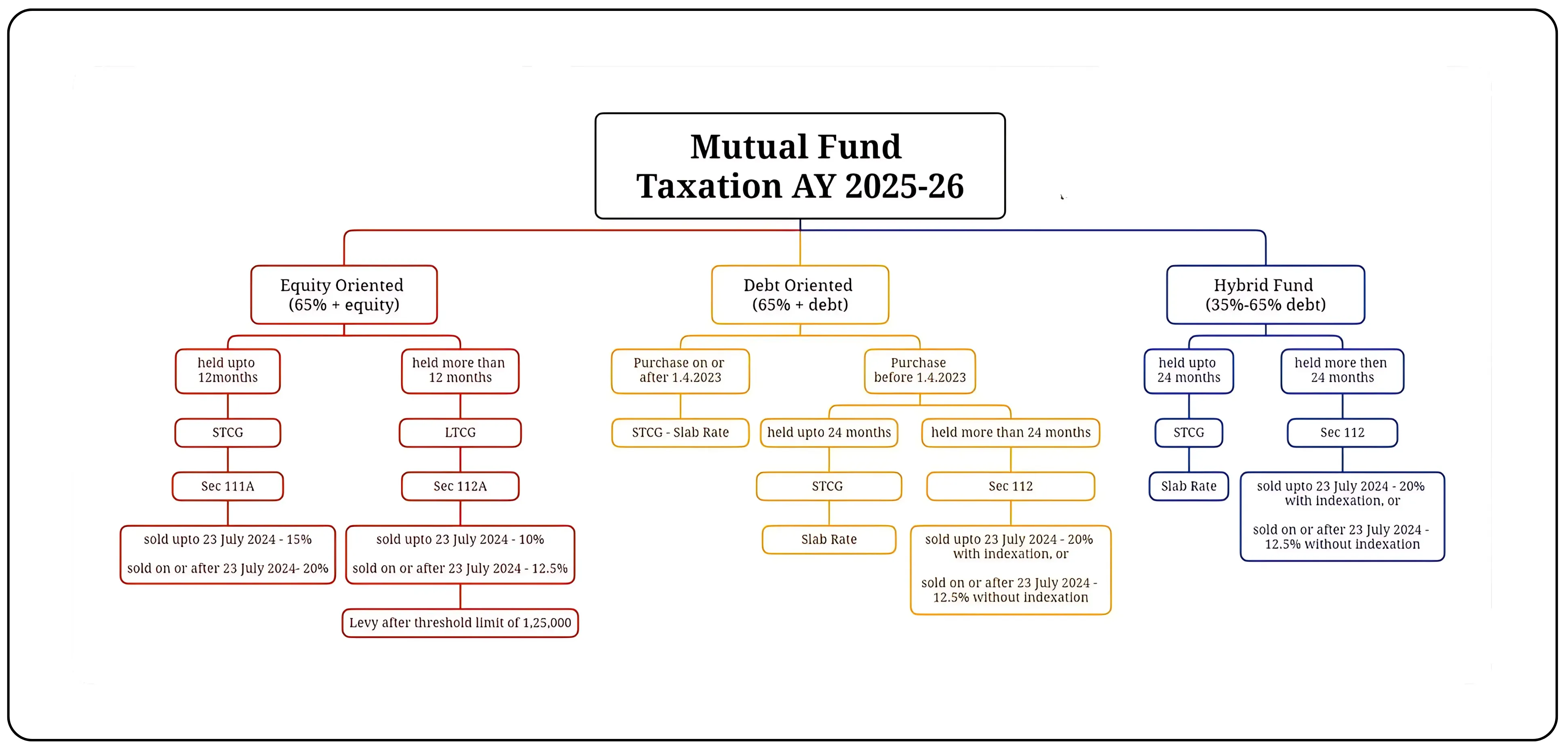
Short-term capital gains (STCG):
If you sell equity shares, equity mutual funds, or equity ETFs within 12 months of purchase, the profit you make is classified as short-term capital gain (STCG). This gain is taxed at a flat rate of 20%, regardless of your income tax slab.
Example:
Buy a stock at ₹100 and sell at ₹120 after 6 months → Gain = ₹20*20% → Tax = ₹4
Long-Term capital gains (LTCG):
If you sell equity shares, equity mutual funds, or equity ETFs after holding them for more than 12 months, the profit is considered a long-term capital gain (LTCG). Gains above ₹1.25 lakh in a financial year are taxed at 12.5%, while gains up to ₹1.25 lakh are exempt from tax.
Example:
Gain of ₹1.5 lakh from equity shares held for 2 years
Taxable amount = ₹1.5L - ₹1.25L = ₹25,000*12.5%
Tax = ₹3,125
Note: Earlier, LTCG was taxed at 10% above ₹1 lakh. It is now 12.5% above ₹1.25 lakh.
| Date of Sale | Tax Rate | Exemption |
|---|---|---|
| Before 23rd July 2024 | 10% | Rs.1.25 Lakhs |
| On or after 23rd July 2024 | 12.5% | Rs.1.25 Lakhs |
Also Read: 5 common Myths about stock market
2.2 Debt instruments (Debt Mutual Funds)
Taxation of Debt Mutual Funds (After 1st April 2023)
From 1st April 2023, the taxation of debt mutual funds underwent a major change following amendments introduced in Budget 2023. Any gains arising from the transfer, redemption, or maturity of units purchased on or after this date are now treated as short-term capital gains, irrespective of the holding period. These gains are taxed at the investor’s applicable income tax slab rate. Additionally, the benefit of indexation has been removed, as such funds are no longer classified as long-term capital assets. However, investments made before 1st April 2023 will continue to be governed by the earlier tax rules.
This can be summarized as follows:
| Purchase Date | Tax Implication |
|---|---|
| Before 1st April 2023 | LTCG at 12.5% after holding for more than 2 years. Else STCG at slab rates. |
| On or After 1st April 2023 | Gains are taxed at applicable slab rates. |
Taxation of Debt Mutual Funds (Before 1st April 2023)
Many investors are still unaware of how share market tax rules vary if they have purchased funds before or after April 1, 2023. Before 1st April 2023, the taxation of debt mutual funds was determined based on the holding period of the investment. If the units were sold within 24 months from the date of purchase, the gains were classified as short-term capital gains (STCG) and taxed as per the investor’s applicable income tax slab rates. However, if the units were sold after 36 months, the gains were treated as long-term capital gains (LTCG) and taxed at 20% with the benefit of indexation. The indexation benefit allowed investors to adjust the purchase cost for inflation, effectively lowering the taxable gains and reducing the overall tax liability.
Example of Tax Treatment Before the Amendment
Example 1: Mr. Umesh invested ₹ 10 lakhs in FY 2020-21 in a debt mutual fund and sold the investments after four years of holding them in FY 2024-25 on or after 23rd July, 2024, for a sale value of ₹ 20 lakhs, thereby earning a capital appreciation value of ₹ 10 lakhs.
| Particulars | Financial Year | Amount (₹) |
|---|---|---|
| Investment Made | 2020-21 | 10,00,000 |
| Sale | 2024-25 | 20,00,000 |
| Less: Cost of Investment | (10,00,000) | 10,00,000 |
| Long-term capital gain | (20,00,000-10,00,000) | 10,00,000 |
| Tax Payable | Tax @ 12.5% | 1,25,000 |
Example of Tax Treatment Before the Amendment
Example 2: Mr. Aneesh invested ₹ 20,00,000 in a debt mutual fund in FY 2024-25. He sold the units in FY 2025-26 for ₹ 30,00,000. In this scenario, as the investment was made after 1st April 2023, the gains will be deemed as short-term capital gains irrespective of the holding period. The computation will be as follows:
Assuming that Mr. Aneesh opts for the New Tax Regime
| Particulars | Amount (₹) |
|---|---|
| Sale Consideration | 30,00,000 |
| (-) Cost of Acquisition | -20,00,000 |
| Short-Term Capital Gains | 10,00,000 |
| Tax Liability | |
| Up to 4 lakhs | 0 |
| 4 lakhs to 8 lakhs | 20,000 |
| 8 lakhs to 10 lakhs | 20,000 |
| Short-Term Capital Gains Tax | 41,600 |
3. ETF taxation
Equity ETFs:
Equity Exchange-Traded Funds (ETFs) are taxed in the same way as equity shares. Whether you're investing in gold or equity ETFs, understanding the tax on share market income ensures better financial planning. If you sell them within 12 months, the gains are treated as short-term capital gains (STCG) and taxed at 20%. If held for more than 12 months, the gains are classified as long-term capital gains (LTCG) and taxed at 12.5% on the portion exceeding ₹1.25 lakh in a financial year.
Gold ETFs:
- According to the rules regarding the gold tax in India, you are liable to pay a 12.5% tax on long-term capital gains on gold sales.
- However, for gold held for less than 2 years, the applied tax rate will be as per your income slab.
4. Dividend taxation
Before April 2020, companies used to pay Dividend Distribution Tax (DDT).
Now, dividend income is taxed in the hands of the investor.
As an investor in equity shares, the other way to earn apart from capital gains is through the dividend that the company pays, which is taxed in the hands of the investor and not the company. Such dividends are to be disclosed under income from other sources and will be taxed at slab rates. Dividends may seem tax-free at first glance, but they must be reported under income tax stock market rules. However, if the dividend received is more than ₹ 10,000 then the company will deduct a TDS at 10% as per Section 194.
Example:
Dividend received: ₹12,000
TDS deducted: ₹1,200
If in the 20% tax bracket → total tax = ₹2,400 → you’ll need to pay ₹1,200 more while filing ITR.
Also Read: Is Tax Loss Harvesting a Smart Way to Save on Taxes?
5. F&O trading taxation
Profits or losses from Futures & Options (F&O) trading are classified as non-speculative business income under Section 43(5) of the Income Tax Act. This classification applies regardless of how frequently you trade or whether positions are intraday or held overnight, both futures and options are uniformly treated as non-speculative business activity for tax purposes.
Your net profit or loss from F&O is added to your total taxable income and taxed according to your applicable income slab (5%, 10%, 15%, 20%, or 30%). Since F&O is treated as a business, you are allowed to deduct expenses related to trading, such as brokerage, advisory fees, internet bills, software tools, and any other directly attributable business costs.
Maintaining proper books of accounts is mandatory if your turnover from F&O trading exceeds ₹25 lakh or if your profit exceeds ₹2.5 lakh. Additionally, a tax audit under Section 44AB is required if:
- Your turnover exceeds ₹10 crore, or
- Your profits are less than 6% of turnover, and you do not opt for presumptive taxation
Example: If you earn ₹1.5 lakh profit from NIFTY futures in a year and your other income is ₹4.5 lakh, your total taxable income becomes ₹6 lakh. This falls under the 5% tax slab, and your total tax liability will be approximately ₹12,500 after standard deductions.
Carry forward of F&O losses
Making the most of carry-forward rules requires an understanding of how tax on share trading operates, particularly when losses are involved. Losses incurred from F&O trading can be carried forward for up to 8 assessment years and Intra day equity trading loss will be treated as speculative loss and can be carried forward only for 4 years, provided they are reported in your Income Tax Return (ITR) on or before the due date. These losses can be set off against future non-speculative business income, including F&O gains or other business profits. Failing to report them properly may result in the disallowance of carry-forward benefits and possible penalties.
Takeaway
Understanding how taxation works in the stock market is crucial for every investor, not just for compliance, but to make smarter financial decisions. Whether it's STT on transactions, capital gains from shares or mutual funds, or dividend taxes, stock market taxation plays a major role in shaping your actual returns. By staying informed about the latest tax rules and planning accordingly, you can optimize your investments and avoid unexpected tax surprises. Always consult a tax advisor if you're unsure, and make sure to file your returns accurately and on time.
Disclaimer: The information provided in our blogs is for informational purposes only and should not be construed as financial, investment, or trading advice. Trading and investing in the securities market carries risk. Always conduct your own research and consult with a qualified financial advisor before making any investment decisions. Past performance is not indicative of future results. Copyrighted and original content for your trading and investing needs.
© 2025 — Tradejini. All Rights Reserved.