

Understanding price movement is not just about knowing that prices go up or down, but knowing why they move. This is where the concept of double pressure comes in. In simple terms, if you are wondering what is double pressure in price action trading, double pressure happens when both buyers and sellers are forced to act in the same direction at the same time. When this happens, the price does not move slowly. It moves fast and with strength, which is why breakout energy trading is such a powerful concept in price action intraday India.
Read our part 1 here: How to Read Price Action in Indian Markets
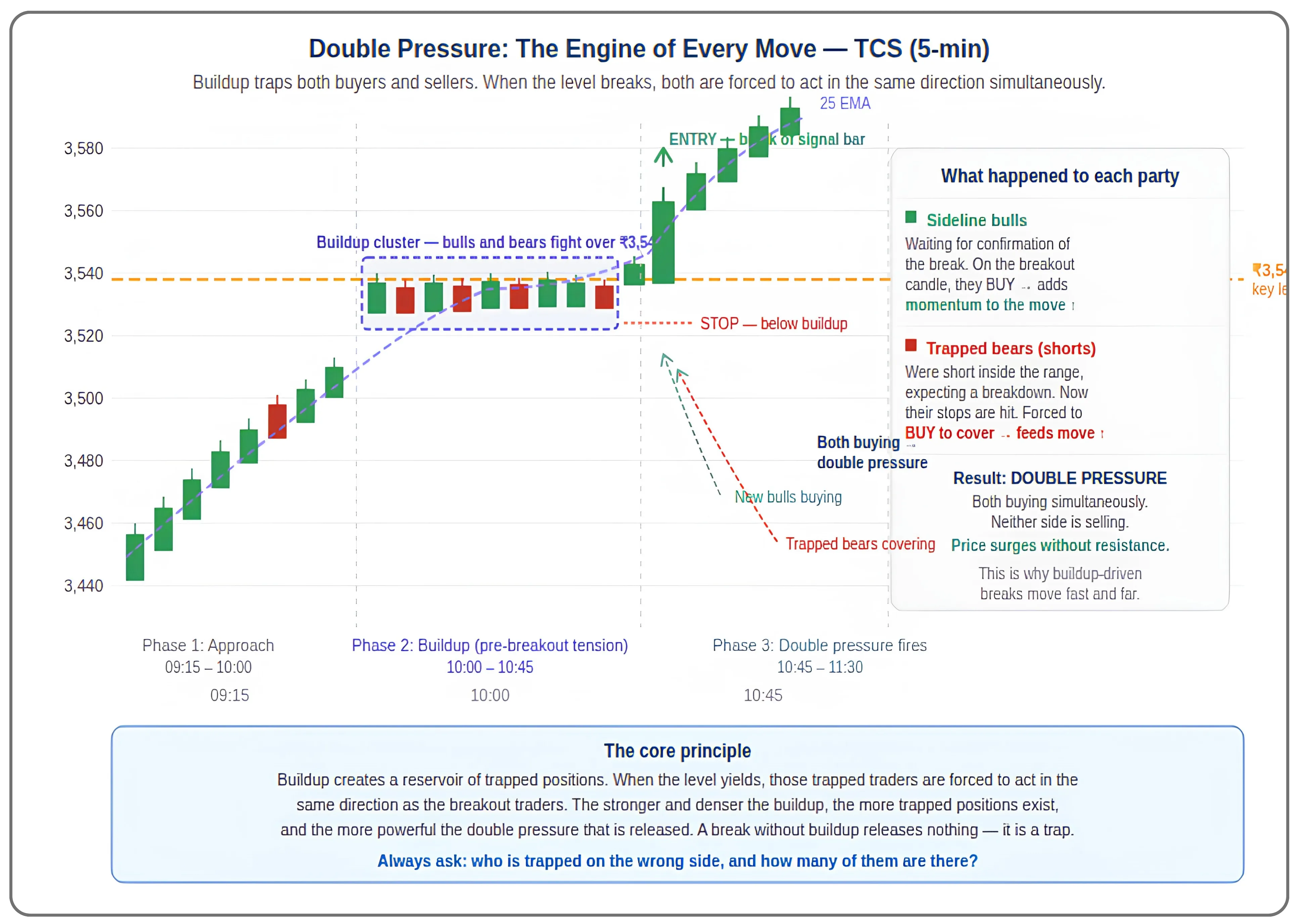
Here is how it works in practice. Suppose TCS has been consolidating between ₹3,500 and ₹3,540 for the better part of a morning session. This kind of price action consolidation is where the real story begins. Buyers are positioned long, expecting a breakout upward. Sellers are positioned short, expecting a breakdown. Both groups are waiting. Both groups are sitting with their positions, waiting. Now suppose the price begins to push through ₹3,540, the top of the range. In this moment, two things happen simultaneously. First, the buyers who were waiting begin to enter, adding buying pressure. Second, the sellers who were short inside the range are now trapped. This is exactly what traders mean when they talk about price action trapped traders. They are forced to buy back their position.
The same dynamic works in reverse for bearish moves. When Infosys breaks below a level where sellers had been accumulating positions, the buyers who are long get trapped and are forced to sell. At the same time, new sellers rush in to join the move. Both groups are selling simultaneously, and the price drops sharply.
Also Read: Simple Guide to Chart Patterns, Candlesticks & Time Frames
Double pressure price action is not a rare event. It is the underlying engine of every significant price move in every market, at every time of day. The reason this concept matters so much is that it defines exactly what the price action trader is looking for. He is not trying to predict where the market will go based on economic fundamentals or analyst reports. He is looking for the conditions under which double pressure is most likely to occur, because when it does, the move that follows tends to be fast, clean, and profitable for anyone positioned correctly.
Those conditions always begin with buildup. If you are asking what is buildup price action trading, it is the visible tension before a move. It is the cluster of bars that form near a key level, pushing up against it, pulling back, pushing again, as buyers and sellers battle for control.
In price action Nifty 50 futures, you will see this regularly in the first half hour of a session: the market will establish a range, and within that range, the price action will tighten progressively, with smaller and smaller bars, as both camps become increasingly committed and neither is willing to yield. This is the coil being tightened. The eventual breakout releases that energy in one direction, and the magnitude of the double pressure is directly proportional to the quality and duration of the buildup that preceded it.
A breakout without buildup is an entirely different animal. If Nifty 50 simply gaps up and runs through a level in a single long candle with no preceding consolidation, there has been no accumulation of trapped positions on either side. There is no double pressure because there are no bears who were short inside a buildup that have been caught. Such moves often reverse sharply. The breakout trader who acts on them quickly finds himself on the wrong side as the gap fills. In India's market, this type of false momentum is particularly common in the opening minutes of a session, especially on days following significant global news. The discipline to distinguish between a buildup-supported break and an impulse move is the difference between a professional and an amateur.
If you are following this price action for beginners India series, this is a key idea. This price action series part 3 is about understanding why price moves fast, not just reacting to it. Stay tuned for part 4
Start yours with smart investing on CubePlus and take control of your financial goals.
Disclaimer: The information provided in our blogs is for informational purposes only and should not be construed as financial, investment, or trading advice. Trading and investing in the securities market carries risk. Always conduct your own research and consult with a qualified financial advisor before making any investment decisions. Past performance is not indicative of future results. Copyrighted and original content for your trading and investing needs.
© 2026 — Tradejini. All Rights Reserved.