Caustic soda is one of the most widely used industrial chemicals in the world, yet most people have never bought it directly. It is in the aluminium of a soft-drink can, the paper of a notebook, the soap in a bathroom and the cotton of a shirt, because it was used somewhere in making each of them. Chemically it is sodium hydroxide (NaOH), a strong alkali. Industry buys it either as a liquid solution called lye (usually 32% or 48% strength) or as solid flakes and pellets, which are easier to ship over long distances. For investors, caustic soda matters for two reasons. It is a core product for several listed Indian companies, so its price moves their earnings. And because it is made together with chlorine, its market behaves differently from almost any other commodity.
How it is made: one plant, two products
Caustic soda is made by passing electricity through salt water (brine) in what is called the chlor-alkali process. One input, salt, comes out as two products at the same time:
- Caustic soda (NaOH), about 1 tonne
- Chlorine, about 0.9 tonne for every tonne of caustic soda
- Plus a little hydrogen, often used as fuel or sold
This fixed pairing is the single most important thing to understand about caustic soda. A plant cannot make more caustic soda without also making more chlorine. Chlorine is hard and dangerous to store or ship, so it must be used or sold almost immediately, mainly to make PVC plastic and other chemicals.
Two consequences follow:
- Chlorine demand often decides how much caustic soda is made. When PVC demand is strong, plants run hard and caustic soda can pile up, pushing its price down. When PVC is weak, plants slow down and caustic soda can turn scarce.
- Profit is earned on the pair. The industry tracks the Electrochemical Unit (ECU), the combined value of one tonne of chlorine and 1.1 tonnes of caustic soda, minus costs. One product’s weakness is often offset by the other’s strength. The other big input is electricity. Chlor-alkali is power-hungry, so a plant’s power cost, and whether it has its own captive power plant, decides much of its competitiveness.
Where it is used
Caustic soda’s demand is spread across many industries, which makes it a good indicator of overall industrial activity.
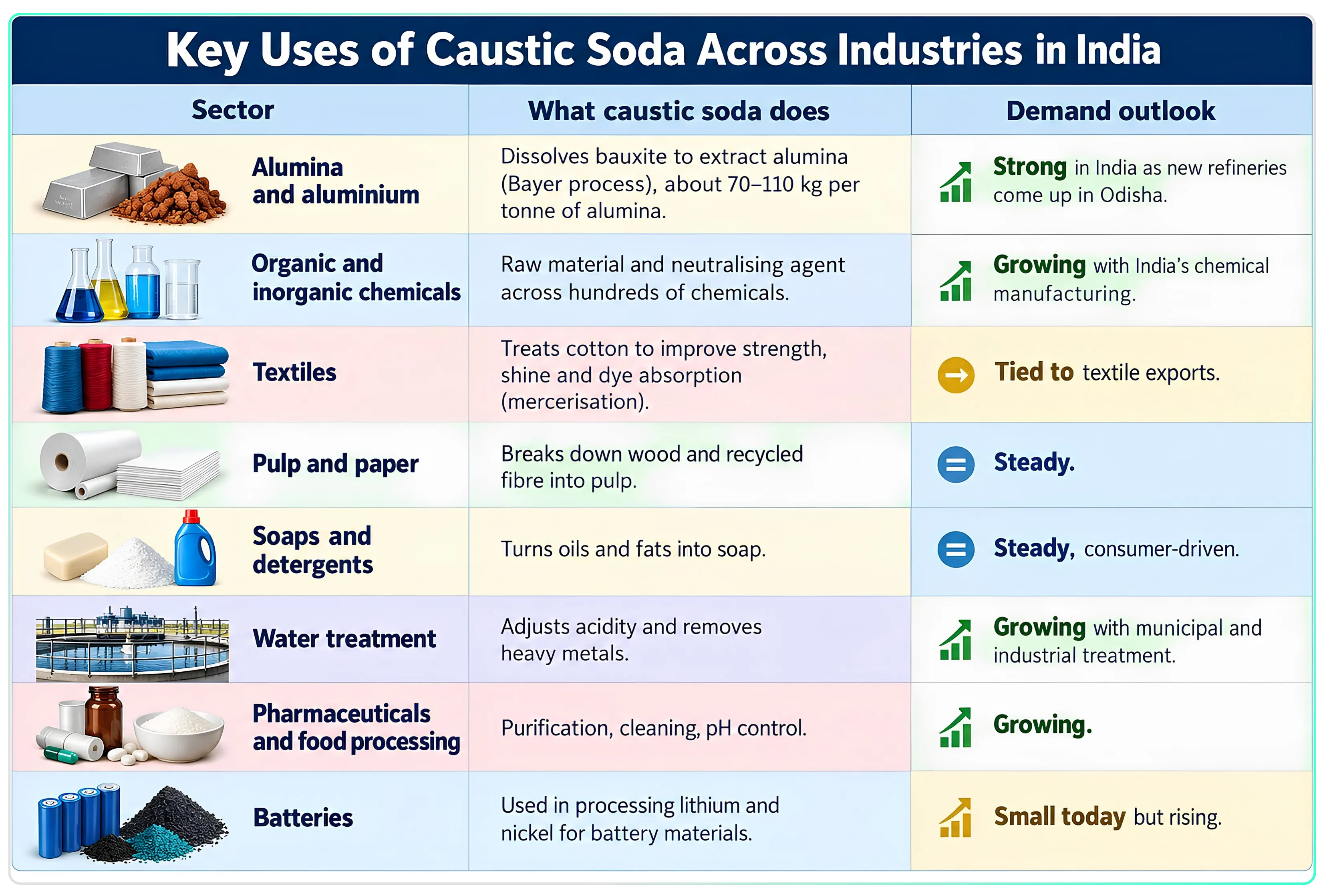
In India, the fastest new source of demand is alumina. Hindalco’s Kansariguda refinery alone could need 210,000–330,000 tonnes of caustic soda a year at full capacity, and the eastern alumina belt could need close to 1 million tonnes a year by the early 2030s.
Price trend: one chemical, very different prices
Caustic soda has no single world price. Because it is bulky and mostly shipped as a liquid that is half water, its price depends heavily on where you are, and the gap between regions is large
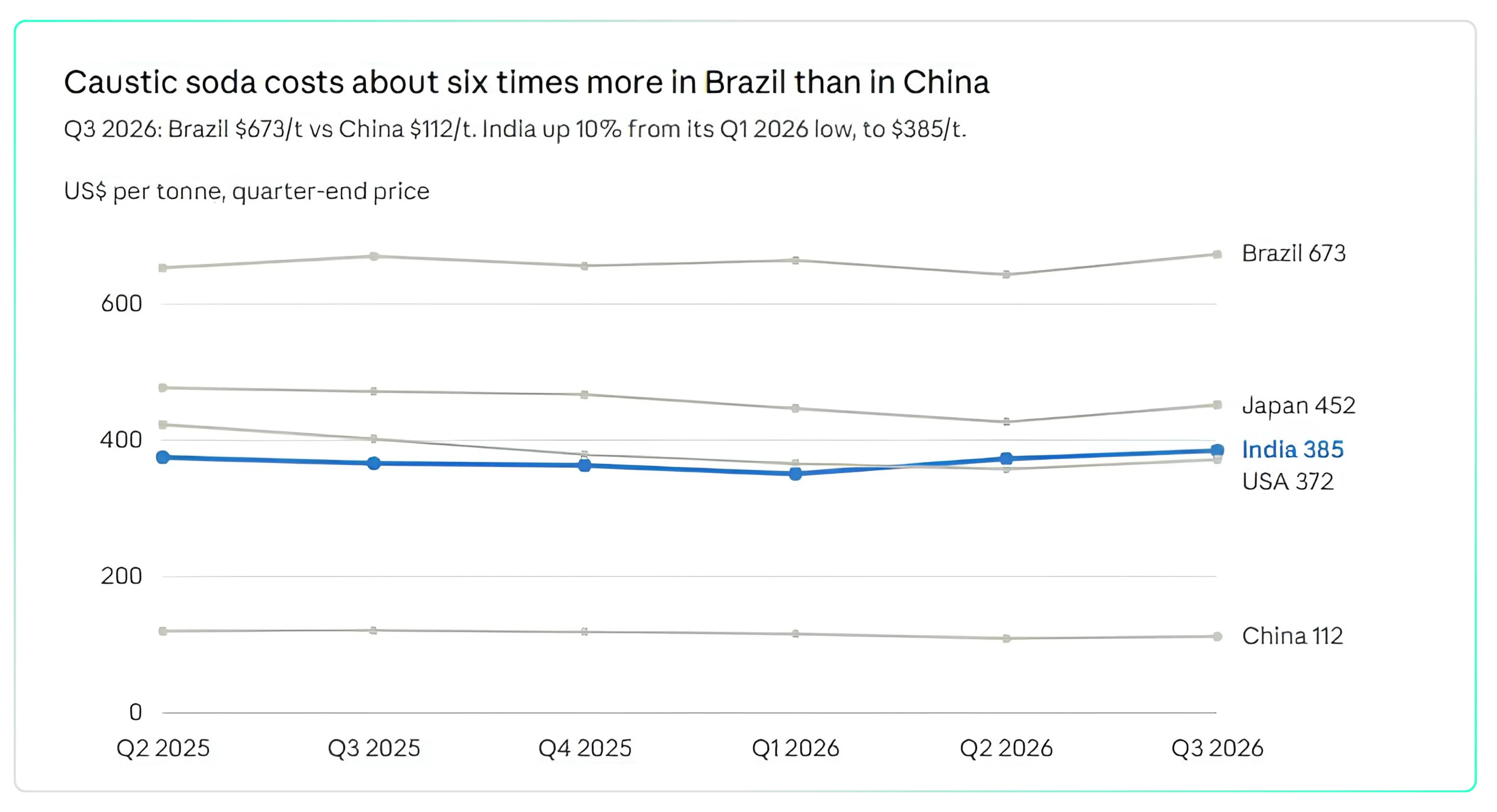
Three things stand out over the last six quarters:
- China is the cheapest place in the world. It has more than 51 million tonnes of capacity, running mostly on coal power, and weak demand from its own alumina sector. Chinese prices slid through 2025 and the first half of 2026.
- India is in the middle and edging up. Indian prices bottomed in Q1 2026 and have risen since, helped by demand from new alumina refineries and higher import costs.
- 2026 brought an energy shock. The Middle East conflict and Strait of Hormuz disruption from late February raised gas and power costs. Another data provider, ChemAnalyst, reports European caustic soda prices jumping by more than 50% in Q2 2026.
A word of caution on data: price levels differ widely between providers because they quote different strengths (32% or 48% lye, or flakes) and delivery terms. Compare trends from one source rather than mixing numbers from several.
Also Read: Navigating Risk and Opportunity in the Aluminium Market
Producers in India
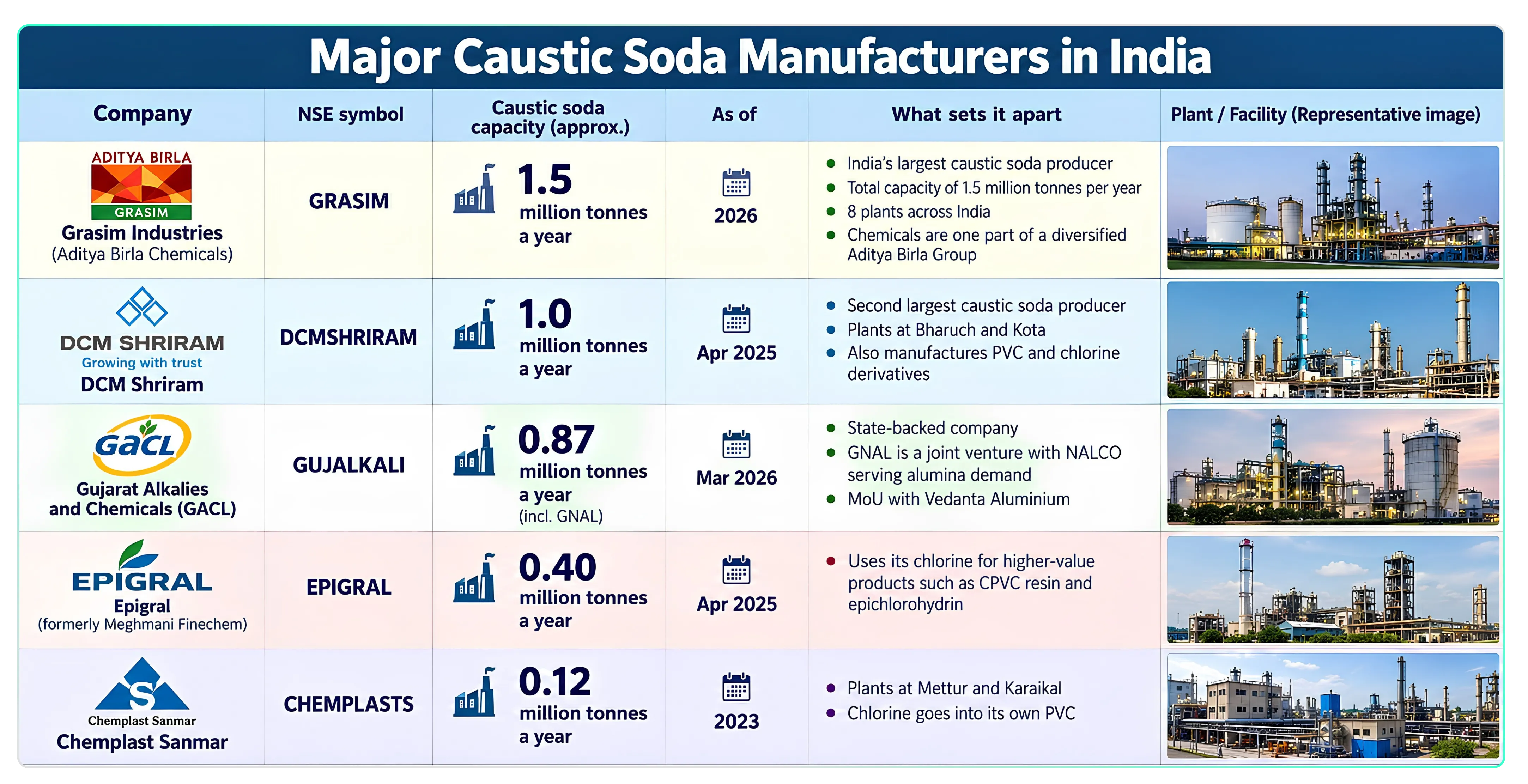
India had about 6.4 million tonnes of caustic soda capacity in March 2025 and produced 5.02 million tonnes in FY25, a utilisation rate of about 78%, according to the Alkali Manufacturers Association of India. More than 80% of that capacity is in Gujarat.
The five largest listed producers:
Smaller Listed player
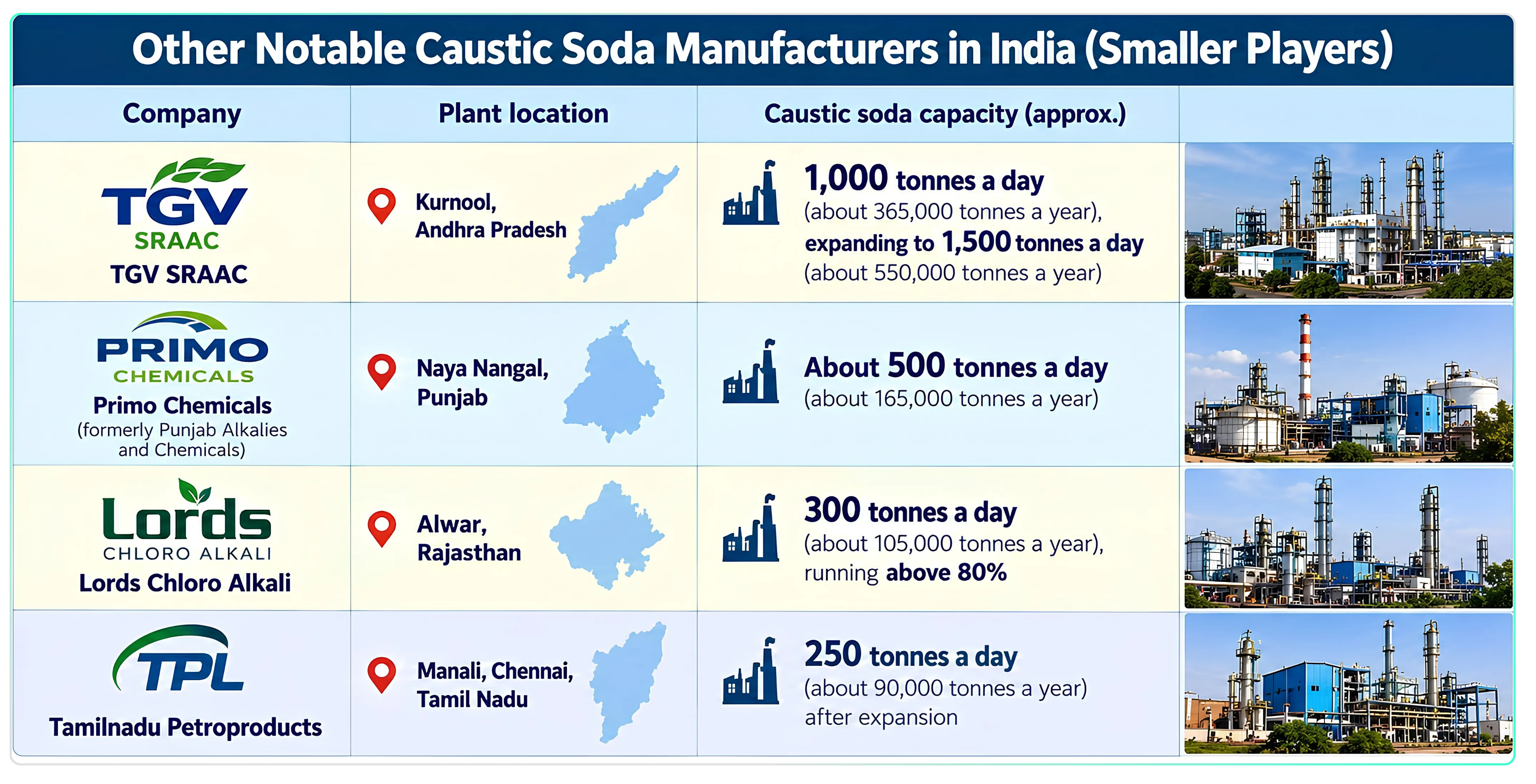
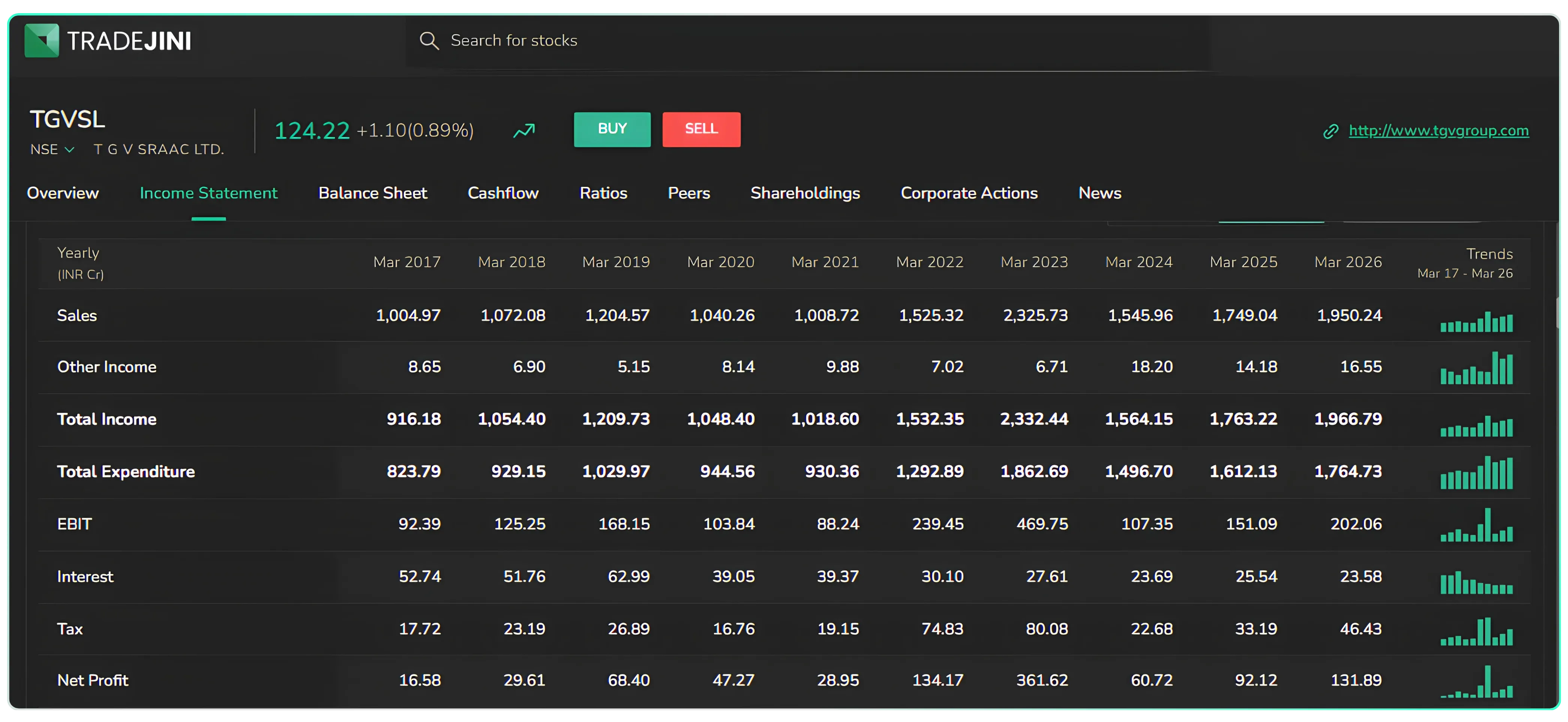
Among the smaller players in the caustic soda industry, TGV SRAAC stands out. Its net profit increased from ₹29 crore in FY2021 to ₹131 crore in FY2026, highlighting a significant improvement in profitability over five years.
What to look for as an investor:
- What happens to the chlorine. Companies that turn chlorine into their own higher-value products (PVC, CPVC, chloromethanes, epichlorohydrin) are less exposed when chlorine prices collapse.
- Power cost. Captive power plants, and increasingly renewable power, give a lasting cost advantage.
- Location. Most capacity is in Gujarat, but the new alumina demand is in Odisha, 1,500 km away. A producer close to Odisha’s refineries saves heavily on freight.
The global market
The world produces roughly 80 million tonnes of caustic soda a year, worth about US$47 billion. The market is expected to grow around 4% a year. China dominates supply, with about 51.5 million tonnes of installed capacity.
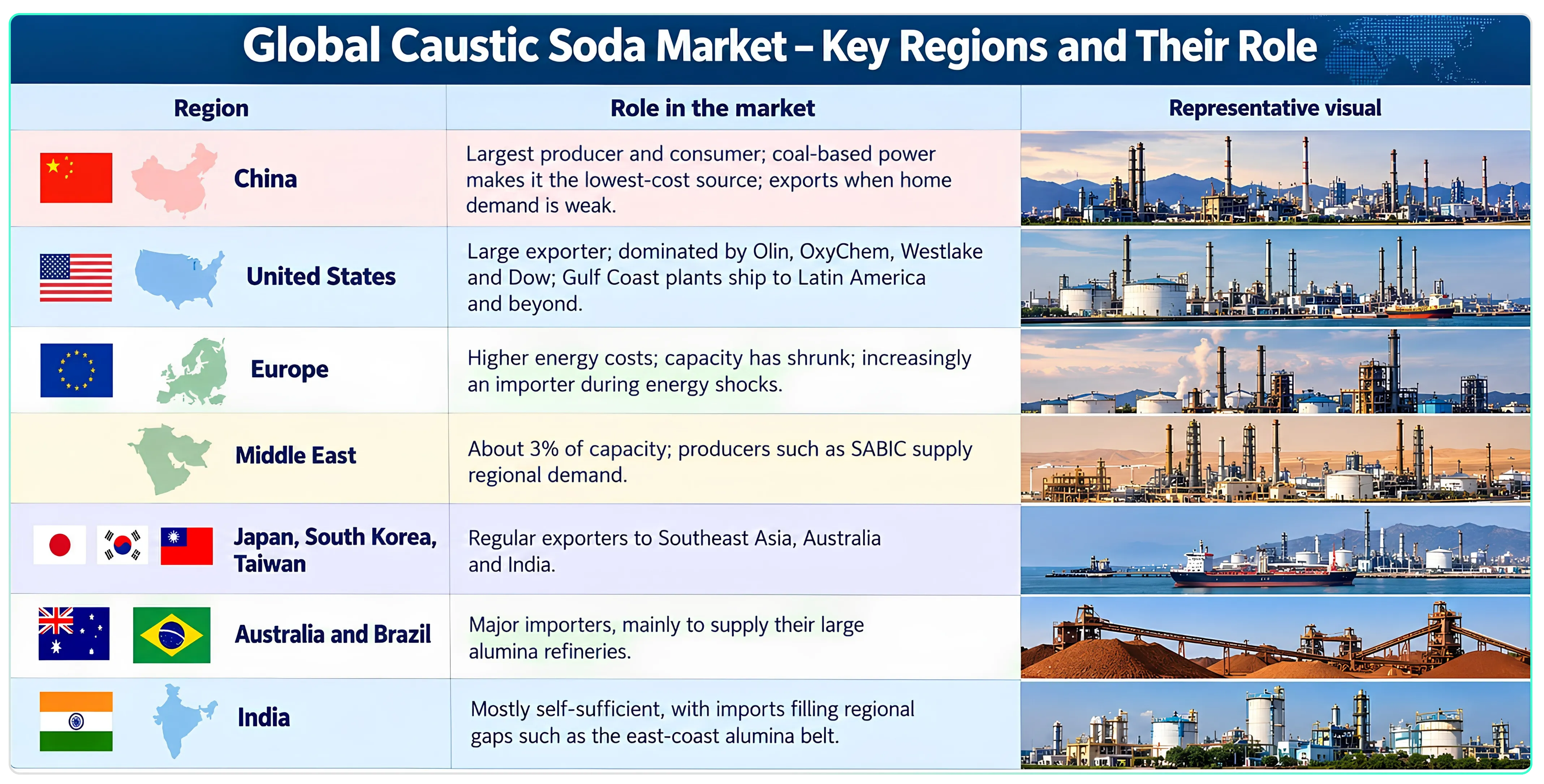
How trade works. Caustic soda moves in two forms. Liquid lye travels in bulk tankers, cheaply per tonne but carrying half water. Flakes travel in bags or containers, cost more to make, but can go anywhere. Freight and distance therefore explain much of the price gap between regions shown in the chart above.
Opportunities
India’s demand outlook is one of the strongest in the world, and much of it comes from industries that are themselves expanding.
The alumina boom in Odisha. Hindalco, Vedanta and NALCO are adding alumina capacity in eastern India. The region could need close to 1 million tonnes of caustic soda a year by the early 2030s, while over 80% of current supply sits in Gujarat. A producer that builds capacity near Odisha, or secures cheap coastal shipping, has a clear opening.
Spare capacity to fill. With utilisation near 78%, Indian producers can raise output without heavy new investment. As demand catches up, margins improve because fixed costs are spread over more tonnes.
Chlorine-based specialty products. Turning chlorine into higher-value products (CPVC, epichlorohydrin, chloromethanes, PVC) protects producers when chlorine is in surplus. Epigral and DCM Shriram have built strategies around this.
Import substitution. India still imports PVC and many chlorine derivatives. Each new domestic derivative plant also creates steady demand for chlorine, which in turn supports caustic soda output.
Green power. Power is the largest cost in chlor-alkali. Producers that switch to cheaper solar and wind power, or build captive renewable capacity, lock in a lasting cost advantage.
New uses. Water treatment, pharmaceuticals and battery-material processing (lithium and nickel) are small today but growing.
For a market participant, a sustained rise in Indian caustic soda prices tends to help listed producers such as Grasim, DCM Shriram, GACL and Epigral, while raising costs for alumina refiners, textile processors and soap makers.
Disclaimer: The information provided in our blogs is for informational purposes only and should not be construed as financial, investment, or trading advice. Trading and investing in the securities market carries risk. Always conduct your own research and consult with a qualified financial advisor before making any investment decisions. Past performance is not indicative of future results. Copyrighted and original content for your trading and investing needs.
© 2026 — Tradejini. All Rights Reserved.