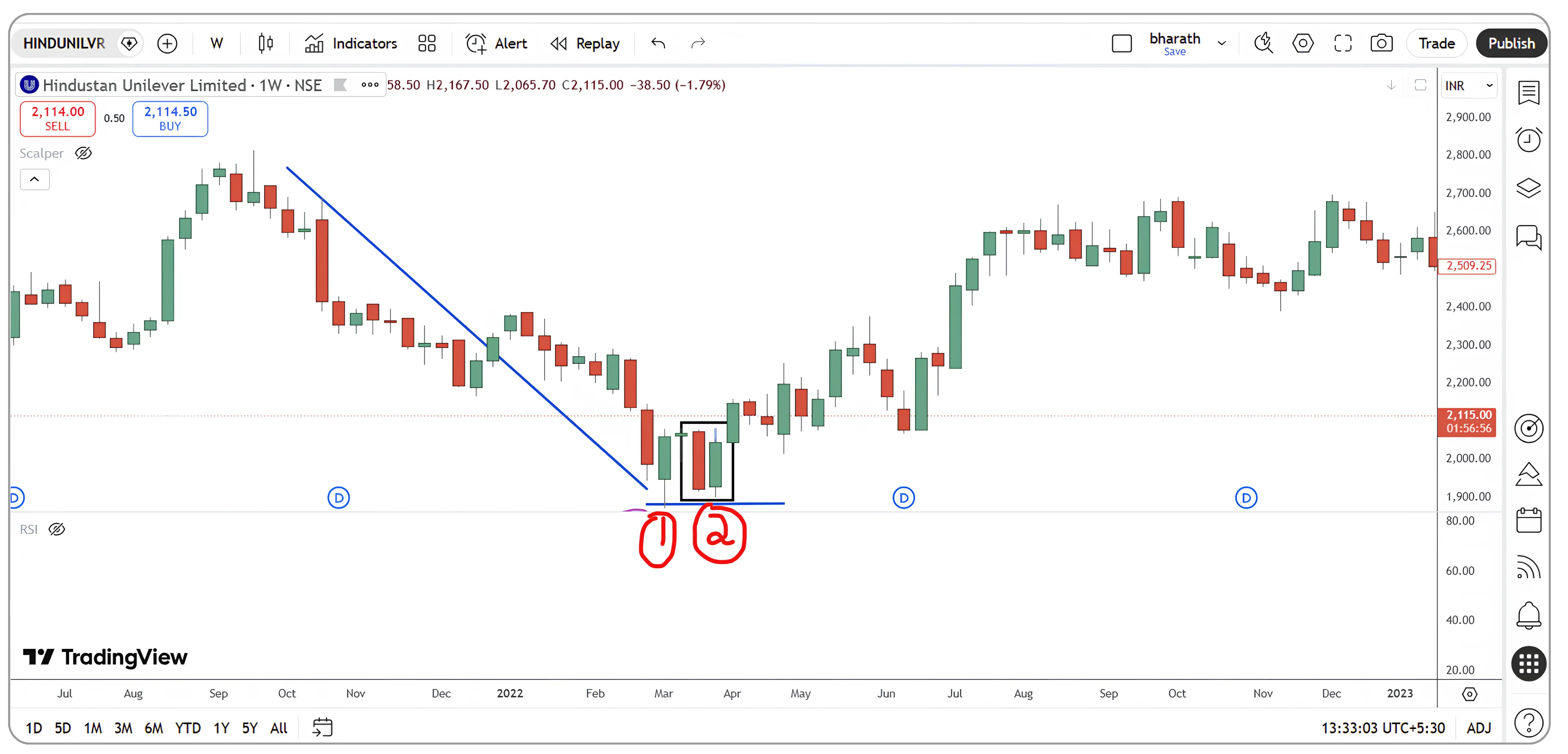
Markets rarely move in straight lines, but when they fall hard and fast, they tend to leave behind something useful: clear levels where buyers stepped in and price found its footing. The Hindustan Unilever weekly chart in early 2022 was one such moment. The stock had been in a sustained downtrend for months, and as it approached a key price zone, two consecutive weekly candles printed a piercing pattern at the same level. That combination of technical confirmation, elevated implied volatility, and a well-defined options structure came together into a Bull Put Spread trade that did not need the market to rally in order to work.
When Does a Bull Put Spread Strategy Make Sense in India?
The Bull Put Spread works best when a specific set of conditions align. Understanding these conditions is more important than the mechanics of the strategy itself, because deploying it in the wrong environment will not give you the edge you are looking for.
The first condition is weekly support after a fall. When a stock finds support on the weekly timeframe after a sustained decline, that level tends to hold for at least one to two weeks. You watch and wait during this period. Price consolidating around that support level, without breaking down, is itself the confirmation you need before entering the trade.
What Is a Piercing Pattern on a Weekly Chart?
A piercing pattern is a two-candle bullish reversal signal on a candlestick chart. The first candle is a strong bearish close. The second candle opens below that close but recovers sharply, closing above the midpoint of the first candle. One piercing pattern is suggestive. Two of them printed at the same support level, on a weekly timeframe, is a meaningful confirmation. The first pattern created the support. The second one confirmed it.
Second Condition: Once the support has shown two weeks of sustenance, the second condition comes into focus: implied volatility. In most cases, IV rises sharply during a downtrend as fear and hedging activity push option premiums higher. By the time you are ready to enter, after that confirmation period, IV is still elevated and options are still expensive. Entering the Bull Put Spread at this point means you are selling into high premium, with IV likely to cool off from there. Alongside that, every day the trade is open, theta decay erodes the value of the options sold. Both forces work in your favor from the moment you enter.
If the stock then rallies from support, the long delta nature of the strategy adds a third layer of profit on top. This is what makes the Bull Put Spread a three-dimensional trade: short vega, short theta, and long delta, all working together when the conditions are right.
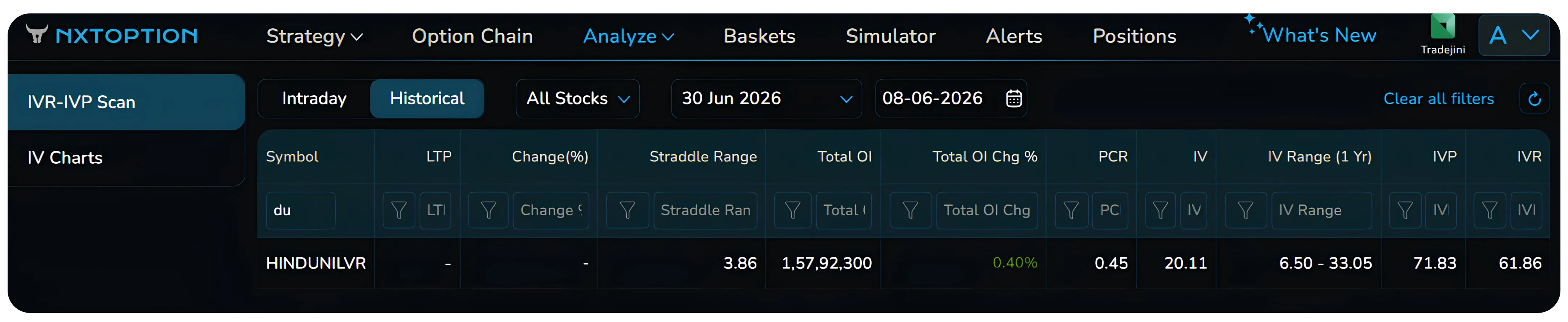
To confirm the IV condition before entering, use the IVR and IVP scan on NxtOption. An IVP reading above 75 tells you that implied volatility is in the upper range of its historical levels, which is the primary trigger for this strategy. This is the one condition that should not be skipped. Without elevated IV, the premium collected is thin, the vega tailwind disappears, and the trade loses much of its structural edge.
Building a Bull Put Spread on NxtOption
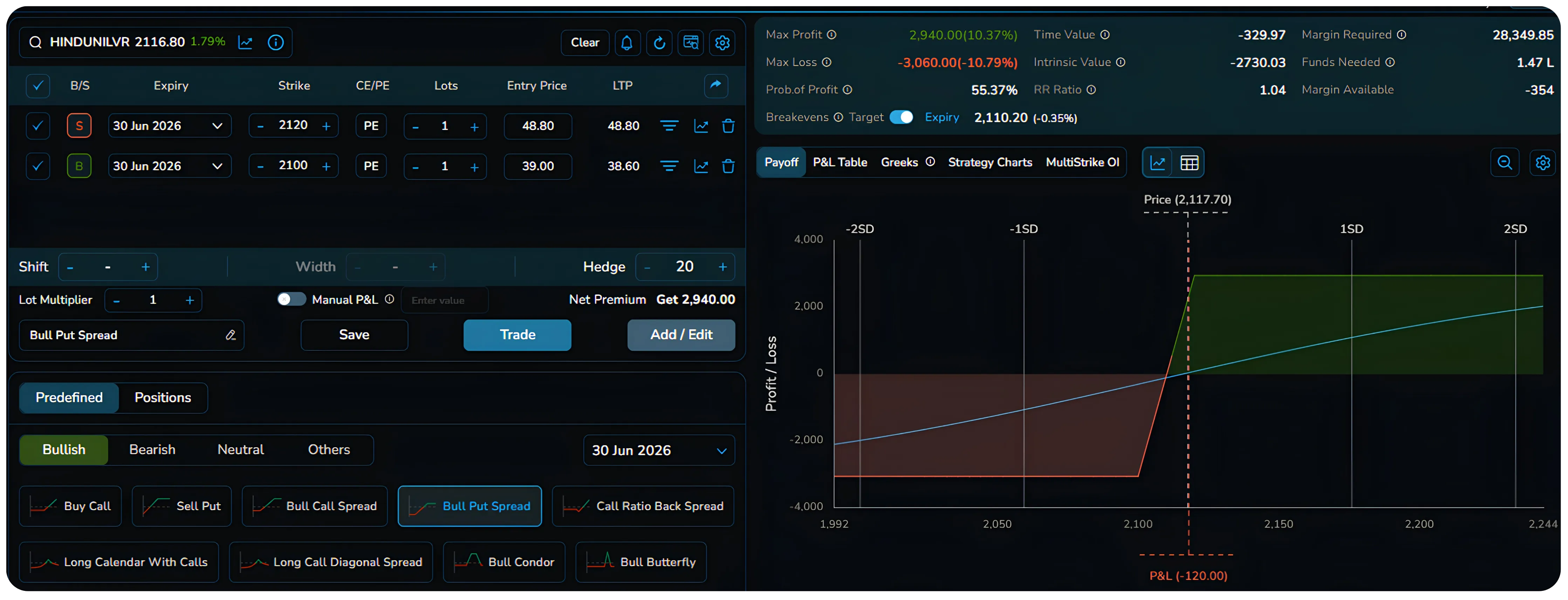
NxtOption's Strategy Builder has the Bull Put Spread available as a predefined strategy under the Bullish tab. Once you select it, the builder lays out the two legs automatically: the short put at your chosen strike and the long put at the lower strike as the hedge. You can adjust the strikes, expiry, and lot size directly within the builder, and the platform instantly shows you the payoff chart, breakeven, probability of profit, and margin required before you place the trade.
Also Read: How to Read OI Profile on NxtOption
What Can Go Right and Wrong in a Bull Put Spread
If the stock holds above the breakeven at expiry, both puts expire worthless or decline in value, and the full premium collected is retained. IV cooling and daily theta decay work in favor of the position throughout the holding period.
If the stock breaks below support and closes below the long put strike at expiry, the trade hits its maximum loss. The bought put ensures the loss cannot exceed that fixed amount regardless of how far the stock falls. That defined ceiling on risk is what makes the spread a more manageable structure than a naked short put.
What Is the Practical Edge of a Bull Put Spread?
What makes this trade structured and repeatable is the alignment of three factors at the same time. The chart provided a clear support signal through two weekly piercing patterns. The high-IV environment made selling options more rewarding. And the Bull Put Spread structure, built in seconds on NxtOption's Strategy Builder, meant the maximum capital at risk was fixed and known from the moment the trade was placed.
There was no requirement for a rally. The trade worked if the stock simply sat at support and did nothing for a week or two. IV contraction and theta decay alone were enough to generate a profit. A move higher just accelerated the outcome.
That is the core idea behind a Short Vega, defined-risk spread after a period of sharp selling. You are not predicting a big move. You are positioning around a level where the stock is unlikely to fall much further, collecting premium while the market takes time to settle down.
Disclaimer: The information provided in our blogs is for informational purposes only and should not be construed as financial, investment, or trading advice. Trading and investing in the securities market carries risk. Always conduct your own research and consult with a qualified financial advisor before making any investment decisions. Past performance is not indicative of future results. Copyrighted and original content for your trading and investing needs.
© 2026 — Tradejini. All Rights Reserved.