An Option is a financial contract that gives its buyer the right, but not the obligation, to buy or sell an asset at a predetermined price, known as the strike price, within a set time frame. To acquire this right, the buyer pays a premium to the seller, who takes on the associated risk. If the market moves in the buyer’s favour, the option can deliver substantial profits. If not, the buyer can simply let it expire, with the maximum loss limited to the premium paid. Unlike shares, options have an expiry date, after which they either become worthless or generate a cash flow, depending on price movements. Traders often analyze the put-call ratio to gauge market sentiment before taking a position.
Let us now examine Call and Put Options, the two fundamental building blocks of options trading that determine whether you are positioning for prices to rise or fall.
Call Option
Among the call option and put option, buying a call option is a bullish options strategy where an investor buys a call option, giving them the right to purchase a stock at a predetermined strike price before the expiry date. This strategy is profitable when the stock price rises above the strike price, allowing the investor to buy at a lower price and sell at a higher market price. The maximum loss is limited to the premium paid, while the potential profit is unlimited if the stock price continues to rise.
Buying a Call Option on Tata Motors (24 Apr 2025)
Stock Chart: TATA Motors
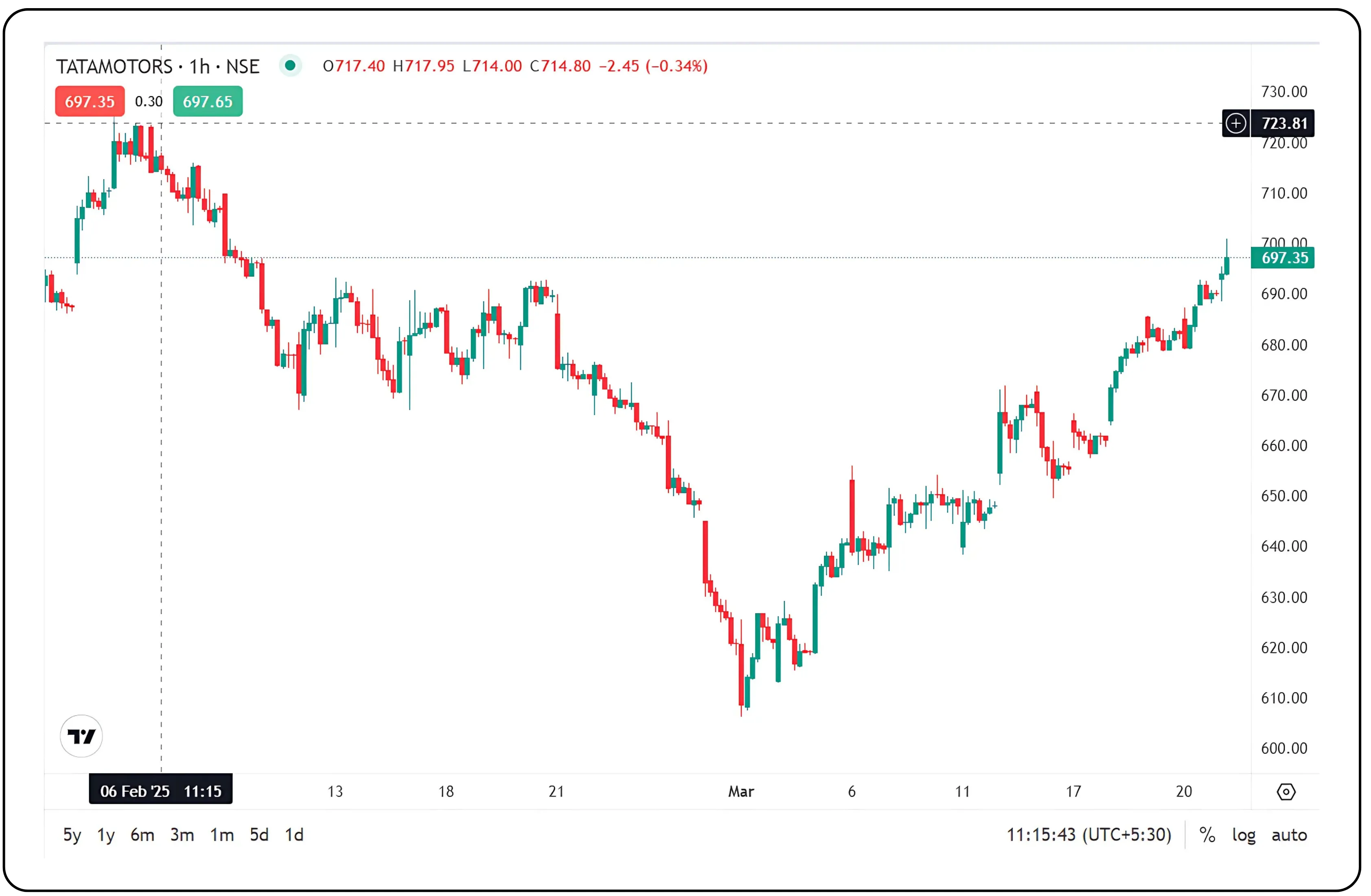
If you anticipate that Tata Motors' share price will rise, you can purchase a call option with a strike price of ₹750 by paying a premium of ₹7.55 per share. Since the lot size is 550 shares, the total premium payable amounts to ₹4,152.5. This amount will be deducted from your margin account as you place.
| Term | Example | Definition |
|---|---|---|
| Stock Name | TATA MOTORS | Underlying Asset |
| Strike Price | ₹750 | The predetermined price at which the buyer can purchase SBI |
| Premium | ₹7.55 per share | The cost paid by the buyer to acquire the option. |
| Expiry Date | 24th April 2025 | The last date by which the option must be exercised. |
| Lot Size | 550 shares | The number of shares per contract. |
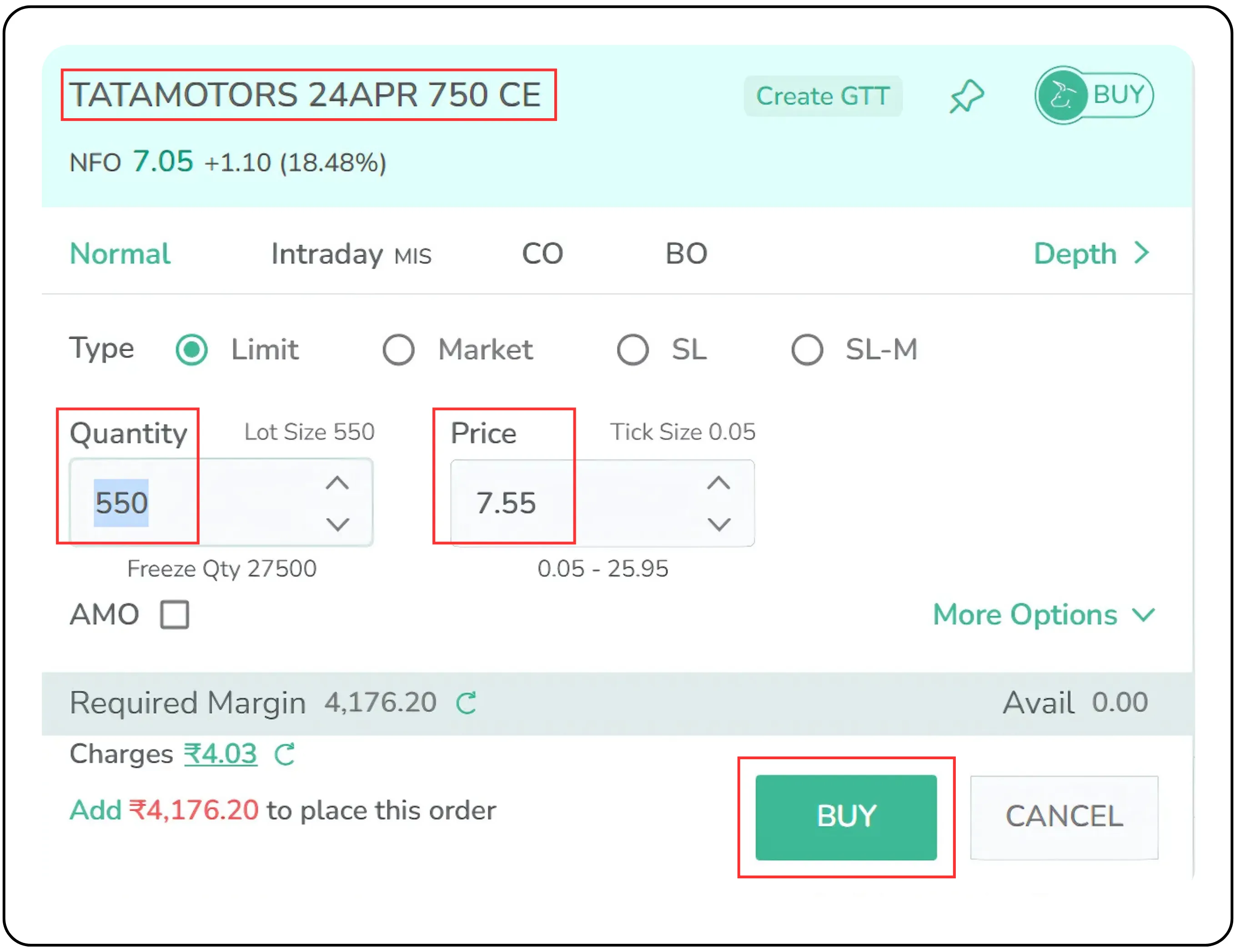
If the share price moves above ₹750, you can exercise your right and buy the shares at ₹750. If the share price remains at or falls below ₹750, you will not exercise your right and are not required to buy the shares. In this case, your only loss is the premium paid (₹4,152.5).
How to calculate call option payoffs?
Understand the call option structure
A call option gives the buyer the right (not the obligation) to purchase an underlying asset at a predetermined strike price on or before the expiry date.
Know why it matters
Calculating call option payoffs is important for traders who want to make confident and informed decisions in the options market.
Identify the payoff formula
The payoff depends on the difference between:
- the market price of the asset at expiry, and
- the strike price,
minus the premium paid for the option.
Determine the outcome
- If the market price is higher than the strike price → the option is profitable.
- If the market price is equal to or below the strike price → the option is not exercised, and the maximum loss is the premium paid.
Why this helps
By accurately calculating call option payoffs, traders can:
- Estimate potential returns
- Manage risk exposure
- Make informed decisions during market volatility
Also read: Understanding Intraday and Delivery Trades in Stock Markets
Put Option
Buying a put option is a bearish options strategy where an investor buys a put option, giving them the right to sell a stock at a predetermined strike price before the expiry date. This strategy is profitable when the stock price falls below the strike price, allowing the investor to sell at a higher price and buy back at a lower market price. The maximum loss is limited to the premium paid, while the potential profit increases as the stock price declines.
Buying a Put Option on SBIN (24 Apr 2025)
Stock Chart: SBIN
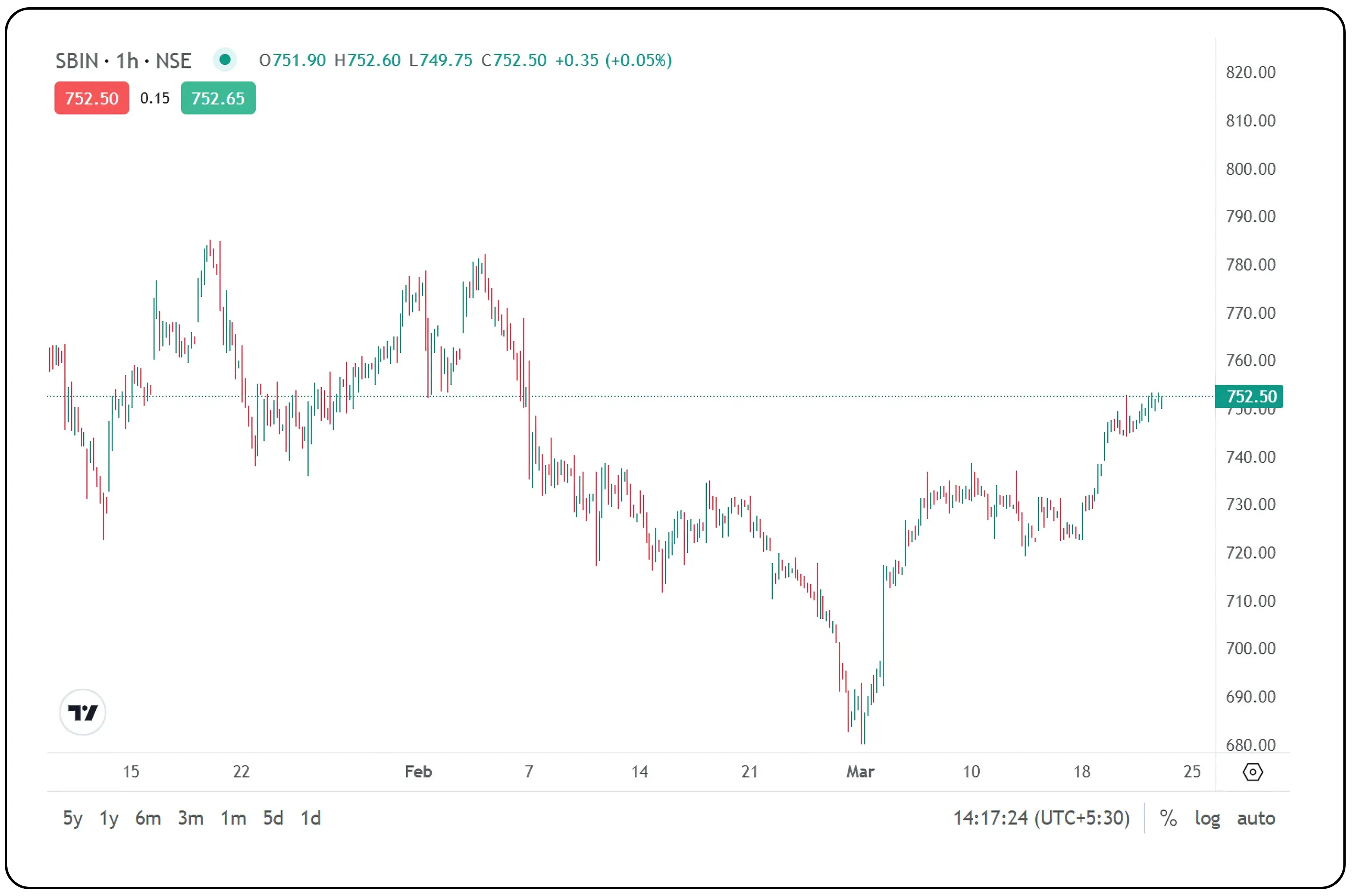
If you anticipate that SBI's share price will decline, you can purchase a put option with a strike price of ₹780 by paying a premium of ₹32 per share. Since the lot size is 750 shares, the total premium payable amounts to ₹24,000. This amount will be deducted from your margin account as you place the trade.
| Term | Example | Definition |
|---|---|---|
| Stock Name | SBI | Underlying Asset |
| Strike Price | ₹780 | The predetermined price at which the buyer can sell SBI |
| Premium | ₹32 per share | The cost paid by the buyer to acquire the option. |
| Expiry Date | 24th April 2025 | The last date by which the option must be exercised. |
| Lot Size | 750 shares | The number of shares per contract. |
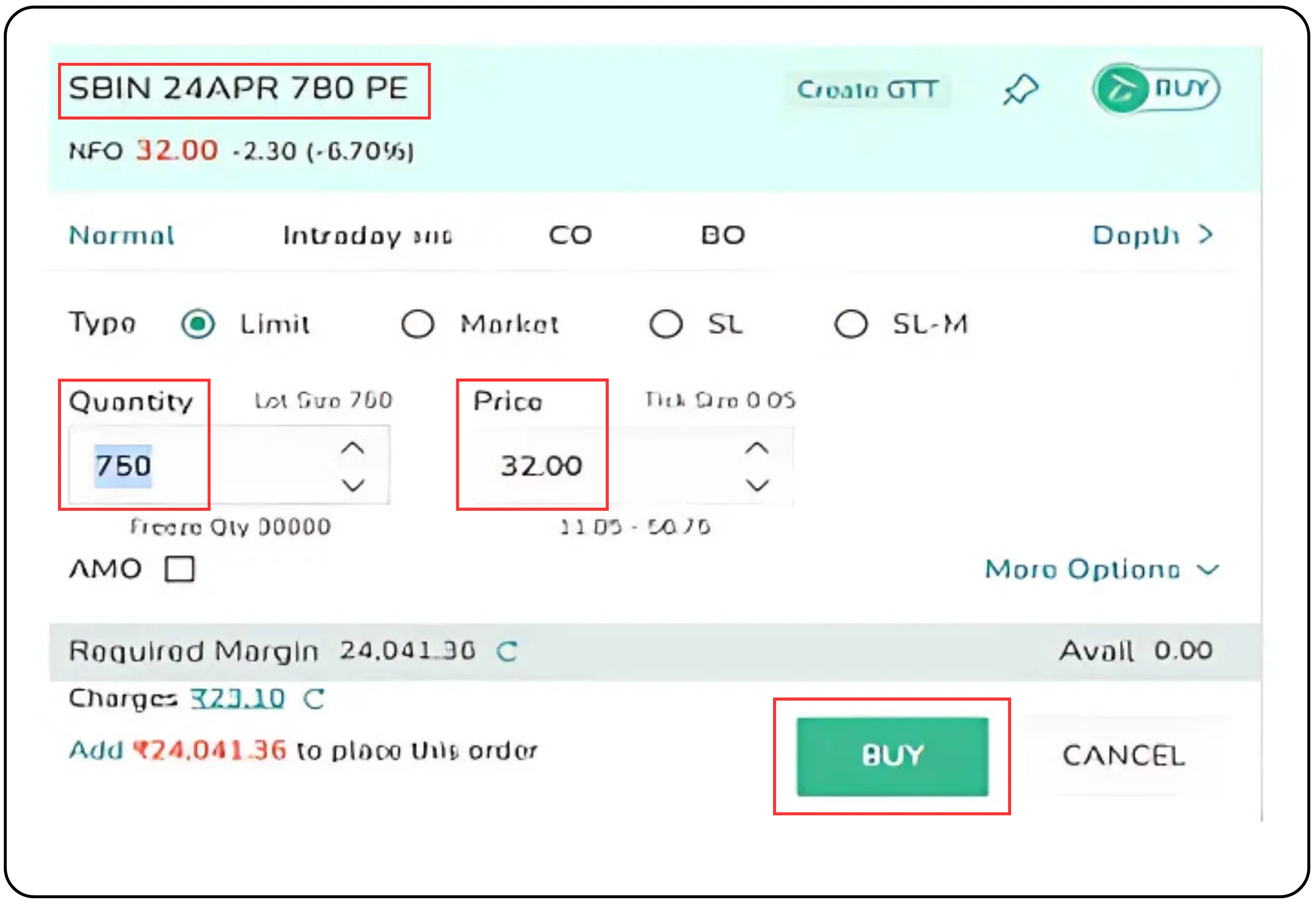
If the share price moves below ₹780, you can exercise your right and sell the shares at ₹780. If the share price remains at or rises above ₹780, you will not exercise your right and are not required to sell the shares. In this case, your only loss is the premium paid (₹24,000), just like in other call and put contracts.
How to calculate put option payoffs?
Understand the put option structure
A put option gives the buyer the right (not the obligation) to sell an underlying asset at a predetermined strike price before or on the option’s expiry date.
Know why it matters
Calculating the payoff is crucial for understanding how this derivative can help you manage risk or profit from market declines.
Identify the payoff formula
The payoff is calculated based on the difference between:
- the strike price and
- the market price at expiry,
minus the premium paid.
Determine the outcome
- If the market price falls below the strike price → the option becomes profitable, and the gain increases the further the price drops.
- If the market price stays above the strike price → the option expires worthless, and the maximum loss is the premium paid.
Why this helps
By calculating put option payoffs, traders can:
- Evaluate downside protection strategies
- Plan for anticipated price declines
- Make more informed trading decisions in volatile or bearish markets
Also read: Understanding Monetary Policy
Types of Strike Prices for Call & Put Options
In options trading, the strike price (also called the exercise price) is the fixed price at which the buyer and seller agree to buy or sell the underlying asset if the option is exercised. This price is set by the exchange when the contract is created and remains unchanged until expiry.
The relationship between the strike price and the current market price (spot price) determines the moneyness of an option, which can also influence the option put call ratio. Moneyness tells us whether an option has intrinsic value at the moment. Broadly, strike prices fall into three categories, In-the-Money, At-the-Money, and Out-of-the-Money.
| Type | Meaning | Call Option | Put Option | Example |
|---|---|---|---|---|
| In-the-Money (ITM) | Exercising the option would be immediately profitable. |
Strike price is below the current market price |
Strike price is above the current market price |
Stock at ₹200: Call with ₹180 Strike = ITM Put with ₹220 Strike = ITM |
| At-the-Money (ATM) | Strike price is roughly equal to the market price. |
Strike price is close to the market price |
Strike price is close to the market price |
Stock at ₹200: Call with ₹200 Strike = ATM Put with ₹200 Strike = ATM |
| Out-of-the-Money (OTM) | Exercising the option would not be profitable currently. |
Strike price is above the current market price |
Strike price is below the current market price |
Stock at ₹200: Call with ₹220 Strike = OTM Put with ₹180 Strike = OTM |
Also read: Unveiling Indian Stock Price Drivers and Market Dynamics
Takeaway:
Options trading doesn’t have to be overwhelming once you break it down into simple terms. A Call option can help you benefit from an expected price rise, while a Put option can protect you or profit from a price fall. By understanding how to calculate payoffs, you can measure potential gains, limit losses and make decisions with greater confidence.
The key is to start small, practice with real examples, and always be clear about your risk before entering a trade. Whether you’re aiming to hedge your portfolio, speculate on price movements, or create additional income streams, options can be a valuable addition to your trading toolkit when used wisely. Remember, in the stock market, knowledge and discipline are your strongest allies.
Disclaimer: The information provided in our blogs is for informational purposes only and should not be construed as financial, investment, or trading advice. Trading and investing in the securities market carries risk. Always conduct your own research and consult with a qualified financial advisor before making any investment decisions. Past performance is not indicative of future results. Copyrighted and original content for your trading and investing needs.
© 2025 — Tradejini. All Rights Reserved.
.webp%3Falt%3Dmedia%26token%3D0ead9799-20bc-4d1e-ae8f-d75ab18921b5&w=3840&q=75)