Most investors who begin their mutual fund journey start with equity funds. The growth story is easy to understand, the long-term numbers are compelling, and SIPs make the entry simple. Fixed deposits, on the other hand, feel familiar and safe. Debt funds occupy a space between the two, and that middle ground is where most investors go quiet. They have heard the term, seen it mentioned in portfolio allocation advice, but never quite understood what debt funds actually do or why they exist.
This piece addresses that gap.
What is a Debt Fund
A debt fund is a mutual fund that lends money. When you invest in a debt fund, the fund manager takes that money and uses it to buy bonds and other fixed-income instruments issued by governments, public sector companies, banks, and private corporations. These issuers pay interest on the money they borrow, and that interest income flows back into the fund. The fund's NAV rises as this income accumulates, and investors earn returns when they redeem their units at a higher NAV than what they purchased at.
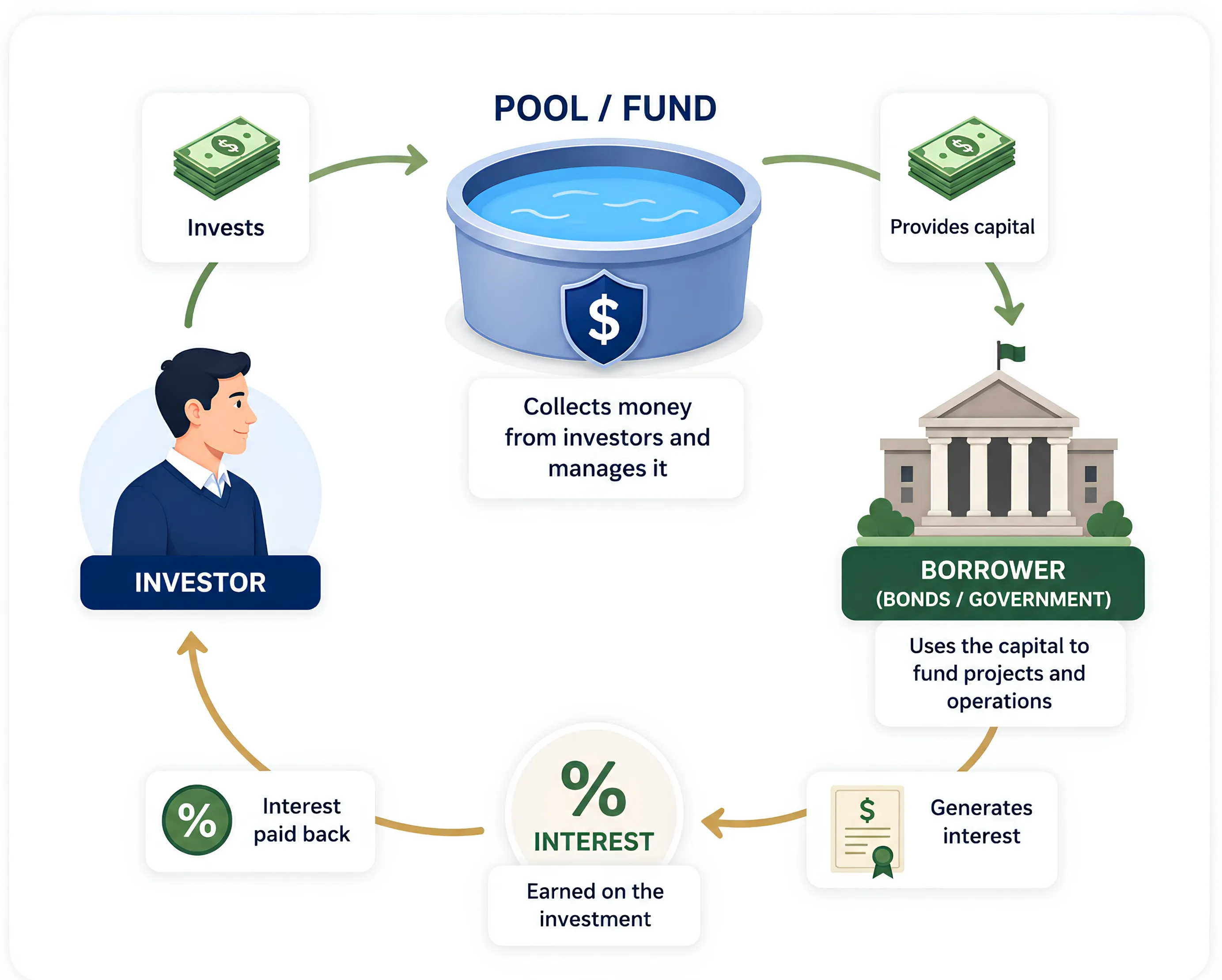
Unlike equity funds, where returns depend on how company profits and market sentiment move, debt fund returns are primarily driven by interest income and, to a lesser extent, by changes in bond prices when interest rates in the economy shift. This makes debt funds more stable than equity funds in most market conditions, though they are not without their own risks.
How a Debt Fund Works
The fund manager pools money from all investors and deploys it across a basket of debt instruments. Each instrument has a face value, an interest rate called the coupon, and a maturity date. The fund earns coupon income on these instruments daily, and this gets reflected in the NAV. When interest rates in the economy fall, existing bonds with higher coupons become more valuable, and the NAV rises further. When rates rise, bond prices fall, and the NAV can dip temporarily.
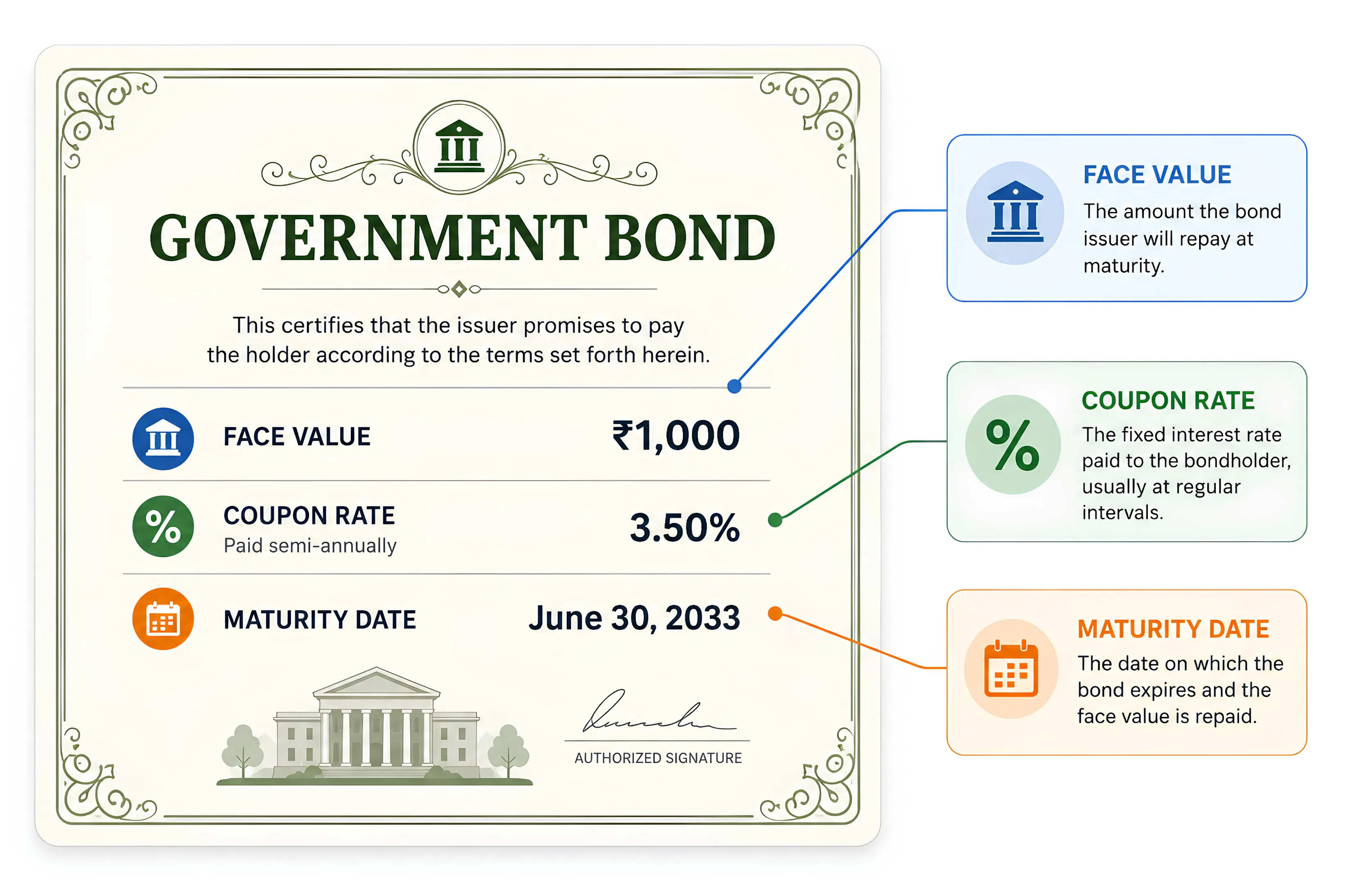
The instruments a debt fund holds vary depending on its category. The table below covers the most common ones.
| Instrument | Issued by | Typical tenure |
|---|---|---|
| Government securities (G-secs) | Central government | 5 to 40 years |
| Treasury bills (T-bills) | Central government | 91, 182, or 364 days |
| State development loans (SDLs) | State governments | 5 to 15 years |
| Corporate bonds | Private and PSU companies | 1 to 10 years |
| Commercial paper | Companies and financial institutions | 7 days to 1 year |
| Certificates of deposit | Banks | 7 days to 1 year |
Types of Debt Funds
SEBI classifies debt funds into categories based on the maturity of instruments they hold and the credit quality they target. Rather than listing all of them, it helps to think of them in three groups based on how long you plan to stay invested.
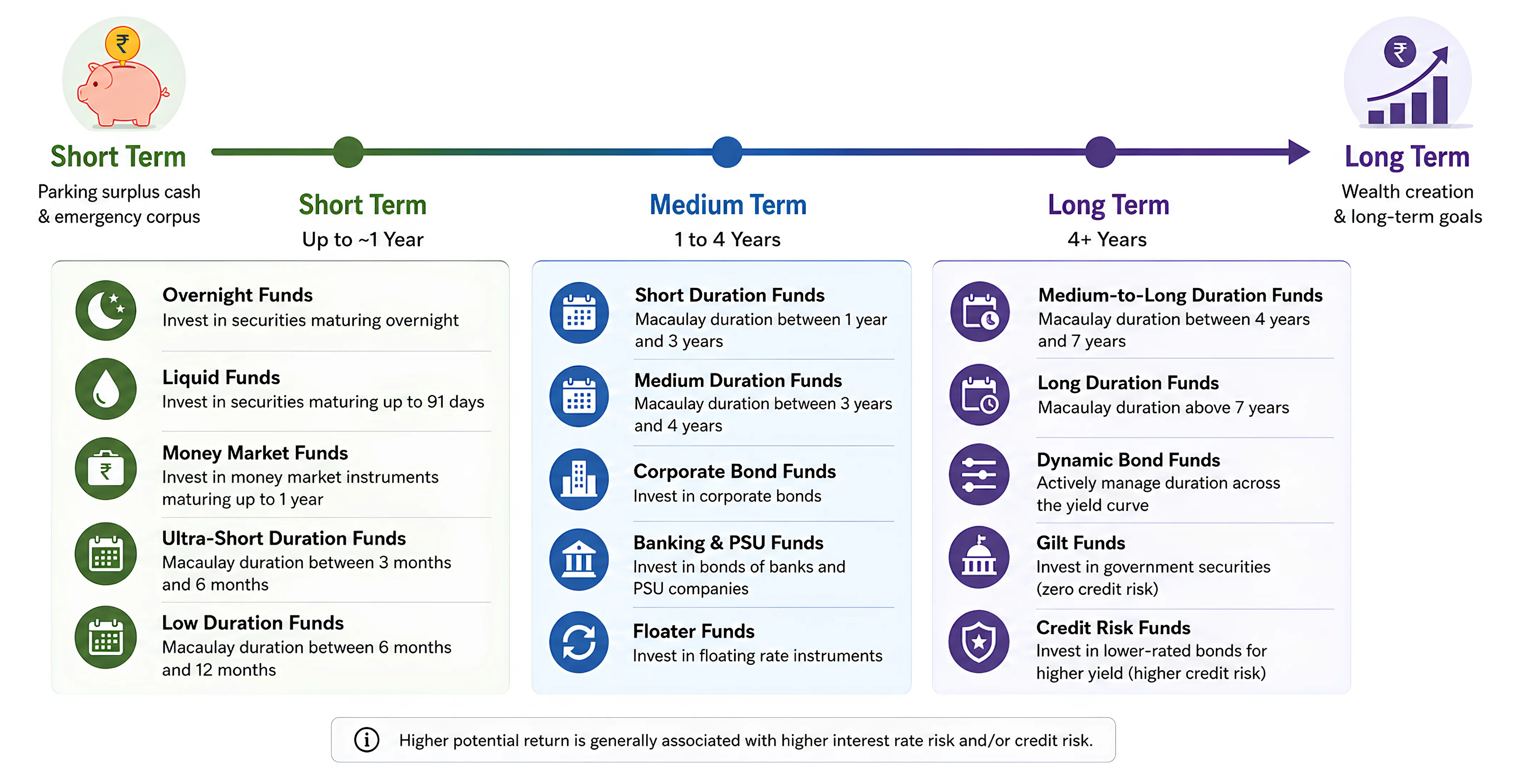
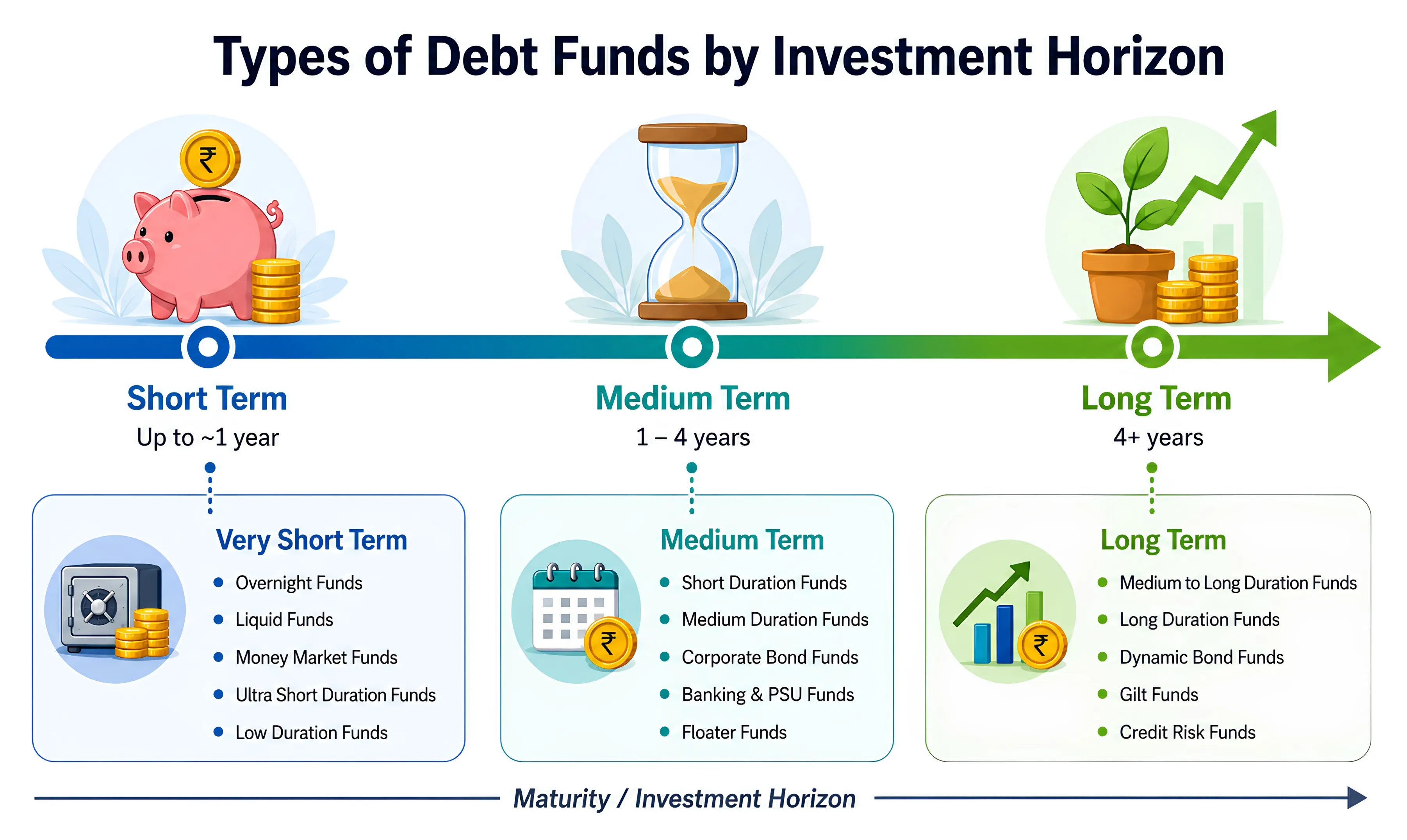
For very short horizons of a few days to about a year, overnight funds, liquid funds, money market funds, ultra-short duration funds, and low duration funds are the relevant categories. These funds hold instruments with very short maturities, which means their NAV is relatively stable and they carry minimal interest rate risk. They are commonly used for parking surplus cash or building an emergency corpus.
For a medium horizon of one to four years, short duration, medium duration, corporate bond, banking and PSU, and floater funds come into the picture. These funds hold slightly longer-maturity instruments and generate better yields than the short-end categories, though they are more sensitive to interest rate movements. Conservative investors building towards a medium-term goal or those looking for better post-tax returns than an FD over a two to three year period often consider these.
At the longer end, medium-to-long duration, long duration, dynamic bond, gilt, and credit risk funds operate with either longer maturities or lower-rated instruments for higher yield. These carry meaningful interest rate risk or credit risk and suit investors who understand that NAV can be volatile in the short term. Gilt funds, which hold only government securities, carry zero credit risk but can swing sharply when interest rates move.
Debt Funds vs Fixed Deposits
The most common question debt funds face is how they compare to an FD. The table below covers the key differences.
| Parameter | Debt Fund | Fixed Deposit |
|---|---|---|
| Returns | Market-linked, not guaranteed | Fixed and guaranteed |
| Liquidity | Redeemable on any business day | Premature withdrawal carries penalty |
| Safety | No capital guarantee; credit and interest rate risk exist | Capital guaranteed up to ₹5 lakh per bank under DICGC |
| Taxation | Gains taxed at slab rate (for new investments) | Interest taxed at slab rate every year |
| Inflation adjustment | Returns may keep pace depending on category | Fixed rate regardless of inflation |
| Flexibility | Can switch between categories based on rate cycle | Fixed tenure, limited flexibility |
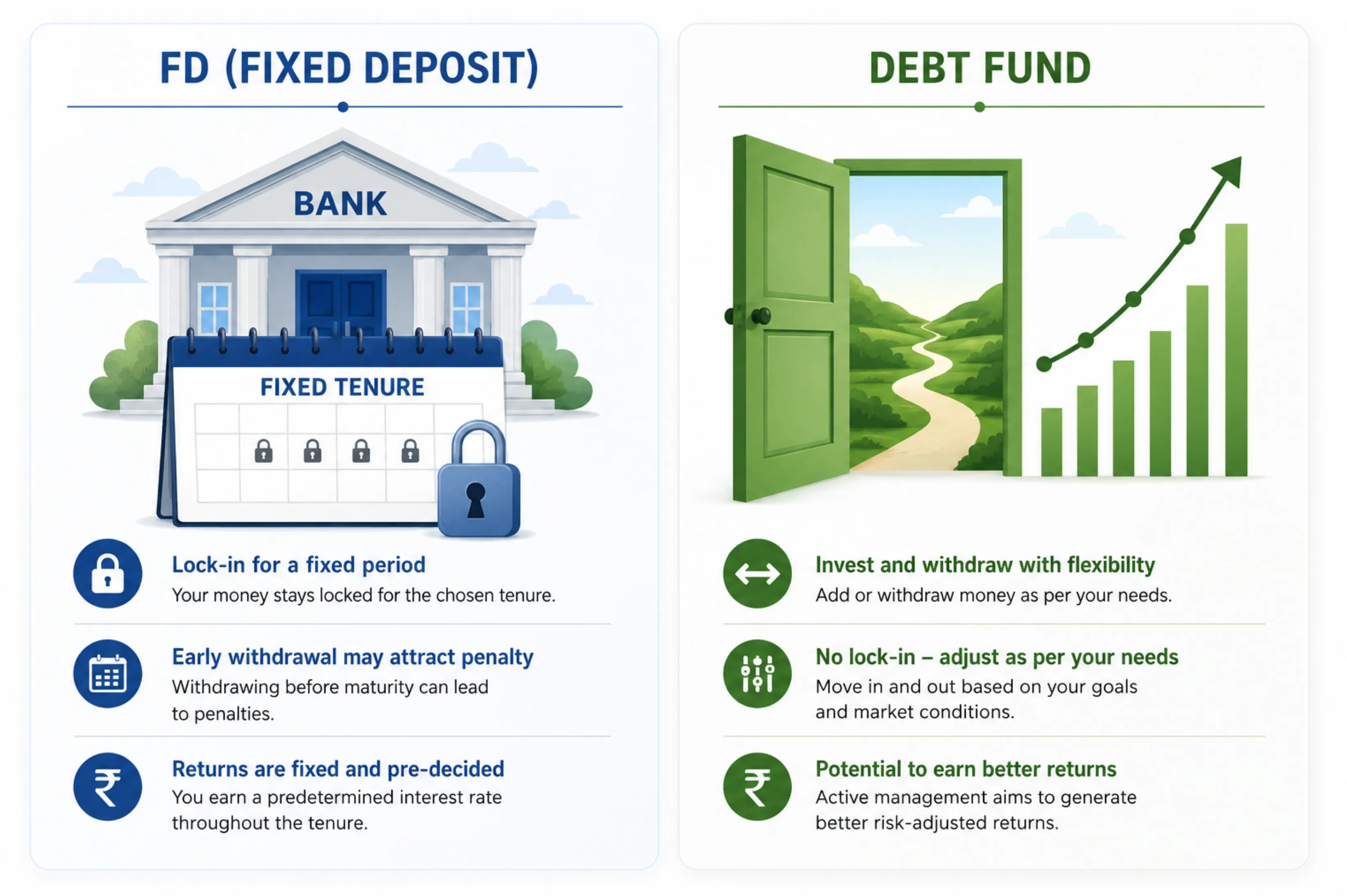
The critical difference for a long-term investor is the timing of tax. With an FD, the bank adds interest to your income every year and you pay tax on it annually, regardless of whether you have redeemed the deposit. With a debt fund, tax is triggered only when you redeem. For someone in a higher tax bracket who does not need the money immediately, this deferral can matter.
Who Should Consider Debt Funds
A conservative investor who has maxed out their FD limits and wants better liquidity without taking equity risk will find liquid or short duration funds a natural fit. Someone six to twelve months away from a financial goal, such as a house down payment or a child's education expense, should consider moving out of equity and into a short duration debt fund to protect accumulated gains. A retiree drawing regular income from a corpus, when used alongside a Systematic Withdrawal Plan, benefits from the stability debt funds provide. And an investor who has received a large lumpsum and wants to deploy it gradually into equity over the next twelve months can park it in a liquid fund in the interim, earning better than a savings account while the transfers happen.
Taxation
For any debt fund investment made on or after 1 April 2023, all capital gains are taxed at the investor's income tax slab rate, regardless of how long the investment is held. There is no indexation benefit and no concessional long-term rate. For investments made before 1 April 2023 and redeemed on or after 23 July 2024, gains qualify for long-term treatment if held for more than 24 months, and are taxed at a flat 12.5% without indexation. IDCW payouts from debt funds are added to the investor's total income and taxed accordingly.
For new investments today, the tax treatment of a debt fund and a fixed deposit is largely similar; both are taxed at your slab rate. The difference is that debt fund gains are taxed only at redemption, while FD interest is taxed every year as it accrues. Debt funds offer no benefit under Section 80C.
Closing
Debt funds are not instruments you invest in for excitement or high returns. They serve a specific purpose in a portfolio: to preserve capital, manage near-term financial goals, provide liquidity, and reduce the overall volatility of what might otherwise be an entirely equity-heavy holding. Understanding how they work is the first step toward using them deliberately rather than defaulting to an FD out of habit. For investors already using a Systematic Withdrawal Plan or thinking about how to balance equity and debt across their portfolio, debt funds are the part of that equation worth understanding properly.
Disclaimer: The information provided in our blogs is for informational purposes only and should not be construed as financial, investment, or trading advice. Trading and investing in the securities market carries risk. Always conduct your own research and consult with a qualified financial advisor before making any investment decisions. Past performance is not indicative of future results. Copyrighted and original content for your trading and investing needs.
© 2026 — Tradejini. All Rights Reserved.


.webp%3Falt%3Dmedia%26token%3D95b8e400-dddc-4dbb-9213-6caa6b886a90&w=3840&q=75)