Every trader eventually runs into the desire to maximize their capital. Discovering leverage margin trading in India, where you can take much larger positions without tying up your entire cash reserve, can feel like unlocking a cheat code in your trading journey. However, any veteran trader will tell you the same thing: leverage is a double-edged sword.
It is incredibly common for traders to jump into derivatives or intraday equity simply because the upfront capital requirement is much lower than buying the stock outright. But when investors take on massive positions just because they can, they often find themselves caught in the trap of over-leveraging. Understanding exactly what margin money is, and the strict rules that govern it, is essential for retail investors in India who want to trade responsibly and protect their hard-earned capital.

What Actually is Margin Money?
In simple terms, margin money is the fraction of the total trade value that you have to deposit with your broker to initiate a leveraged trade. You'll encounter this whenever you take an intraday equity position, buy a futures contract, or write an options contract.
Traders use margin because it multiplies their potential returns; your profit is calculated on the total size of the position, not just the small margin amount you put up. But here is the catch: your losses are multiplied in the same way. Instead of paying the full price for those shares or contracts, you are essentially borrowing the rest from your broker or fulfilling a strict risk requirement set by the exchange. You aren't just putting down a harmless deposit; you are taking on the financial liability of the entire contract.
How Does Margin Work in the Indian Market?
If you're trading in India, you've probably noticed that margin isn't just a single flat fee. SEBI heavily regulates this space to prevent market-wide defaults, so your margin is usually broken down into a few distinct parts:
1. Initial Margin (SPAN + Exposure)
Before you can even initiate a futures or options writing position in India, you have to pay an upfront margin. This is usually made up of two parts: the SPAN margin, which the exchanges calculate based on how volatile the asset historically gets, and an Exposure margin, which acts as a secondary safety net. If you don't have this combined amount sitting in your account, your broker's system will simply reject the order.
2. Mark-to-Market (MTM) Margin
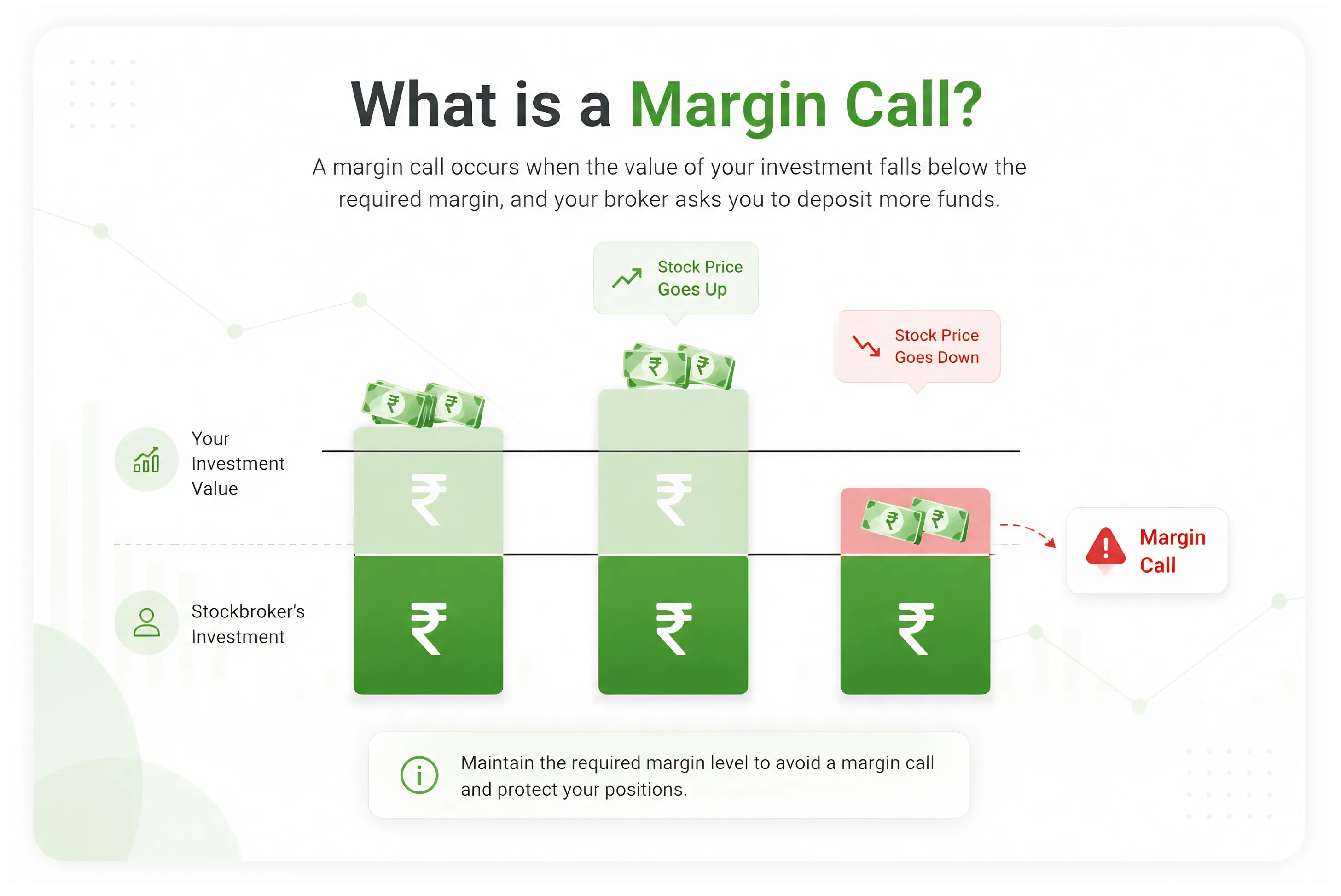
The market fluctuates every single day. If your leveraged position is running at a loss by the time the market closes, your account balance takes a hit. If that drop pushes your available funds below the required maintenance margin, you get hit with a margin call. At that point, you have to deposit more funds immediately. If you don't, your broker has the regulatory right to step in and automatically square off your position to stop the bleeding.
Also read: Types of Breakouts in the Stock Market
3. The Margin Pledge System
One of the more helpful features in the Indian market is that you don't always need to sit on piles of liquid cash to meet these requirements. Since September 2020, brokers can accept your existing securities as margin through a pledge in the depository system. This means you can use your long-term investments, such as approved stocks, mutual funds, or sovereign gold bonds, as collateral to obtain trading limits. The broker just applies a standard deduction called a haircut to account for price fluctuations.
How to Manage Margin Safely in Intraday Trading
Using margin effectively means looking past the allure of amplified profits and hyper-focusing on risk management.
Respect Your Position Sizing: Position sizing in trading should be based on your risk tolerance and account size. It might mean a stock is highly liquid or less volatile, but it definitely doesn't mean the trade is risk-free. Always treat your total position size as your true exposure, not just the small margin amount you paid.
Keep Buffer Cash on Hand: One of the smartest ways to avoid the stress of a forced square-off is to keep excess liquid cash in your trading account. This buffer absorbs those daily MTM fluctuations so you don't wake up to margin calls.
Understand the Penalty Structure: In India, failing to maintain your required upfront or MTM margin doesn't just result in closed trades; it results in strict, exchange-levied margin penalties. If you are constantly trading right at the absolute limit of your available funds, your account is likely bleeding from hidden penalty costs.
Also read: Types of Charges Applicable When You Trade or Invest in India
Final Thoughts
Successful trading isn't about using the maximum leverage your broker will allow; it's about finding high-quality setups and managing your risk capital ruthlessly. The power of leverage is only helpful if the underlying trading strategy is actually sound. By understanding the line between responsible margin use and reckless over-leveraging, Indian traders can protect their capital and ensure they survive the markets long enough to see consistent, long-term growth. For margin trading beginners in India, the key is to start small, understand the mechanics completely, and never risk more than you can afford to lose.
Disclaimer: The information provided in our blogs is for informational purposes only and should not be construed as financial, investment, or trading advice. Trading and investing in the securities market carries risk. Always conduct your own research and consult with a qualified financial advisor before making any investment decisions. Past performance is not indicative of future results. Copyrighted and original content for your trading and investing needs.
© 2026 — Tradejini. All Rights Reserved.
.webp%3Falt%3Dmedia%26token%3D0ead9799-20bc-4d1e-ae8f-d75ab18921b5&w=3840&q=75)