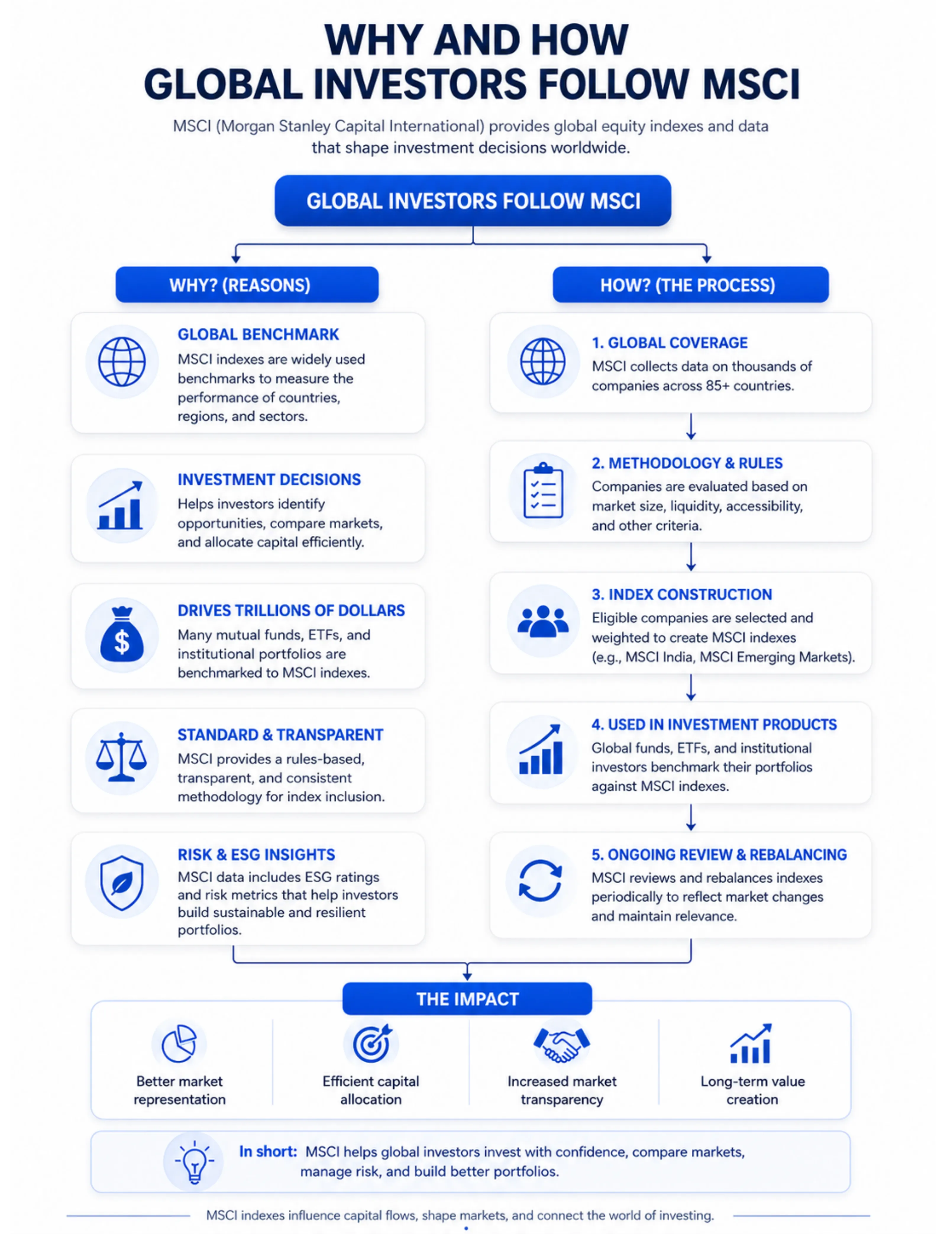
MSCI is an influential benchmark used by international investors to allocate capital across global markets. Thousands of mutual funds, pension funds, sovereign wealth funds, and Exchange Traded Funds (ETFs) managing trillions of dollars rely on MSCI indices to guide their investment decisions.
As a result, even a small change in an MSCI index can trigger billions of dollars worth of buying or selling across financial markets. This role of MSCI acts as a benchmark for global investors.
For Indian investors, understanding MSCI can provide valuable insight into why certain stocks experience sudden price movements, how foreign institutional money enters the Indian market, and why some companies receive increased global attention.
Whether you are a long-term investor, a market enthusiast, or someone beginning your investment journey, understanding how MSCI works can help you interpret market movements with greater confidence.
What is MSCI?
MSCI stands for Morgan Stanley Capital International, one of the world’s leading providers of investment research, analytics, and stock market indices.
Rather than recommending which stocks investors should buy or sell, MSCI creates benchmark indices that represent different countries, industries, and regions.
These benchmarks allow Foreign institutional investors to measure performance and build portfolios that mirror specific markets.
How Does MSCI Work?
MSCI periodically reviews its indices to ensure they continue to reflect changing market conditions.
During these reviews, companies may be:
- Added to an index
- Removed from an index
- Assigned a higher weight
- Assigned a lower weight.
These changes are commonly referred to as MSCI rebalancing.
- When MSCI announces that a company will be added to its index, every passive investment fund tracking that benchmark must purchase the stock before the effective date to ensure its portfolio mirrors the index composition. These purchases are mechanical and are driven by the index change rather than by a fund manager’s personal opinion.
- The same principle works in reverse. If a company is removed from the index, these funds must reduce or completely exit their holdings, creating temporary selling pressure.
This automatic buying and selling is one of the key reasons why MSCI announcements receive close attention from market participants.
Why Does MSCI Matter to Indian Investors
At first glance, MSCI may seem like a benchmark designed primarily for global institutions. However, its decisions have a direct impact on Indian markets, influencing capital flows, stock liquidity, institutional participation, and investor sentiment. Let's see what MSCI does to the Indian market:
1. It brings global capital to Indian markets.
2. MSCI Rebalancing Can Influence Stock Prices
3. A Mark of Global Credibility.
The MSCI India Index
The MSCI India Index was launched on April 30, 1993. It has 165 constituents, and the index covers approximately 85% of the Indian equity universe.
The MSCI India Index has delivered strong long-term returns despite periods of high volatility caused by events such as demonetisation, COVID-19, rising interest rates, and global geopolitical tensions.
10-Year Performance (as of March 2026)
| Period | Annualized Return (Gross, USD) |
|---|---|
| 1 Year | -12.02% |
| 3 Years | 7.52% CAGR |
| 5 Years | 5.35% CAGR |
| 10 Years | 8.26% CAGR |
| Since Inception | 7.37% CAGR |
Note: MSCI reports these returns in US dollars, so the returns in INR are generally higher.
Major sectors in MSCI India
- Financial Services
- Information Technology
- Consumer Goods
- Energy
- Industrials
- Healthcare
- Automobile
- Telecommunications.
The index currently has 165 stocks. Some well-known constituents include:
| Financials | Technology | Industrials | Consumer |
|---|---|---|---|
| HDFC Bank | TCS | Larsen & Toubro | Hindustan Unilever |
| ICICI Bank | Infosys | Siemens India | ITC |
| Axis Bank | HCL Tech | ABB India | Nestlé India |
| SBI | Tech Mahindra | Cummins India | Titan |
| Kotak Mahindra Bank | Wipro | Bharat Electronics | Asian Paints |
Some other constituents include Reliance Industries, Bharti Airtel, Adani Ports, UltraTech Cement, Bajaj Finance, Tata Motors, Maruti Suzuki, Coal India, NTPC, Power Grid, Cipla, Dr. Reddy's Laboratories, Sun Pharma, Trent and many more.
Which funds invest in the MSCI India Index?
1. Passive ETFs
The largest ETF tracking MSCI India is:
- iShares MSCI India ETF.
Other international ETFs tracking MSCI India include:
- Xtrackers MSCI India Swap UCITS ETF
- Amundi MSCI India Swap UCITS ETF
- UBS MSCI INDIA SF UCITS ETF
2. Global Emerging Market Funds
Most Emerging Market funds benchmarked to MSCI EM invest in MSCI India stocks.
Examples include:
- BlackRock Emerging Markets Fund
- iShares Core MSCI Emerging Markets ETF (IEMG).
- Fidelity Emerging Markets Fund
3. Estimated assets tracking MSCI India
Analysts estimate over 100billion US Dollars is benchmarked to or tracks MSCI India directly or through broader emerging-market indices, which is why even small index changes can trigger meaningful passive flows.
How much money is needed to invest?
There is no minimum amount required to invest in the MSCI India Index itself because investors access it through funds.
Examples:
- International ETFs (like INDA): one ETF unit (depending on market price)
- Mutual funds: often start from about ₹500–₹1,000 SIPs in India, depending on the fund.
Likely additions
| Stock | Probability | Notes |
|---|---|---|
| Groww (Billionbrains Garage Ventures) | High | Expected to draw the largest passive inflow among candidates (~$821M est.) |
| Adani Green Energy | High | ~$773M est. inflow |
| Adani Energy Solutions | High | ~$342M est. inflow |
| Laurus Labs | High | Migration from MSCI India Small Cap Index to Standard |
| Biocon | High | Migration from Small Cap to Standard |
| Ather Energy | Medium | Contingent on further free-float market cap improvement in the observation window |
| Coforge | Medium | Migration candidate, ~$567M est. inflow if it happens |
| SAIL (Steel Authority of India) | Mixed signal | One report lists it as a "leading candidate," another as "low probability", treat as uncertain until confirmed |
Stocks considered at risk of removal
Analyst estimates have identified names such as:
- Astral
- SBI Cards
- Jubilant FoodWorks
Some analysts have also suggested that companies such as RVNL, Kalyan Jewellers, and Hyundai Motor India could face exclusion in certain MSCI reviews.
The expected announcement date for the MSCI August 2026 Index Review is:
- Announcement Date: 12 August 2026 after market hours (typically after the U.S. market close timing, which is late evening/night in India).
- Effective date: 31 August 2026, when the additions and deletions become part of the MSCI indices and passive funds rebalance their portfolios.
How Does MSCI Select Stocks?
MSCI follows a transparent, rules-based methodology when constructing its indices. While the detailed methodology varies by index, companies are generally evaluated based on:
- Market capitalisation
- Free-float market capitalisation
- Trading liquidity
- Accessibility for foreign investors.
The objective is to ensure that each index accurately represents the investable market while remaining practical for institutional investors to replicate.
Conclusion
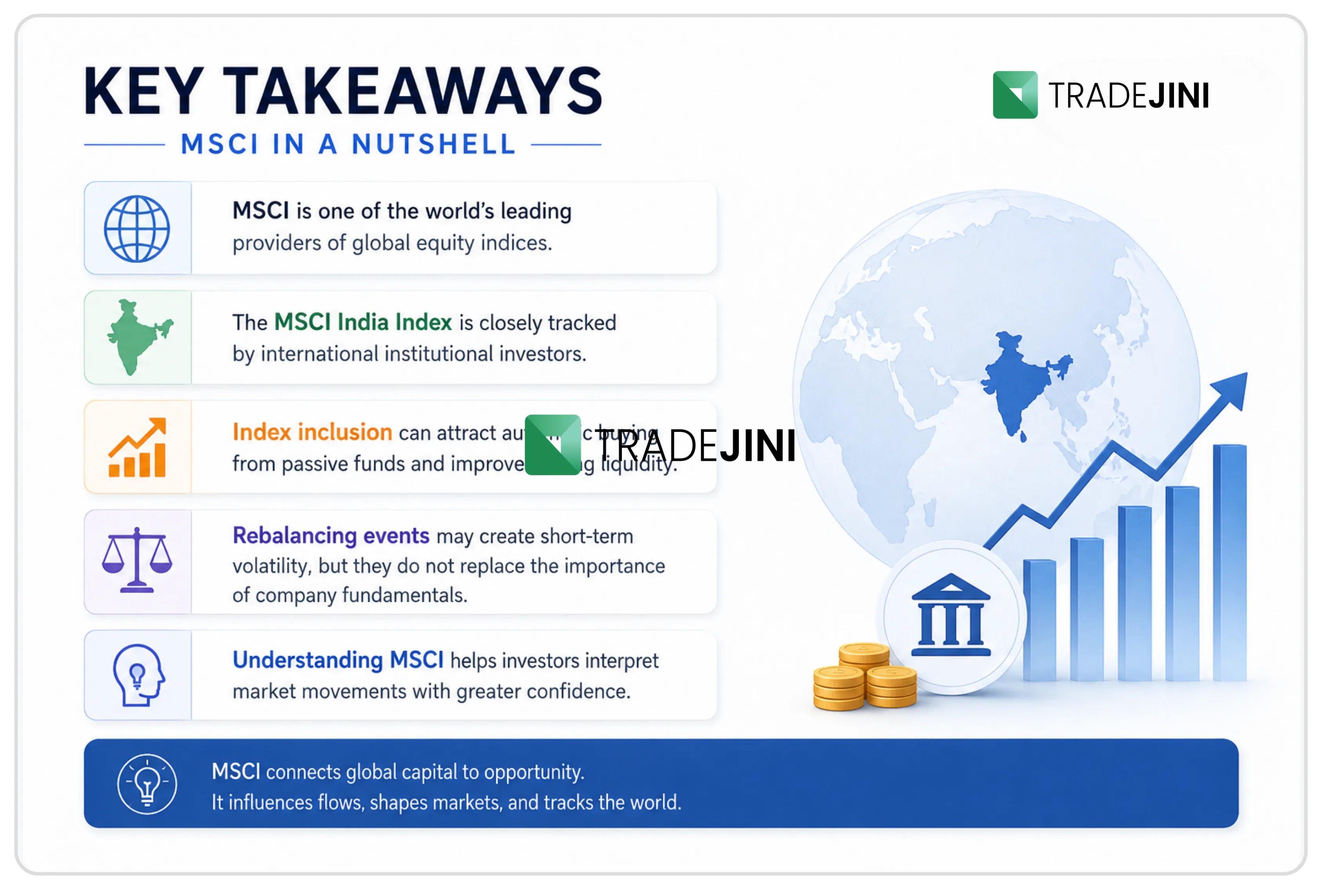
MSCI may operate behind the scenes, but its influence on global financial markets is significant. For Indian investors, understanding how MSCI works provides valuable insight into why foreign capital flows into certain companies, why some stocks experience sharp movements around index reviews, and how institutional investing shapes market behaviour.
However, while MSCI inclusion can enhance a company’s visibility and attract passive investment, it should not be viewed as a guarantee of long-term success. Sustainable wealth creation continues to depend on investing in fundamentally strong businesses with sound governance, consistent earnings growth, and reasonable valuations.
By combining an understanding of MSCI with disciplined fundamental analysis, investors can make more informed decisions and avoid being driven solely by short-term market excitement.
Disclaimer: The information provided in our blogs is for informational purposes only and should not be construed as financial, investment, or trading advice. Trading and investing in the securities market carries risk. Always conduct your own research and consult with a qualified financial advisor before making any investment decisions. Past performance is not indicative of future results. Copyrighted and original content for your trading and investing needs.
© 2026 — Tradejini. All Rights Reserved.
.webp%3Falt%3Dmedia%26token%3D0ead9799-20bc-4d1e-ae8f-d75ab18921b5&w=3840&q=75)