

When equity markets turned volatile in 2025, one category of mutual funds gained attention for offering relatively steadier returns: multi-asset funds. While pure equity schemes struggled with market turbulence, these diversified portfolios demonstrated the benefits of spreading risk across multiple asset classes.
The numbers tell a compelling story. Assets under management in multi-asset funds grew from ₹67 trillion to ₹80.5 trillion by November 2025. Gold exchange-traded funds more than doubled as investors sought safety in precious metals. This shift reflects a maturing investment landscape where investors increasingly value stability alongside growth.
What Makes Multi-Asset Funds Different
Multi-asset funds invest across equity, debt, gold, and international securities rather than concentrating on a single asset class. This diversification creates a natural buffer against market weakness and is increasingly viewed as a practical way of hedging equity volatility in 2025. When one asset class underperforms, gains in others help cushion overall portfolio returns.
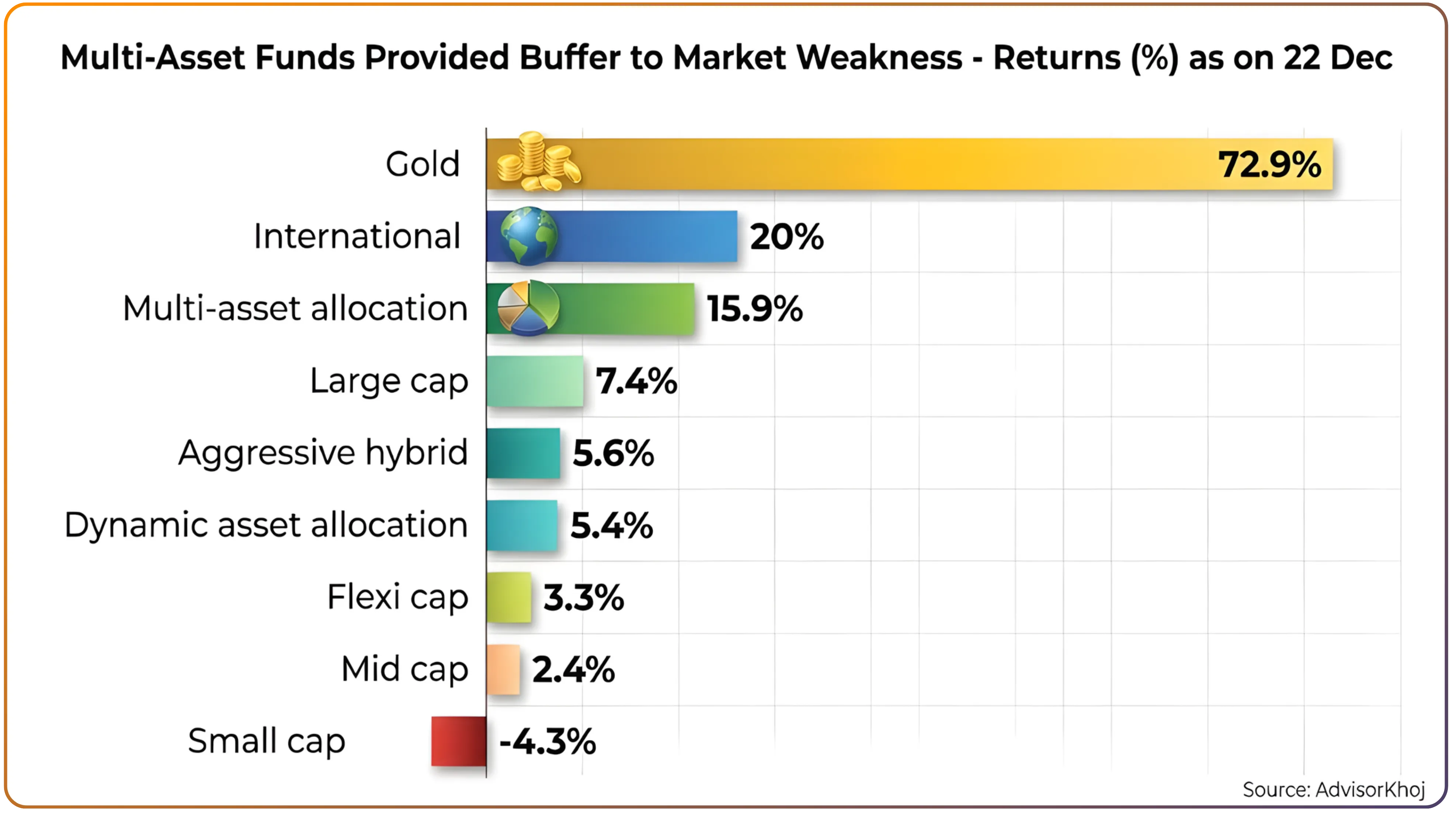
This strategy proved particularly relevant in 2025. Equity markets experienced heightened volatility, with flexi-cap funds delivering moderate returns despite leadership from select sectors. In contrast, gold and silver posted strong gains, while international funds delivered returns of around 20%. Multi-asset mutual funds in India in 2025 that were positioned across these asset classes benefited from multiple return drivers instead of relying on a single market trend.
The premise is straightforward. Different asset classes rarely move in perfect sync. Equity tends to perform well during periods of economic growth, gold often gains during uncertainty, and debt provides stability during market corrections. By holding all three, multi-asset funds reduce the impact of weak performance in any one asset class.
Also Read: Understanding Good XIRR for Mutual Fund Growth
In 2025, funds with a 15–20% allocation to gold benefited meaningfully from the metal’s rally. Pure equity funds, by contrast, had no exposure to this source of returns. Similarly, during equity market corrections, the debt portion of multi-asset portfolios helped provide stability and predictable income.
The Debt Fund Alternative Emerges
While multi-asset funds gained prominence, another category emerged as a tax-efficient debt fund alternative: income-plus-arbitrage funds. These hybrid schemes typically allocate a portion of the portfolio to equity arbitrage strategies, with the remainder invested in debt instruments.
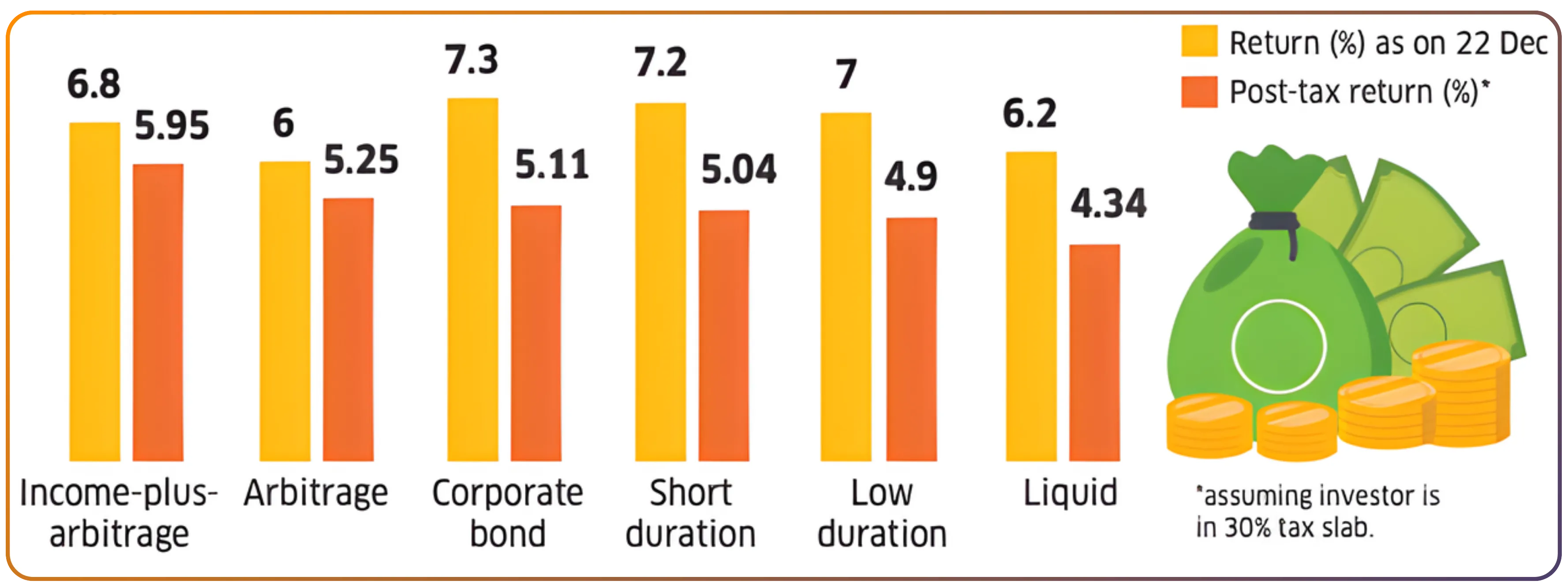
Because these funds maintain the required equity exposure for classification, they qualify for equity taxation, making income-plus-arbitrage funds tax benefits particularly relevant for investors in higher slabs. Gains held beyond one year are taxed as long-term capital gains at 12.5% above the ₹1.25 lakh exemption. Traditional debt funds offering similar returns are taxed at the investor’s income slab rate, which can be as high as 30% for investors in the top bracket.
In 2025, income-plus-arbitrage funds delivered returns broadly in the range of 6.5–7.3%, comparable to traditional debt funds. However, post-tax outcomes differed materially. An investor in the 30% tax bracket earning 7% from a debt fund would net only about 4.9% after tax. The same return from an income-plus-arbitrage fund, when held beyond one year, would attract significantly lower tax, improving post-tax returns.
Also Read: Active vs Passive INvesting in Mutual Funds
This tax treatment makes these funds particularly attractive for parking surplus funds in higher tax brackets. They offer debt-like stability with equity-like tax efficiency and stand out among tax-efficient debt fund alternatives.
Regulatory Changes Bring Transparency
SEBI introduced important reforms to mutual fund expense disclosures in 2025, known as the SEBI expense ratio reforms 2025. Earlier, investors paid a single Total Expense Ratio that bundled multiple costs together. The revised framework breaks expenses into base fund management fees, statutory levies, brokerage costs, and distributor commissions, clarifying the base expense ratio vs TER distinction. While overall costs remain broadly similar, the itemised disclosure improves transparency and comparability across funds.
Fund houses must now display these broken-down costs on factsheets, making it easier to compare funds on specific cost components. For investors evaluating similar funds, this transparency reveals differences in brokerage efficiency or distributor payments that affect net returns.
The reforms also tightened brokerage limits and required clearer separation between fund management fees and taxes. This change nudges the industry toward cleaner fee structures and helps investors see the actual cost of fund management versus market-related expenses.
Also Read: Capture Ratios Mutual Funds in Bull vs Bear Markets
Looking Ahead to 2026
The strong growth of multi-asset funds in 2025 was not incidental. It reflected a clear shift in investor thinking away from concentrated bets and toward balanced portfolio construction. With equity markets remaining volatile and return expectations moderating, diversification across equity, debt, and gold has become a practical risk-management tool rather than a theoretical concept. For investors who want to participate in growth while limiting downside volatility, multi-asset mutual funds in India in 2025 offer a sensible middle ground between aggressive equity strategies and low-return debt options.
Disclaimer: The information provided in our blogs is for informational purposes only and should not be construed as financial, investment, or trading advice. Trading and investing in the securities market carries risk. Always conduct your own research and consult with a qualified financial advisor before making any investment decisions. Past performance is not indicative of future results. Copyrighted and original content for your trading and investing needs.
© 2025 — Tradejini. All Rights Reserved.


