Think about the last OTP you received. Or the bank alert after a UPI payment, the delivery update from an online order, or the boarding-pass message from an airline. You did not get these from your telecom company. A business sent them, and somebody in the middle carried them to your phone.
Think Route Mobile as a courier company for business messages. A bank or an app hands over a message. Route Mobile picks the best road, pays the telecom company a toll to use its network, and makes sure the message reaches you in seconds. It does this billions of times a quarter, in India and across the world.
Like any courier, Route Mobile's biggest cost is the toll. Like any courier, it now faces a change in how people send things: more and more messages travel through WhatsApp and new chat formats instead of old SMS. And like a well-run courier, it has kept a large pile of cash in the safe.
At Tradejini, we decided to look at what is happening inside this business. The share price has fallen from ₹1,626 (the price at which Belgian telecom group Proximus bought control in 2024) to about ₹454 on 9 November 2026. That is a fall of roughly 72%. Revenue, on the other hand, is close to its all-time high, the company has almost no debt, and nearly half of its market value sits in the bank as cash. This piece looks at both sides: why the market has turned cautious, and what the business is actually doing.
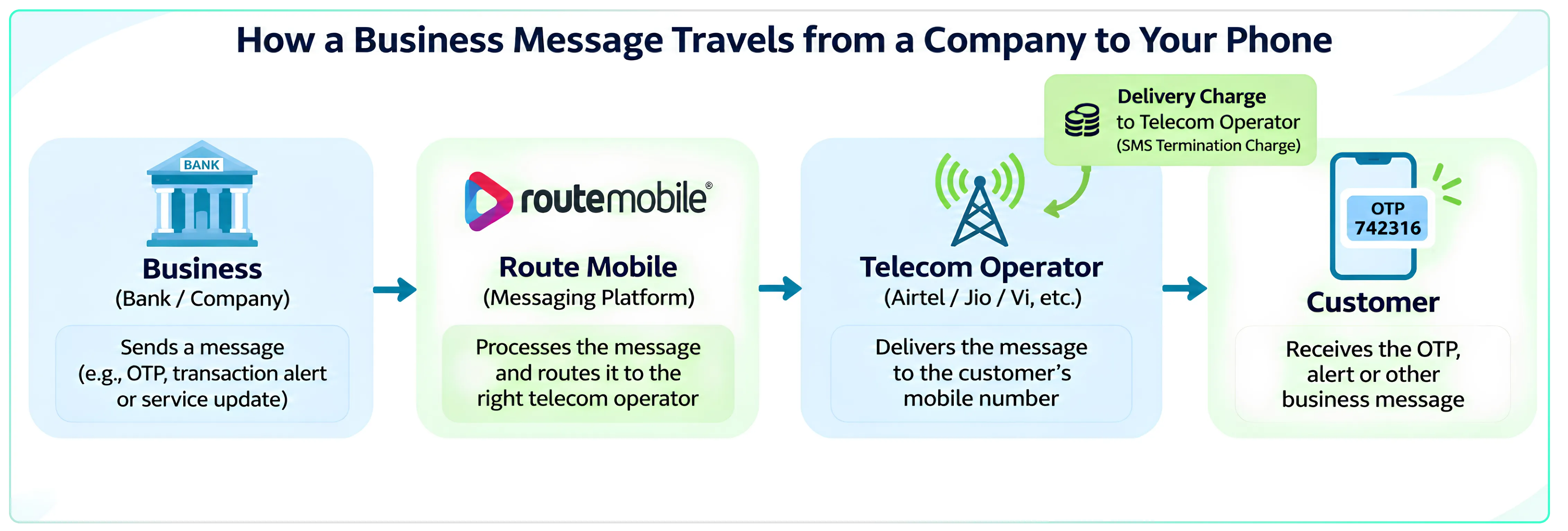
Diagram showing a bank sending an OTP through Route Mobile and a telecom operator to a mobile phone.
What does Route Mobile do?
Route Mobile was founded in Mumbai in 2004 and listed on the stock exchanges in September 2020 at an IPO price of ₹350. It is what the industry calls a CPaaS company.
CPaaS stands for Communication Platform as a Service. In plain words: a company that rents out the pipes for business communication. A bank does not build its own link to every telecom network in the world. It plugs into a CPaaS platform once and sends SMS, WhatsApp messages, voice calls or emails through it.
The business can be understood through five pillars.
1. It carries messages that businesses send to people
The core product is A2P messaging — Application-to-Person messages. These are OTPs, bank alerts, order updates and reminders. In Q2 FY26, about 85% of its SMS traffic was transactional (OTPs and alerts) and only 15% promotional. That matters: people need transactional messages, so the demand does not disappear in a slowdown. In FY26 the company processed about 174.9 billion billable transactions for more than 3,100 active clients.
2. It has direct roads into telecom networks
Route Mobile has around 280 direct connections with mobile network operators (MNOs) — the Jios, Airtels and Vodafones of the world. A direct connection is like owning a private entry ramp onto the highway: faster, more reliable, and usually cheaper than going through another middleman.
3. It is moving into new channels: WhatsApp, RCS and AI chat
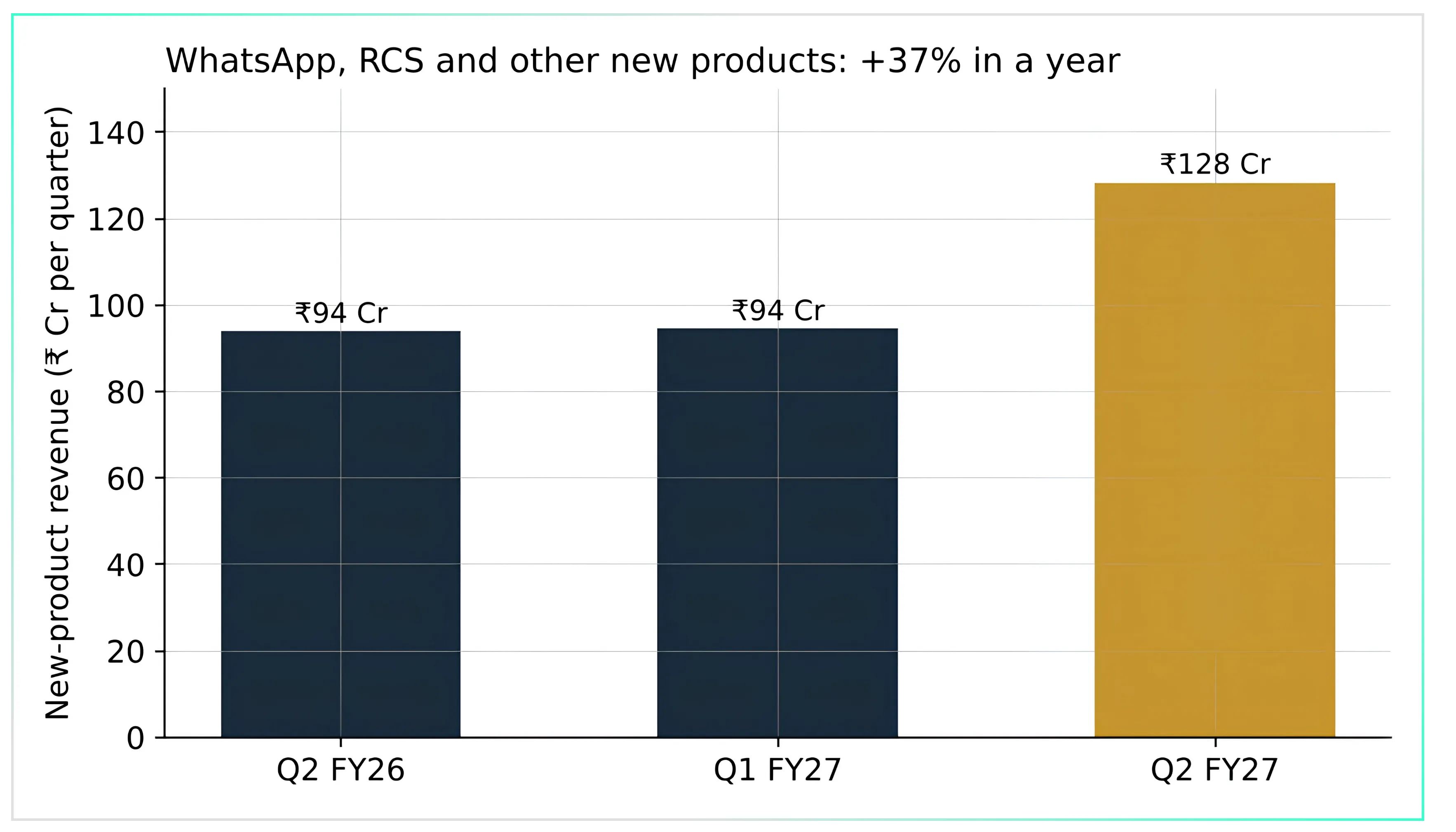
Businesses increasingly talk to customers through WhatsApp Business and RCS (Rich Communication Services — an upgraded SMS that can carry images, buttons and brand logos). Route Mobile calls these its new products. In FY26 they earned about ₹350 crore, roughly 8% of revenue, and grew only 11% because WhatsApp prices were cut during the year. Growth picked up sharply in Q2 FY27: ₹128 crore in a single quarter, more than 10% of revenue.
4. It sells security software to telecom companies
Through its subsidiary 365squared, Route Mobile sells SMS firewalls to telecom operators. A firewall blocks spam and catches businesses that try to sneak messages onto a network without paying the proper fee. For the courier, this is like selling security guards to the highway owner. The firewall is now live at 12 operators. It is still a small part of revenue (management says single-digit percent, reported inside the SMS line), but management puts its blended gross margin at 50–60%, far above the core messaging margin.
5. It is part of a global telecom group
Since May 2024, Route Mobile has been controlled by Proximus, Belgium's largest telecom company. Proximus groups Route Mobile with two sister companies, BICS (international carrier) and Telesign (digital identity and messaging), under a unit called Proximus Global. We look at what this means later.
How Route Mobile makes money on each message
The key thing to understand about Route Mobile is that it is a high-volume, low-margin business. Most of what a customer pays goes straight to the telecom operator as the toll for delivering the message.
| For every ₹100 a customer pays(FY26) | Amt | What it means |
|---|---|---|
| Paid to telecom operators and carriers | ₹77 | The 'toll' for using their networks |
| Gross profit kept by Route Mobile | ₹23 | Gross margin of 22.9% |
| Staff, technology and office costs | ₹11 | Running the platform and sales teams |
| EBITDA (operating profit before interest, tax and depreciation) | ₹12 | Adjusted EBITDA margin of 11.9% |
Two things follow from this table. First, small changes in the toll matter a lot. If gross margin slips by just one percentage point on ₹4,400 crore of revenue, Route Mobile loses about ₹44 crore of gross profit, roughly 8% of its yearly EBITDA. Second, the company's real 'output' is not revenue but gross profit. This is why management keeps pointing to gross profit, which crossed ₹1,000 crore for the first time in FY26 even though revenue fell.
Who owns Route Mobile now?
In July 2023, Proximus agreed to buy 57.56% of Route Mobile from its founders at ₹1,626.40 per share, about ₹5,922 crore in cash. Indian rules then required an open offer to public shareholders at the same price. Public shareholders tendered another 24.99%, taking Proximus to 82.70% when the deal closed in May 2024.
Because Indian rules require at least 25% of a listed company to be held by the public, Proximus sold shares in July and September 2024 at an average of about ₹1,662, bringing its stake down to 74.90%. The founders, led by Rajdipkumar Gupta, reinvested about €300 million into the Proximus parent unit, so they now own a slice of the whole Proximus Global business rather than Route Mobile directly. Rajdipkumar Gupta still runs Route Mobile as Managing Director, a role he has held since 2004.
| Shareholder (as of 3 Nov 2026) | Stake |
|---|---|
| Promoter — Proximus Global (Belgium) | 74.8% |
| Foreign institutional investors | 1.6% |
| Domestic institutions (mutual funds, insurers) | 2.2% |
| Public and others | 21.3% |
This ownership has two sides. On the plus side, Route Mobile gets a deep-pocketed parent, access to BICS's carrier network and Telesign's global customers, and joint selling programmes that are already running. On the minus side, a single owner decides the big questions — how the cash is used, which sister company serves which client, and what price is charged when Route Mobile carries traffic for Telesign. Management says these related-party deals are done at arm's length on a cost-plus-markup basis, but it has not disclosed how much revenue or margin they bring. Institutions also hold less than 4% of the shares, down from about 12.6% in March 2025: FIIs have cut their stake from 4.5% to 1.6% and domestic institutions from 8.1% to 2.2% over that period. There are now few large independent voices on the register. In February 2026, management stated that there are no plans to delist the company.
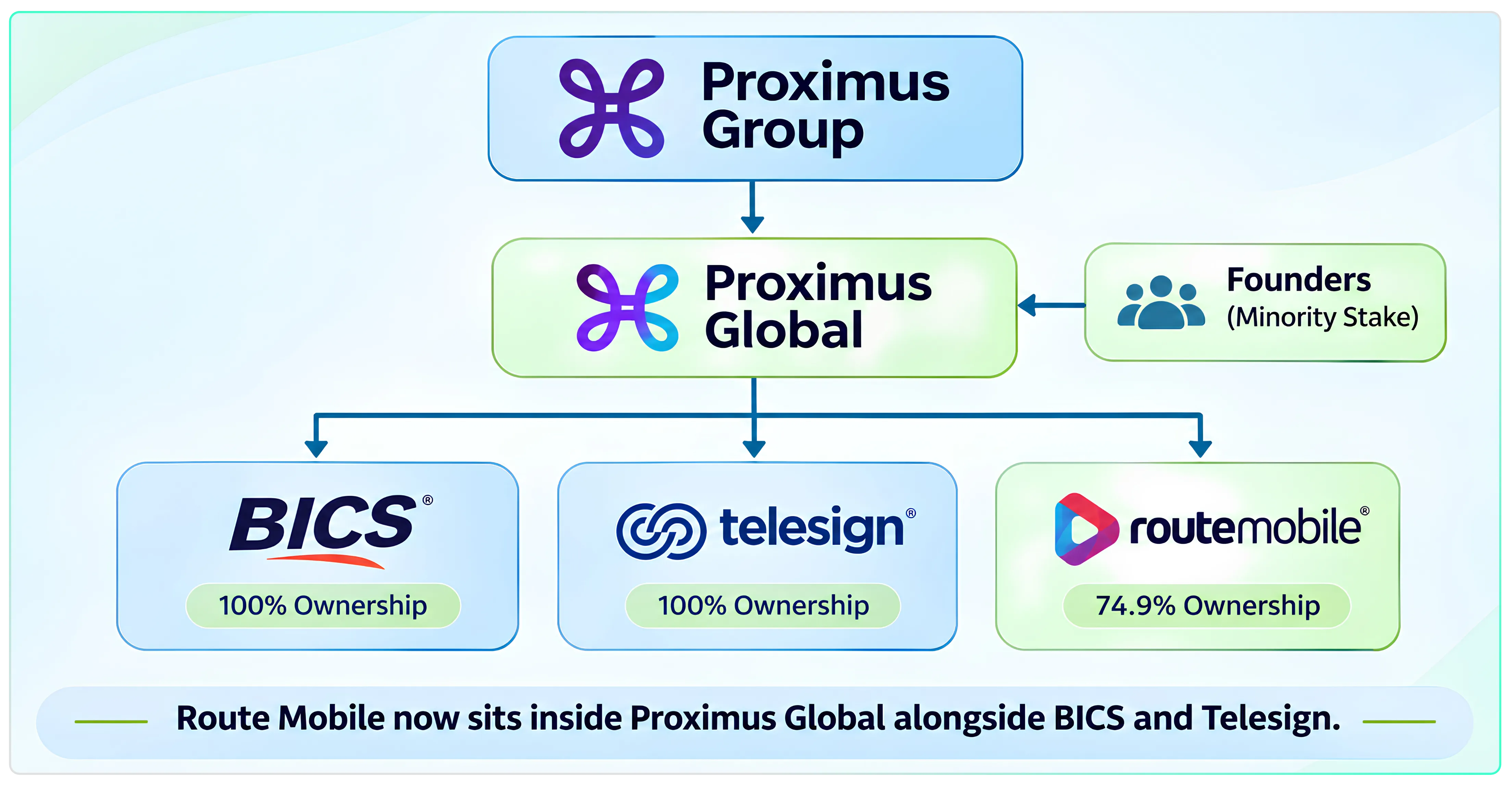
Organisation chart showing Proximus Global owning BICS, Telesign and 74.9% of Route Mobile.
Why the messaging business is changing
For most of the last decade, SMS was the default way for a business to reach a customer. That is shifting, in two ways.
1. International SMS into India is shrinking. Global companies that send OTPs to Indian users (called ILD, or international long-distance traffic) have been moving volumes to cheaper channels such as WhatsApp and app notifications. On the Q4 FY26 call, management said ILD makes up roughly a quarter to a third of revenue and is in long-term decline. It was the main reason FY26 revenue fell 3.7%. Management says the fall has now levelled off, and ILD was flat in Q2 FY27.
2. Domestic business is growing, and new channels are rising. Volume from Indian companies sending messages within India has grown, and businesses are adopting WhatsApp and RCS for richer conversations — sales, customer care, payments. These channels carry higher margins for Route Mobile than plain international SMS.
There is a catch. Management explained that the FY26 revenue drop came from price, not volume. An international OTP pays Route Mobile much more per message than a domestic one, so it takes many more domestic messages to replace each lost international message. Total transactions actually grew: 93.4 billion in H1 FY27, about 11% more than a year earlier.
India remains Route Mobile's largest market, but its share is falling: messages delivered to Indian numbers made up about 41% of revenue in FY26, down from about half in FY25. Financial services is its biggest customer group (15% of revenue), followed by digital-native companies such as apps and platforms (12%).
The question for any investor is simple: will the new channels grow faster than old SMS shrinks? Most of what follows comes back to that question.
The Route Mobile financial story
| ₹ Crore | FY21 | FY22 | FY23 | FY24 | FY25 | FY26 | H1 FY27 |
|---|---|---|---|---|---|---|---|
| Revenue | 1,406 | 2,002 | 3,569 | 4,023 | 4,576 | 4,408 | 2,331 |
| Revenue growth | — | 42% | 78% | 13% | 14% | −4% | +7% |
| Gross margin | 19.7% | 21.0% | 22.0% | 21.4% | 20.8% | 22.9% | 21.6% |
| EBITDA (adjusted) | 174 | 258 | 457 | 511 | 524 | 526 | 227 |
| EBITDA margin | 12.4% | 12.9% | 12.8% | 12.7% | 11.5% | 11.9% | 9.8% |
| Net profit (reported) | 133 | 170 | 333 | 389 | 334 | 257 | 151 |
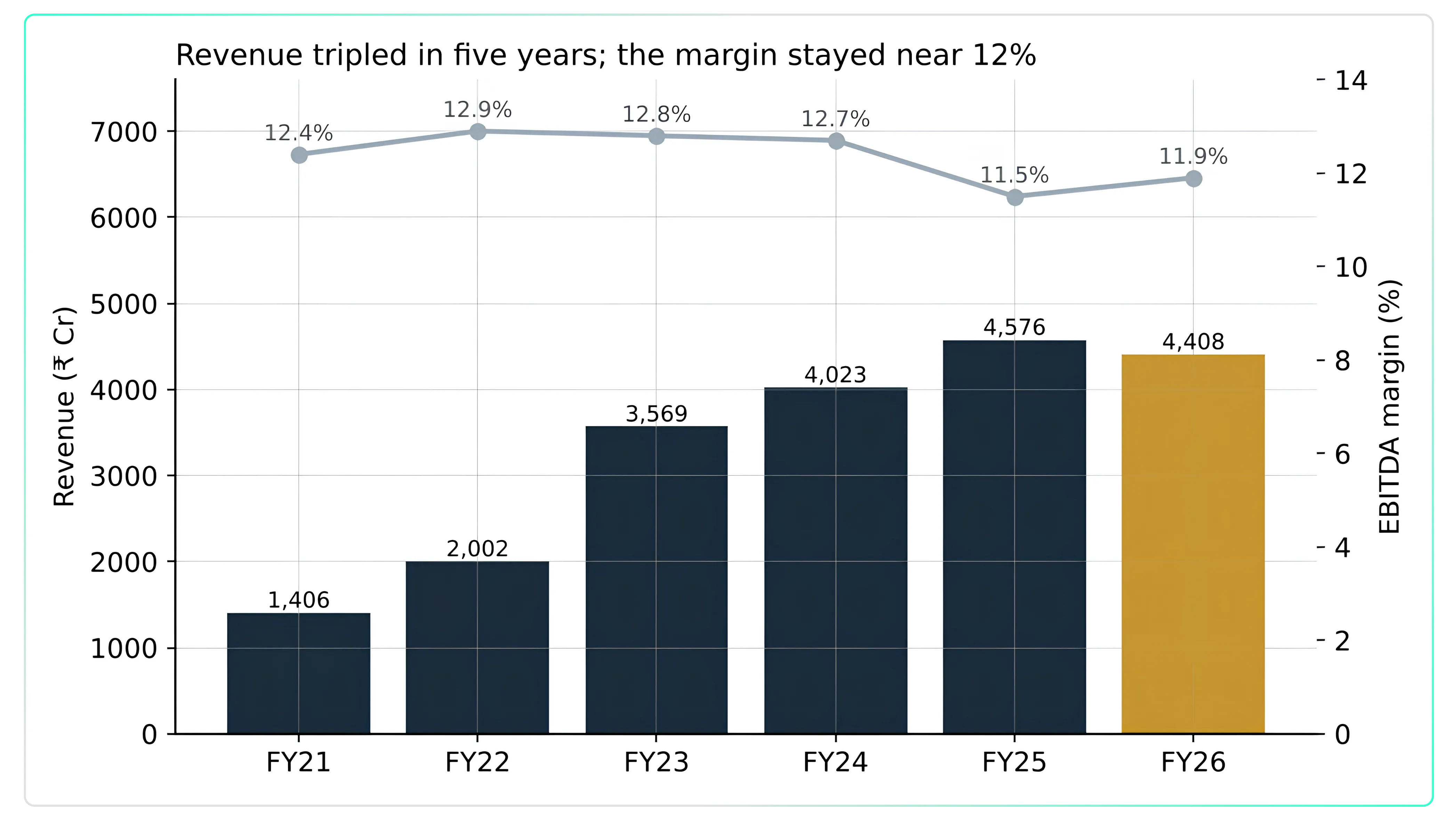
Revenue grew about 3.1x between FY21 and FY26. EBITDA margin stayed in an 11–13% band.
What this table shows:
1. A growth phase, then a pause. Revenue rose from ₹1,406 crore in FY21 to ₹4,576 crore in FY25 — about 34% a year — helped by acquisitions such as Masivian in Colombia. FY26 was the first year of decline, as low-margin international SMS volumes fell away.
2. Margins never expanded with scale. A company that triples its revenue usually earns a higher margin, because fixed costs get spread over more sales. That did not happen here. EBITDA margin was 12.4% in FY21 and 11.9% in FY26. The tolls paid to operators rise with volume, so scale alone does not lift margins.
3. EBITDA has been flat for three years. EBITDA was ₹511 crore in FY24, ₹524 crore in FY25 and ₹526 crore in FY26. The business is stable but not growing its earnings.
4. Reported profit has fallen, but mostly because of one-off charges. We look at these next.
The write-off problem
Reported net profit fell from ₹389 crore in FY24 to ₹257 crore in FY26. Most of this drop came from exceptional items — losses the company treats as one-time, outside normal operations.
| ₹ Crore | FY24 | FY25 | FY26 |
|---|---|---|---|
| Profit before one-offs and tax | 438 | 445 | 489 |
| Exceptional items (one-offs) | +17 | −18 | −136 |
| Profit before tax (reported) | 455 | 426 | 353 |
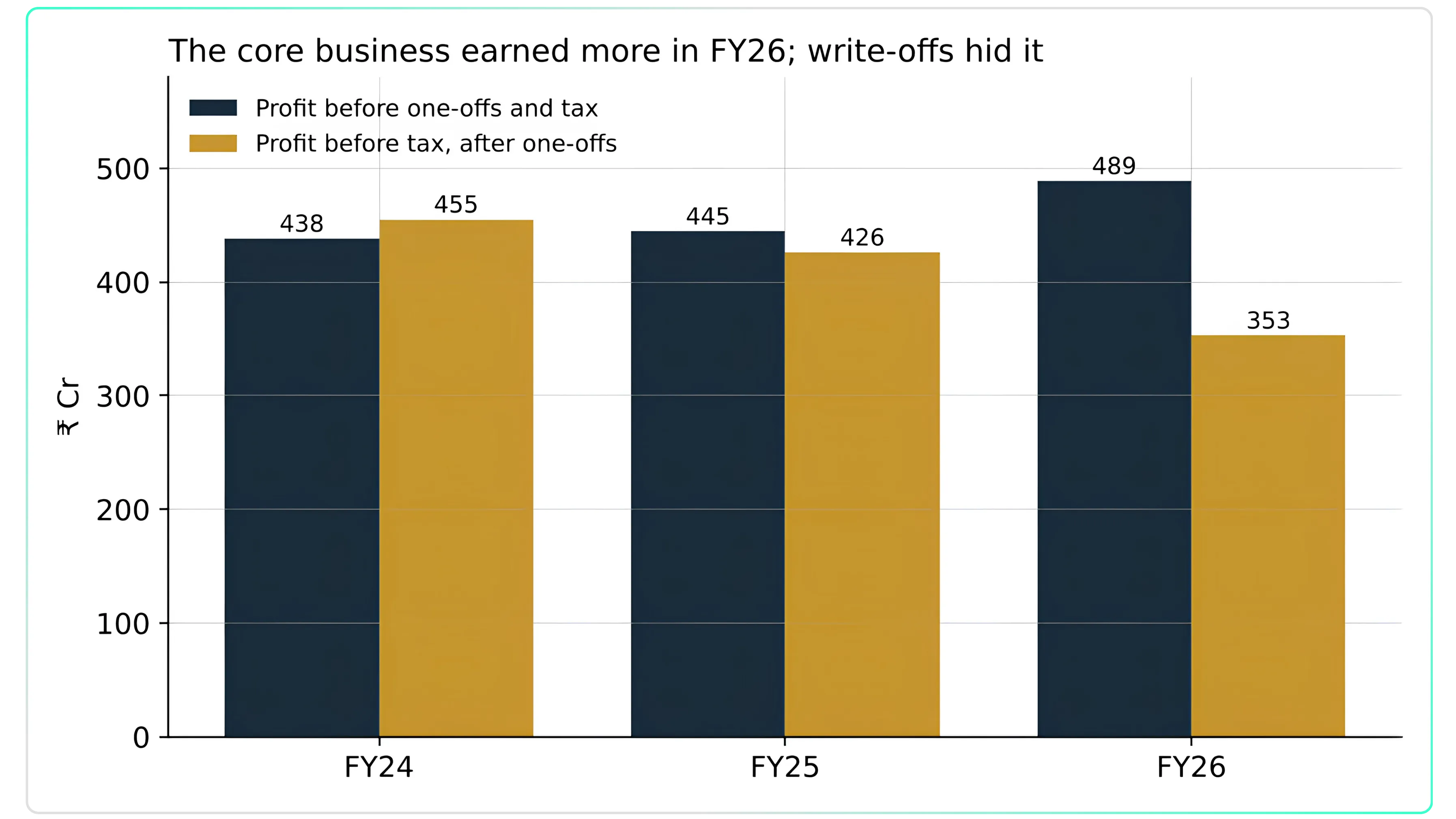
Profit before one-offs rose about 10% in FY26. Reported profit fell because of a ₹136 crore write-off.
What were these charges?
FY25 (₹18 crore net; ₹25 crore in Q4): impairment of goodwill at a step-down subsidiary (a past acquisition that was worth less than the price paid), a write-off of money owed by a telecom operator, and a loss on a short-term operator contract that was not fulfilled.
FY26 (₹136 crore, booked in Q2 FY26): ₹108 crore written off after an arbitration ruling went against Route Mobile in a dispute with a vendor, and ₹28 crore of advance payments to another vendor that stopped operating.
Two points are worth holding together. The core business — profit before one-offs — earned more in FY26 than in FY25, and the write-off sat in overseas subsidiaries: standalone profit at the Indian parent grew about 3%. But in a business where the company pays large advances to operators and aggregators to secure capacity, write-offs on those advances are a cost of doing business, not purely bad luck. Two years in a row of such charges means investors cannot fully ignore them.
Route Mobile cash and dividends: the strongest part of the story
If the profit line has been noisy, the cash line has been strong for the last two years — though that has not always been the case.
- Almost no debt. The company repaid most of its borrowings during FY26. They fell from ₹468 crore in March 2025 to ₹42 crore in March 2026 and ₹39 crore in September 2026, a debt-to-equity ratio of just 0.01.
- Large cash pile. Cash and equivalents stood at about ₹1,389 crore at the end of FY26, up from ₹1,333 crore a year earlier.
- Profits turn into cash. Cash flow from operations was ₹581 crore in FY26 — 110.5% of adjusted EBITDA. In simple terms, for every ₹100 of operating profit, ₹110 arrived in the bank. FY25 conversion was 114%. This is a recent strength, not a long record: operating cash flow was only ₹73 crore in FY23 and negative ₹98 crore in FY24, when money owed by customers swelled (debtor days reached 97).
- Rising dividends. Total dividend for FY26 was ₹11 per share. For FY27, management has guided a gross dividend of ₹16.5 per share, and two interim dividends of ₹4 each have already been declared.
On how the cash will be used, management was clear on the Q2 FY27 call: acquisitions come first, and dividends and buybacks are secondary. It says it wants AI and chat-channel companies, not more SMS businesses. It also estimates its truly free cash at ₹1,150–1,200 crore, lower than the headline cash figure, because part of the cash is needed for advance payments to vendors.
One caution for the coming quarters: in Q2 FY27, operating cash flow lagged net profit because money owed by customers (receivables) went up. Working-capital days also rose from 7 in FY25 to 40 in FY26. This is worth watching, because the strong cash conversion of the last two years has not always held.
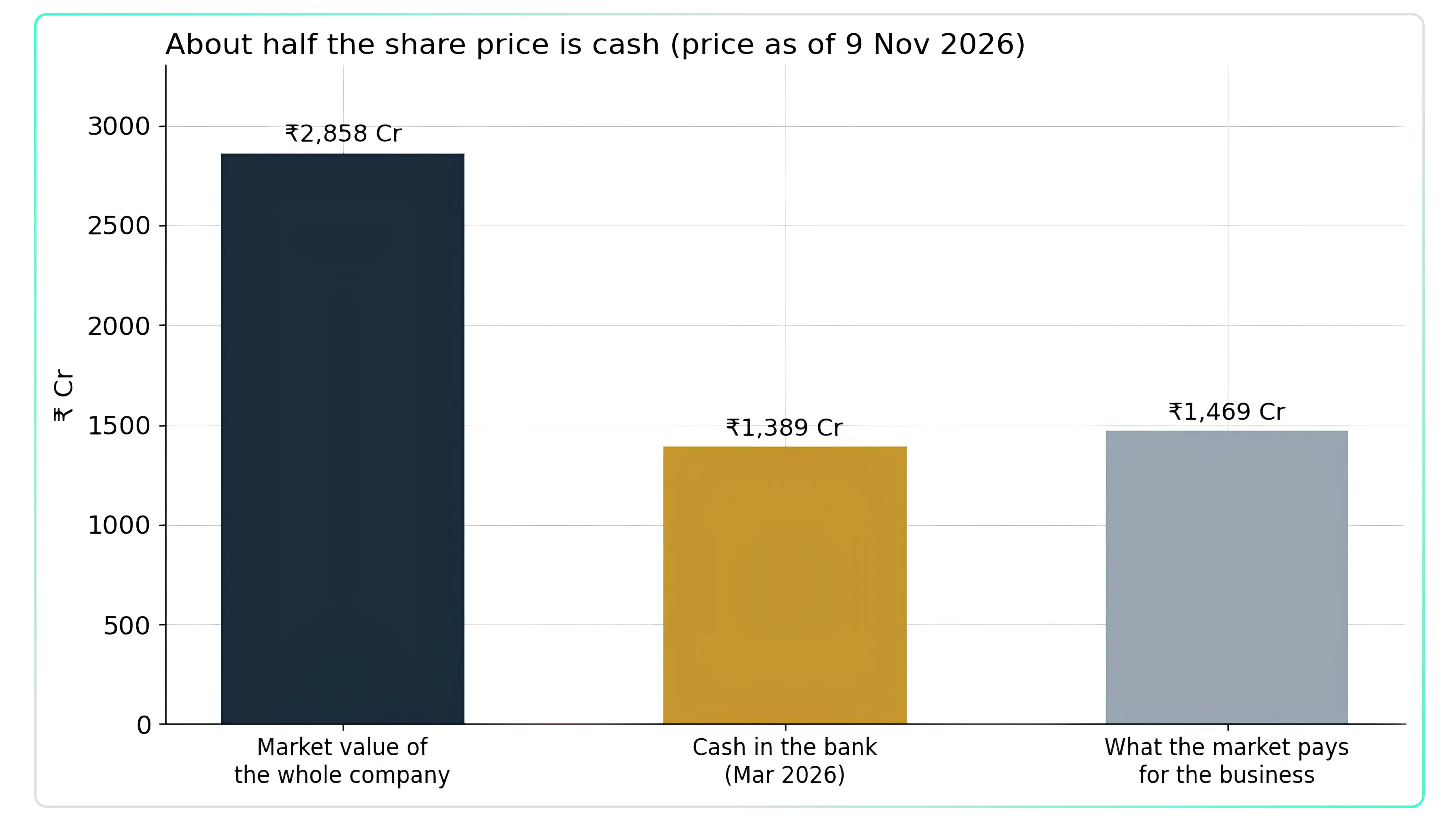
Market value based on ₹454 per share (9 November 2026). Cash as of 31 March 2026; dividends and the Heltar purchase have used some since.
Latest quarters: back to growth, margins still recovering
| ₹ Crore | Q1 FY26 | Q2 FY26 | Q3 FY26 | Q4 FY26 | Q1 FY27 | Q2 FY27 |
|---|---|---|---|---|---|---|
| Revenue | 1,051 | 1,119 | 1,107 | 1,131 | 1,152 | 1,180 |
| Gross margin | 21.4% | 22.1% | 24.5% | 23.3% | 20.9% | 22.4% |
| Adjusted EBITDA | 115 | 133 | 143 | 134 | 109 | 118 |
| EBITDA margin | 11.0% | 11.9% | 12.9% | 11.9% | 9.5% | 10.0% |
| Net profit (reported) | 59 | −19 | 103 | 114 | 69 | 83 |
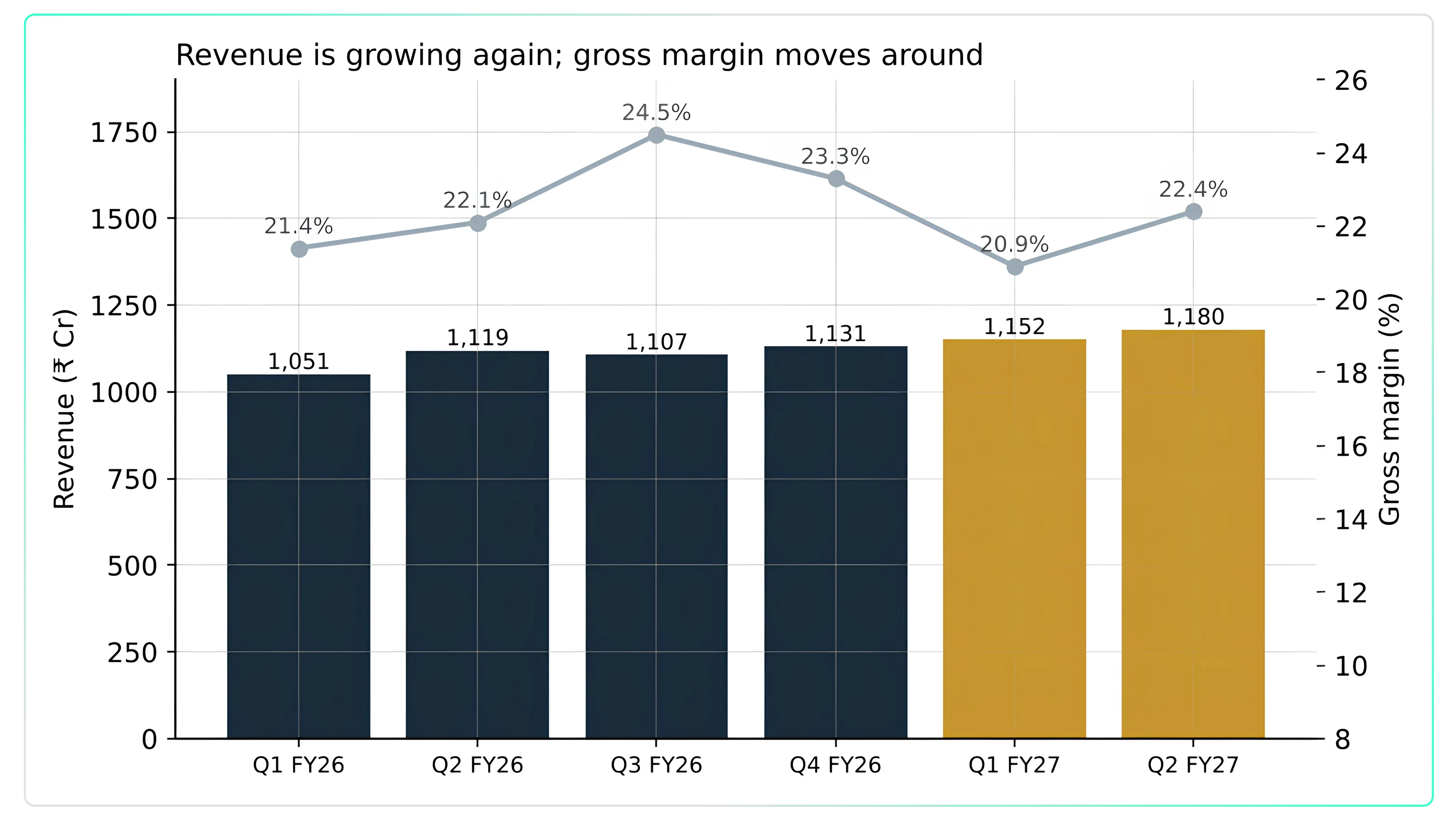
Revenue has risen for three quarters in a row. Gross margin dipped in Q1 FY27 and partly recovered in Q2.
Revenue has grown every quarter since Q3 FY26, and H1 FY27 revenue was up 7.4% year-on-year. That is in line with management's FY27 guidance of mid-to-high single-digit growth.
Profitability is the weaker part. In Q1 FY27, gross margin fell to 20.9%. Management said traffic from some large, high-margin customers was disrupted while new systems were rolled out, and there was a smaller impact from a security incident at its Colombian subsidiary. Gross margin recovered to 22.4% in Q2, but EBITDA margin stayed at 10% because of salary increases, higher legal spending, clean-up costs from the Colombia security incident and the timing of a bonus provision. The CFO said these one-offs do not affect the underlying run rate, and a new CEO has been appointed at the Colombian unit (Masivian). On the call, management also admitted to "execution issues" on the path back to 12%. Management is targeting a return to about 12% EBITDA margin in the second half. Even if it gets there, full-year EBITDA would be roughly flat, at about ₹515 crore against ₹526 crore in FY26, because the first half ran below 10%. Management has also spoken of mid-single-digit EBITDA growth for the year; by our estimate that would need a second-half margin closer to 14%.
What gives Route Mobile its edge?
Direct links into telecom networks
Around 280 direct operator connections took years to build. A new competitor cannot replicate them quickly, and they let Route Mobile route messages on the cheapest reliable path.
Customers who stay and spend more
Net revenue retention was 105% in H1 FY27. That means existing customers, as a group, spent 5% more than a year ago. About 93% of revenue over the last twelve months was recurring, up from 89% in FY26. Large accounts are growing too: 80 customers now bill more than $1 million a year, up from 73 in FY26. The top five customers made up 30% of revenue, down from 33% a year earlier.
Net revenue retention compares what the same set of customers paid this year with what they paid last year. Above 100% means existing customers are, on balance, using the service more.
A high-margin firewall business
The firewall product sells to telecom operators rather than to businesses, and earns 50–60% gross margin. Each new operator contract adds profit far out of proportion to its revenue. A large deal with Claro (a big Latin American operator) is live across three networks, and the firewall business hit its highest-ever monthly revenue in early 2026. Management says more operator deals are in advanced discussion, and that some operator customers earn up to 70% gross margin. On 3 November 2026, 365squared also launched 365callguard, an AI-based voice-fraud protection product for operators and carriers.
A cash-rich, nearly debt-free balance sheet
With roughly ₹1,400 crore of cash and almost no debt, Route Mobile can invest in new products, make small acquisitions and pay dividends without borrowing.
A global parent
Being part of Proximus Global gives Route Mobile access to BICS's carrier relationships and Telesign's international customers. Joint commercial programmes with both are running. The parent also opens the door to Network APIs — software hooks that let apps use telecom network features (such as confirming that a SIM has not just been swapped, a common fraud signal). Route Mobile has deployed a silent-verification product for Aakash Education and is selling a network-API product called Konera. Management says it is too early to put a number on this opportunity.
Where is growth coming from?
| Growth driver | Where it stands | What to watch |
|---|---|---|
| New products (WhatsApp, RCS, AI chat) | ₹128 Cr in Q2 FY27, +37% year-on-year, over 10% of revenue | Share of revenue rising towards 15% |
| SMS firewall for operators | 50–60% gross margin; Claro live on three networks; new deals in the pipeline | New operator contracts signed |
| Heltar acquisition | AI-led customer-engagement platform bought for ₹33.7 Cr (₹23.9 Cr paid, ₹9.8 Cr due in 18 months); added only about ₹5 Cr to Q2 revenue; meant to add subscription and outcome-based pricing, not just per-message fees | Cross-selling to the top-50 enterprise clients |
| Network APIs with Proximus Global | Early stage | First paying customers and revenue disclosure |
| Acquisitions using cash | Looking at conversational-AI companies in Latin America, Southeast Asia, Western markets and Saudi Arabia; no deal yet | Price paid and fit |
| Outbound international traffic | Two new contracts with Indian banks for messages sent to customers abroad | Ramp-up in coming quarters |
Management guidance for FY27: revenue growth in the mid-to-high single digits, adjusted EBITDA margin of around 12%, and a dividend of ₹16.5 per share. These are management's targets, not results.
A sense of scale is useful here. New products earn roughly ₹500 crore a year at the current run rate, against total revenue of about ₹4,600 crore. They are growing fast, but they are still a small part of the whole. For now, the direction of the core SMS business still decides most of the result.
What can go wrong?
| Risk | Severity | Why it matters | Early-warning sign |
|---|---|---|---|
| Shift away from SMS to chat apps and app notifications | Major | FY26 revenue fell 3.7% as international SMS into India declined. If SMS shrinks faster than new products grow, revenue stalls. | Year-on-year revenue decline for two quarters in a row |
| Thin margins and the operators' pricing power | Major | About ₹77 of every ₹100 goes to telecom operators. One point of gross margin is worth about ₹44 Cr, or 8% of EBITDA. | Gross margin below 21% for two quarters |
| Repeated 'one-off' write-offs | Medium | ₹18 Cr in FY25 and ₹136 Cr in FY26, linked to vendor advances and disputes. | Any new exceptional item; operating cash flow below 80% of EBITDA; rising receivables |
| Control by the parent and related-party dealings | Medium | Proximus owns 74.8% and decides on cash use and sister-company pricing. Institutions hold under 4%, down from about 12.6% in March 2025. | Rising related-party revenue; cash moved to group entities |
| Leadership changes | Medium | The CEO role has changed hands twice since mid-2025; Tushar Agnihotri became CEO in February 2026, and Seckin Arikan replaced Mark Reid as Chairman in January 2026. | Further senior exits or strategy shifts |
| Acquisition risk | Medium | ₹1,400 Cr of cash invites deals. An FY25 goodwill write-down shows past deals have not all worked. | A large deal at a high price |
| Customer concentration | Low–Medium | Top five customers give 30% of revenue. | Loss of a top client |
| RCS price change by telcos | Medium | From 1 September 2026, telcos raised RCS marketing-message rates sharply (management said nearly double). RCS is part of the new-products engine. | Slower RCS volumes or new-product growth below 20% |
| Limited disclosure | Low–Medium | Management declined to share domestic vs overseas volume splits, product-level margins and related-party revenue share, citing competition. | Further cuts in disclosure |
| Regulation and security incidents | Low | Rules on commercial messaging (TRAI in India) and cyber incidents such as the one at its Colombian unit can disrupt traffic. | New rules on message pricing or delivery |
Route Mobile valuation: what is the market pricing?
All figures below use a share price of ₹454 (9 November 2026), a market value of about ₹2,858 crore, and cash of about ₹1,389 crore as of March 2026.
Method 1: Price-to-earnings (P/E)
Earnings per share over the last four reported quarters (Q3 FY26 to Q2 FY27) add up to about ₹55. At ₹454, the stock trades at about 8 times its trailing earnings.
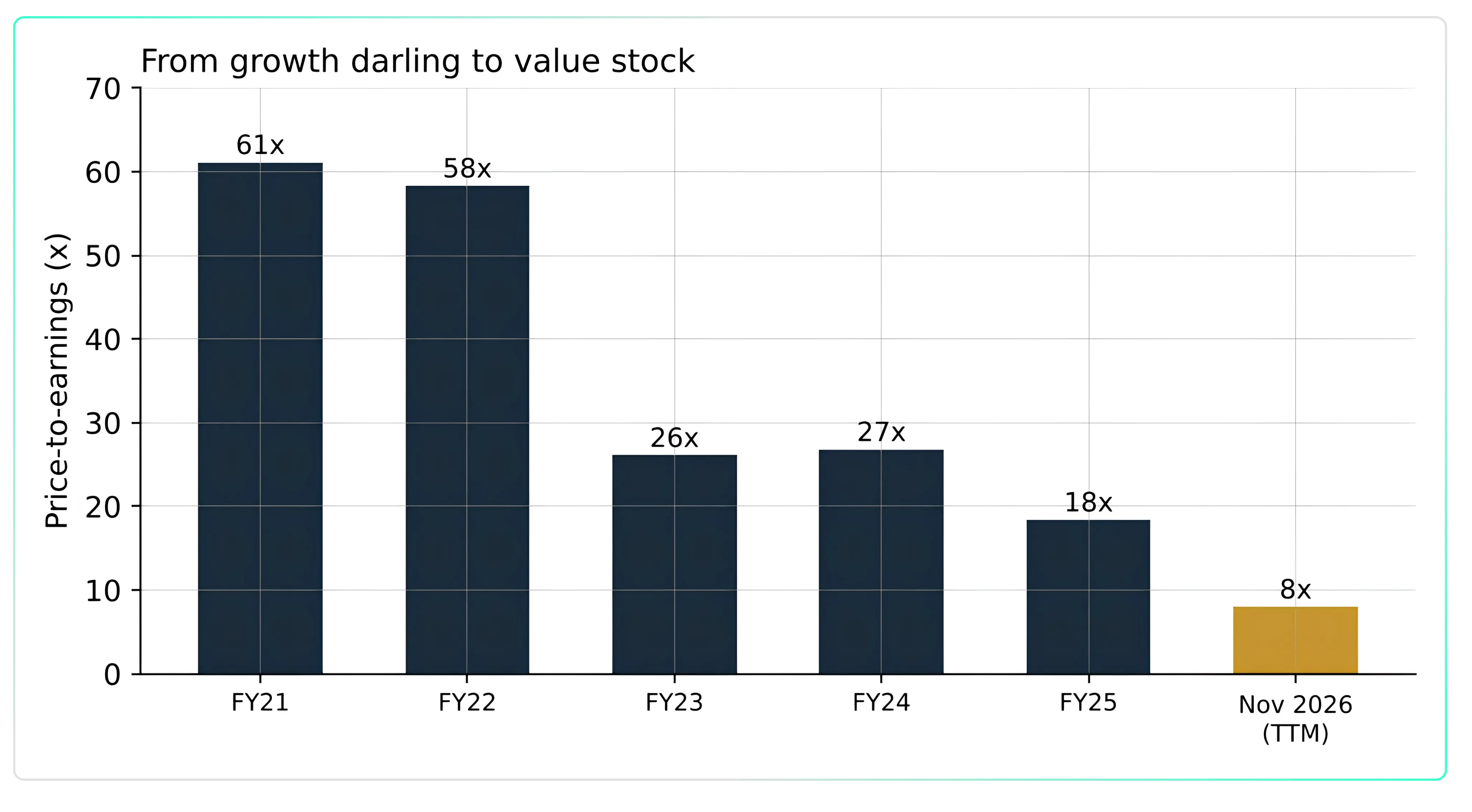
P/E at each financial year-end from Value Research; Nov 2026 figure is our calculation from trailing four-quarter EPS.
The market once paid around 60 times earnings for Route Mobile, when revenue was growing 40% a year. As growth slowed and then turned negative, the multiple fell year after year. Today's price assumes very little growth.
Method 2: EV/EBITDA — paying for the business, not the cash
A buyer of the whole company would get ₹1,389 crore of cash with it. Subtract that cash from the market value, and the market is paying about ₹1,469 crore for the operating business. Adjusted EBITDA over the last four quarters was about ₹505 crore. That gives an EV/EBITDA of about 2.9 times.
EV/EBITDA is how many years of operating profit you pay to buy the whole company, after adjusting for its cash and debt. Imagine a shop that earns ₹100 a year in operating profit. If you could buy it for ₹290 after taking out the cash in its till, you would be paying 2.9 years of profit.
Method 3: Cash per share
₹1,389 crore of cash spread over about 6.3 crore shares works out to roughly ₹220 per share — nearly half of the ₹454 share price. Using management's own, more cautious 'free cash' estimate of ₹1,150–1,200 crore, the figure is about ₹185–190 per share, or roughly 41% of the price. Either way, a buyer at ₹454 is paying ₹235–270 for the business itself, which earned about ₹80 per share in EBITDA over the last year. On the free-cash basis, EV/EBITDA rises to about 3.3 times.
Cash figure is from March 2026 and includes cash held across subsidiaries. It has since been used in part for dividends and the Heltar purchase.
Method 4: Price-to-book (P/B)
Book value is what shareholders' money in the company is worth on its balance sheet. For Route Mobile it is about ₹462 per share, so at ₹454 the stock trades at about 0.98 times book — slightly below the value of its own net assets.
Two cautions. Much of that book value is goodwill and intangible assets from past acquisitions rather than cash or hard assets, and the FY25 goodwill write-down shows those values can shrink. Even so, paying about 1x book for a business that earns a return on equity of about 13% (and about 17% on capital employed) is an undemanding price.
What the price implies under different outcomes
| Scenario (FY27E) | Assumption for H2 FY27 | FY27E net profit | P/E at ₹454 |
|---|---|---|---|
| Bull | EBITDA margin returns to ~12%, as management targets | ~₹348 Cr | 8.2x |
| Base | EBITDA margin around 11% | ~₹329 Cr | 8.7x |
| Mild bear | Margin stays near H1's 10% | ~₹310 Cr | 9.2x |
| Deep bear | Margin at 10% plus another ₹135 Cr write-off | ~₹175 Cr | 16.3x |
FY27E = estimate. H1 FY27 actual net profit of ₹151 Cr is included in every case. Scenarios are our illustrations, not forecasts. P/E = market value ÷ estimated net profit. Our model assumes H2 FY27 revenue of about ₹2,390 crore (7% growth for the full year), first-half levels of other income, interest and depreciation, and a 22% tax rate.
Across the first three outcomes, the stock trades at 8–9 times earnings, with nearly half its value in cash and a forward dividend yield of about 3.6% (₹16.5 guided dividend ÷ ₹454). The trailing yield, based on dividends actually paid over the last year, is about 2.4%. The deep-bear case shows the cost of another large write-off: the earnings multiple roughly doubles, but the cash and the business are still there.
What the market seems to be saying is not that Route Mobile is in trouble. It is saying it does not believe in growth, and it is not sure how the cash will be used — especially after management said acquisitions take priority over returning cash to shareholders. Those are the two things that would need to change for the view to shift.
Where the business stands today
Route Mobile is a courier that has run into a change in how people send letters. Its old route — international SMS into India — is shrinking. Its newer routes — domestic traffic, WhatsApp, RCS and firewall services — are growing, but they are still a small share of the whole. In the meantime, the business is stable: revenue near ₹4,600 crore a year, EBITDA steady at about ₹500 crore, strong cash conversion and almost no debt.
The market has moved from pricing Route Mobile as a fast-growing tech company to pricing it as a cash box. About half the share price is cash, the operating business is valued at under three times EBITDA, and the dividend is rising. Against that sit real concerns: two years of write-offs, flat EBITDA, frequent leadership changes and a controlling parent that makes the big decisions.
For investors following the company, the next few quarters come down to three numbers: whether EBITDA margin gets back to about 12%, whether new products keep growing above 30%, and whether the year passes without another exceptional charge.
For a related look at a company whose numbers the market had been slow to credit, see our piece on SAMHI Hotels: A Fundamental Analysis of the Turnaround Case. For another Indian company that works behind the scenes for large global clients, see A closer look at Laurus Labs beyond the market noise.
Disclaimer: The information provided in our blogs is for informational purposes only and should not be construed as financial, investment, or trading advice. Trading and investing in the securities market carries risk. Always conduct your own research and consult with a qualified financial advisor before making any investment decisions. Past performance is not indicative of future results. Copyrighted and original content for your trading and investing needs.
© 2026 — Tradejini. All Rights Reserved.