This article is a follow-up to our earlier coverage of Mahindra Logistics, where we examined the company's asset-light model, its dependence on the Mahindra group for revenue, and management's stated ambition to double revenue to ₹10,000 crore by FY26 while rebalancing away from traditional third-party logistics toward higher-margin network services. The central question at the time was whether that revenue leap would arrive. FY26 results give a clear, and somewhat unexpected, answer.
What Has Changed Since Our Last Report
Our earlier coverage, published in May 2025, looked at Mahindra Logistics as a company positioning itself for transformational growth. Revenue was around ₹6,105 crore, the business was carrying meaningful debt, and the headline promise was a near doubling of revenue to ₹10,000 crore within a year, supported by a shift in business mix toward express, freight forwarding and last-mile delivery.
FY26 results show the revenue target was not met. The company closed the year at ₹6,999 crore, roughly seven-tenths of the ₹10,000 crore figure. The mix shift also did not happen in the way described, as Contract Logistics still accounts for about 78% of revenue, almost exactly where it stood a year earlier. What did happen is more important than what didn't. After two consecutive years of losses, the company returned to profit. The story has changed from how fast can revenue grow to can this business make money, and management itself now frames its priority as profitable growth rather than scale for its own sake.
Three things also stand out that were not part of the earlier story. The company raised ₹749 crore through a rights issue and used most of it to clear its debt. It introduced a stricter way of reporting operating profit that strips out lease rent. And it deliberately shrank parts of the business, cutting empty warehouse space and exiting unprofitable last-mile sites, accepting lower revenue in exchange for better margins.
Mahindra Logistics Financial Recovery in Numbers
Before the FY26 detail, the multi-year context is worth stating plainly. FY24 was a loss-making year. FY25 was a larger loss before a recovery began. FY26 is the first year in which revenue, margins, and the bottom line all moved in the right direction together.
| Metric | FY25 | FY26 | Change |
|---|---|---|---|
| Revenue (₹ cr) | 6,105 | 6,999 | +14.7% |
| Gross Margin | 9.4% | 10.0% | +60 bps |
| Reported EBITDA (₹ cr) | 284 | 377 | +32.6% |
| Reported EBITDA Margin | 4.7% | 5.4% | +70 bps |
| Adjusted EBITDA (₹ cr) | 121 | 158 | +31% |
| Adjusted EBITDA Margin | 2.0% | 2.3% | +30 bps |
| Net Profit (₹ cr) | -35.8 | 2.3 | Turned positive |
| EPS (₹) | -4.8 | 0.2 | Turned positive |
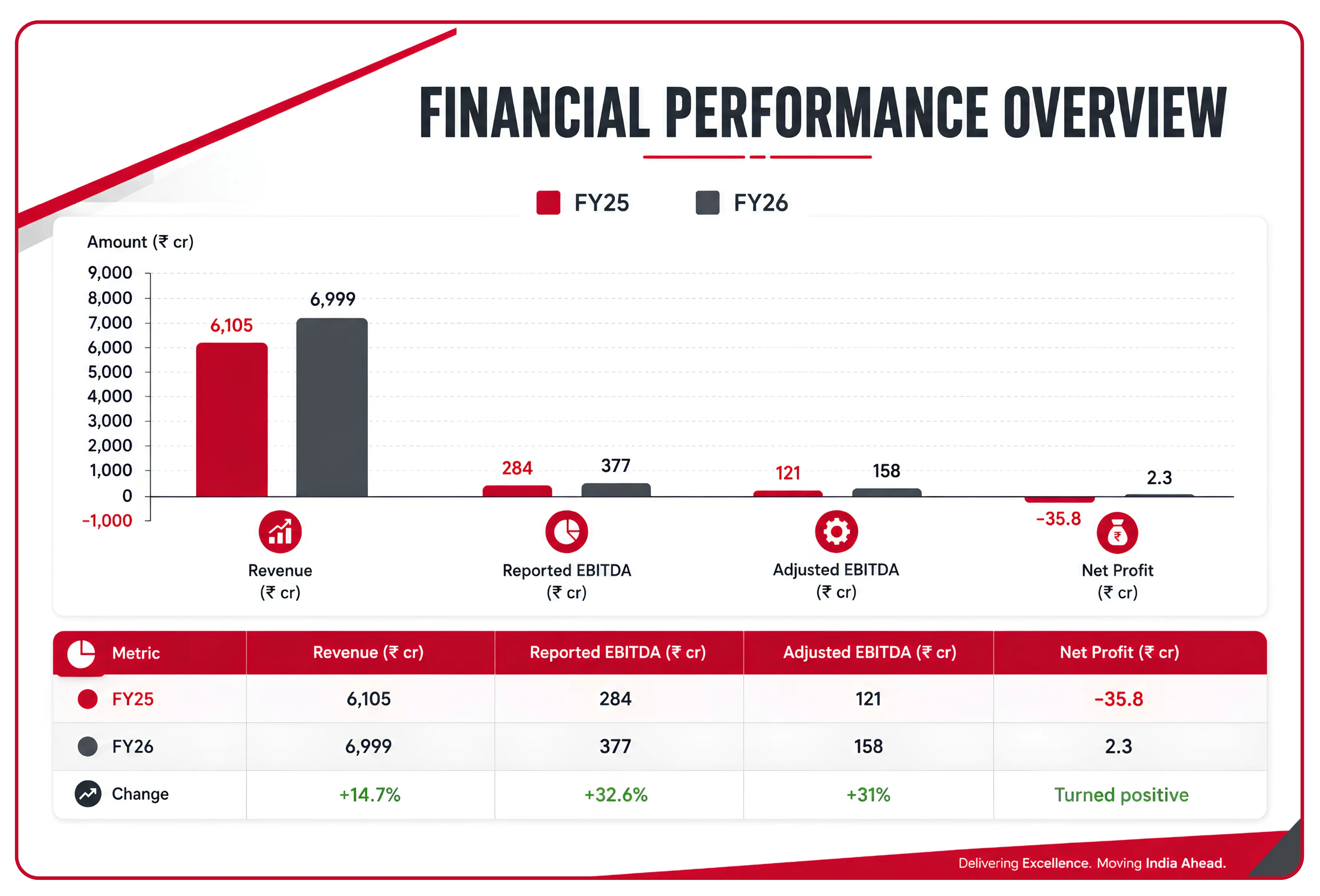
Revenue grew 14.7% to ₹6,999 crore. Profit margins improved at every level. For every ₹100 of revenue, the company kept ₹10.0 as gross profit, up from ₹9.40. At the operating level, the reported margin widened to 5.4% from 4.7%, and operating profit rose by nearly a third. Most importantly, the company reported a net profit of ₹2.3 crore against a loss of ₹35.8 crore the year before.
That net profit figure needs a footnote. FY26 carried a one-time charge tied to the new Labour Codes, a provision for past-service gratuity costs. Adjusting for the tax-effected impact of that item, the company puts its operational profit closer to ₹8.2 crore. Either way, the business moved from red to black.
There is also a presentation change to understand. Under accounting rules, long-term lease costs do not show up as plain rent but are split between depreciation and interest, which flatters reported operating profit. The company now also reports an Adjusted EBITDA that deducts the actual lease rent paid, which was ₹218 crore for the year. The bridge looks like this.
The improvement is real on both measures, but the adjusted figure is the more honest one to carry in your head. On that stricter basis the company's true operating cushion is just 2.3% of revenue. The business is profitable, but only slimly so.
Q4 FY26 Snapshot
The fourth quarter was the strongest of the year on profitability, even though revenue dipped sequentially.
| Metric | Q4 FY25 | Q3 FY26 | Q4 FY26 | YoY | QoQ |
|---|---|---|---|---|---|
| Revenue (₹ cr) | 1,570 | 1,898 | 1,791 | +14% | -6% |
| Gross Margin | 9.5% | 10.0% | 10.5% | +100 bps | +50 bps |
| EBITDA (₹ cr) | 78 | 103 | 112 | +45% | +9% |
| EBITDA Margin | 5.0% | 5.4% | 6.3% | +130 bps | +90 bps |
| Net Profit (₹ cr) | -6.7 | 3.3 | 20.2 | Turned positive | +6.1x |
| PAT Margin | -0.4% | 0.2% | 1.1% | — | — |
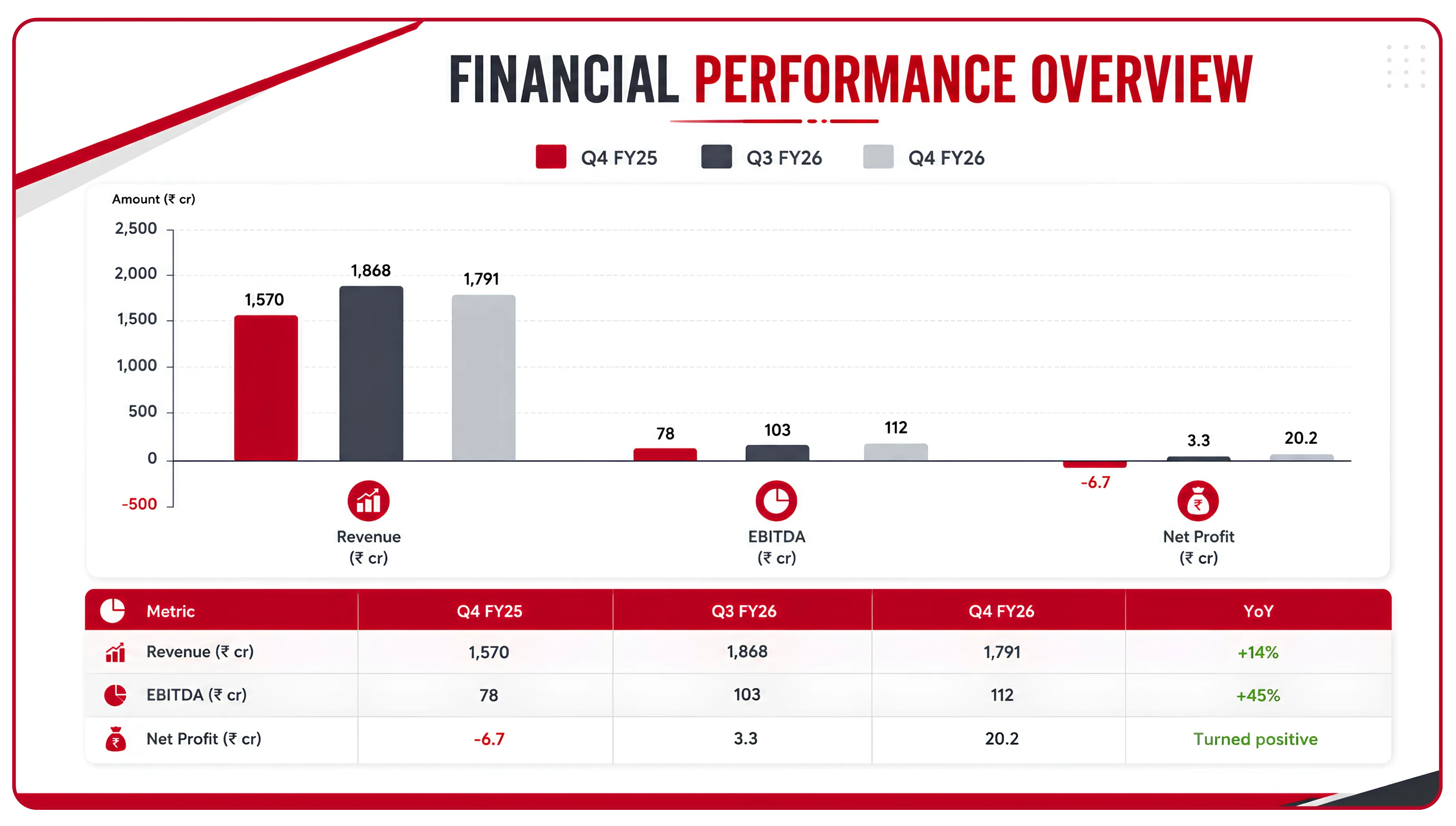
Quarterly revenue fell about 6% from the previous quarter, a reminder that logistics revenue can be lumpy, but operating margin reached 6.3%, its best of the year, and net profit of ₹20.2 crore was the clearest sign that the cost structure has started to work.
Segment Performance
The consolidated numbers hide five business lines at very different stages. The table shows full-year figures after intercompany eliminations.
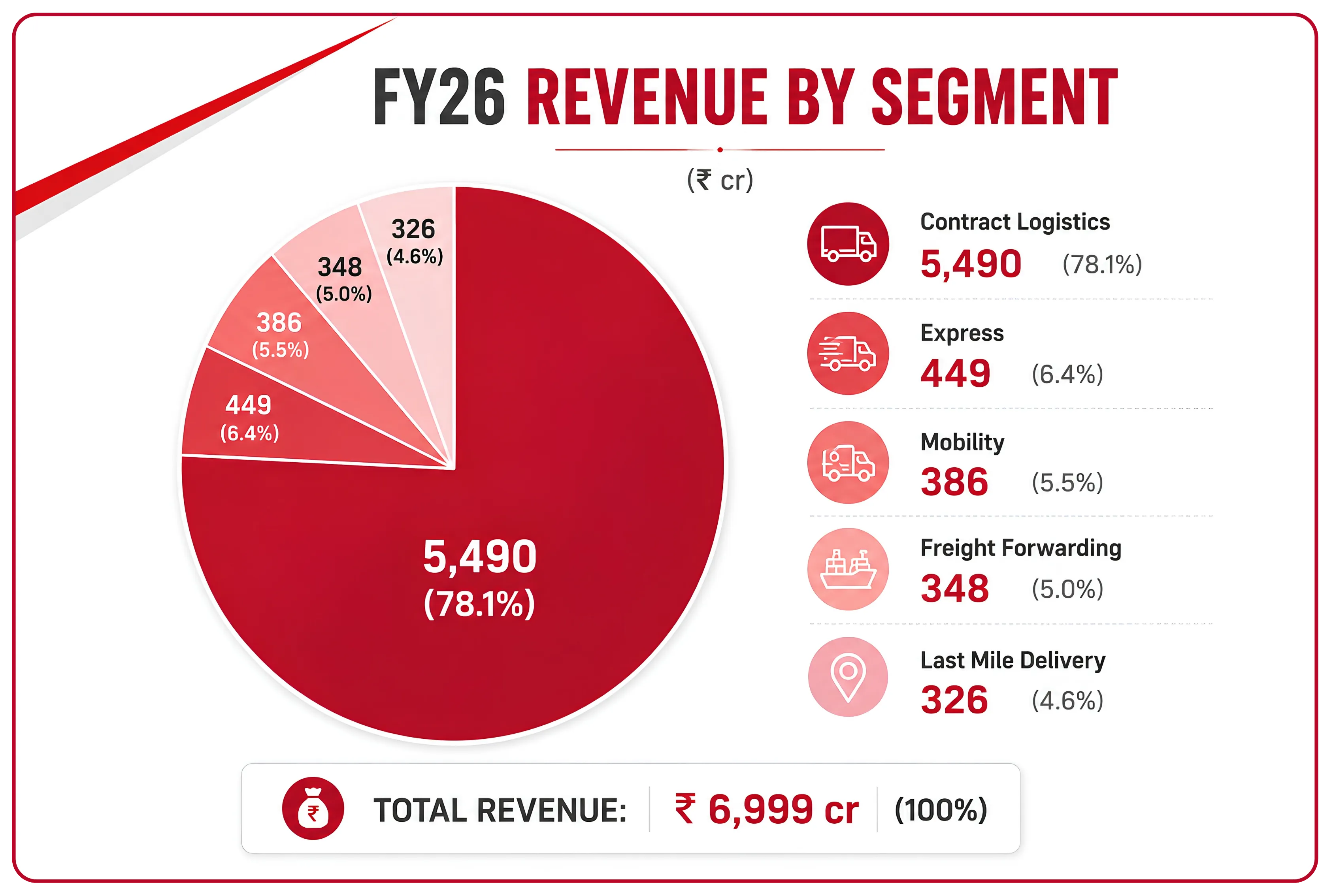
Contract Logistics remains the engine. Revenue grew 15.7% and segment operating profit rose 24% to ₹389 crore, driven by selectivity about customers and the advantage of running the parent group's complex distribution network. This is the part of the business that works, and it is what allowed the rest of the portfolio to be cleaned up without sinking the whole.
Express is the swing factor and the one to watch. This is the subsidiary, branded around MESPL, that has lost money for years. FY26 is the year it began to look fixable. Revenue grew 25% to ₹449 crore, the segment turned gross-margin positive for the full year at about 1.3% after years of negative gross margins, and the operating loss narrowed to ₹31 crore from ₹51 crore. Management says it is very close to operating breakeven but has refused to commit to a date. The right way to read Express is as a business that has stopped getting worse and started getting better, while remembering it is still loss-making.
Last Mile Delivery is a case of deliberate shrinkage. Revenue fell 14.5% because the company chose to exit unprofitable sites, and the result was that the fourth quarter swung to a small operating profit. Management says the pruning is now complete, which implies the segment should grow from here. Freight Forwarding grew 14% with operating profit rising to ₹10 crore, but it carries the most visible external risk, as its ocean and air trade lanes are directly exposed to the disruption in West Asia. Mobility, the corporate transport and premium-cab business under the Alyte and Meru brands, grew 22% and scaled its operating profit, though it remains the smallest line.
The Rights Issue and Balance Sheet Repair
The single largest event of the year does not appear in the revenue or profit lines. It sits in the balance sheet.
| Metric | Mar-25 | Mar-26 | Change |
|---|---|---|---|
| Total Borrowings (₹ cr) | 424 | 44 | -380 |
| Lease Liabilities (₹ cr) | 445 | 606 | +161 |
| Shareholders' Equity (₹ cr) | 454 | 1,199 | +745 |
| Cash & Bank (₹ cr) | 76 | 200 | +124 |
| Finance Cost, full year (₹ cr) | 44 | 24 | -20 |
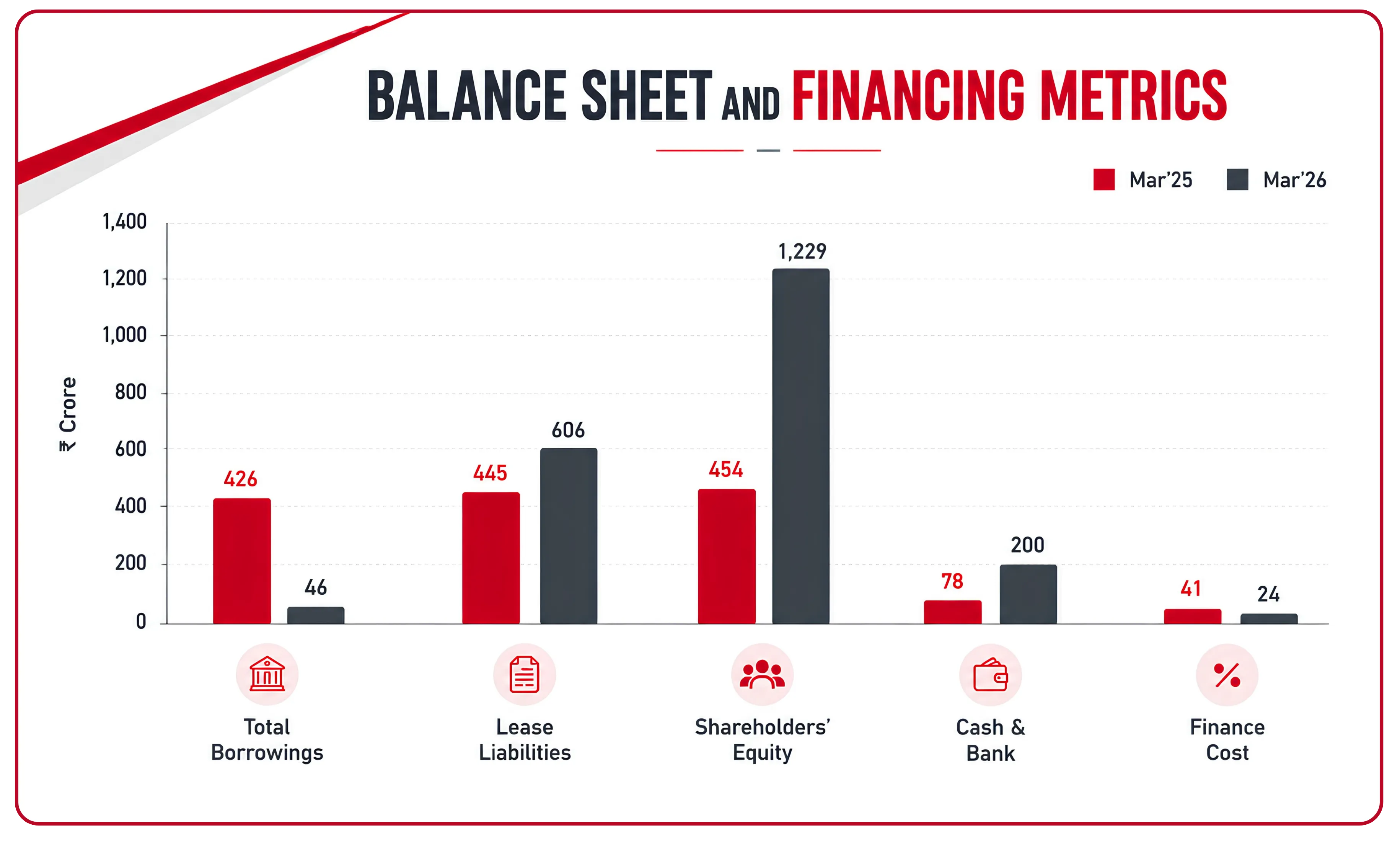
During FY26, Mahindra Logistics raised ₹749 crore through a rights issue, offering existing shareholders new shares at ₹277 each in the ratio of three new shares for every eight held. The Mahindra group subscribed in full, which both signalled confidence and limited dilution for minority holders. About ₹556 crore of the proceeds went to repaying debt.
The effect was dramatic. Total borrowings fell from roughly ₹424 crore to about ₹44 crore, an almost complete deleveraging. Shareholders' equity more than doubled. Finance costs nearly halved to ₹24 crore, which directly helped the swing to profit. A company that a year ago carried one of the heavier debt loads among mid-sized logistics players now carries almost none.
This deserves a measured reading rather than applause. The debt was not retired because the business generated enough cash to clear it. It was repaid with money raised from shareholders. That is a sensible move, and it removes the drag of interest, but existing owners funded the cleanup. It is also worth noting that while borrowings fell, lease liabilities rose to ₹606 crore, reflecting the warehousing and fleet commitments the asset-light model carries off the conventional debt line. On cash generation, the company produced ₹254 crore in net operating cash, lower than the prior year's ₹343 crore mainly because of higher taxes paid after a prior-year refund, though pre-tax operating cash actually rose to ₹410 crore from ₹309 crore.
The Warehousing Reset
The earlier report celebrated warehousing expansion. This year the language is about reduction, and that too is by design. The company cut what it calls white space, meaning warehousing it pays for but has not filled with paying customers, from 1.6 million square feet at the start of the year to 0.7 million by year-end, with a commitment to reduce it by 95% by September 2026. Total capacity came down to around 19 million square feet as the company relinquished leases tied to customers it no longer wanted. Empty warehouse space is pure cost, so shrinking it is part of the same margin discipline visible across the segments.
Leadership and the Smaller Print
Hemant Sikka continues as Managing Director and Chief Executive, and management credits the stability of the leadership team for the year's execution. For those tracking the Express turnaround, Ankur Bansal, previously head of strategy and transformation, has been appointed Chief Executive of the Express subsidiary with effect from June 2026, putting dedicated leadership over the segment that most needs it.
Two accounting items help read the profit figure correctly. Beyond the Labour Codes charge, the company provided roughly ₹28 crore against older receivables it judged harder to collect, a prudent housekeeping step, and recorded a gain of about ₹14 crore from the early termination of certain leases, the kind of item that can swing a thinly profitable line from one period to the next.
Risks to Watch
The Express business is still loss-making at the operating level, and management has given no committed timeline for breakeven, so the turnaround remains unproven until it covers its full costs. Freight Forwarding faces a real and ongoing headwind from the disruption in West Asia, with shipping delays and higher freight and insurance costs expected to persist in the near term. The business remains heavily dependent on a single anchor customer in the Mahindra group, which is a strength while that group grows but a concentration risk in itself. And the debt was cleared with shareholders' capital rather than internal cash generation, which raises the bar for the returns the business now needs to deliver to justify that money.
Where This Leaves Things
A year ago the question was whether Mahindra Logistics could grow fast enough to hit an ambitious revenue target. It did not, and it has effectively retired that target in favour of a different ambition. The question now is whether the profitability that returned in FY26 can be made durable and then widened. The case for optimism is that the turnaround is broad, with margins up across every segment, a debt-free balance sheet, and a loss-making Express business moving in the right direction. The case for caution is that the reported profit is small and flattered by presentation, the adjusted margin is thin, and the cleanup was funded by shareholders. The transformational revenue story did not arrive on schedule. What arrived instead was a company that learned to make money, which is a different outcome from the one the earlier report described, and arguably a more solid one to assess.
Disclaimer: The information provided in our blogs is for informational purposes only and should not be construed as financial, investment, or trading advice. Trading and investing in the securities market carries risk. Always conduct your own research and consult with a qualified financial advisor before making any investment decisions. Past performance is not indicative of future results. Copyrighted and original content for your trading and investing needs.
© 2026 — Tradejini. All Rights Reserved.