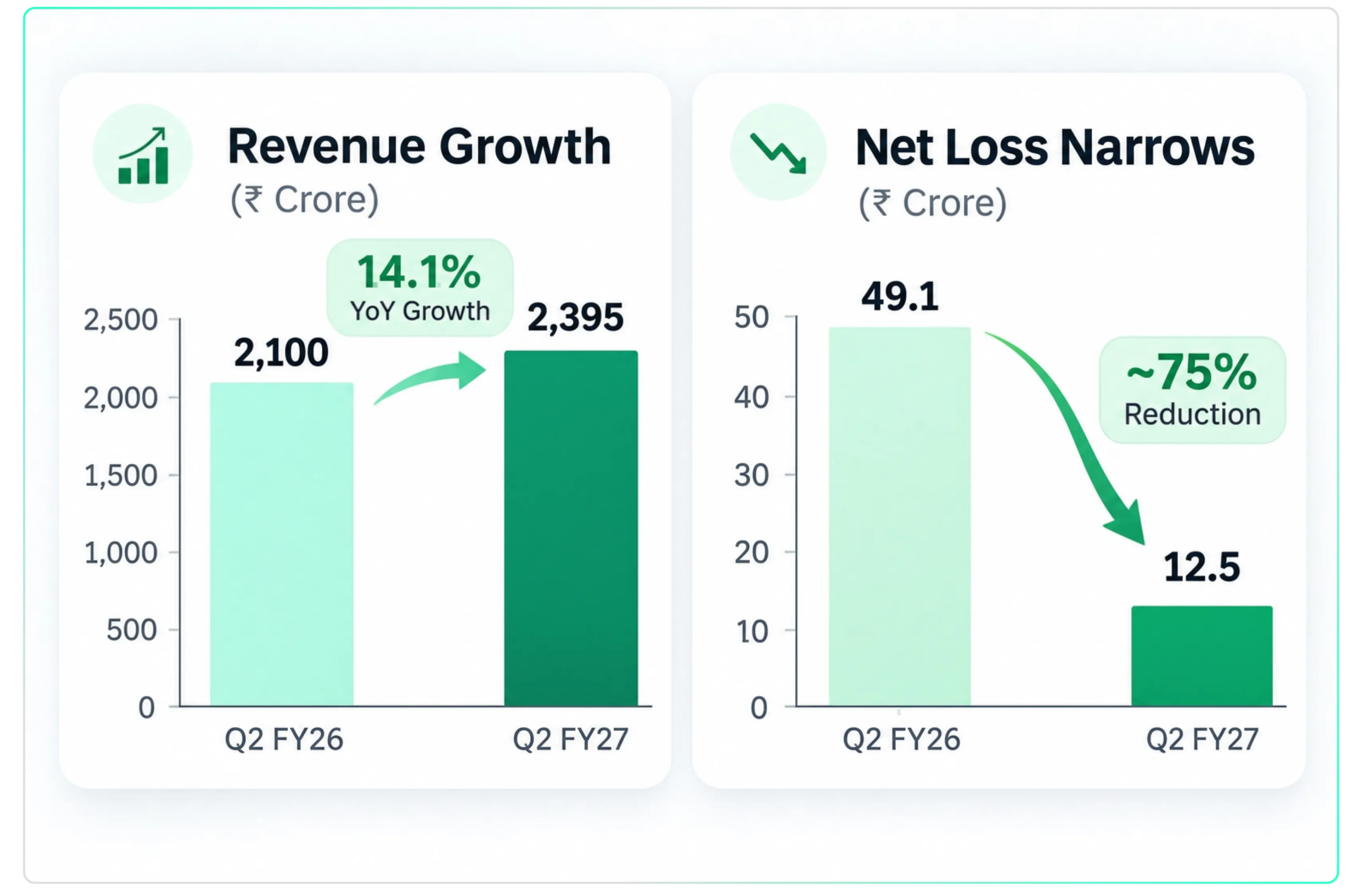
Brainbees Solutions, the parent company of FirstCry, reported a stronger Q2 FY27 performance, with consolidated revenue growing 14.1% year-on-year to ₹2,395 crore, its highest growth in six quarters.
The net loss narrowed nearly 75% to ₹12.5 crore from ₹51 crore in the year-ago quarter, indicating a significant improvement in profitability.
The improvement reflects progress in strengthening the delivery network, expanding product assortment and quick-commerce operations, and controlling operating costs.
Management expects gross margins in India to improve in Q3 and Q4 FY27, supported by lower competitive discounting in the diaper category and a recovery in manufacturing margins as crude-linked raw material costs normalise.
However, the sustainability of these margin improvements remains a key monitorable.
1. India Business: Growth Is Picking Up
India remains Brainbees' key growth engine. Its multi-channel business, covering online and offline operations, reported 18.6% year-on-year revenue growth, the highest in eight quarters.
Offline GMV grew approximately 13%, while online GMV increased 8%. GMV (Gross Merchandise Value) represents the total value of goods sold through a platform before applicable deductions. Management attributed the relatively slower online growth partly to festival timing, with some festive demand shifting from September to October.
However, online revenue, after adjusting for discounts, returns and taxes, grew by more than 10%. This provides a better indication of the revenue retained by the business.
The adjusted EBITDA margin for the India multi-channel business improved 120 basis points quarter-on-quarter to 6.9%.
What Is Driving the Improvement?
Management highlighted three key factors:
- Improved product assortment across online and offline channels.
- Better delivery experience, encouraging higher purchase frequency.
- Tighter control over logistics and reverse-pickup costs.
The company is also seeing moderation in competitive discounting in the diaper category, an important segment for FirstCry. Intense discounting had previously weighed on margins. Easing competition could support margin improvement in the coming quarters.
2. RocketBees: Building Its Own Delivery Network
A key development during the quarter was the expansion of RocketBees, Brainbees' in-house logistics and last-mile delivery network.
RocketBees has expanded its presence from 13 to 102 cities and now handles approximately 60% of online shipments.
Delivery performance has also improved significantly:
- Over 90% on-time delivery.
- 20% faster deliveries.
- 50% reduction in Return to Origin (RTO).
- 60% fewer delivery-related complaints.
Why does this matter?
Efficient delivery directly influences customer satisfaction, repeat purchases and operating costs. A better delivery experience can encourage customers to shop more frequently while reducing logistics-related expenses.
Management indicated that customer transaction frequency in RocketBees-served cities improved by 10%, contributing to an overall improvement of approximately 5%.
Over the long term, the expansion of RocketBees could reduce dependence on third-party logistics providers while improving delivery efficiency and cost control.
3. FC Quick: FirstCry's Quick-Commerce Opportunity
FirstCry is expanding its quick-commerce offering through FC Quick, which was operational in 16 cities by the end of Q2 FY27, offering delivery within one to three hours.
Management aims to eventually increase FC Quick's contribution to around 10% of total online volume.
Rather than focusing only on entering new cities, the company is expanding coverage within existing markets by adding more pin codes and delivery catchments. This approach can help build higher order density and improve delivery economics.
FirstCry can leverage its existing product catalogue, inventory network and customer base to offer faster delivery of baby-care and children's products.
However, the impact of scaling FC Quick on operating costs and margins remains an important monitorable.
4. Offline Expansion: Store Openings Resume
FirstCry's offline business continues to perform well. Despite operating with approximately 10 fewer stores, offline GMV grew around 13%, indicating improved productivity across existing stores.
Management attributed this growth partly to a sharper product assortment, with stores stocking products that are more relevant to customer demand.
After slowing company-owned store expansion to focus on capital efficiency, the company now plans to accelerate store openings.
Management's expansion plans:
- 50–60 new stores during the remainder of FY27.
- 90–100 new stores annually over the next two to three years.
FirstCry operates through two store models:
- FOFO (Franchise Owned, Franchise Operated): The franchise partner invests in and operates the store.
- COCO (Company Owned, Company Operated): The company invests in and operates the store.
The current store mix is approximately 55% FOFO and 45% COCO. Management expects COCO stores to expand faster, offering greater control over store operations and potentially better returns on capital.
New stores are expected to cover 3,000–4,000 sq. ft., with an estimated investment of ₹2,000–₹2,200 per sq. ft.
5. International Business: Moving Towards Profitability
FirstCry's international business, particularly in the Middle East, continued to show gradual improvement in Q2 FY27.
Key performance highlights:
- GMV grew 10% year-on-year, while revenue increased 6%.
- Gross margin improved to 28.5% from 26.3%.
- Adjusted EBITDA loss narrowed to ₹15.9 crore from ₹18.9 crore.
- Adjusted EBITDA loss as a percentage of revenue improved to 6.4% from 8% a year ago.
The company is focusing on increasing the contribution of home brands, improving product selection and strengthening customer acquisition and retention to improve profitability.
However, geopolitical uncertainty in the Middle East remains a key challenge. A more stable operating environment could support further growth in the region.
6. GlobalBees: Business Rationalisation Is Complete
GlobalBees, FirstCry's house of brands and consumer products business, reported revenue of ₹530.6 crore, up 7.7% year-on-year.
Adjusted EBITDA increased to ₹19 crore from ₹10.4 crore, while margins improved to 3.6% from 2.1%.
The company has completed the rationalisation of non-core brands and is now focused on improving the performance of its existing portfolio. Management also noted that the shifting of festive promotions and sales from Q2 last year to Q3 this year affected the quarterly performance.
Another positive development was the resolution of uncertainty surrounding the Kuber Mart dispute. The NCLT rejected the bankruptcy application, and management stated that no additional liability is expected to be recognised in GlobalBees' books.
Management expects further improvement in the coming quarters, although currency depreciation and temporary operational disruptions remain key monitorables.
7. Preschool Business: An Additional Growth Engine
FirstCry continues to expand its preschool network, which management views as an extension of its broader parenting ecosystem.
The network currently comprises:
- 512 schools across 218 cities.
- 28,075 enrolled students.
- Q2 revenue growth of 19.3% year-on-year.
- Adjusted EBITDA of ₹5.3 crore, compared with ₹2.9 crore a year ago.
The preschool business complements FirstCry's core retail operations by creating opportunities to cross-sell products and services. The broader strategy is to build an integrated ecosystem around young parents, driving customer engagement across both retail and education.
8. Swara Manufacturing IPO: A Strategic Move
Management discussed the proposed listing of Swara, Brainbees' manufacturing subsidiary, to raise capital and fund the expansion of its hygiene manufacturing business.
Swara aims to strengthen its position as a large OEM (Original Equipment Manufacturer), with plans to expand manufacturing capacity in domestic and international markets.
The listing could provide independent access to capital and greater visibility for the manufacturing business.
Importantly, Brainbees will continue to consolidate Swara's financial results after the listing and remain its holding company. Therefore, the proposed IPO should not be viewed as an exit from the manufacturing business.
9. Working Capital: Understanding the Rise in Other Current Assets
The increase in other current assets was primarily driven by accumulated GST credits and higher advances to suppliers, according to management.
The GST accumulation is partly linked to capital expenditure by Swara and the company's store expansion programme.
Despite this increase, the net working capital cycle improved from 67 days to 61 days, indicating better working capital efficiency.
Management also expects some relief from the accumulated GST credits following regulatory changes scheduled to take effect from April 1, 2027.
What Should Investors Watch Going Forward?
Q2 FY27 indicates progress in revenue growth and operating efficiency. However, the coming quarters will be crucial in determining whether these improvements translate into sustainable profitability.
Investors should monitor five key areas:
1. Gross Margin Recovery
Whether lower discounting in the diaper category and normalisation of crude-linked raw material costs translate into better gross margins in Q3 and Q4 FY27.
2. RocketBees and FC Quick Economics
Whether higher delivery volumes can improve customer purchase frequency while keeping logistics and delivery costs under control.
3. Offline Store Expansion
Whether the planned addition of 50–60 stores in H2 FY27 generates adequate returns on invested capital.
4. GlobalBees Profitability
Whether GlobalBees can sustain revenue growth and improve EBITDA margins following the completion of portfolio rationalisation.
5. Consolidated Profitability
Whether improving performance in India and narrowing international losses can help Brainbees move towards consistent consolidated profitability.
The Road Ahead: Can FirstCry Sustain Its Recovery?
FirstCry's Q2 FY27 performance indicates a gradual recovery in its operating performance. Revenue growth has accelerated, consolidated losses have narrowed, and the India business is showing improved operating efficiency.
The expansion of RocketBees, FC Quick and offline stores also reflects management's focus on strengthening its distribution and customer-service network.
However, growth alone will not determine the company's long-term success. The key question is whether these investments can translate into sustainable margins and consistent profitability.
Q3 and Q4 FY27 will be important quarters to watch, particularly for the expected recovery in India's gross margins.
Disclaimer: The information provided in our blogs is for informational purposes only and should not be construed as financial, investment, or trading advice. Trading and investing in the securities market carries risk. Always conduct your own research and consult with a qualified financial advisor before making any investment decisions. Past performance is not indicative of future results. Copyrighted and original content for your trading and investing needs.
© 2026 — Tradejini. All Rights Reserved.