After nearly two decades of intermittent negotiations, India and the European Union have finalised a long-awaited free trade agreement, marking a major milestone in India’s global trade strategy. Prime Minister Narendra Modi confirmed the development on Tuesday, 28th January 2026, calling it a transformative deal that opens up significant opportunities for both sides.
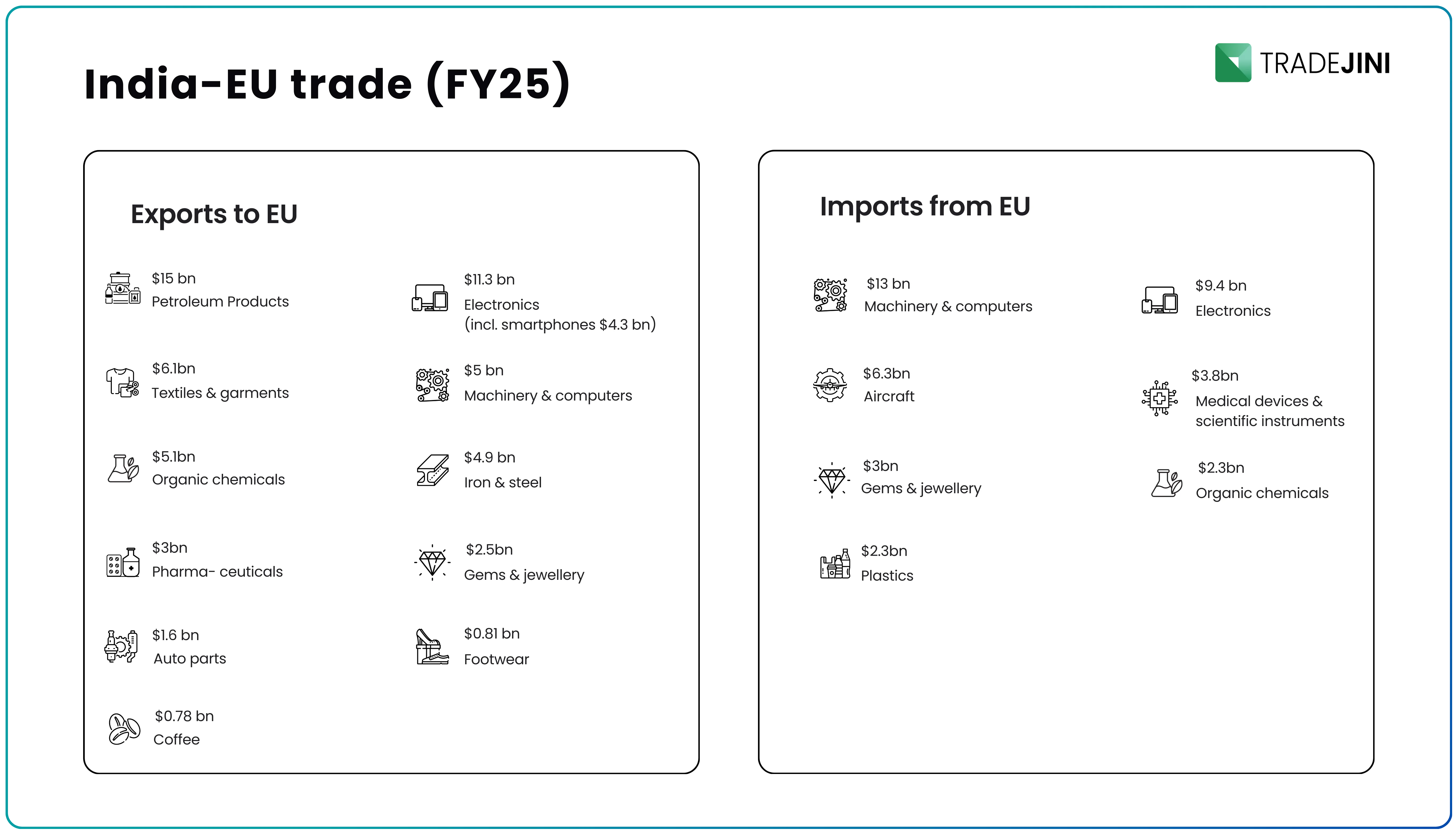
The agreement brings together two large economic partners. India, the world’s most populous country, and the European Union, a bloc of 27 nations and India’s biggest trading partner. Trade between India and the EU stood at $136.5 billion in the financial year ending March 2025, underlining the scale and importance of the relationship.
What's the deal?
- Duties will be reduced on 99.5% of goods exported from India to the EU, including products like seafood and footwear.
- India will cut or remove tariffs on 96.6% of goods imported from the EU, with gradual reductions for European cars and alcoholic beverages.
- After implementation, the agreement will cover a combined market of nearly 2 billion people, linking India and the 27-nation EU bloc.
- Indian textile exports to Europe, along with apparel, gems, and jewellery, are expected to be among the biggest gainers as EU duties fall to zero.
- Indian food producers will gain preferential access to European markets.
- Indian automobile and liquor companies may face tougher competition, as lower import duties make European products more affordable in India.

A Deal Years in the Making
Negotiations between India and the EU began almost 20 years ago but faced repeated pauses due to differences over market access, tariffs, labour standards, and regulatory issues. The finalisation of the India EU Free Trade Agreement 2026 signals that both sides have bridged these long-standing gaps.
Speaking about the agreement, Prime Minister Modi said the deal would create major opportunities for the 1.4 billion people of India and millions of citizens across Europe. European Commission President Ursula von der Leyen is expected to jointly announce the details of the agreement with the Prime Minister at the India–EU summit in New Delhi.
What the Agreement Is Expected to Do
While detailed provisions are yet to be formally released, the trade deal is expected to pave the way for greater market access between India and the EU. This includes a gradual opening of India’s traditionally guarded markets and smoother trade flows across goods, services, and investments.
For Indian exporters, especially in sectors such as engineering goods, pharmaceuticals, textiles, chemicals, and IT services, improved access to European markets could enhance competitiveness and scale. European companies, on the other hand, are likely to benefit from expanded access to India’s fast-growing consumer base and industrial ecosystem.
Part of a Broader Trade Push
The India–EU agreement comes at a time when both sides are actively strengthening trade ties with multiple global partners. The European Union has recently concluded trade agreements with several regions and countries, while India has also finalised trade pacts with nations such as the United Kingdom, New Zealand, and Oman.
This reflects a broader push by major economies to diversify trade relationships and build resilient supply chains through formal trade agreements.
Timeline for Implementation
According to officials familiar with the process, the agreement will now undergo legal vetting, a process expected to take around five to six months. Following this, the deal will move towards formal signing and ratification. The agreement is expected to be implemented within a year, subject to the completion of these procedures.
Why This Deal Matters
The India–EU trade agreement is significant not just because of its size, but because of what it represents. It signals India’s growing integration with major global economies and reinforces the EU’s role as a key long-term trade partner. For businesses, investors, and policymakers, the deal could reshape trade flows, investment decisions, and economic cooperation between the two regions in the years ahead.
As more operational details emerge, the focus will shift to how effectively this landmark bilateral trade agreement India EU translates into sustained economic gains.
(Source: Reuters and India Today)
Time to build your portfolio the smarter way with CubePlus. 👉 Create your CubePlus account
Disclaimer: The information provided in our blogs is for informational purposes only and should not be construed as financial, investment, or trading advice. Trading and investing in the securities market carries risk. Always conduct your own research and consult with a qualified financial advisor before making any investment decisions. Past performance is not indicative of future results. Copyrighted and original content for your trading and investing needs.
© 2026 — Tradejini. All Rights Reserved.