A Real Estate Investment Trust (REITs) also known as a real estate income trust is a company that owns and, in most cases, operates income-generating real estate. REITs hold a diverse range of property types, including office buildings, apartment complexes, studios, warehouses, hospitals, shopping centers, hotels, and commercial forests. Certain REITs also engage in real estate financing activities.
Functioning as a link between financial markets, institutional investors, and the real estate sector, REITs play a role in facilitating housing and urban development. They are generally classified into Commercial REITs (C-REITs) and Residential REITs (R-REITs), with the latter specializing in housing assets such as apartments and single-family residences.
While trading volumes aren’t massive, they are sufficient for most retail investors, and large orders can be handled easily with limit or iceberg orders. Once invested, it’s wise to review the REIT’s annual report each year to ensure it’s performing in line with expectations.

Types:
1. Equity REITs
Equity REITs are among the most common types, primarily focused on owning, operating and managing income-generating commercial properties. Their primary source of revenue is rental income. These are the most common types of real estate investment trust in the market.
2. Mortgage REITs (mREITs)
Mortgage REITs primarily engage in lending to property owners and providing mortgage financing. They also invest in mortgage-backed securities. Their income is derived mainly from the interest earned on funds lent to property owners. They are a popular choice in reit investing because income comes mainly from interest.
3. Hybrid REITs
Hybrid REITs combine features of both equity REITs and mortgage REITs, allowing investors to diversify their portfolios. These REITs generate income from both rental earnings and interest. Hybrid REITs allow broader reit real estate exposure by combining both rental and lending income.
4. Private REITs
Private REITs operate as private placements, serving a limited pool of investors. They are not listed on national securities exchanges and are not registered with SEBI. Such reit companies are listed on national stock exchanges and regulated by SEBI
5. Publicly Traded REITs
Publicly traded REITs issue shares listed on national securities exchanges and are regulated by SEBI. These shares can be bought and sold by individual investors through platforms like the NSE.
6. Public Non-Traded REITs
These REITs are registered with SEBI but are not listed on the national stock exchange. They tend to be less liquid than publicly traded REITs but offer greater stability as they are less exposed to market fluctuations.
Also Read: Understanding Call & Put Options
How to evaluate a REIT?
The first thing to look at is the REIT’s portfolio, what types of properties it holds, where they’re located, and who the tenants are. A portfolio spread across several cities reduces risk, and financially strong tenants, especially large corporates or MNCs, can offer more stability in rental income. It’s also worth checking how dependent the REIT is on a small number of tenants, because over-reliance on one or two clients can be risky.
Next, review the REIT’s financial health. Look at its rental income over the past few years and see if it’s growing steadily. Net property income, which is rental income minus property expenses, is a good measure of profitability. Also, check the distributable income per unit this indicates how much cash the REIT can actually pay out to investors after covering its expenses and taxes.
Since commercial property is capital-intensive, every REIT carries some debt. This isn’t necessarily bad as long as it’s manageable. A high interest coverage ratio shows the REIT can comfortably meet its interest obligations, and a lower average cost of debt means it’s borrowing at favourable rates. The average maturity of the debt matters too; longer maturities reduce refinancing pressure.
Occupancy rates are another critical factor. Higher occupancy usually means more stable rental income. Also pay attention to the average length of tenant leases. Longer leases can provide stability, while shorter ones might allow more frequent rent revisions but also bring greater uncertainty.
Finally, consider whether the REIT is attractively priced. For investors searching good REITs to invest in, factors like dividend yield and tenant quality become crucial. Compare the current market price with its NAV, look at the price-to-book ratio, and check the dividend yield. Ideally it should be higher than what you’d get from a bank fixed deposit. Studying past price trends can also help you decide on a good entry point.
Also Read: REITs or Mutual Funds: Which Investment Fits Your Portfolio
How to Invest in Real Estate Investment Trusts (REITs)
Similar to public stocks, investors can purchase shares in a REIT listed on major stock exchanges. This can be done in the following three ways:
1. Stocks
For individuals seeking a more direct approach to investing in REITs, purchasing shares through Tradejini Cubeplus is a suitable option. You can buy units directly, or through reit funds and reit mutual funds available on exchanges.
2. Mutual Funds
This method allows investors to diversify their portfolios significantly. As an indirect form of investment, it requires investing in a REIT-focused mutual fund through a mutual fund company. This is an easy way to invest in real estate investment trusts reits without directly managing property.
3. Exchange-Traded Funds (ETFs)
This option provides investors with indirect ownership of properties while offering the added benefit of diversification.
To know more about mutual funds, visit this link for a complete guide: Mutual Funds Guide
Conclusion
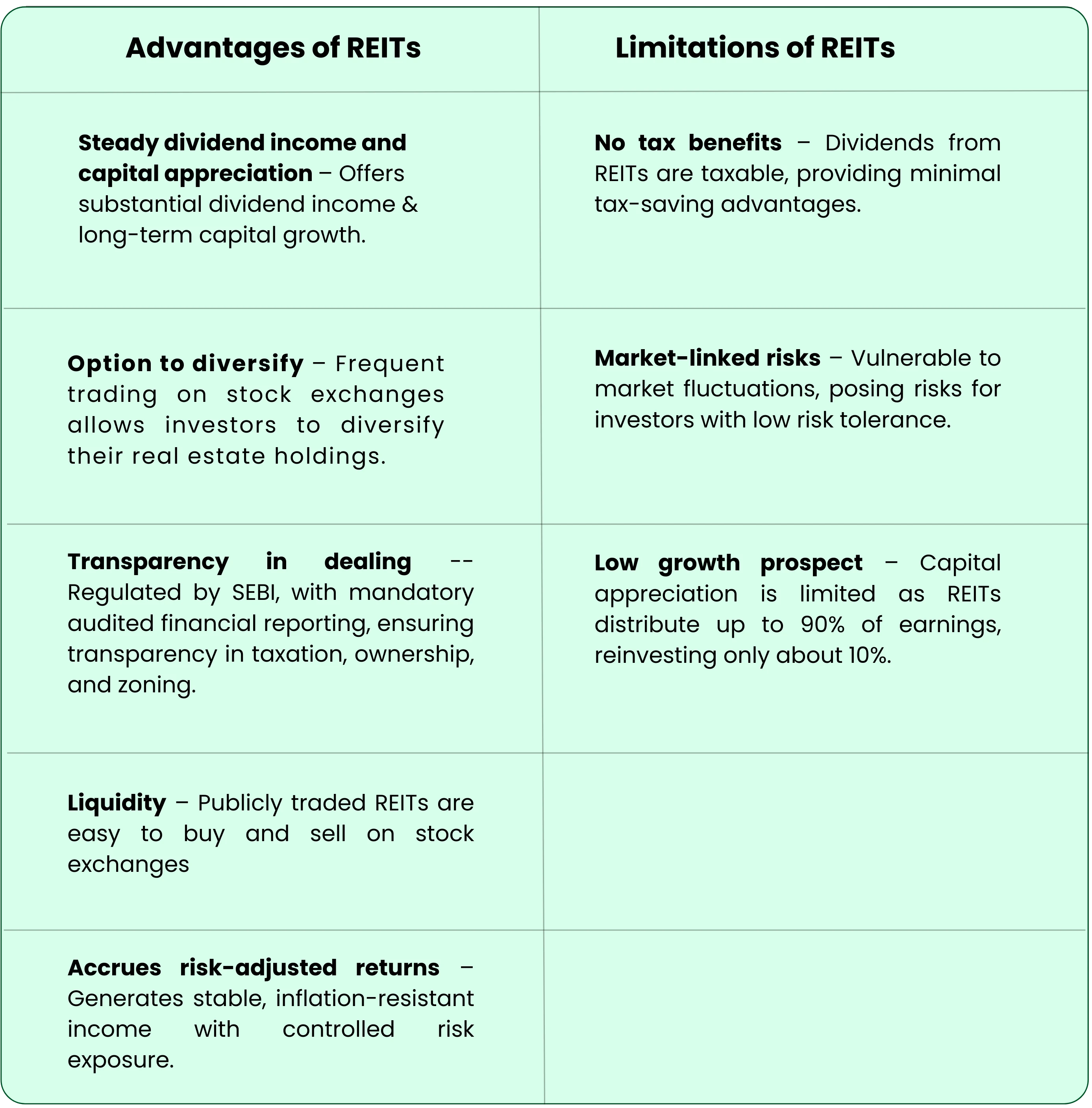
REITs offer investors an accessible way to gain exposure to real estate without directly owning property. With options ranging from equity and mortgage REITs to ETFs and mutual funds, they provide diversification, liquidity, and steady income potential. While they come with market risks and certain limitations, careful evaluation of a REIT’s portfolio, financial health and pricing can help investors make informed, profitable decisions.
Also Read: Understanding Open Interest in F&O Trading
Disclaimer: The information provided in our blogs is for informational purposes only and should not be construed as financial, investment, or trading advice. Trading and investing in the securities market carries risk. Always conduct your own research and consult with a qualified financial advisor before making any investment decisions. Past performance is not indicative of future results. Copyrighted and original content for your trading and investing needs.
© 2025 — Tradejini. All Rights Reserved.
.webp%3Falt%3Dmedia%26token%3D0ead9799-20bc-4d1e-ae8f-d75ab18921b5&w=3840&q=75)