Think of a skilled tailor in Mysuru. Big brands send him their designs, and he stitches the garments for them. He does not sell clothes under his own name. He is paid to make them well and on time.
Kaynes Technology is that tailor, but for electronics. Car makers, railway suppliers, defence firms and factory-equipment companies send Kaynes their designs. Kaynes buys the parts, puts the circuit boards together and often builds the full product. This is called electronics manufacturing services, or EMS.
For years, the tailor had to buy his cloth and his best buttons from abroad. Kaynes is now building its own cloth mill (a plant that makes bare circuit boards, called PCBs) and its own button factory (a plant that packages computer chips, called OSAT). If both work, Kaynes will make more of each product itself and keep a bigger share of the money.
There is also a side business that has caused trouble. Kaynes makes smart electricity meters and, under some government contracts, also installs and maintains them for about eight years. Those customers pay slowly. A lot of cash is stuck there.
At Tradejini, we decided to look at all three parts together. The share price has fallen from a 52-week high of ₹7,705 to about ₹2,975 on 16 November 2026, a drop of about 61%. Revenue, meanwhile, has grown about 8.6 times in five years and the order book is at a record ₹10,625 crore. This piece explains what is going well, what is not, and what the market seems to be pricing.
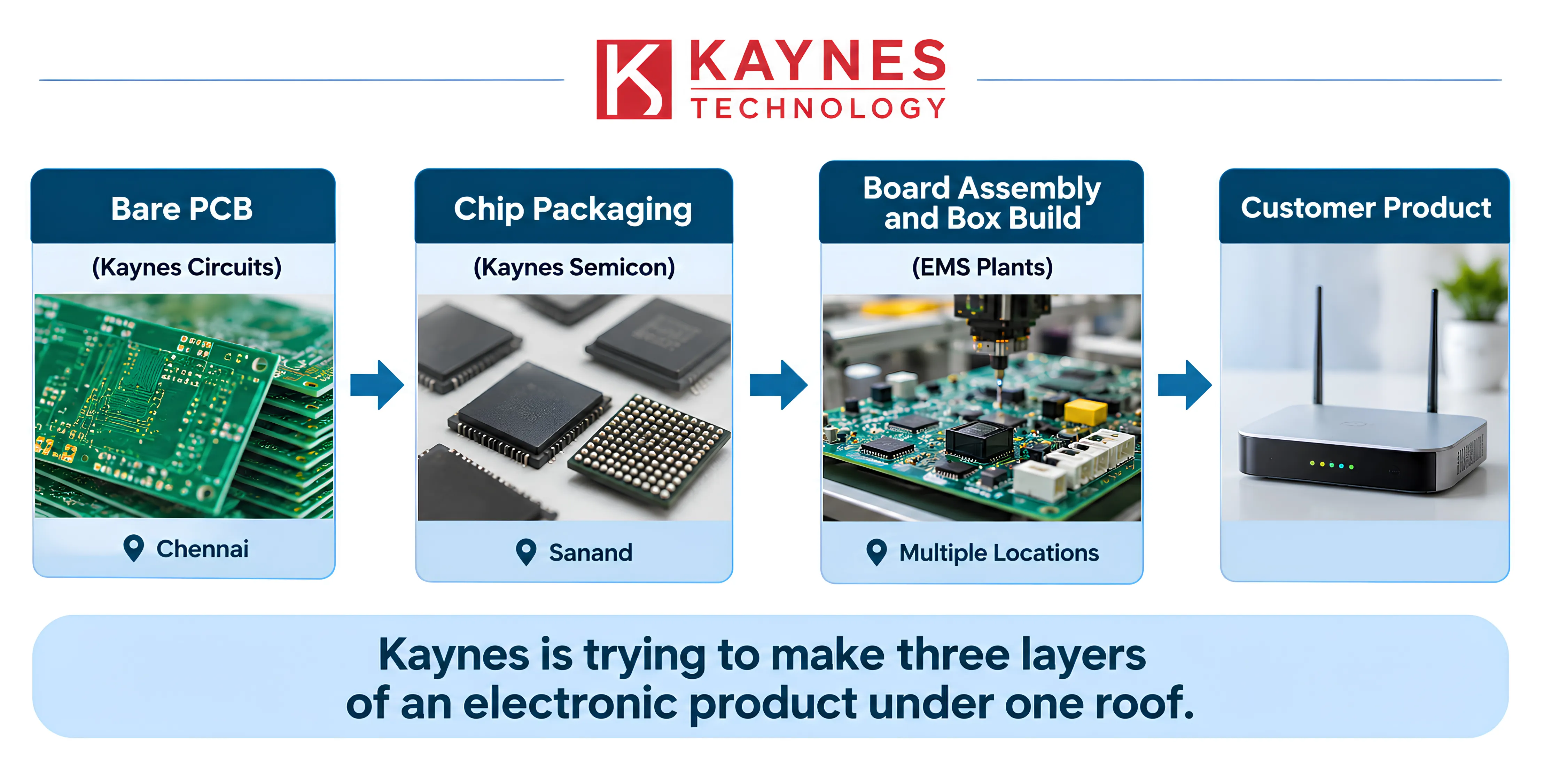
What does Kaynes Technology do?
Kaynes traces its roots to 1988 in Mysuru as a small electronics maker and listed on the stock exchanges in November 2022. Today it runs 22 manufacturing facilities and serves about 500 customers. Its business can be understood through five pillars.
1. It builds electronics for other companies (EMS)
This is the main business. Kaynes assembles PCBAs (printed circuit board assemblies — the green boards with chips and parts soldered on) and builds complete units, called box build. In Q1 FY27, box build gave 51% of revenue, board assembly 23%, and design-led work and IoT solutions 25%.
EMS stands for Electronics Manufacturing Services. An EMS company makes electronic products for a brand owner, the way a tailor stitches garments for a fashion label.
2. It focuses on 'high-mix, low-volume' products
Kaynes does not make millions of identical phones. It makes smaller batches of complex products for industries where failure is costly: industrial machines and electric vehicles (about 55% of revenue in FY25), automotive (about 26%), railways, aerospace, defence and medical. These customers value reliability and do not switch suppliers easily.
3. It is moving into design (ODM)
About 28% of revenue now comes from design-led work, where Kaynes also designs the product. Management wants this to reach 40% by 2030. Examples include parts for Kavach (the Indian Railways anti-collision system) and a smart power unit for cars.
4. It is building chip packaging and PCB plants
Kaynes Semicon in Sanand, Gujarat, is an OSAT plant. OSAT means Outsourced Semiconductor Assembly and Test — the step where a raw silicon chip is packaged, connected and tested so it can be used. Kaynes Circuits in Chennai will make bare PCBs, including complex boards with up to 74 layers. India imports about 88% of the PCBs it uses.
5. It makes smart meters
Through Iskraemeco, bought in FY25, Kaynes makes smart electricity meters. In some state contracts it also installs and services them for about eight years and is paid over time. This part has tied up a lot of cash, as we explain later.
How Kaynes makes money
An EMS company buys most of the parts that go into a product and passes their cost on to the customer. What it keeps is its fee for design, assembly, testing and reliability.
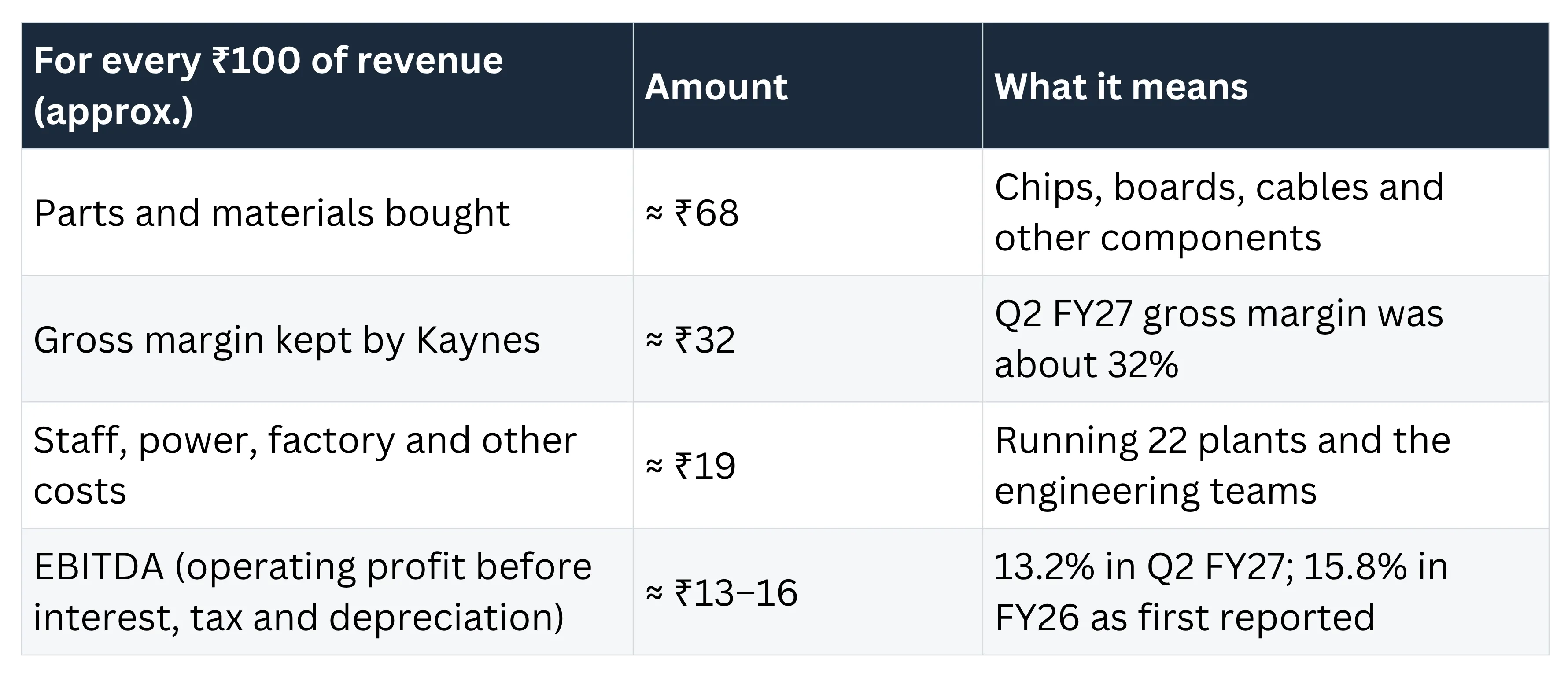
EBITDA is profit from running the business before interest, tax and depreciation (the accounting cost of machines wearing out). A 15% EBITDA margin means that for every ₹100 of sales, about ₹15 is operating profit before those items.
Kaynes earns a higher margin than most Indian EMS companies because its products are complex and made in small batches. Firms that assemble phones or TVs in huge volumes usually keep only a few rupees out of every ₹100. The trade-off is that complex, custom work needs more inventory and longer payment cycles.
Why electronics manufacturing in India is growing
Kaynes sits in a part of the economy that the government is actively supporting.
Government schemes. The India Semiconductor Mission has a budget of ₹76,000 crore. Under it, Kaynes's OSAT plant has a support agreement covering 50% of eligible capital cost from the Centre and 20% from the state, on eligible capex of ₹2,615 crore. Its PCB plant was the first project approved under the Electronics Component Manufacturing Scheme (ECMS).
'China plus one'. Global companies want a second source outside China. Kaynes's new partner Vishay mentioned direct access to markets other than China as one reason for the tie-up.
More electronics in everything. Electric vehicles, railway safety systems such as Kavach, defence equipment and factory automation all use more electronics each year. Management puts the Indian EMS market's growth at about 15–17% a year.
Import replacement. About 88% of PCBs used in India are imported. Local production can cut lead times, which some customers now face at six to eight months for boards.
The Kaynes Technology financial story
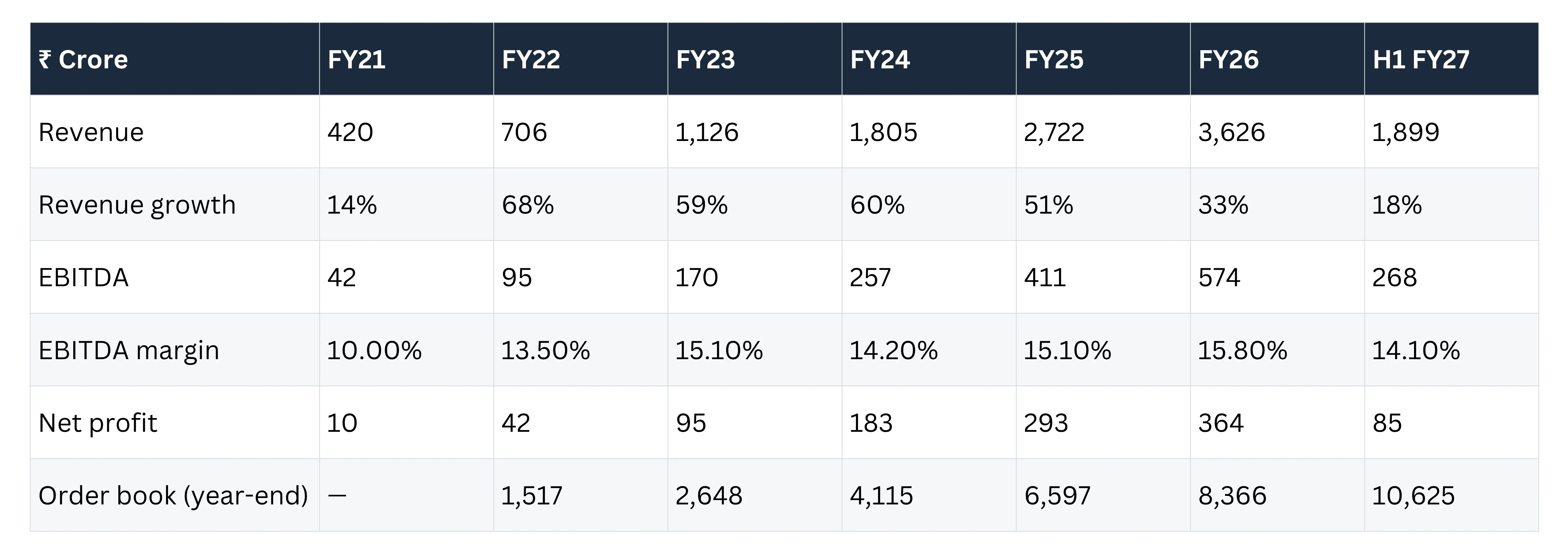
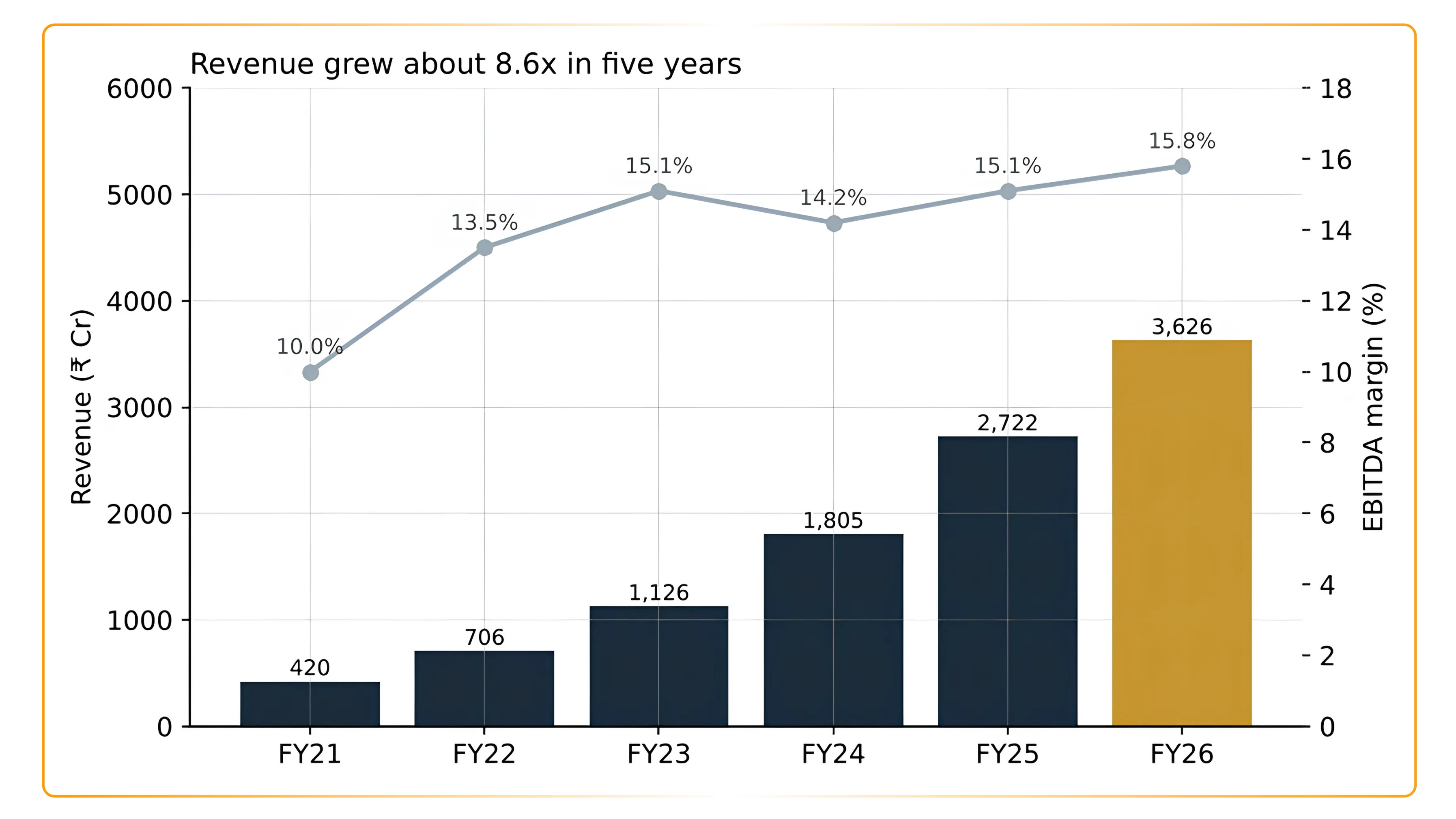
Revenue rose from ₹420 Cr in FY21 to ₹3,626 Cr in FY26. EBITDA margin moved up from 10% to around 15%.
What this table shows:
Very fast growth. Revenue grew about 8.6 times between FY21 and FY26 — roughly 54% a year. Part of this came from buying companies: Iskraemeco (smart meters), August Electronics in Canada and a stake in Sensonic in Austria.
Better margins than at the start. EBITDA margin rose from 10% in FY21 to about 15% in FY23–FY26. This reflects the shift to complex, high-reliability products.
Profit growth is slowing down. Net profit grew 60% in FY25 but 24% in FY26, slower than revenue. In H1 FY27, net profit fell 53% even though revenue rose 18%. Higher interest costs, depreciation on the new plants, a higher tax rate and losses in new subsidiaries are the main reasons.
The order book keeps rising. Orders in hand reached ₹10,625 crore in September 2026 — about 2.9 times FY26 revenue. Management says this gives 18–24 months of visibility.
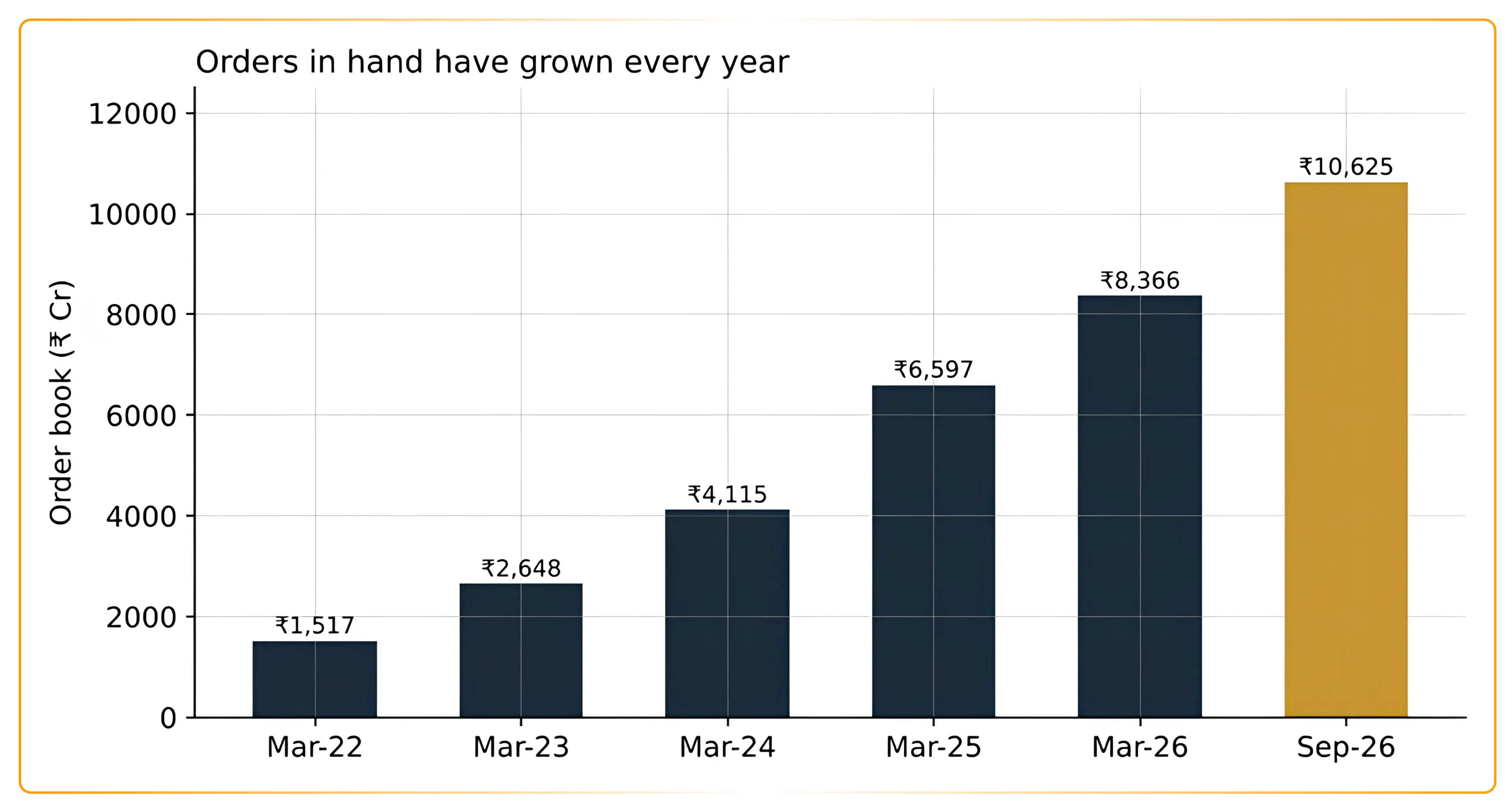
*Order book at each year-end (March) and September 2026. *
The cash problem: profits on paper, cash going out
This is the most important section of the story. Kaynes reports profits, but its operating cash flow has been negative.
- In FY26, net profit was ₹364 crore, but cash from operations was minus ₹600 crore at the group level. The parent company alone generated plus ₹247 crore; the problem sat mainly in subsidiaries, especially smart metering.
- In H1 FY27, cash from operations was minus ₹278 crore, an improvement on minus ₹404 crore a year earlier but still negative.
- The cash conversion cycle — the number of days between paying for parts and collecting cash from customers, stretched to 125 days in FY26 from 87 days a year earlier. Receivable days reached 134.
- On a rolling 12-month basis, net working capital stood at 169 days in September 2026, up from 163 days in June.
Working capital is the money tied up in running the business day to day: stock waiting to be used, plus money owed by customers, minus money owed to suppliers. If it grows faster than sales, a company can report profits and still run short of cash — like a shop that sells on credit and waits months to be paid.
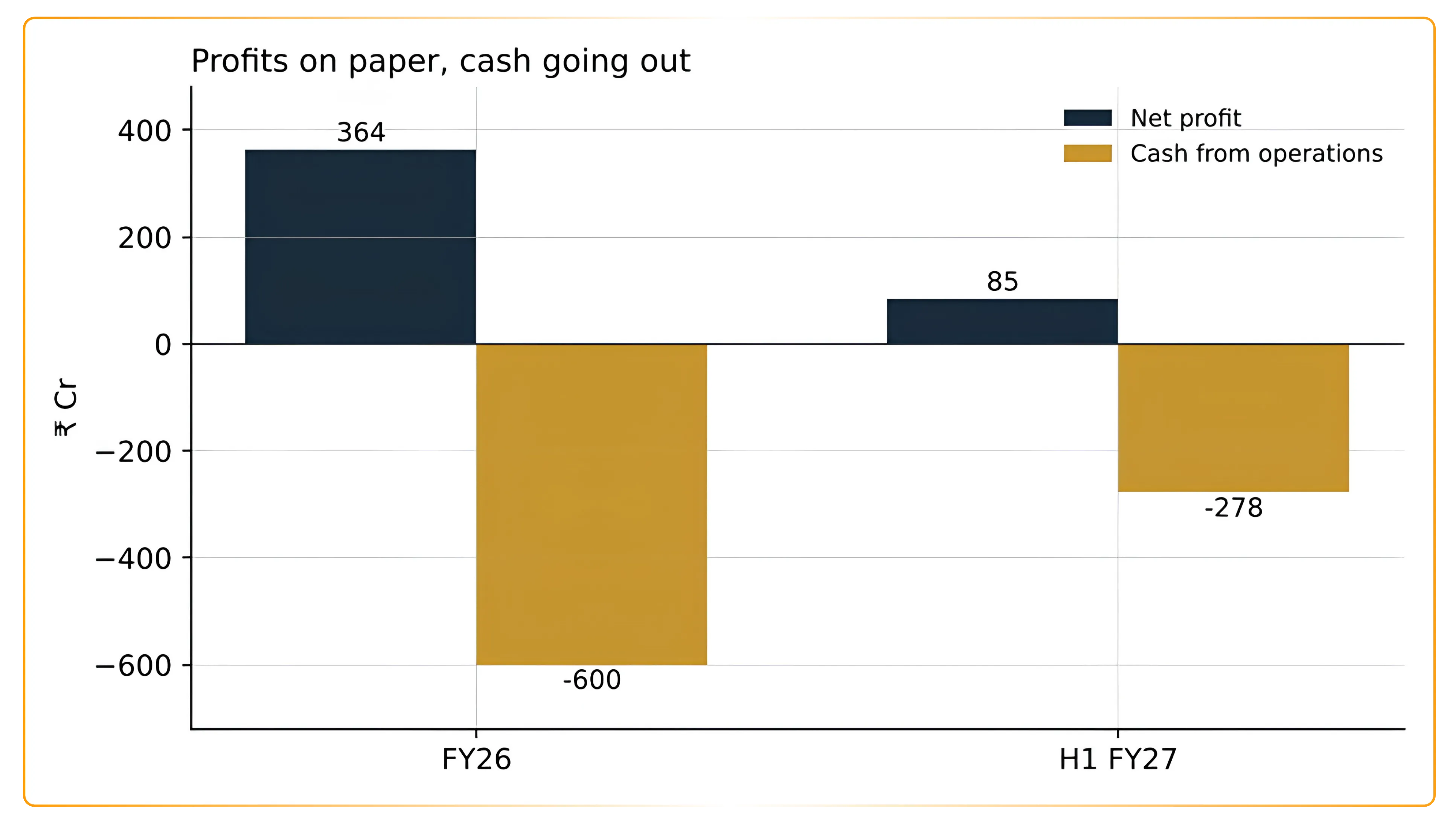
FY26 and H1 FY27 consolidated operating cash flow
Where the cash is stuck: smart metering
Under some government smart-meter contracts, Kaynes supplies, installs and services meters, and the utility pays in instalments over years. In Q1 FY27, metering sales were about ₹240 crore but collections only ₹88 crore. Money owed on meters rose from ₹1,158 crore in March to about ₹1,311 crore in June 2026 (management cited ₹1,402 crore on a broader basis in the next call).
Management then made a clear choice: slow down meter supplies until customers pay. Metering revenue fell from about ₹228 crore in Q2 FY26 to about ₹54 crore in Q2 FY27, a fall of about 76%. In the same quarter, the team collected more than ₹400 crore and metering receivables fell to ₹1,091 crore. The target is to bring them below ₹750 crore before raising supplies again.
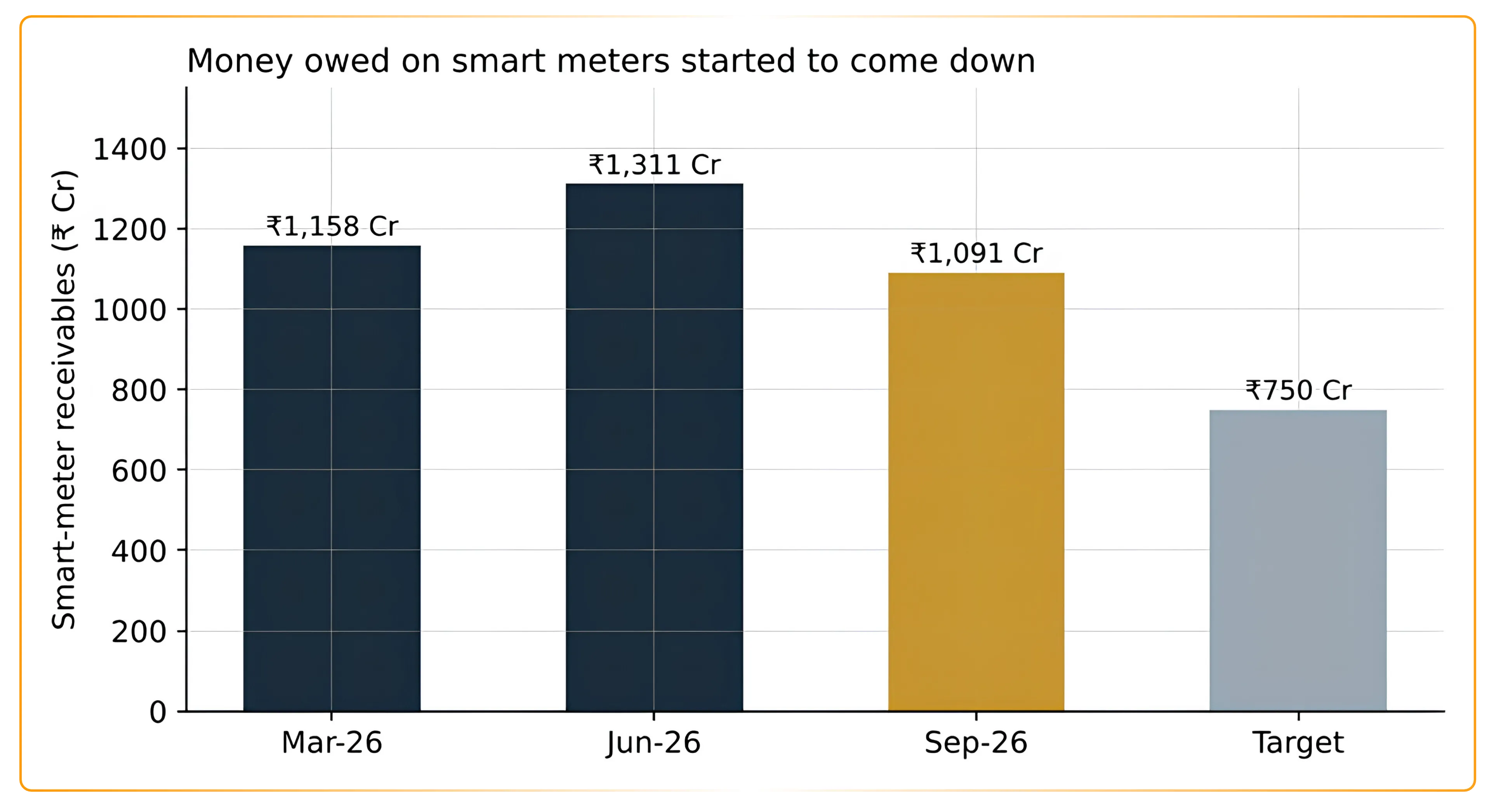
Smart-meter receivables as cited on the Q1 and Q2 FY27. ₹750 Cr is management's target, not an actual figure.
Management also plans to separate the installation-and-maintenance part of metering into a partner-led structure. Kaynes would keep making the meters, while a third party would handle installation and the long payment cycle. Management said two parties are at an advanced stage and promised details by the next quarterly call. Until a deal is signed, this remains a plan.
Debt has gone up
Kaynes raised ₹1,600 crore through a QIP (a share sale to institutions) in June 2025. Even so, net debt reached about ₹1,703 crore by September 2026, and cash on hand was about ₹68 crore. Part of the rise is an accounting change: bill discounting and supplier financing, which were earlier shown outside borrowings, are now counted as debt. Management has said it will not raise new equity for at least the next year.
What changed in the accounts
Trust in the numbers has been a live issue for Kaynes, so it gets its own section.
December 2025: the Kotak report
On 3 December 2025, Kotak Institutional Equities flagged gaps in Kaynes's FY25 disclosures. The main points were mismatches in related-party transactions between Kaynes, its promoter-linked firm Kaynes Electronics Manufacturing and subsidiary Iskraemeco; how goodwill from the Iskraemeco and Sensonic deals was recorded; a sharp rise in contingent liabilities; and high borrowing costs. The share price fell about 40% in a month.
Kaynes said some related-party transactions were "inadvertently not disclosed" in the standalone accounts, but that they did not need disclosure at the consolidated level. It explained the goodwill and intangibles treatment and said the main new contingent liability was a ₹96.8 crore performance bank guarantee for Iskraemeco projects. Some brokerages, including ICICI Securities, said the issue looked like weak disclosure rather than wrong intent.
November 2026: new auditor and restated figures
Kaynes has since moved to a larger audit firm, Walker Chandiok & Co LLP, and restated past figures under Ind AS 8. Management says no major accounting policies were changed. The main effects:
- Borrowings look higher. Bill discounting and supplier financing are now shown as loans.
- One meter contract is recorded differently. A West Bengal contract is now treated as a service concession. This raised FY26 revenue from about ₹3,620 crore to about ₹3,680 crore.
- Margin lower, profit higher. Inventory provisions and timing items cut FY26 EBITDA margin from 15.8% to 14.2%, but FY26 net profit rose from ₹364 crore to ₹392 crore.
A larger auditor and cleaner presentation are positive steps. But restated numbers also make year-on-year comparisons harder, and investors should check the next annual report carefully, especially the related-party notes.
Latest quarters: core EMS strong, group numbers weak
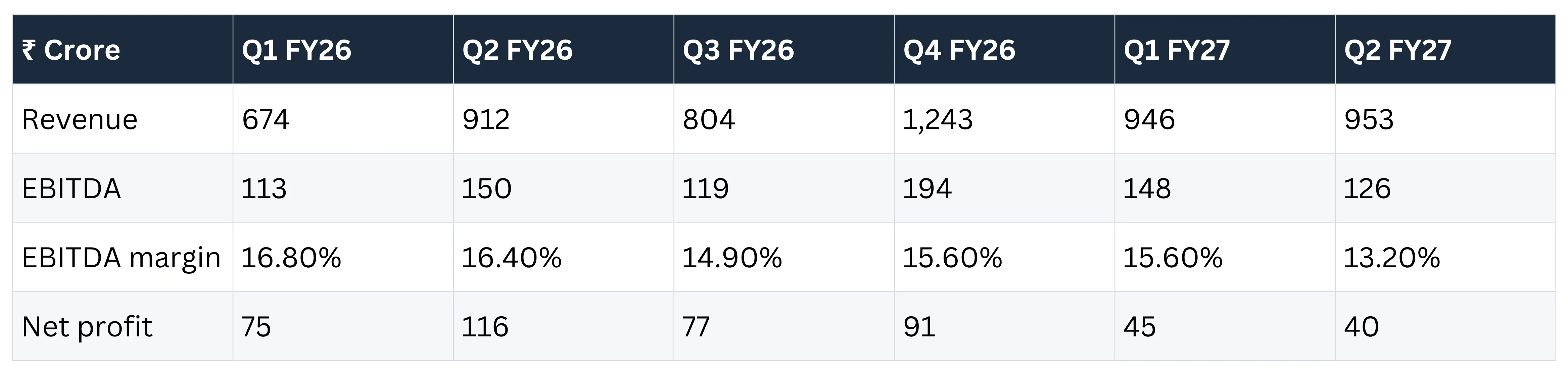
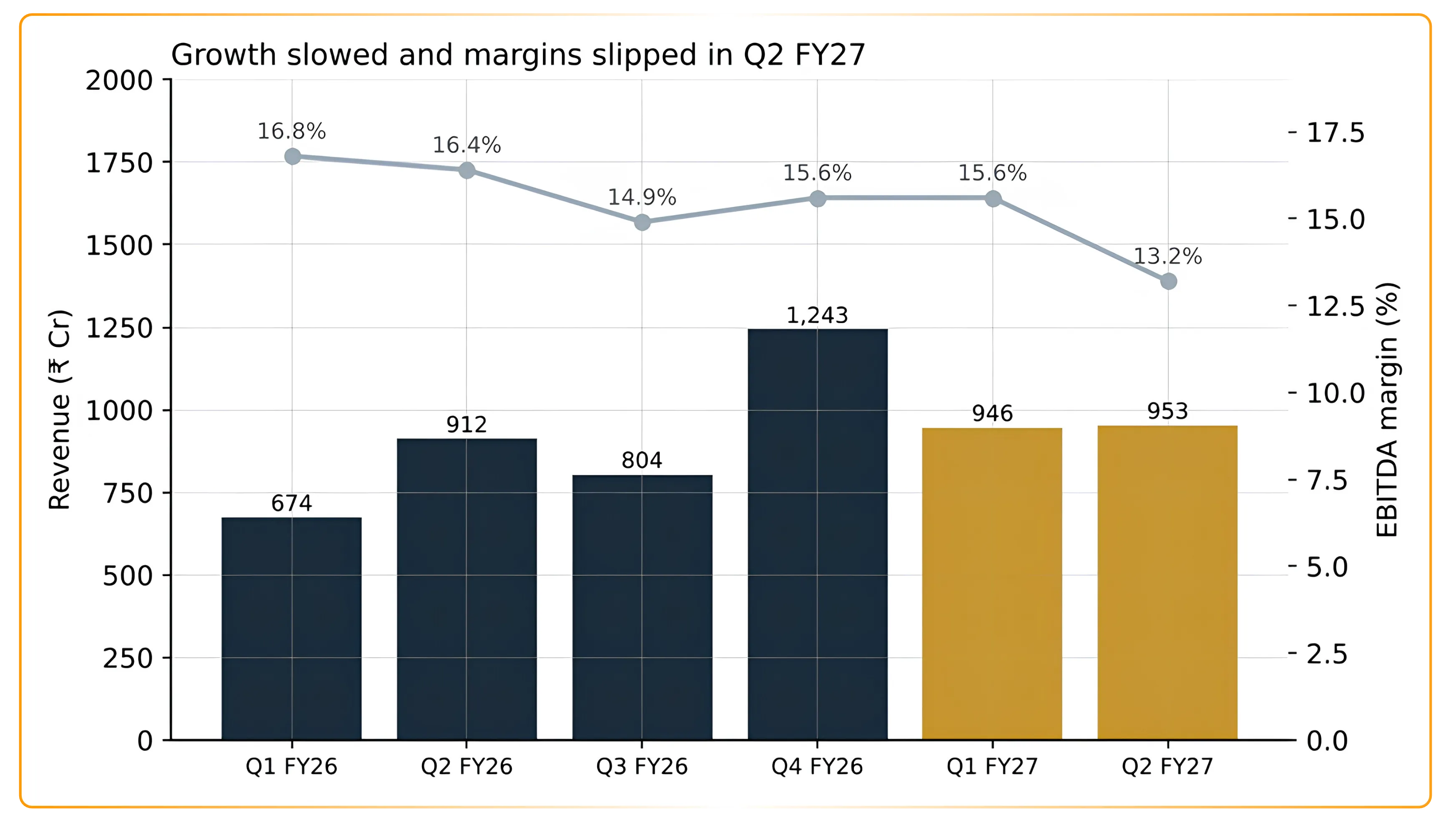
Quarterly revenue and EBITDA margin. Q2 FY27 margin was the lowest in the six quarters shown.
The group numbers hide two very different trends:
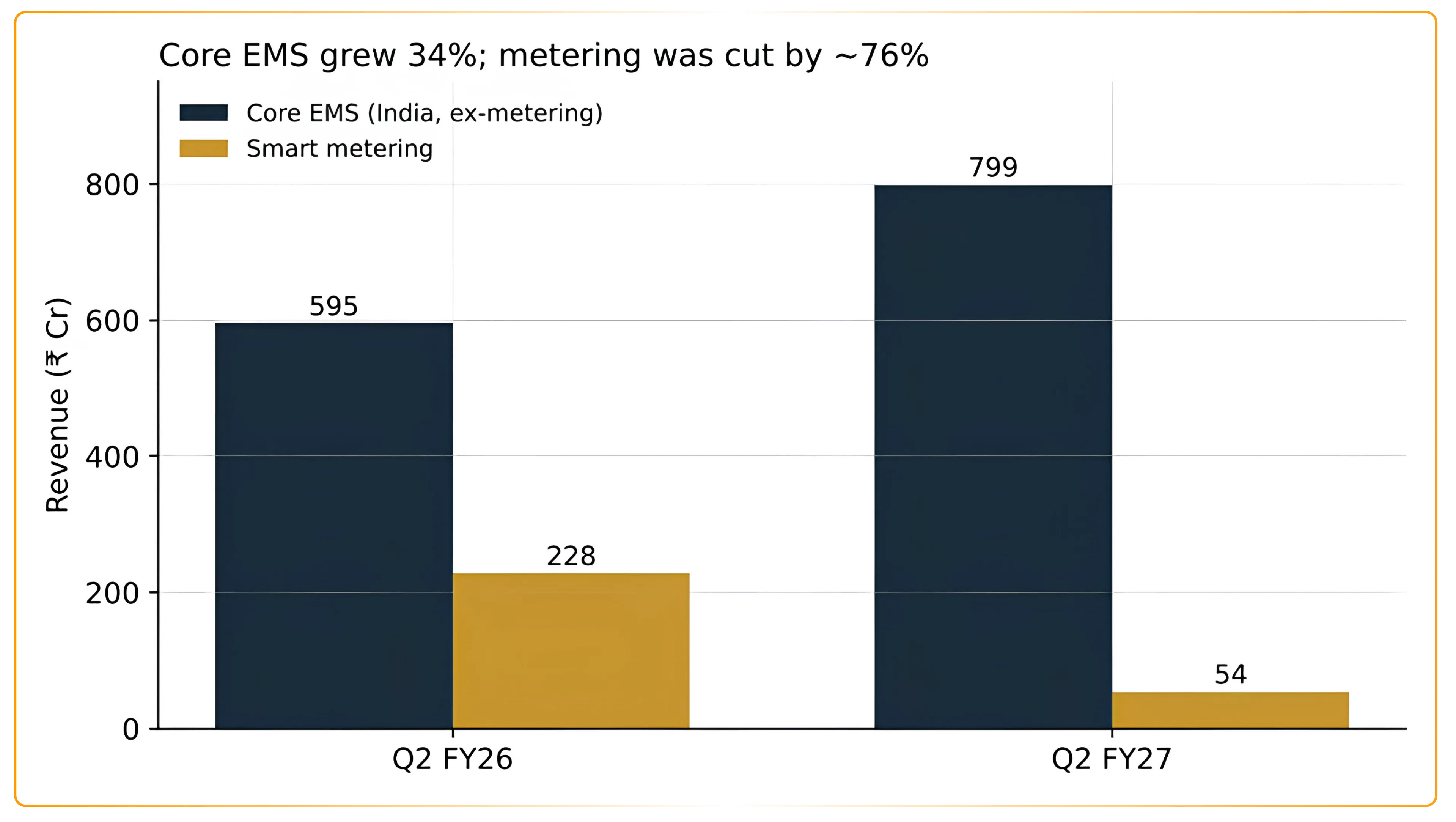
Core EMS = India EMS excluding smart metering. Overseas units (mainly August Electronics) are not shown.
- Core EMS is growing fast. Excluding meters, India EMS revenue grew 34% in Q2 FY27 (₹595 crore to ₹799 crore) after 53% growth in Q1. Aerospace grew more than 70% and railways more than 50%.
- Metering was cut on purpose. It fell about 76% in Q2 as Kaynes prioritised collections.
- Margins are under pressure. Management blamed higher crude-linked and metal costs, a weaker rupee, and the start-up cost of the OSAT and PCB plants. Prices are passed on to customers, but with a lag. Management said PCB prices had risen about three times in the supply crunch.
- Profit was squeezed below EBITDA. Finance cost in Q2 was about ₹39 crore, nearly three times a year earlier. The effective tax rate was about 38%, because some subsidiaries made losses and some interest was capitalised. Lower interest income on QIP money also hurt.
The market reacted sharply. The share fell about 13–15% on 16 November 2026, the day after the Q2 results.
What gives Kaynes its edge?
Sticky customers in hard-to-enter industries
Railway safety, aerospace, defence and medical products need long approvals, sometimes 12–14 months. Once a supplier is approved, customers rarely switch. Kaynes has won awards from customers such as Mahindra and Siemens.
A broader customer base
The top five customers gave 85% of revenue in FY23. That fell to 53% in FY24 and 46% in FY25 and FY26. The company now serves about 500 customers.
Design capability
About 28% of revenue comes from design-led work, and the R&D team has about 200 people. Design ownership usually means better margins and stickier customers.
Silicon-to-system under one roof
If the PCB and OSAT plants work as planned, Kaynes could offer bare boards, packaged chips and finished products from one group. Few Indian companies are attempting this. It could shorten lead times for customers and let Kaynes capture a larger share of each product's cost.
Government support
Capital subsidies for the OSAT plant (50% Centre, 20% state on eligible capex) lower the money Kaynes must put in. The company had received about ₹170 crore of subsidy by July 2026.
Where is growth coming from?
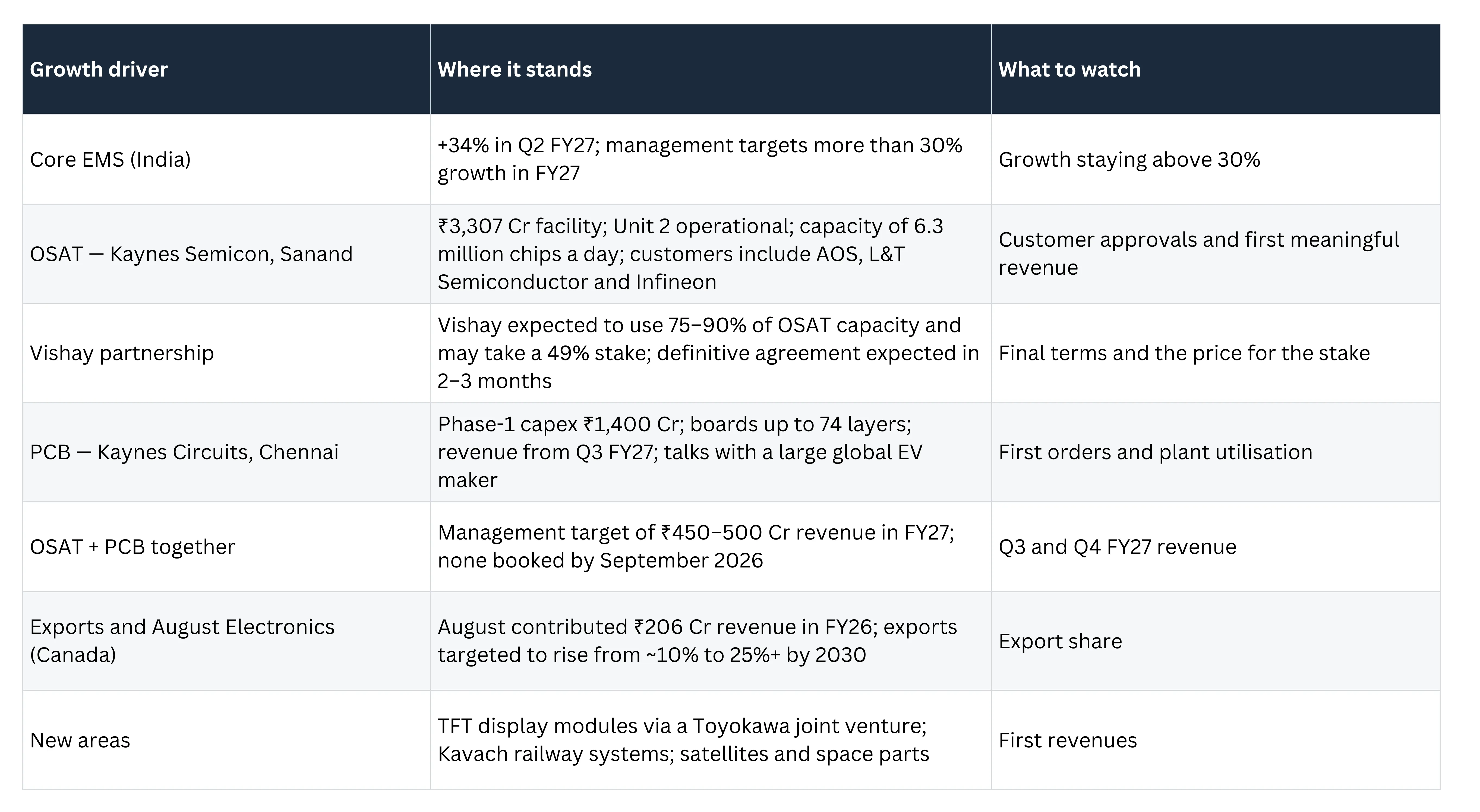
Management's long-term goal is ₹10,000 crore of revenue by 2030, with OSAT expected to reach 30% of group revenue in four to five years. These are targets, not results. Kaynes missed its own FY26 revenue guidance, which is worth keeping in mind when reading any new target.
The capex is large. FY26 capex was ₹473 crore for OSAT and ₹324 crore for PCB. FY27 plans include about ₹300 crore each for OSAT and PCB and ₹250 crore for EMS. Until the new plants earn revenue, they add depreciation and interest costs without matching income.
What can go wrong?
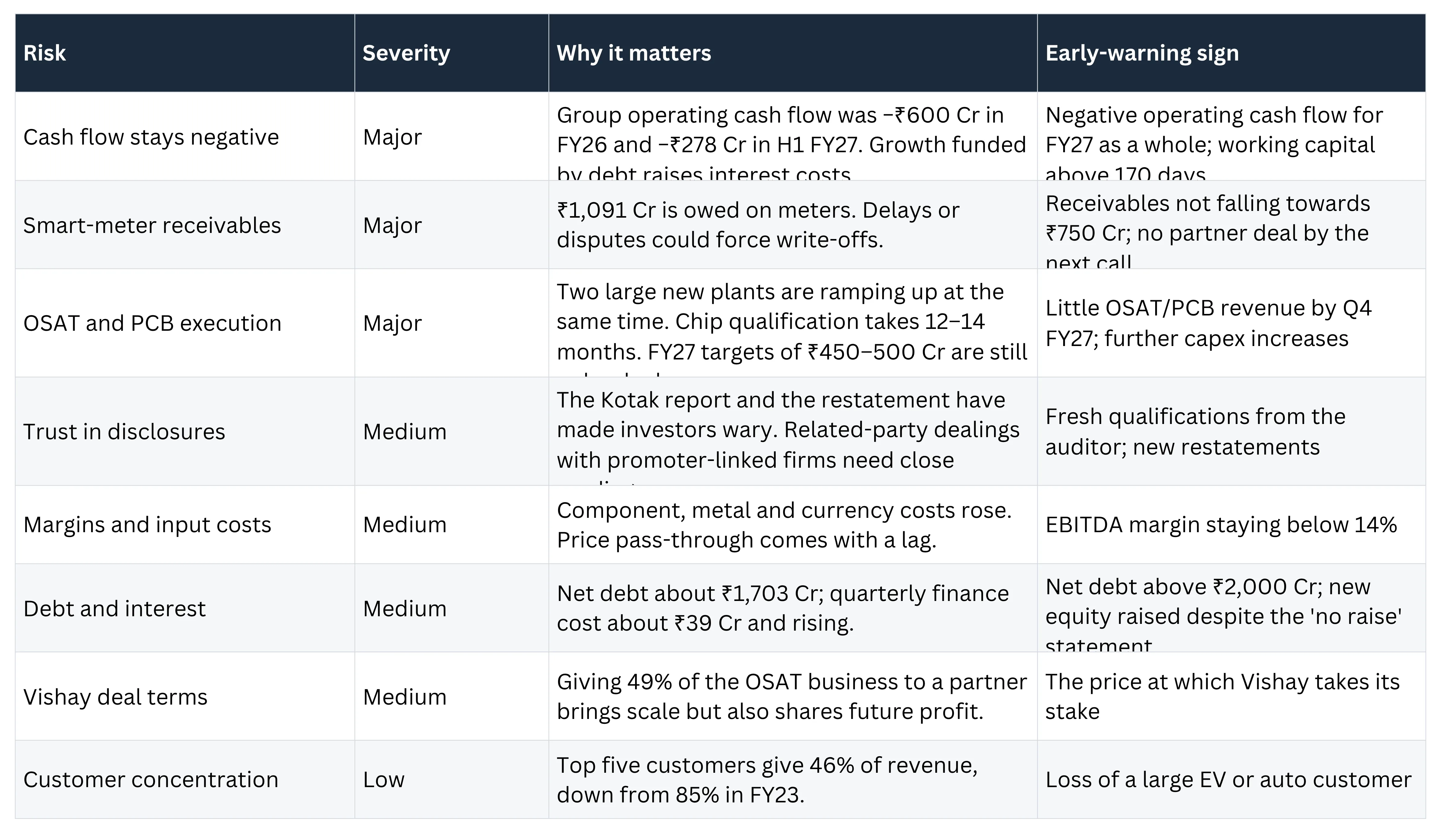
The stress test
What if part of the meter money is never collected? Assume 20% of the ₹1,091 crore of meter receivables has to be written off.
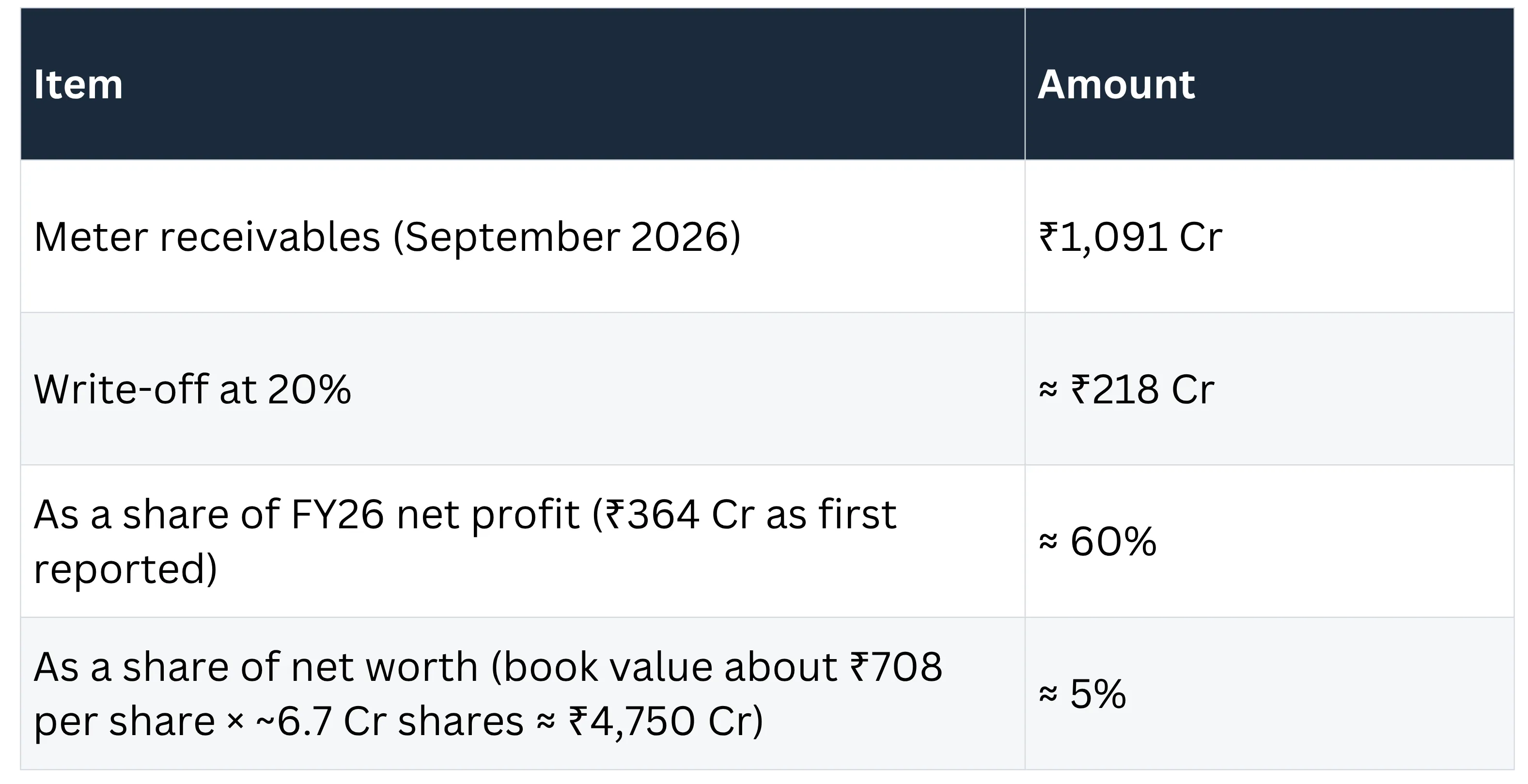
Stress case is our illustration, not a forecast.
Such a loss would hurt one year's profit badly, but it would not threaten the company's survival. Kaynes has a large equity base after the QIP. The balance sheet can absorb a shock; the bigger question is whether cash flow turns positive.
The one risk that really matters: that growth keeps needing more cash than the business generates. If the new plants ramp up slowly while working capital stays high, Kaynes would need more debt or equity, and earnings per share would grow much more slowly than revenue.
Kaynes Technology valuation: what is the market pricing?
All figures use a share price of about ₹2,975 (BSE close, 16 November 2026), about 6.7 crore shares, and a market value of roughly ₹20,000 crore.
Method 1: Price-to-earnings (P/E)
Net profit over the last four reported quarters (Q3 FY26 to Q2 FY27) adds up to about ₹253 crore. At ₹20,000 crore of market value, that is a P/E of about 79 times.
P/E tells you how many years of current profit you are paying for. A P/E of 79 means paying ₹79 for every ₹1 of yearly profit. High P/Es only make sense if profits are expected to grow fast for many years.
Method 2: EV/EBITDA
Add net debt of about ₹1,703 crore to the market value, and the whole business is valued at about ₹21,700 crore. EBITDA over the last four quarters was about ₹580 crore. That gives an EV/EBITDA of about 37 times.
EV/EBITDA is how many years of operating profit you would pay to buy the whole company, including its debt. Think of a shop that earns ₹100 a year before interest and tax. Paying ₹3,700 for it, after taking on its loans, means paying 37 years of operating profit.
Method 3: Price-to-book Book value is about ₹708 per share, so the stock trades at about 4.2 times book value. In 2025, before the fall, investors were paying more than 10 times book.
What the price implies under different outcomes
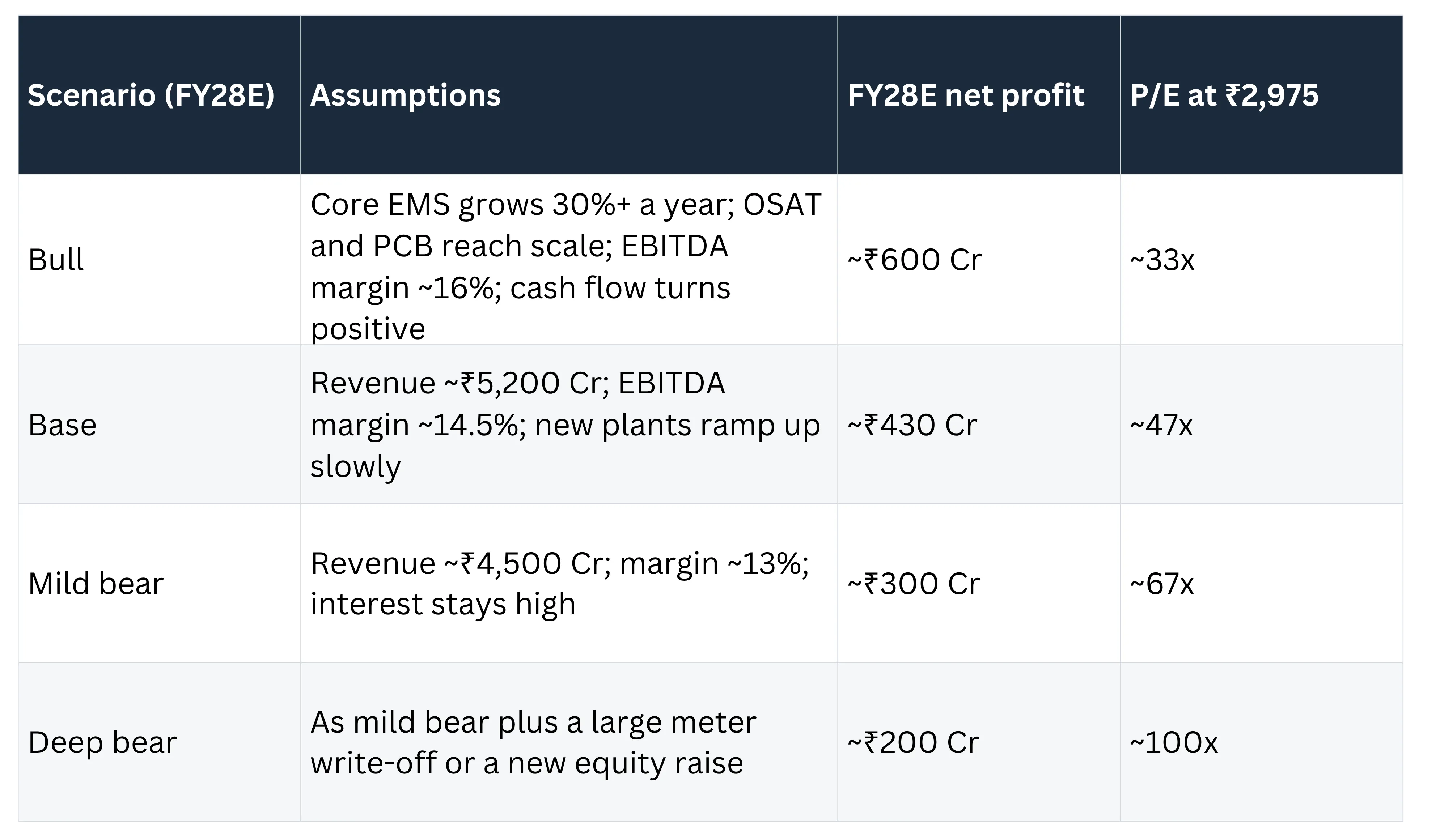
FY28E = estimate for April 2027–March 2028. Scenarios are our illustrations, not forecasts or management guidance. P/E = current market value ÷ estimated net profit.
Even after a 61% fall, the stock is not cheap on today's earnings. The price still assumes that profits will grow strongly over the next few years, as the new plants come on stream and working capital comes down. In the base case, the stock trades at about 47 times FY28 earnings.
What the market seems to be saying is that it believes in the core EMS business and the industry, but wants proof on two things: that cash flow turns positive, and that the OSAT and PCB plants start earning real revenue.
Where the business stands today
Kaynes is a skilled tailor that is building its own cloth mill and button factory while sorting out a side business that pays slowly. The core electronics business is doing well: it grew 34–53% in the last two quarters, orders are at a record ₹10,625 crore, and customers are spread across rail, aerospace, auto and industry.
The weak spots are cash and trust. Operating cash flow has been negative, net debt has risen to about ₹1,703 crore, smart-meter receivables are still above ₹1,000 crore, and the accounts have been restated after an auditor change. The new chip and PCB plants are real and operational, but they have not yet earned meaningful revenue.
For investors following the company, the next few quarters come down to four things: OSAT and PCB revenue in Q3 and Q4 FY27; meter receivables falling towards ₹750 crore; a positive operating cash flow; and the final terms of the Vishay and metering partner deals.
For a different kind of story (a business the market priced as a cash box) see our analysis of Route Mobile. For a company whose turnaround depended on cutting debt, see SAMHI Hotels: A Fundamental Analysis of the Turnaround Case.
Disclaimer: The information provided in our blogs is for informational purposes only and should not be construed as financial, investment, or trading advice. Trading and investing in the securities market carries risk. Always conduct your own research and consult with a qualified financial advisor before making any investment decisions. Past performance is not indicative of future results. Copyrighted and original content for your trading and investing needs.
© 2026 — Tradejini. All Rights Reserved.