In September 2025, we published a sector-wide analysis of India's hospital industry, arguing that the structural tailwinds, rising insurance penetration, an aging population, and the growing burden of chronic disease, were firmly in place for listed hospital chains. A year is enough time to ask a simple question: did the stocks reflect that story?
The Nifty 50 has returned essentially nothing over this period, closing on 1st September 2025 at 24,625 and sitting near the same level today. Against that flat benchmark, the five major listed hospital chains delivered sharply divergent results.
| Company | Price, 1 Sep 2025 | Price, 6 Aug 2026 | Return |
|---|---|---|---|
| Aster DM Quality Care | 605.2 | 840.0 | +38.8% |
| Apollo Hospitals | 7,671.5 | 8,948.5 | +16.6% |
| Narayana Hrudayalaya | 1,785.2 | 1,881.0 | +5.4% |
| Fortis Healthcare | 924.7 | 918.0 | -0.7% |
| Max Healthcare | 1,181.2 | 1,067.5 | -9.6% |
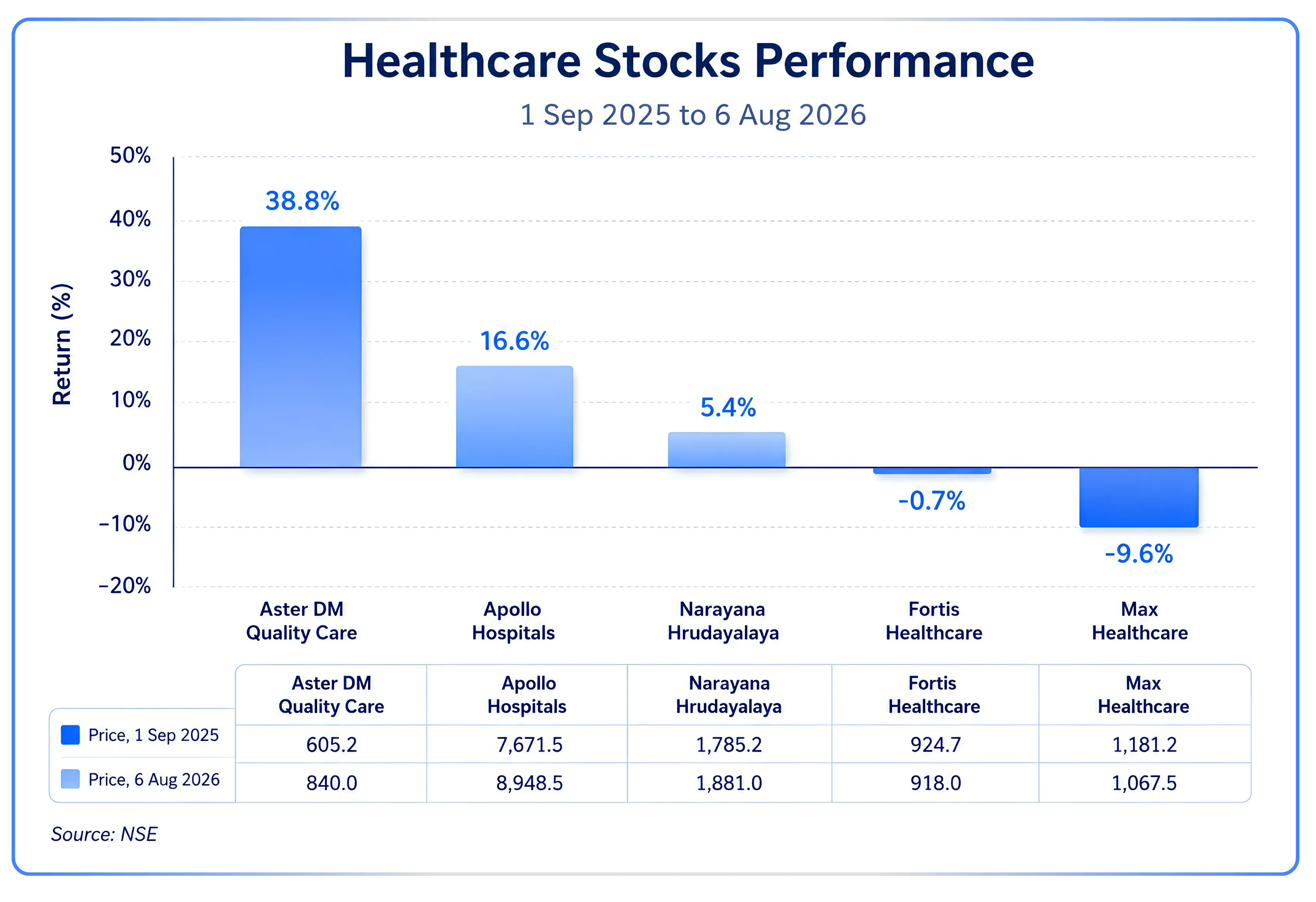
Three names beat a flat market. Two did not. The reasons for the divergence are worth understanding, because they have less to do with the sector's fundamentals, which remain intact, and more to do with execution, corporate events, and what investors were willing to pay for growth as the year progressed.
Aster DM Quality Care: A Merger, Not Just a Market
The standout return of 38.8% from Aster requires an immediate qualifier: this is not a pure hospital performance story. The company that existed on 1st September 2025 is structurally different from the one trading today. In April 2024, Aster had already separated its Gulf operations, transforming from an India-Gulf conglomerate into a focused India healthcare play. Then, on 2nd July 2026, Aster completed its merger with Quality Care India, bringing together the Aster DM, CARE Hospitals, Evercare, and KIMSHEALTH brands into a single entity now called Aster DM Quality Care. The combined network spans 39 hospitals across 28 cities with over 10,600 beds, roughly double the bed count Aster carried when the deal was announced. The stock's gain over the past year reflects the market pricing in this transformation rather than organic hospital-level growth. Aster DM Quality Care is now one of India's largest hospital networks by beds, but it is also a business that has only been operating in its current form for five weeks. The real performance test begins now.
Apollo Hospitals: Compounding Across All Three Engines
Apollo's 16.6% return is the group's most instructive, because it reflects genuine operating momentum rather than a one-off event. Apollo runs three distinct businesses under one listed entity: the core hospital network, a retail health and diagnostics arm, and Apollo HealthCo, which houses the pharmacy distribution business and the Apollo 24/7 digital health platform. Through FY26, revenue across the consolidated entity grew 16% year on year, while profit after tax grew 33%, a clear sign of operating leverage kicking in. The segment that changed most meaningfully over the past year was Apollo HealthCo, which turned profitable for the first time in FY26 after years of investment losses. The digital and pharmacy arm now contributes roughly 43% of consolidated revenues, and its shift from loss-making to profit-generating removed a structural overhang that had weighed on investor sentiment for several years. The core hospital business continued its steady run, with margins holding near 24-25% and occupancy remaining firm. Apollo is the largest and most diversified of the five names covered here, and FY26 confirmed that scale and diversification were working in its favour.
Narayana Hrudayalaya: Strong India Business, Complex Consolidation
A 5.4% return over 11 months against a flat index looks modest but masks a more interesting story. Narayana's India hospital business has been performing well through the period, and its Cayman Islands health facility continues to grow. The complexity comes from international expansion. The company acquired the Practice Plus Group in the UK in late 2025, adding a sizable but lower-margin operation to its consolidated financials. When Narayana reported its Q1 FY27 results in late July 2026, the top-line showed a 78% year-on-year jump in consolidated revenue, but EBITDA margin fell to 18.8% from 23.9% a year earlier, and profit after tax grew just 5.7% despite the revenue surge. The UK business carries thinner margins than Narayana's India and Cayman operations, and the market responded accordingly: the stock dropped over 5% on the result day. The stock's 11-month return reflects a business mid-transition, with the market willing to give partial credit for the India operations while waiting to see how the international mix settles. For investors tracking this name, the India-only operating metrics remain the cleaner signal for now.
Fortis Healthcare: Flat Stock, Uneven Quarters
Fortis's near-zero return (-0.7%) over the period is not quite as neutral as it appears. The stock spent most of the year in positive territory before a string of weaker quarterly results brought it back to near where it started. Fortis reported Q3 FY26 profit after tax that fell 22% year on year even as revenue rose 18%, with net margin compressing to 8.6% from 13% a year earlier. Rising operational costs, across drugs, staffing, and utilities, were the primary culprits. IHH Healthcare, the Malaysian conglomerate that owns Fortis, has been working to integrate and streamline operations since taking control, and the benefits of that process have been slower to reach the income statement than the market had expected. Fortis remains a business with a strong brand and a growing bed count, but the gap between revenue growth and profit delivery has kept investors cautious.
Max Healthcare: Growth Rate Moderation on a Premium Valuation
Max is the clearest underperformer of the group, down 9.6% while the index went nowhere. The explanation sits at the intersection of valuation and execution. Max entered the period as one of the most expensive hospital stocks by price-to-earnings, reflecting investor confidence in its premium positioning, particularly in North India. Through the year, that positioning began to face a test. Revenue growth, which had run above 25% in the first half of FY26, moderated to 10.7% by Q3, the slowest growth rate in 14 consecutive quarters. Margins came under pressure as new capacity was added ahead of it being fully utilised. The Q4 FY26 results, reported in May 2026, showed sequential revenue that was actually lower than Q3, the weakest quarterly print in three years, and the stock dropped sharply on the announcement. Max's FY26 full-year profit after tax still grew a healthy 34% to Rs 1,442 crore, and the company is building out capacity aggressively, with a new 712-bed hospital planned for Lucknow at a cost of Rs 1,400 crore. But at a trading multiple well above sector peers, the market has been pricing in a level of growth consistency that the recent quarters have not fully delivered.
What the Past Year Says About the Sector
The structural thesis from the September 2025 report has not changed. India's hospital sector continues to benefit from rising chronic disease burden, expanding insurance penetration, and significant bed supply gaps in Tier 2 and Tier 3 cities. All five companies are expanding capacity, and demand for quality private healthcare has not softened.
What the past year makes clear is that within a sector with shared tailwinds, returns have been driven by company-specific factors: corporate restructuring at Aster, digital business maturity at Apollo, international margin dilution at Narayana, cost management at Fortis, and valuation normalisation at Max. The sector as a whole has broadly kept pace with or beaten a flat market, but the range of outcomes, from +38.8% to -9.6%, illustrates that picking the sector is only half the work.
Disclaimer: The information provided in our blogs is for informational purposes only and should not be construed as financial, investment, or trading advice. Trading and investing in the securities market carries risk. Always conduct your own research and consult with a qualified financial advisor before making any investment decisions. Past performance is not indicative of future results. Copyrighted and original content for your trading and investing needs.
© 2026 — Tradejini. All Rights Reserved.