Picture two shopkeepers.One has been in your neighbourhood for 90 years. Everyone’s grandmother bought soap from him. He owns the shop, the warehouse next door, and has a delivery agent delivering stock to 9 million stores across the country. He doesn’t need to shout, people just walk in.
The other opened 10 years ago, all over Instagram. No physical shop for the first few years, just ads, influencers, and a very good story about “toxin-free” products. She’s now renting counter space in malls and slowly opening her own outlets, but she still spends a fortune every month just to get people through the door.
The first shopkeeper is Hindustan Unilever (HUL). The second is Honasa Consumer, the company behind Mamaearth.
This is the story of what happens when old-school scale meets new-school storytelling and why, on the numbers, the old shopkeeper is still winning by a mile.
First, the size difference, and it’s not close
Here’s the reality check, straight from FY26 (the year ended March 2026):
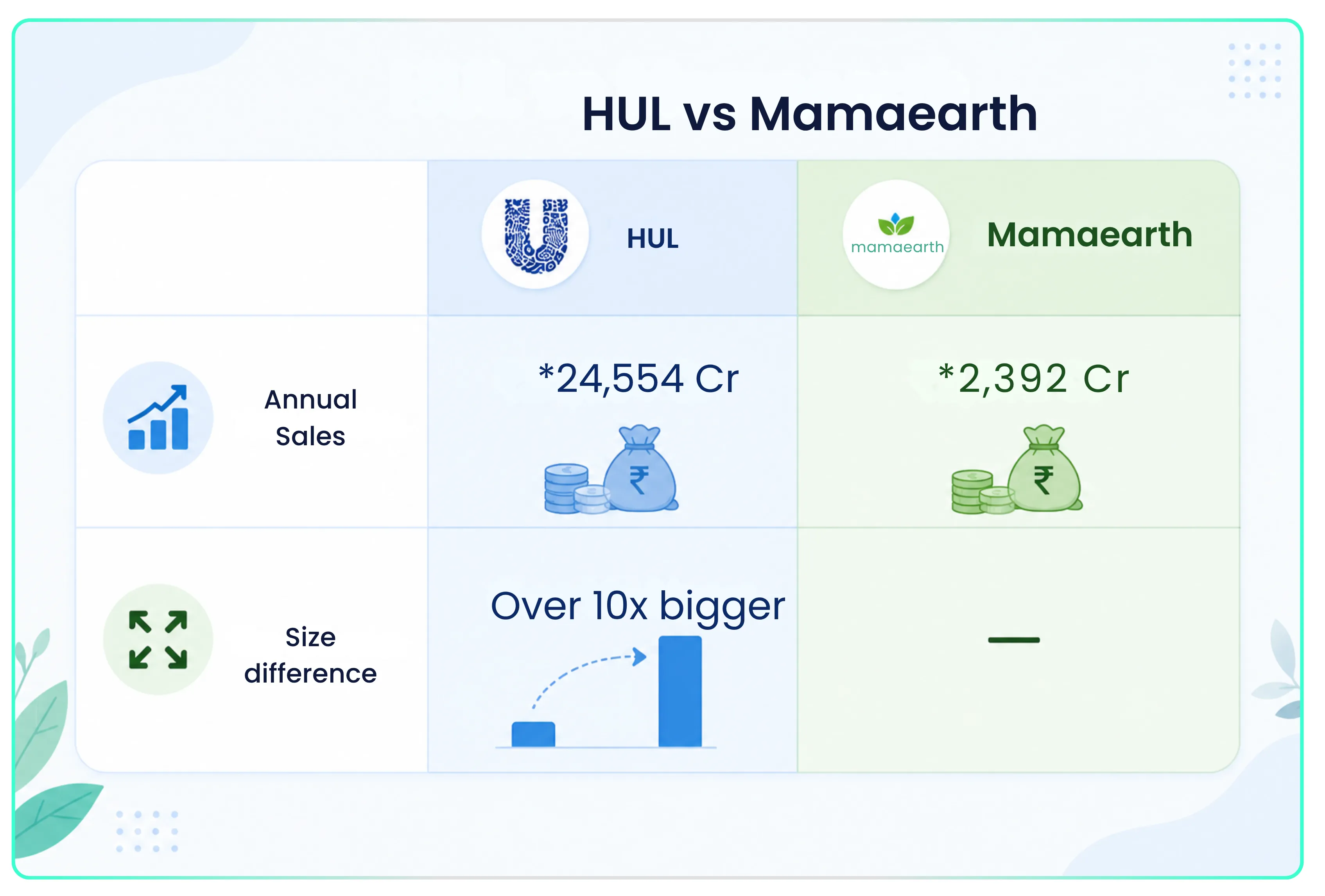
Think about what that means in plain terms: for every ₹1 Mamaearth’s parent company makes, HUL’s beauty & personal care business alone makes more than ₹10.
But here’s the more interesting part: they’re not really fighting over the same products.
Two different games, played on the same board
HUL mainly sells Lifebuoy, Lux, and Dove soap priced around ₹10 to ₹40 bars . It sells over 40% of every bath soap bought in India. That’s not a market share, that’s dominance.
But then it turns around and spends 4 times as much of every rupee just to convince you to buy it. That’s the real story of D2C brands: high gross margin, high customer-acquisition cost. HUL doesn’t need to convince you to buy Lifebuoy or Lux, you already know it. Mamaearth has to earn that trust, in an ad, every single time.
The result: despite better raw margins, Mamaearth ends up keeping far less than actual profit. That’s the tax you pay for not having 90 years of shelf space and trust already built in.
The good news for Mamaearth: this gap is closing. Its EBITDA margin has climbed from a painful 1.2% in FY21 to roughly 10% in FY26
The real moat isn’t the brand, it’s the delivery van
Here’s the number that should worry any D2C challenger more than any soap ad ever could:
HUL reaches over 9 million retail outlets across India, from Mumbai malls to villages with no paved road.
Honasa reaches roughly 250,000-plus outlets.
That’s a 35-to-1 gap. HUL built this over nine decades: trucks, warehouses, rural “Shakti” saleswomen on bicycles, tie-ups with every quick-commerce app. You cannot buy that overnight, no matter how good your Instagram ads are. It’s less a brand advantage and more an infrastructure advantage, and infrastructure is much harder to copy than a marketing campaign.
This is exactly why Honasa’s big strategic bet right now is offline expansion; it’s trying to go from a purely digital brand to one that also sits on a physical shelf, because it’s realized that reach, not just recognition, is what actually protects a business long-term.
Why HUL is also fighting itself
Here’s a twist most people miss: HUL’s own premium beauty products (Dove, Pond’s, the newer Minimalist and Simple brands) make a 28–32% margin, nearly double what its classic mass-market soaps make (18–19%).
In simple terms, Mamaearth’s whole business is built around selling premium skincare products at higher prices, using a D2C-style model. Interestingly, HUL is now doing the same, and this has become one of its fastest-growing and most profitable businesses.
So HUL isn’t just trying to protect its traditional soap business from newer brands like Mamaearth. HUL is building its own version of a Mamaearth-style business from within the company, with one big advantage: HUL already has a massive distribution network and delivery system in place
That’s the uncomfortable truth for every challenger brand in FMCG: if your idea works, the giant next door can copy the idea and still keep the distribution.
So who “wins”?
Wrong question, honestly. They’re not really playing the same game.
If you’re betting on stability, scale, and slow compounding, HUL is the story: a business so entrenched in daily Indian life that its soap alone outsells an entire challenger’s entire company.
If you’re betting on India’s shift toward premium, natural, online-first consumption, Mamaearth is the story: a decade-old idea (D2C beauty) finally growing into real, if still thin, profitability, and now racing to build the one thing it never had: HUL’s kind of reach.
The neighbourhood grocery store isn’t going anywhere. But the boutique down the street is slowly, expensively, learning how to become one too.