One of the biggest mistakes investors make when looking at Indian e-commerce is treating every digital platform as if it were the same kind of business.
They are not.
A company operating 3,500 sq ft dark stores and delivering groceries in ten minutes is very different from a zero-commission marketplace selling unbranded clothes to customers in Tier-3 towns. Both are also very different from a B2B platform that generates leads for businesses and operates with negative working capital.
Their businesses work differently. They have different customer acquisition costs, take rates, capital requirements, logistics costs, gross margins, and cash-flow profiles. As a result, the market can also value them very differently.
Comparing these companies without first understanding what type of business they actually run can lead to meaningless conclusions.
First understand the archetype. Then look at the numbers.
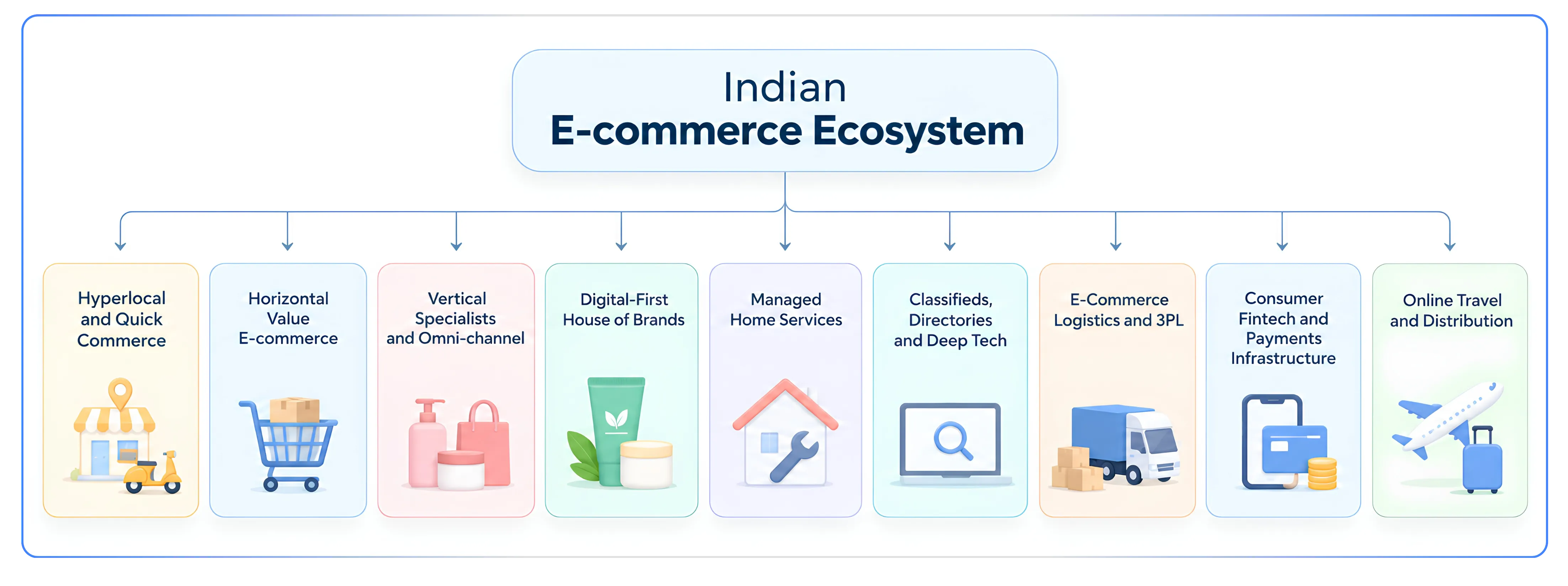
The nine archetypes below are analytical categories, not official industry classifications. No regulator publishes them, and companies do not describe themselves using these labels. They are useful because businesses within the same archetype tend to have similar ways of making money, similar margin structures, and similar ways in which the business can go wrong.
1. Hyperlocal and Quick Commerce
Benchmark companies: Eternal (Blinkit, Zomato), Swiggy (Instamart, food delivery)
These businesses connect customers, merchants and delivery partners in a local area. They make money mainly through merchant commissions, customer delivery and convenience fees, and advertising sold to brands on the platform.
In food delivery, merchant commissions are roughly 16 to 24 per cent. In quick commerce, marketplace commissions are around 8 to 14 per cent.
The most important number to watch is dark-store order density, which simply means the number of orders a store receives each day.
A dark store generally needs around 800 to 1,000 orders a day to reach the store-level breakeven point. Mature stores can handle more than 2,000 orders a day. At the FY26 level, operating margins remain negative to roughly breakeven.
The advantage these companies have comes from having a dense local network, getting customers used to deliveries in less than 15 minutes, and using algorithms that become more efficient as the number of orders increases.
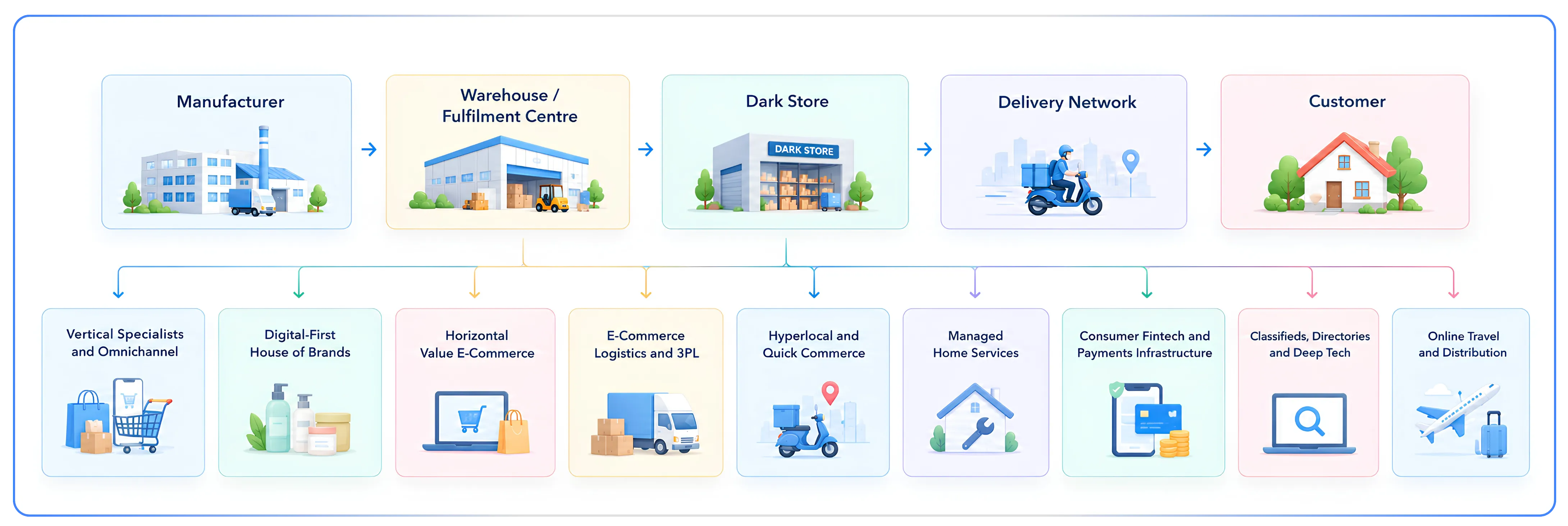
The main risks are higher obligations towards delivery workers under the labour codes, limited availability of suitable dark-store locations, rising rents, and discounting wars as companies enter new categories.
2. Horizontal Value E-Commerce
Benchmark company: Meesho This is a mass-market marketplace that connects unbranded manufacturers and regional wholesalers directly with customers, particularly in Tier 2, Tier 3 and Tier 4 cities and towns.
Sellers do not pay a commission simply to list their products. Instead, the platform makes money through seller advertising, where sellers bid for better visibility in search results, and through a markup on logistics provided through integrated third-party logistics companies.
The average order value is very low, at around Rs 300 to Rs 450. That makes logistics particularly important because even a small increase in shipping cost can take away a large part of the order value.
One of the most important numbers to watch is the return-to-origin rate, or RTO rate. This is the percentage of cash-on-delivery orders that customers refuse to accept when the delivery reaches their doorstep.
When the RTO rate goes above roughly 20 to 22 per cent, the economics of the business can deteriorate sharply. Operating margin is around negative 8 per cent.
The main advantage comes from having a large scale in low-priced, unbranded apparel and home products, strong social or word-of-mouth distribution, and recommendation systems that are designed for people buying online for the first time.
3. Vertical Category Specialists and Omnichannel
Benchmark companies: Nykaa (FSN E-Commerce), FirstCry (Brainbees Solutions), Wakefit
These are platforms that focus deeply on specific categories such as beauty and personal care, baby and parenting products, and home and sleep products.
Their business model combines several things.
They sell products themselves and earn the full retail margin. They also operate a curated marketplace where third-party sellers pay a commission. On top of this, they sell their own private-label products and operate physical stores.
The key number to watch is the private-label GMV mix, which tells us how much of the platform's total sales comes from its own brands.
Nykaa's House of Nykaa reached roughly Rs 3,176 crore of GMV in FY26. That was about 16 per cent of its consolidated GMV and was growing faster than the overall platform.
Operating margins are in the 6 to 8 per cent range.
The advantage these businesses have comes from trust, particularly in categories where customers worry about counterfeit products. Curated products and communities also help build customer confidence. Physical stores add an omnichannel element, allowing customers to see or try products before buying them.
Also Read: The Companies Keeping India's Energy Boom Running
4. Digital-First House of Brands
Benchmark company: Honasa Consumer (Mamaearth, The Derma Co, Aqualogica, BBlunt)
These companies start by building brands online.
They look for new trends on social media, develop products quickly through contract manufacturers, and use influencers and digital advertising to build demand. Once the brand becomes established online, they try to expand into offline general trade and modern trade.
That move from online to offline is the difficult part of the model. It is also where a large part of the investment risk sits.
During the early stages of building a brand, advertising and promotion can account for roughly 35 to 42 per cent of revenue. For the business model to become sustainable at maturity, this needs to fall below 30 per cent.
Honasa was running at around 35 per cent in FY26. Operating margin is around 9 per cent.
The advantage comes from being able to move from an idea to a product on the shelf in around 60 to 90 days, strong social media marketing capabilities, and using customer data to identify emerging trends.
The main risks are low customer loyalty, rising digital customer acquisition costs, and inventory write-offs when a particular beauty trend suddenly loses popularity.
5. Managed Gig Home Services
Benchmark company: Urban Company
This is a managed marketplace for services delivered at home, including beauty services, cleaning, and appliance repairs.
The important difference from a simple classifieds platform is that the company manages much more of the service.
It helps set prices, maintains service standards, trains service partners, and also sells proprietary consumable kits and spare parts to those partners.
The key number to watch is the service take rate, which is typically in the low-to-mid twenties as a percentage of the total value of the service.
Another important measure is the net earnings of each service partner. This is calculated after taking into account the platform's commission, equipment instalments, and consumable costs. It helps show whether service partners are earning enough to remain on the platform.
Consolidated operating margin is around negative 8 per cent. However, Urban Company's core India business generated positive adjusted EBITDA in FY26, while its newer businesses continued to absorb some of those gains.
The advantage comes from customer trust, particularly when allowing a service professional into the home, consistent service quality, and a proprietary training system that helps generate frequent bookings.
6. Classifieds, Directories and Deep Tech
Benchmark companies: Info Edge (India), IndiaMART InterMESH, Just Dial, CarTrade Tech, C.E. Info Systems (MapmyIndia)
These are high-operating-leverage businesses that include directories, classifieds, and software platforms.
They make money in different ways. Some charge customers upfront for multi-year subscriptions. Others earn through paid priority listings and lead-generation bids, dealer software subscriptions, or enterprise licences for mapping and navigation.
These are among the highest-margin businesses in the sector.
The reason is fairly simple. They do not have to deal with most of the physical fulfilment process.
Warehousing, picking, long-distance transportation and last-mile delivery are not part of their business model. Because these physical costs are largely absent, gross margins can exceed 75 per cent and working capital can be negative.
IndiaMART, for example, had Rs 1,965 crore of deferred revenue as of March 2026, compared with Rs 1,569 crore of annual revenue.
Operating margins are in the 30 to 37 per cent range.
The advantage comes from having a large network of buyers and suppliers, proprietary map and data assets, and high switching costs once customers integrate the platform into their payment or ERP workflows.
7. E-Commerce Logistics and 3PL
Benchmark companies: Delhivery, Blue Dart Express
These companies provide the physical infrastructure that allows e-commerce to work at scale.
They operate large supply-chain networks covering warehousing, long-distance trucking, express parcel delivery, and part-truckload freight. Their customers include marketplaces and direct-to-consumer brands.
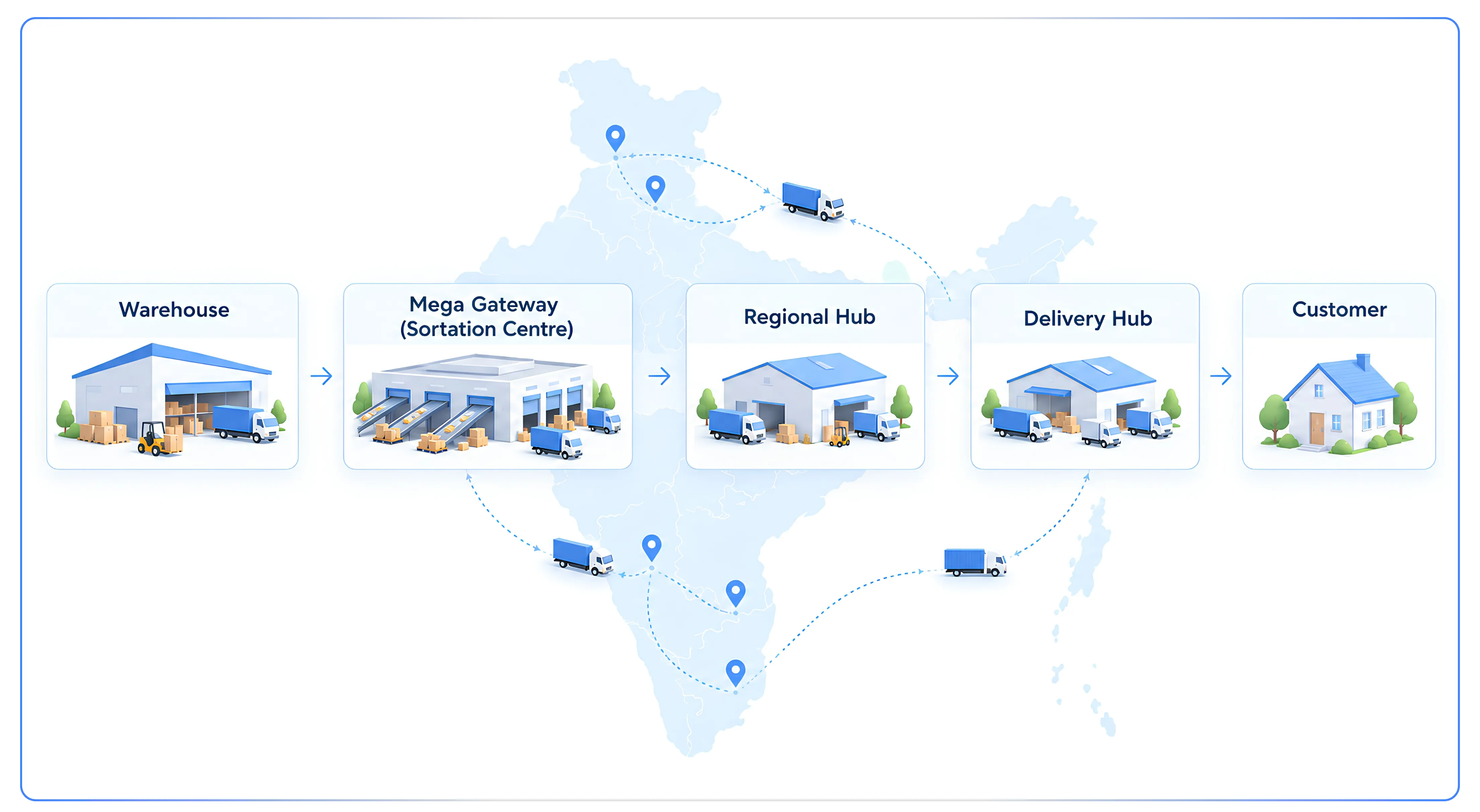
They generally earn revenue based on the number of shipments handled or the weight of the goods transported.
Delhivery crossed one billion e-commerce parcels in FY26. Blue Dart handled 404 million shipments.
The key number to watch is revenue yield per parcel. In simple terms, the amount the company earns from each parcel needs to be higher than the variable cost of delivering and transporting that parcel.
Another important factor is the utilisation of sorting centres and long-distance transportation networks.
Automation requires significant fixed investment. That investment starts making economic sense only when the company has enough volume passing through the network.
Operating margins are in the 7 to 10 per cent range.
The advantage comes from the high cost of building automated mega-gateways, sorting technology, nationwide pin-code coverage, and a network that serves many customers. A single e-commerce company would find it difficult and expensive to build the same infrastructure on its own.
The main risk is that large e-commerce platforms may decide to handle more of their logistics internally. Meesho's Valmo is the clearest live example of this trend.
8. Consumer Fintech and Payments Infrastructure
Benchmark companies: Paytm (One97 Communications), PB Fintech (Policybazaar, Paisabazaar), AvenuesAI (formerly Infibeam Avenues, CCAvenue)
These businesses operate in financial distribution and merchant payments.
They make money through insurance commissions and renewal income, subscriptions for merchant devices, payment processing spreads earned on transaction volumes, and fees for distributing loans.
PB Fintech's trailing renewal revenue increased from Rs 668 crore to Rs 935 crore during FY26.
Paytm reached 1.51 crore subscription merchants in FY26.
Operating margins vary widely, from 6 per cent to 64 per cent. One reason for this large difference is whether a company reports its revenue on a gross basis or a net basis.
The advantage comes from integrations with insurers and banks, merchant dependence on payment terminals, and strong consumer awareness when people are making important financial decisions.
The main risks include regulatory changes affecting commissions or merchant discount rates, price wars around payment devices, and the possibility that lending partners become more cautious during a credit downturn.
9. Online Travel and Distribution
Benchmark companies: TBO Tek, ixigo (Le Travenues Technology), EaseMyTrip
Travel platforms make money from a booking rather than from physically delivering a product.
There are two very different business models within this category.
B2C online travel agencies such as ixigo and EaseMyTrip acquire customers directly. They earn a margin on flights, trains, buses and hotels.
B2B travel distribution companies such as TBO Tek work with travel agents and corporates around the world. This is more of a network business, with much higher switching costs and no direct consumer acquisition cost.
The key number to watch is the relationship between gross transaction value and revenue. This tells us the platform's take rate, or the percentage of the total booking value that becomes revenue for the company.
In FY26, ixigo processed Rs 18,693 crore of GTV and generated Rs 1,228 crore of revenue. That translates into a take rate of about 6.6 per cent.
Another important metric is the ancillary attach rate. This measures how many customers also buy additional services such as insurance, seat selection or cancellation protection.
These additional services are important because they can turn a relatively thin booking margin into a more workable business model.
Operating margins range from negative 6 per cent to 15 per cent.
For B2B travel platforms, the advantage comes from having a wide range of suppliers and becoming deeply integrated into the workflows of travel agents.
For B2C platforms, the advantage comes from being remembered when a customer is ready to book and from building a habit of repeat bookings.
Why This Classification Matters
These archetypes are not just labels. They are tools for understanding how different businesses actually work.
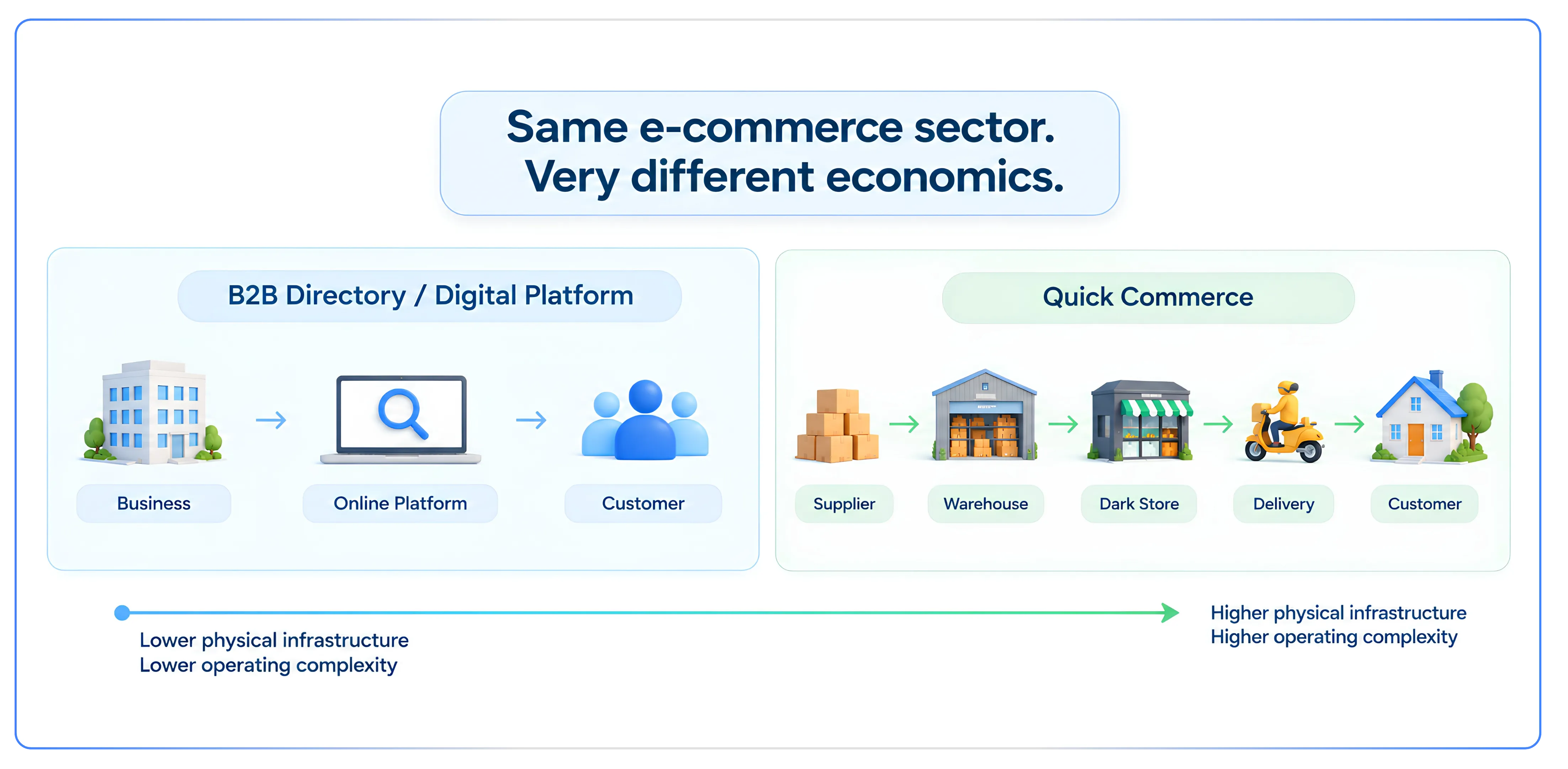
Consider two companies. One may have a 37 per cent operating margin because it runs a B2B directory and does not have to deal with physical fulfilment. Another may be a quick-commerce company still operating with negative contribution margins because it has to maintain dark stores, inventory and delivery infrastructure.
Looking at those two margins side by side without understanding how the businesses work can lead to the wrong conclusion.
The right approach is to first place a company into the appropriate archetype. Then study its margins, risks and economics based on how that particular type of business operates.
Only after that should an investor compare it with companies from completely different archetypes, and even then, only when the specific investment question requires it.
Disclaimer: The information provided in our blogs is for informational purposes only and should not be construed as financial, investment, or trading advice. Trading and investing in the securities market carries risk. Always conduct your own research and consult with a qualified financial advisor before making any investment decisions. Past performance is not indicative of future results. Copyrighted and original content for your trading and investing needs.
© 2026 — Tradejini. All Rights Reserved.