Quick-commerce companies promise to deliver groceries and other products within 10–20 minutes. While this service is convenient for customers, operating such a business involves several costs. To understand whether a quick-commerce company can become profitable, we need to examine the economics of a single order.
Consider a customer placing an order worth ₹500. The company earns money through product margins, delivery charges, and advertising income. However, it also has to pay delivery partners, store employees, rent, technology expenses, and other operating costs.
Let's break down the economics of this transaction.
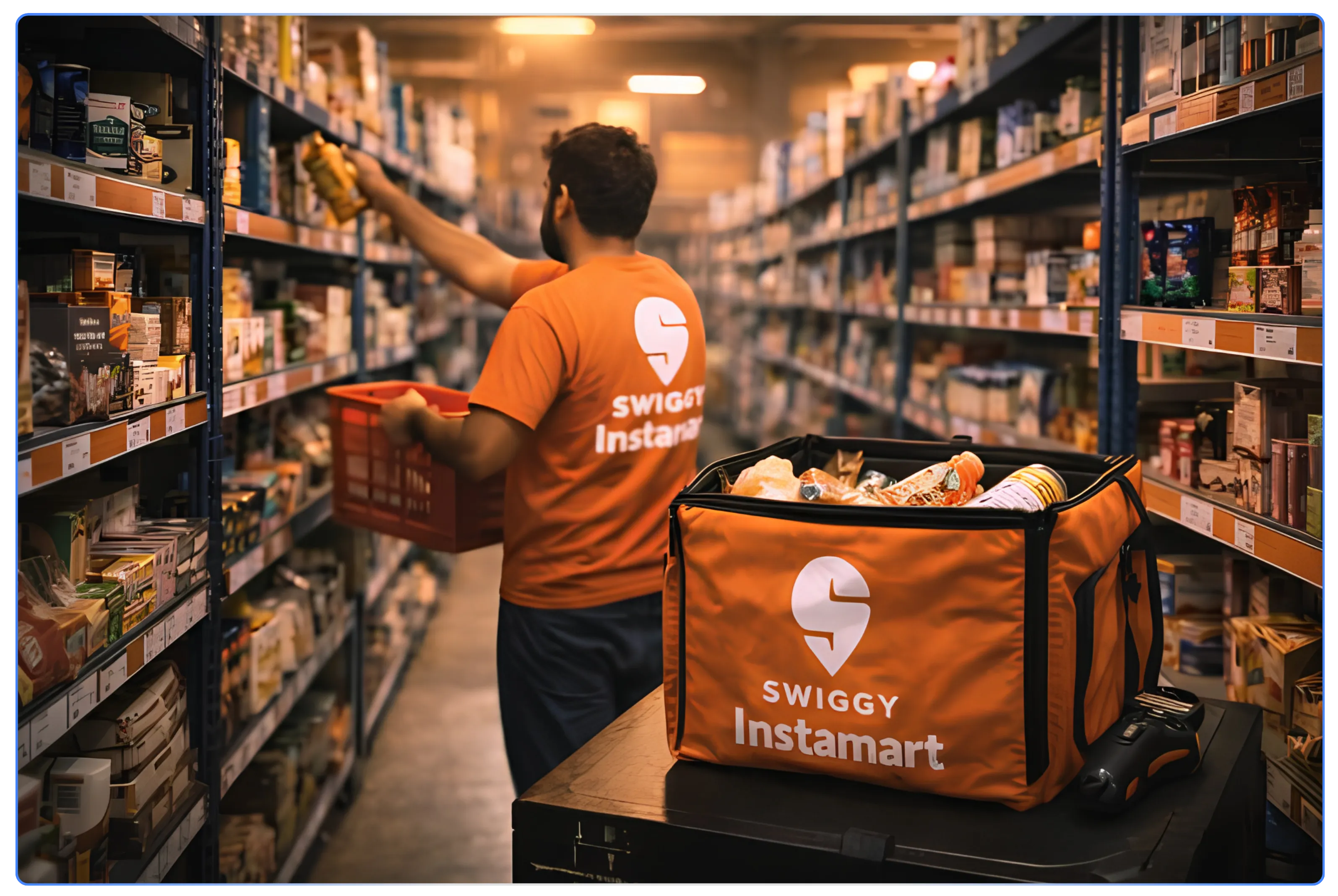
So, where does the ₹500 order value go? Here is how to interpret the numbers:
- Product margin: The company purchases products for ₹387.50 and sells them as part of a ₹500 order. This leaves a gross platform margin of ₹112.50.
- Additional revenue: Delivery charges contribute ₹20, while advertisements from brands generate another ₹15.
- Delivery expenses: The company pays ₹52 to delivery partners for completing the order.
- Store expenses: Picking, packing, rent, electricity, and wastage add to the operating cost.
- Technology and customer support: Payment processing, cloud infrastructure, and refunds also consume money.
After deducting the direct operating expenses, the store generates ₹36 as a contribution. Once ₹22 of allocated corporate expenses is deducted, the operating profit is ₹14, equivalent to 2.8% of the order value.
The important point is that a ₹500 order does not translate into ₹500 of revenue for the platform. Only a portion is retained after product costs and other expenses.
Three ways to improve profitability
Quick-commerce companies generally have three important opportunities to improve their unit economics.
- Increase advertising revenue
Brands pay platforms to promote their products within the application. For example, a consumer goods company may pay to display its detergent or personal care products at the top of search results. Advertising can generate additional revenue without significantly increasing delivery or store operating costs.
- Sell more non-grocery products
Groceries such as milk, rice, and vegetables generally have lower margins. Products such as mobile accessories, toys, beauty products, and selected electronics can offer higher margins. Increasing the share of these categories can improve the overall gross margin.
- Increase the number of orders per store
A dark store has fixed expenses such as rent, electricity, and basic staffing costs. If a store handles 1,000 orders a day, these fixed expenses are distributed across 1,000 orders. If the same store handles 2,200 orders, the fixed cost allocated to each order falls. This is one reason why order density is important to quick-commerce profitability.
2. Understanding the Dark Store Maturity Curve
A dark store is a small warehouse that serves online orders. Unlike a traditional retail outlet, customers generally cannot walk in and purchase products.
When a quick-commerce company opens a new store, it cannot immediately expect the store to generate profits.
It needs time to attract customers, build repeat ordering habits, and increase the number of daily orders. A typical dark store passes through four financial stages.
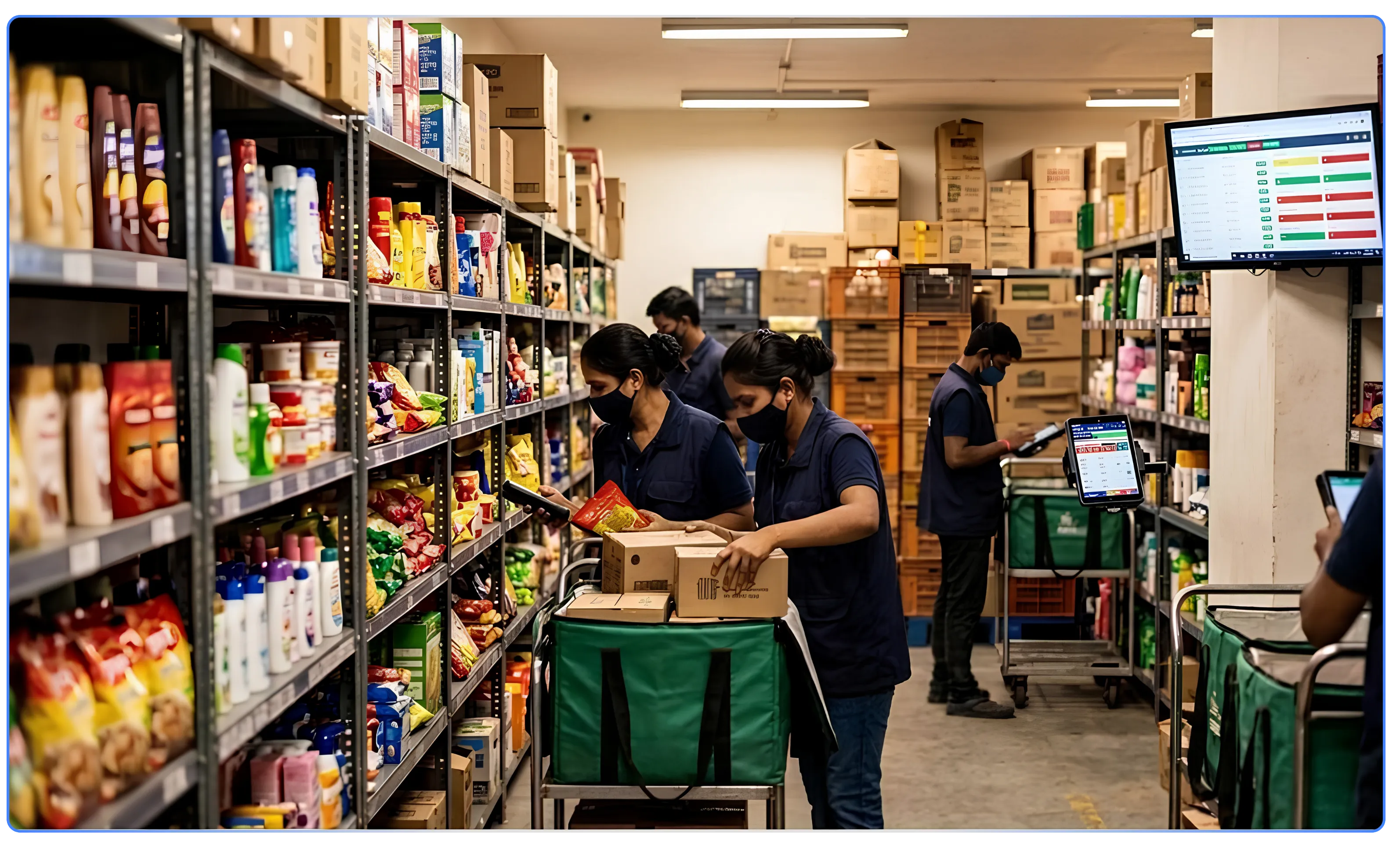
Four stages in the financial maturity of a dark store
Stage 1: Initial investment and losses (Months 1–3)
During the first few months, the company spends money on local promotions and discounts to attract customers. Order volumes are relatively low, but the store still has to pay rent, electricity, and employee salaries. As a result, the store can report significant losses.
Stage 2: Increasing order volumes (Months 4–6)
As more customers become familiar with the service, order volumes start increasing. The company begins to benefit from repeat customers. Delivery routes can also be planned more efficiently, allowing riders to handle more orders. Losses start reducing.
Stage 3: Store-level breakeven (Months 7–12)
At this stage, daily order volumes may become sufficient to cover the store's operating expenses. The company can also expand its product assortment and improve inventory management. The store may start generating a positive contribution.
Stage 4: Mature store (12 months onwards)
An established store generally has a larger customer base and more predictable order volumes. Higher order density, better delivery efficiency, and additional advertising revenue can improve profitability.
Why should investors track store maturity?
Suppose a company opens 400 new stores over two quarters. Most of these stores will initially operate at a loss. Consequently, the company's consolidated contribution margin may decline even if its older stores continue to perform well. This creates a challenge for investors. A decline in consolidated profitability does not necessarily mean that the underlying business is deteriorating. It could also be the result of expansion into new locations. However, companies should not use expansion as an explanation for every decline in profitability.
What should investors examine?
Ask the management to disclose:
- How many stores are less than six months old?
- How many stores are between six and twelve months old?
- What percentage of stores are more than twelve months old?
- What is the contribution margin of stores that have been operational for more than twelve months?
This information helps investors understand whether the company is improving its existing operations or continuously adding new stores to support reported growth.
3. Customer Acquisition Cost (CAC) and Lifetime Value (LTV)
Customer acquisition cost and lifetime value are two important metrics used to evaluate consumer internet businesses. Customer Acquisition Cost (CAC) is the amount a company spends to acquire one new customer.
Lifetime Value (LTV) is the total contribution a company expects to earn from a customer during the period they continue using its service. For example, suppose a quick-commerce company spends ₹300 on advertisements and promotional offers to acquire a customer. If that customer generates ₹900 in contribution over the next two years, the business has generated three times its acquisition cost. However, this relationship can change over time.
Three problems that affect CAC and LTV
1. Increasing advertising costs
Quick-commerce companies compete for the same urban customers. As more companies advertise on Google, social media, and other platforms, the cost of acquiring customers can increase. A company may therefore have to spend more money to attract the same number of customers.
2. Lower customer spending and order frequency
Early customers are often people who live in high-density urban locations and regularly use online delivery services. As companies expand into new locations and customer segments, average order value and ordering frequency may decline. This reduces the lifetime value of customers.
3. Customers who depend on discounts
Some customers use a platform only when attractive discounts are available. If the company reduces promotional offers, these customers may immediately shift to another platform. This indicates that the company has not necessarily built customer loyalty.
How can investors identify this problem?
Track three metrics together:
- Marketing expenditure as a percentage of revenue.
- Monthly transacting users and customer retention.
- Orders per monthly transacting user.
A useful exercise is to examine what happens when the company reduces promotional spending.
If marketing expenditure declines but customer numbers and ordering frequency remain stable, it may indicate that customers are using the service because of convenience rather than discounts.
If customer activity falls sharply, the business may still be dependent on promotional spending.
The Return-to-Origin (RTO) Problem
Return-to-Origin is particularly important in value-commerce businesses that deliver products to customers using cash-on-delivery transactions. RTO occurs when a customer places an order but refuses to accept the parcel when the delivery partner arrives. Consider a customer ordering an unbranded garment worth ₹350. By the time the product reaches the customer's location, the customer may have changed their mind, purchased the product elsewhere, or simply refused delivery.
The parcel then has to travel back to the seller or warehouse.
How does RTO affect profitability?
| Expense | Amount |
|---|---|
| Forward delivery | ₹45 |
| Reverse delivery | ₹35 |
| Total logistics cost | ₹80 |
| Product value | ₹350 |
The company or seller incurs ₹80 in logistics expenses without completing the sale. That is a substantial cost compared with the original product value. As RTO increases, the business has to absorb more delivery expenses without receiving revenue from completed transactions.
Why should investors track RTO?
A marketplace may report strong Gross Merchandise Value (GMV) growth even when a significant percentage of orders are not delivered successfully.
For example, assume a marketplace receives orders worth ₹100 crore.
If 25% of the order value is eventually returned or refused, the delivered order value is only ₹75 crore, before considering other adjustments.
Therefore, investors should not rely only on reported GMV.
They should also examine:
- RTO as a percentage of orders and GMV.
- Delivered GMV versus gross ordered GMV.
- Customer cancellations and delivery refusal rates.
- Forward and reverse logistics costs.
The distinction between orders placed and orders successfully delivered is important when evaluating marketplace growth.
What Investors Should Monitor
The economics of quick commerce cannot be evaluated using revenue growth alone. Investors should monitor a combination of operational and financial metrics.
| Metric | Why it matters |
|---|---|
| Average Order Value (AOV) | Indicates how much customers spend per order |
| Gross Margin | Shows the margin earned on products |
| Orders per Dark Store | Measures store utilization |
| Contribution Margin | Indicates profitability after direct operating costs |
| Advertising Revenue | Shows the contribution from brand promotions |
| Customer Acquisition Cost | Measures the cost of acquiring customers |
| Monthly Transacting Users | Indicates the size of the active customer base |
| RTO Percentage | Measures unsuccessful deliveries and associated costs |
| Mature Store Contribution | Helps evaluate the underlying store economics |
A company that consistently improves these metrics has a better chance of achieving sustainable profitability.
Disclaimer: The information provided in our blogs is for informational purposes only and should not be construed as financial, investment, or trading advice. Trading and investing in the securities market carries risk. Always conduct your own research and consult with a qualified financial advisor before making any investment decisions. Past performance is not indicative of future results. Copyrighted and original content for your trading and investing needs.
© 2026 — Tradejini. All Rights Reserved.