In the first part of our gold series, we explored gold’s origin, its transformation into currency, and its lasting role as a store of value across civilizations. But gold’s story doesn’t stop at vaults and ornaments, it evolves in step with the world’s economy, technology, and geopolitical currents.
In this continuation, we shift focus from the timeless allure of gold to its modern dynamics in production, demand, and global trade. Backed by the latest data, we examine how countries are mining and recycling gold, how central banks are stockpiling it, and how technology, from AI chips to satellites, is reshaping demand. We also uncover how India imports gold, how it’s traded on global markets like the LBMA, and why gold continues to be a cornerstone for investors in times of uncertainty.
Global gold reserves
According to the U.S. Geological Survey (USGS), the estimated unmined global gold reserves, meaning extractable gold using current technology, stood at 59,000 metric tons in 2023. The annual global gold production is approximately 3,600 metric tons. If extraction continues at this rate without discoveries, current gold reserves could be depleted in just 16 years.
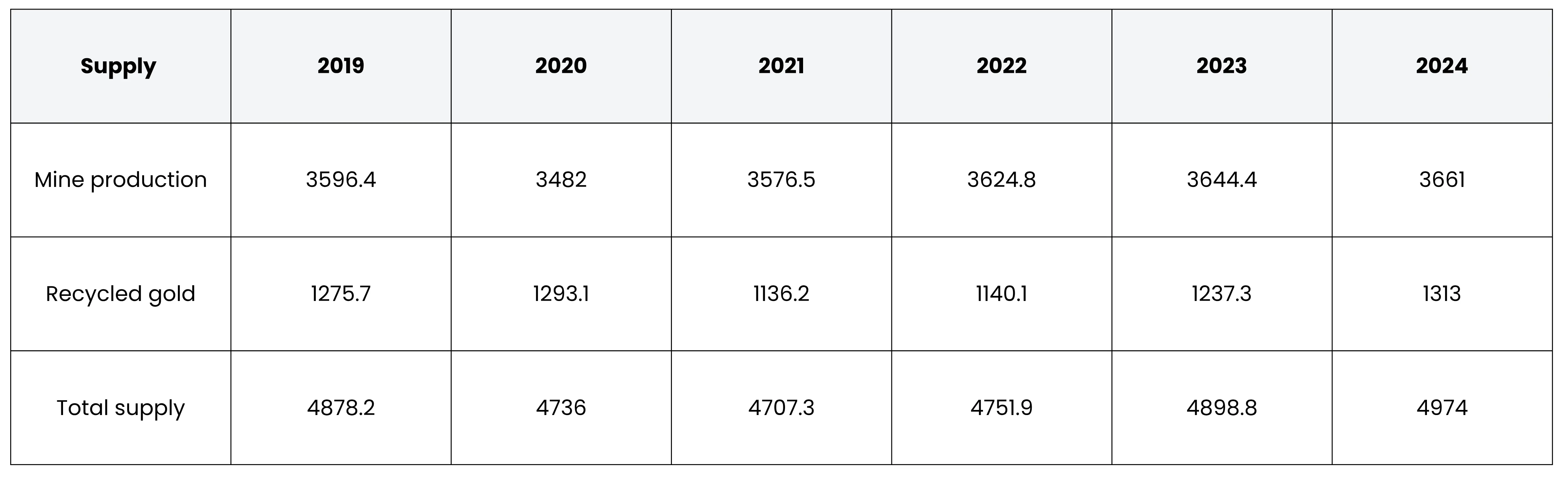
Gold production and supply trends (2019–2024)
Global gold supply has shown a steady and gradual increase from 2019 to 2024. Mine production, which forms the bulk of the supply, fluctuated slightly during the pandemic years but recovered to 3,661 metric tons in 2024, up from 3,482 metric tons in 2020.
Meanwhile, recycled gold also gained importance, increasing from 1,275.7 metric tons in 2019 to 1,313 metric tons in 2024, highlighting a growing emphasis on sustainability and circular gold use.
Overall, total supply rose from 4,878.2 tonnes in 2019 to 4,974 tonnes in 2024, reflecting stable mining operations and rising recycling efforts to meet global demand.
| Country | Gold Production (metric tons) |
|---|---|
| China | 378 |
| Russia | 321 |
| Australia | 293 |
| Canada | 192 |
| United States | 168 |
Looking at country-level production, China remains the top producer with 378 tonnes in 2024, followed by Russia (321 tonnes) and Australia (293 tonnes). Canada also contributed significantly with 192 tonnes. This distribution aligns with the gold reserves chart, where Australia and Russia dominate in underground reserves (~12,000 and ~11,100 tonnes, respectively), ensuring their strong future output potential.
The trend clearly shows that while gold mining remains steady, recycled gold is playing an increasingly crucial role in supplementing the supply. Countries with vast reserves like Australia and Russia are well-positioned to maintain production, while top producers like China lead due to both resource endowment and industrial infrastructure.
Gold consumption trends (2019–2024)
From 2019 to 2024, global gold demand has remained remarkably resilient, reflecting both its cultural significance and strategic economic role. In 2024, total gold consumption reached approximately 5,101 tonnes, nearly matching global supply, underscoring gold’s enduring relevance across multiple sectors.
Jewellery continues to lead global demand, accounting for around 40% of total consumption. This dominance is driven by strong cultural traditions, especially in countries like India and China, where gold remains integral to weddings, festivals, and generational wealth. Despite global economic headwinds, consumer appetite for gold jewellery has held steady.
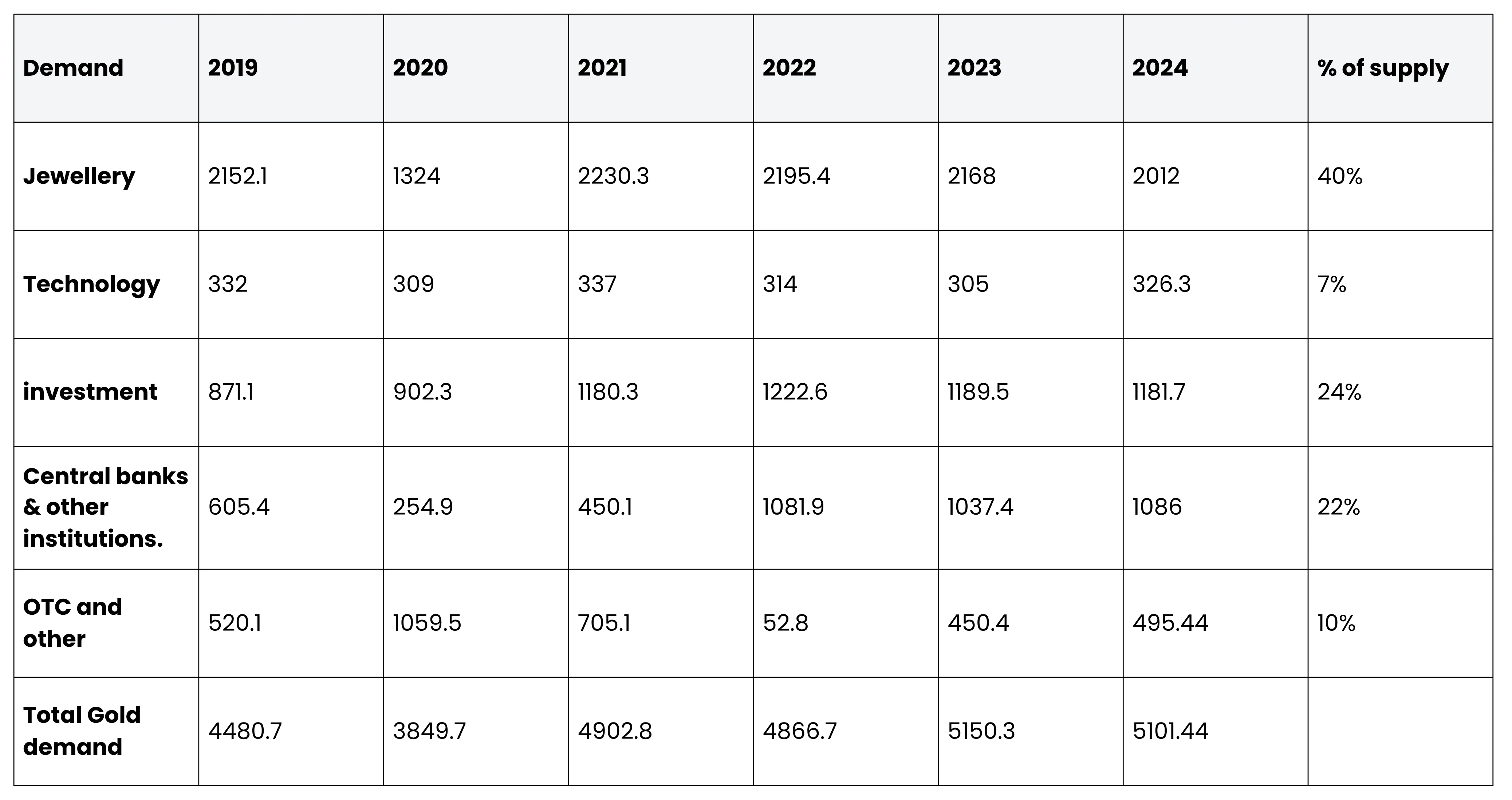
Investment demand, encompassing gold bars, coins, ETFs, and sovereign reserves, contributed a substantial 24% in 2024. Within this, central banks and institutional buyers have notably ramped up their purchases, representing a stable 22% of demand. This trend highlights a strategic shift among nations to hedge against economic uncertainty and reduce reliance on the U.S. dollar by holding more gold in their foreign exchange reserves.
Why is technology driving demand for gold?
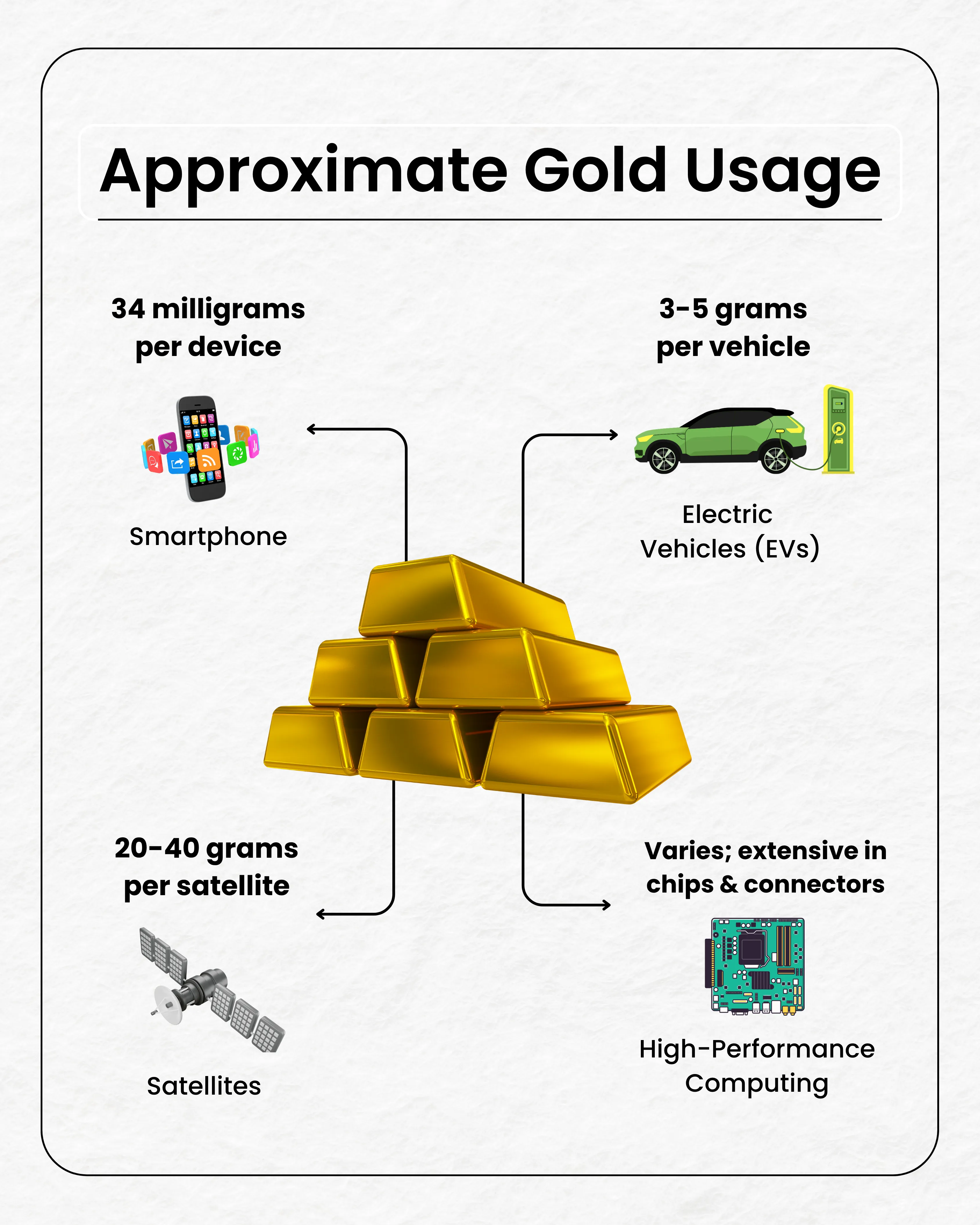
In 2024, the technology sector's demand for gold surged to 326 tonnes, a remarkable 7% increase from the previous year. This growth was primarily fueled by the rapid expansion of artificial intelligence (AI). High-performance computing (HPC) systems and AI processors rely heavily on gold due to its superior conductivity and resistance to corrosion. Major chipmakers like SK Hynix and Samsung reported sold-out inventories of high-end memory chips, underscoring how AI-driven innovation has made gold even more indispensable.
Alongside AI, the consumer electronics sector rebounded strongly after a sluggish 2023, with smartphone shipments rising by 6%. Companies like Huawei saw increased demand for affordable models, while the rollout of technologies such as WiFi 7 and 5G, which require gold-intensive components, further drove consumption.
Additional gold demand stemmed from the aerospace and automotive sectors. The rapid deployment of Low Earth Orbit (LEO) satellites, such as those launched by Starlink, significantly increased gold usage for reliable data transmission in space. Meanwhile, the adoption of Advanced Driver Assistance Systems (ADAS) in vehicles, driven by EU safety mandates, further contributed to rising gold consumption.
Despite these growth areas, some tech sectors implemented cost-cutting measures, such as reducing gold plating in printed circuit boards (PCBs), introducing micro-LEDs that use less gold, and designing NAND memory chips with minimal bonding wire. Even so, the 7% increase in demand aligns with historical trends and is considered justified, especially given gold’s irreplaceable role in modern high-performance technologies. Though gold prices averaged $2,386 per ounce in 2024, raising production costs, its unique properties continue to make it vital across the technology landscape.
| Application | Gold Usage (Approximate) |
|---|---|
| Smartphone | 34 milligrams per device |
| Electric Vehicles (EVs) | 3–5 grams per vehicle |
| Satellites | 20–40 grams per satellite |
| High-Performance Computing | Varies — extensive use in chips and connectors |
How gold is traded on the LBMA
The London Bullion Market Association (LBMA) is the epicentre of global physical gold trading. Unlike typical stock markets, the LBMA operates as an over-the-counter (OTC) market, meaning trades happen directly between institutions away from centralized exchanges through secure electronic platforms or even by phone. Every day, billions of dollars' worth of gold changes hands in this discreet but highly organized financial system.
At the heart of LBMA trading is a commitment to quality. Gold bars traded through the LBMA must adhere to Good Delivery standards, a globally recognized benchmark that ensures each gold bar meets a minimum purity of 99.5%, weighs about 400 troy ounces (roughly 12.4 kilograms), and originates from LBMA-approved refiners. This standardization guarantees trust and uniformity across the global bullion trade. The LBMA’s network includes an elite group of participants: bullion banks like HSBC, JP Morgan, and UBS; major refiners; central banks; sovereign wealth funds; and institutional investors. These players engage in gold transactions for a variety of reasons hedging, portfolio diversification, or reserve management.
Also Read: Gold rush, a cultural and financial asset
What is gold fixing?
Each day, gold prices are set twice at 10:30 AM and 3:00 PM London time through a process historically known as the London Gold Fixing. Today, this process is managed by the ICE Benchmark Administration (IBA), which aggregates buy and sell orders from major participating banks to establish a global benchmark price (price discovery). This price is referenced worldwide in gold contracts, jewellery pricing, and even central bank reporting.
Gold traded on the LBMA is held in two forms of ownership: unallocated and allocated. Most trades occur through unallocated accounts, where buyers own a share of a larger pool of gold without specific bar ownership. In contrast, allocated accounts assign particular gold bars to the buyer.
Behind the scenes, gold is stored in some of the most secure vaults in the world. These are located in London and operated by institutions such as HSBC, Brinks, and the Bank of England. Together, they form the London Precious Metals Clearing Limited (LPMCL), a system that ensures gold trades are settled efficiently and reliably.
In essence, gold trading on the LBMA combines centuries-old trust with modern financial infrastructure, making it the backbone of the global bullion market.
How gold is imported to India (Role of MMTC)
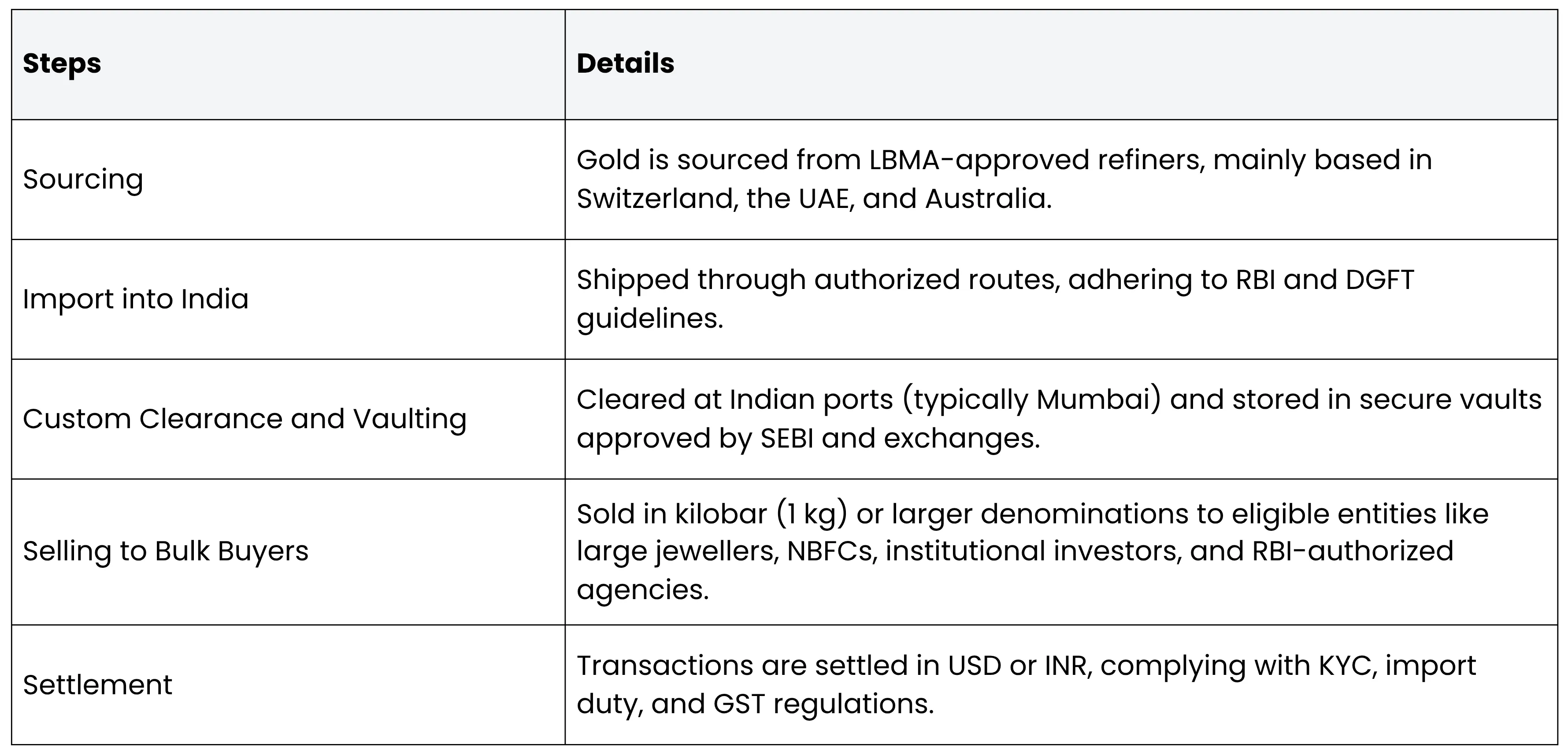
In 2024, India's gold imports increased, reaching 802.8 tonnes, driven by strong investment demand and significant purchases by the Reserve Bank of India, according to the World Gold Council.
Gold is imported into India through authorized agencies under strict regulations set by the Reserve Bank of India (RBI) and the Directorate General of Foreign Trade (DGFT). One of the most important players in this space is MMTC Ltd. (Metals and Minerals Trading Corporation of India), a government-owned enterprise and one of the largest public sector importers of gold.
Gold’s Enduring Role in a Changing World
From mines and recycling centers to trading desks and central bank vaults, gold continues to weave through the heart of the global economy. As shown by the latest supply and demand figures, its value isn’t just historical or cultural, it’s strategic. Nations are accumulating reserves, tech industries are driving new demand, and investors are once again turning to gold as a hedge against inflation, volatility, and devaluation.
Amid rising global uncertainties, gold stands resilient, not merely as a commodity, but as a trusted financial anchor. Whether used in semiconductors or stored by central banks, gold remains as relevant in today's digital economy as it was in ancient trade routes. As we look to the future, gold’s legacy continues, not just as a symbol of wealth, but as a bridge between the ancient past and a volatile, fast-changing world.
Disclaimer: The information provided in our blogs is for informational purposes only and should not be construed as financial, investment, or trading advice. Trading and investing in the securities market carries risk. Always conduct your own research and consult with a qualified financial advisor before making any investment decisions. Past performance is not indicative of future results. Copyrighted and original content for your trading and investing needs.
© 2025 — Tradejini. All Rights Reserved.
.webp%3Falt%3Dmedia%26token%3D0ead9799-20bc-4d1e-ae8f-d75ab18921b5&w=3840&q=75)