

Most retail options traders start with naked call or put buying. It feels simple: pick a direction, buy the option, ride the move. But naked buying has a problem that shows up again and again: false breakouts. You buy a call, Nifty fakes a move up, reverses, and your premium is gone before the "real" move even starts.
This is why we trade straddles instead and specifically, we use them as a trend-identification and entry tool, not just a volatility play. Here's the framework.
1. What a Straddle Actually Is
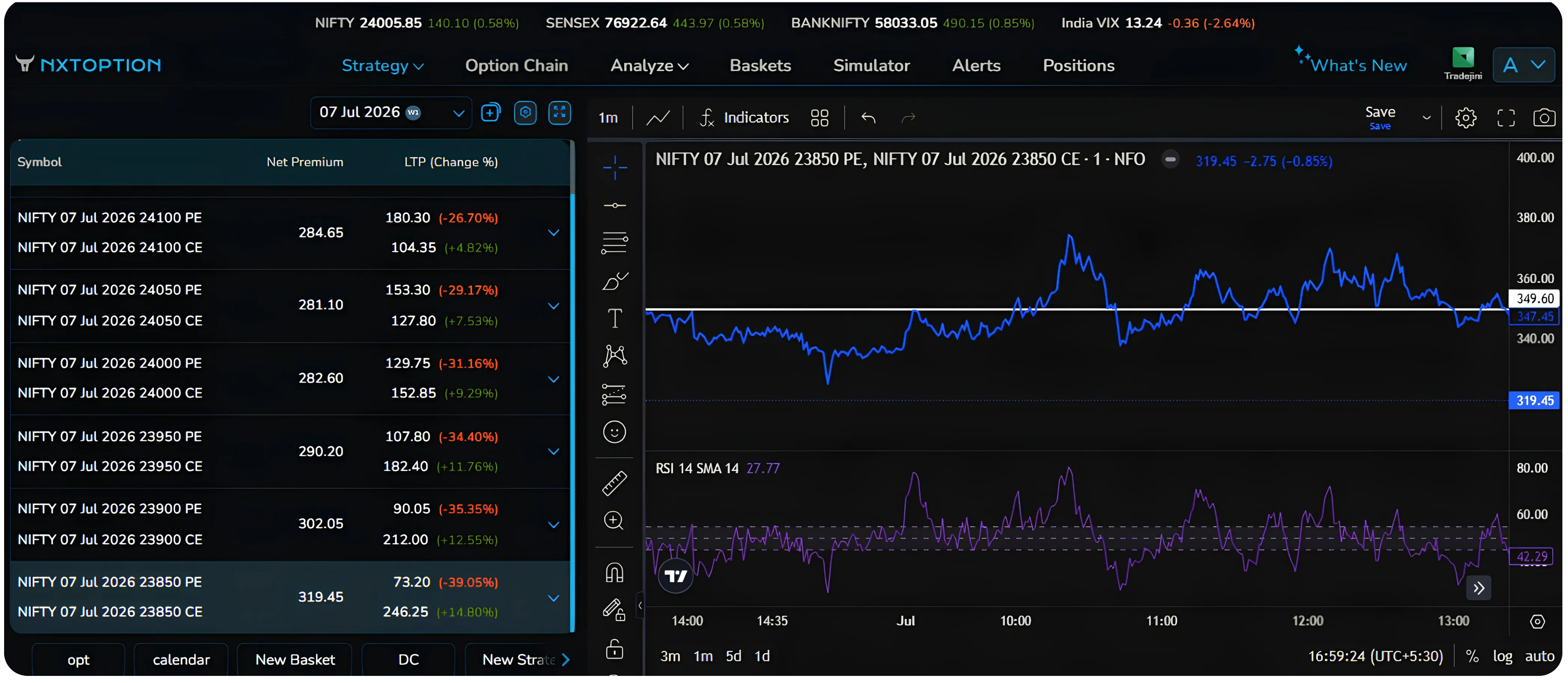
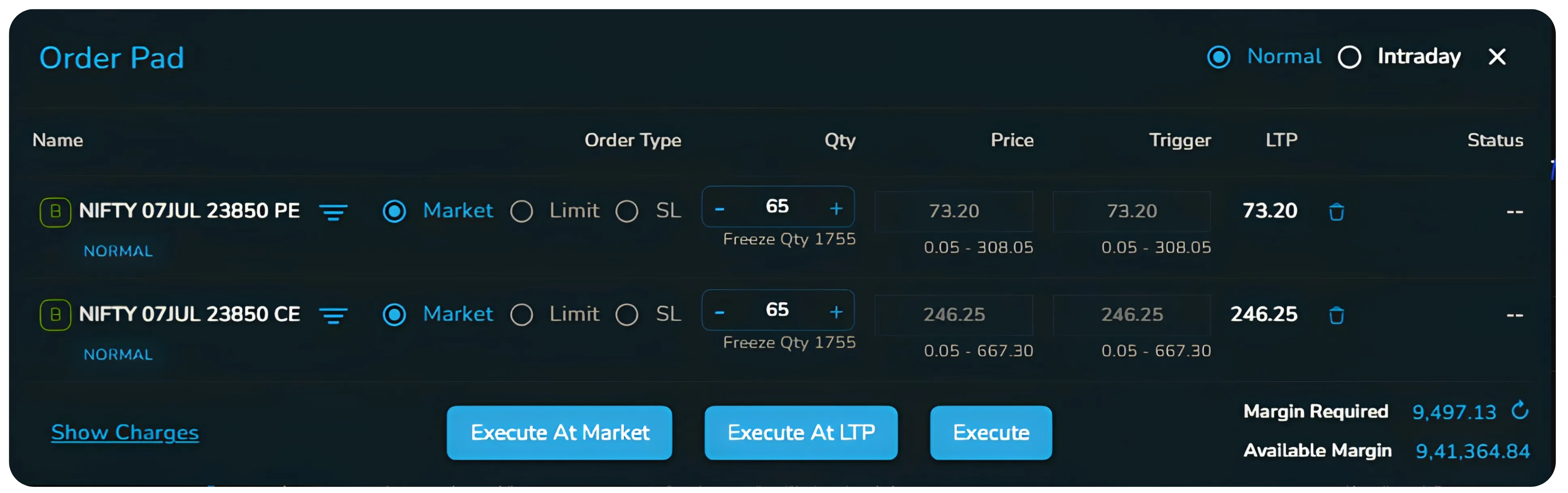
A straddle is simply buying the Call and the Put of the same strike, same expiry, at the same time. If we buy the 23850 CE and the 23850 PE together, that's a straddle. No directional bet is made at entry, both legs are live.
2. Strictly Intraday — No Overnight Carry
Every straddle we take is closed out the same day. We do not carry positions overnight. Overnight gaps in Nifty can wipe out days of edge in a single print, and since our whole method depends on reading intraday price action live, there's no reason to hold exposure into a session where we can't react.
3. We Manage the Straddle, Not the Legs
This is the part most traders get wrong when they first try straddles. We don't babysit the call and the put separately, adjusting one while holding the other. We enter as a straddle and exit as a straddle. The combined premium (not the individual leg price) is what we track, chart, and act on. In the chart above, notice we're not watching the 23850 CE or PE individually; we're watching the combined premium line (currently near 319-347) as a single instrument, complete with its own candle, VWAP-style reference, and RSI.
4. Entry Only Triggers on a Valid, Strong Move
We don't buy a straddle just because the market opened or because it's a round number strike. A straddle buy is triggered only when there's a genuine, qualifying move in the underlying — a real push in premium, not chop. This keeps us out of dead, range-bound sessions where combined premium just bleeds from theta with no follow-through.
Also Read: Lesser-Known Candlestick Patterns for Big Moves
5. Drastically Fewer Fakeouts Than Naked Buying
This is the core edge. With a naked call or put, a sharp move against your position hurts immediately and directionally; you're wrong the second price reverses. With a straddle, a fakeout in either direction is far less damaging, because the opposite leg is absorbing some of that move. We only converts this into a clean directional trade once the move proves itself. Fewer fakeouts means fewer forced, premature exits.
6. Fewer Traders Are Doing This
Compared to naked call/put buying (which is the default entry point for almost every retail options trader) very few people trade straddles this way, as an active intraday directional tool rather than a pure volatility/event play. Less crowding here also tends to mean less "everyone piling in and out together" noise around our entries and exits.
7. Fully Rule-Based Entries and Exits
There's no discretion on "does this feel right." Entries are triggered by defined premium-move criteria; exits are governed by trailing logic (VWAP, Supertrend, ATR-based trails; whatever the system specifies) and hard intraday time cutoffs. The straddle either meets the rule or it doesn't. This removes the emotional layer that kills most options buyers that are chasing, hesitating, or exiting on gut feel.
8. Using Straddles to Identify Trend
Beyond just being an entry vehicle, the straddle premium chart itself becomes a trend-reading tool. When combined premium is expanding and holding above key levels (VWAP, moving averages) with RSI confirming momentum, that tells us a real trend is developing) in either direction (before we even need to commit to calls or puts individually. We're essentially using the straddle's premium behavior as a proxy for "is this move real," and only then do we let it play out as a directional trade.
9. Applying Technical Analysis Tools to the Straddle Premium Itself
Here's the shift in thinking that makes this work: once you've combined the CE and PE into a single premium line, you can throw the same TA toolkit you'd use on a stock or index chart onto that line, not onto Nifty spot, onto the straddle.
- VWAP on premium — acts as the intraday fair-value reference for the combined premium. Premium holding above VWAP with rising slope signals real strength in the move; premium hugging or falling below VWAP flags a low-conviction session, which is one of our filters for point 4 (no valid move, no entry).
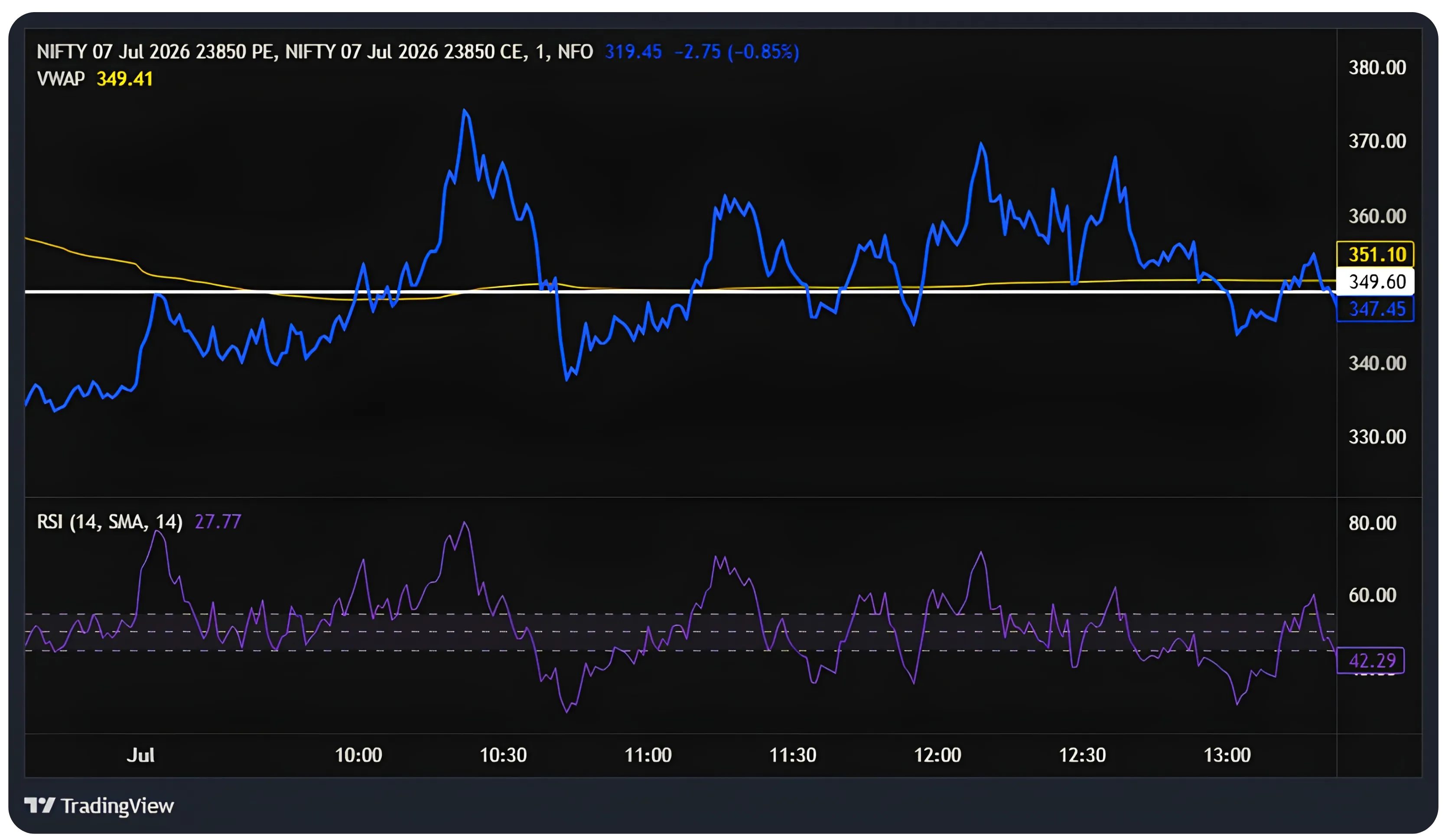
Supertrend — plotted directly on the premium candle, it gives a binary trend flip signal on the straddle itself. A Supertrend flip is often used as the trailing stop mechanism referenced in point 7, since it adapts to volatility rather than using a fixed point stop.
ATR (Average True Range) — measures how much the premium is actually expanding, session to session. Rising ATR on the premium confirms the move has real volatility behind it (useful for the trigger in point 4); flat/falling ATR is a sign to sit out.
RSI on premium (as in the chart above, RSI 14 SMA 14) — used less as overbought/oversold and more as a momentum-of-premium-expansion gauge. Sustained RSI above the mid-line alongside expanding premium adds confidence the move is trending, not chopping.
Moving averages / EMA crossovers on premium — a fast EMA crossing above a slower one on the combined premium line works as a secondary trend confirmation layered on top of the VWAP/Supertrend signals, reducing whipsaw entries.
Support/resistance and prior session premium levels — horizontal levels from the previous day's premium range, or intraday consolidation zones, mark the breakout thresholds that define what counts as a "valid move" in point 4.
Volume/OI on the underlying strikes — while the premium chart drives entries/exits, a quick OI build-up check on the individual CE and PE strikes (without managing them separately) helps confirm whether the move is backed by fresh positioning or just premium decay/expansion from existing OI.
The key idea: every indicator here is applied to the straddle as a single instrument, not to the individual legs. That's what keeps the system consistent with point 3, we're never making a call-vs-put decision mid-trade, just reading one premium line the same way we'd read any other price chart.
In short: naked option buying gets you cheap premium and maximum exposure to being wrong. Straddle buying costs more upfront but filters out the noise; you're not betting on direction at entry, you're betting on the move being real, and you find out fast, intraday, with rules doing the deciding instead of emotion.
Disclaimer: The information provided in our blogs is for informational purposes only and should not be construed as financial, investment, or trading advice. Trading and investing in the securities market carries risk. Always conduct your own research and consult with a qualified financial advisor before making any investment decisions. Past performance is not indicative of future results. Copyrighted and original content for your trading and investing needs.
© 2026 — Tradejini. All Rights Reserved.