

Before starting, it would be useful to have an understanding on the ‘Different Types of Mutual Funds’. This chapter builds on those fundamentals and examines how a single fund structure can encompass all of them, and why that matters from a portfolio construction standpoint.
What is a Multi Asset Allocation Fund?
A Multi-Asset Allocation Fund is a mutual fund scheme that invests across three or more asset classes within a single portfolio. These typically include equity, debt, commodities such as gold, and may also extend to other permitted asset classes like REITs or InvITs.
As per SEBI regulations, for a scheme to be classified under this category, each asset class must have a minimum allocation of 10%, maintained on a continuous basis and subject to periodic rebalancing. This framework is intended to ensure meaningful diversification rather than concentration under a multi-asset label.
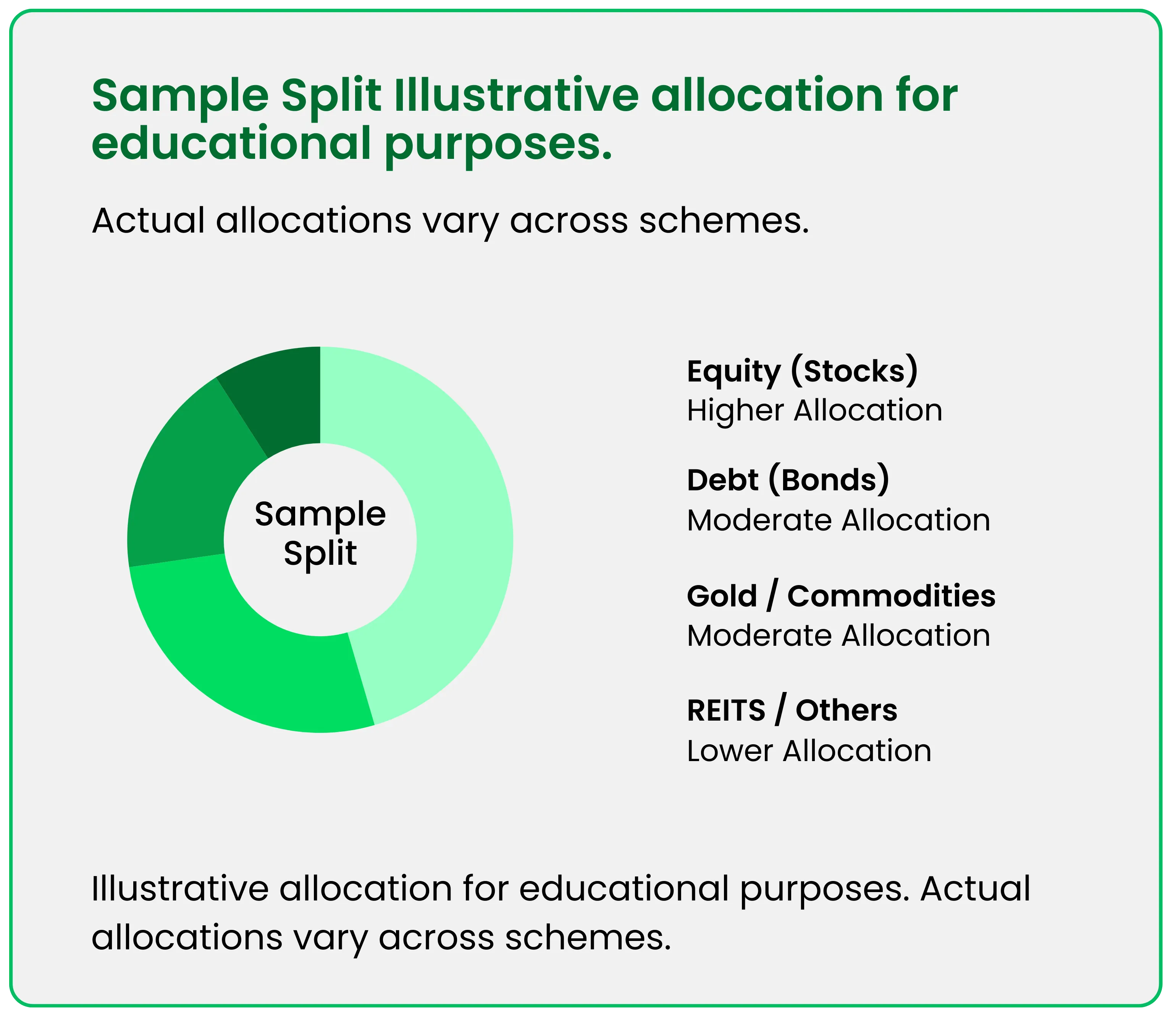
Why does multi-asset allocation matter?
Different asset classes respond to different economic forces. Equity returns are influenced by corporate earnings and growth expectations. Debt instruments are sensitive to interest rate movements and monetary policy. Gold and other commodities tend to react to inflation trends, currency movements, and periods of elevated uncertainty.
Because these drivers are distinct, asset classes generally exhibit imperfect correlation across market cycles. While correlations may increase during periods of extreme market stress, diversification across assets can help moderate portfolio volatility over longer holding periods.
Dynamic Allocation
The role of the fund manager
Unlike index funds or passive schemes, multi-asset allocation funds are actively managed. The fund manager, along with the investment team at the AMC, is responsible for deciding how much capital flows into each asset class, and critically, for revising those allocations as macroeconomic conditions evolve. This process is referred to as dynamic allocation.
The decision framework typically involves monitoring variables such as inflation trajectory, central bank monetary policy, equity valuations relative to historical averages, and global risk sentiment. Based on these inputs, the manager adjusts the portfolio accordingly. This is not a one-time decision, it is an ongoing, iterative process throughout the life of the fund.
Dynamic Allocation Example
Scenario: CPI inflation rises meaningfully, and the RBI signals a tightening bias.
The fund manager may reduce exposure to interest-rate-sensitive debt instruments (either by lowering allocation or shortening portfolio duration) and increase allocation to assets that have historically shown resilience during inflationary phases, such as gold. Equity exposure may be retained or adjusted depending on valuation comfort and earnings visibility.
*Allocation changes are driven by evolving macroeconomic conditions and are subject to the fund’s stated investment mandate and risk framework.
Associated Risks
Market Risk
During global downturns, asset correlations rise. Equities, commodities, and bonds can fall together, reducing diversification benefits.
Interest Rate Risk
The fund’s debt exposure is sensitive to RBI policy. Rate hikes can lower bond prices and drag the fund’s NAV.
Manager Risk
Performance depends on the fund manager’s allocation decisions. Incorrect macro or valuation calls can lead to underperformance.
Liquidity Risk
Less liquid assets like REITs or certain commodities may be hard to sell in stressed markets, delaying exits or hurting prices.
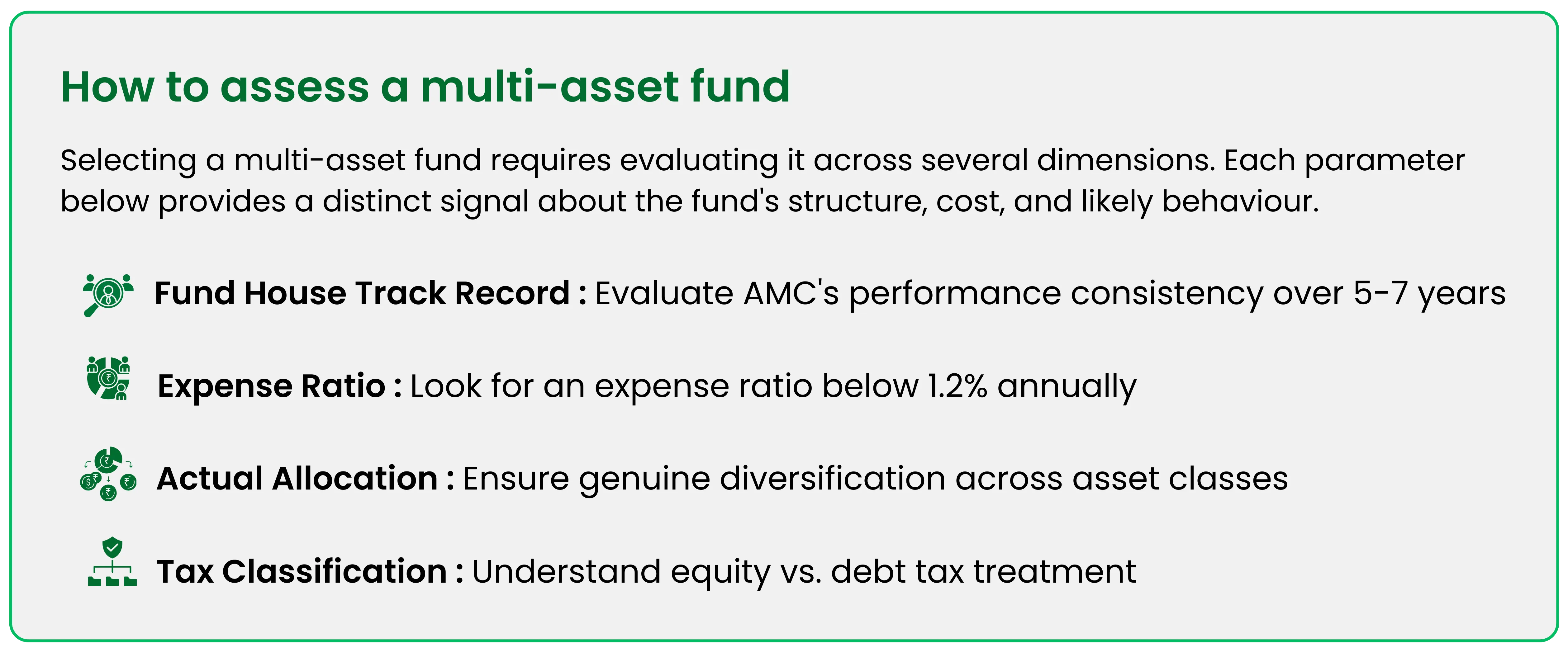
Who should consider this category?
Investment horizon of 3 years or more. The fund's value proposition is built on long-term correlation dynamics between asset classes. Short holding periods increase the likelihood of realising losses during transient drawdowns before the diversification benefit can fully manifest.
Moderate risk tolerance. The fund will experience volatility, particularly from its equity component. Investors who are uncomfortable with short-term NAV fluctuations in the range of 10–15% may find this category unsuitable.
Limited capacity or preference for active portfolio management. If you do not wish to manually monitor and rebalance across equity, debt, and commodities, a multi-asset fund delegates that responsibility to a professional team.
Seeking portfolio-level diversification within a single instrument. Rather than constructing a multi-asset portfolio through separate funds, each with its own expense ratio and monitoring overhead, this category consolidates that exposure.
Disclaimer: The information provided in our blogs is for informational purposes only and should not be construed as financial, investment, or trading advice. Trading and investing in the securities market carries risk. Always conduct your own research and consult with a qualified financial advisor before making any investment decisions. Past performance is not indicative of future results. Copyrighted and original content for your trading and investing needs.
© 2026 — Tradejini. All Rights Reserved.