

Silver always travelled before it settled. Mined deep in the Americas, it crossed oceans not as an ornament but as economic power, funding empires, closing trade gaps, and anchoring the world’s earliest global markets.
REWIND
In 1980, silver came dangerously close to touching 50 dollars an ounce.
For a brief moment, it looked unstoppable. Traders panicked, governments intervened, and fortunes were made and destroyed. By the end of that same year, silver had collapsed back to around 15 dollars.
Most assets don’t behave like that.
Silver does.
Because silver has never been just a metal. It has been money, power, politics, and sometimes, chaos.
To understand silver, you don’t start with charts. You start with history.
Before Gold Took the Spotlight
Long before gold became the symbol of wealth, silver was already moving the world.
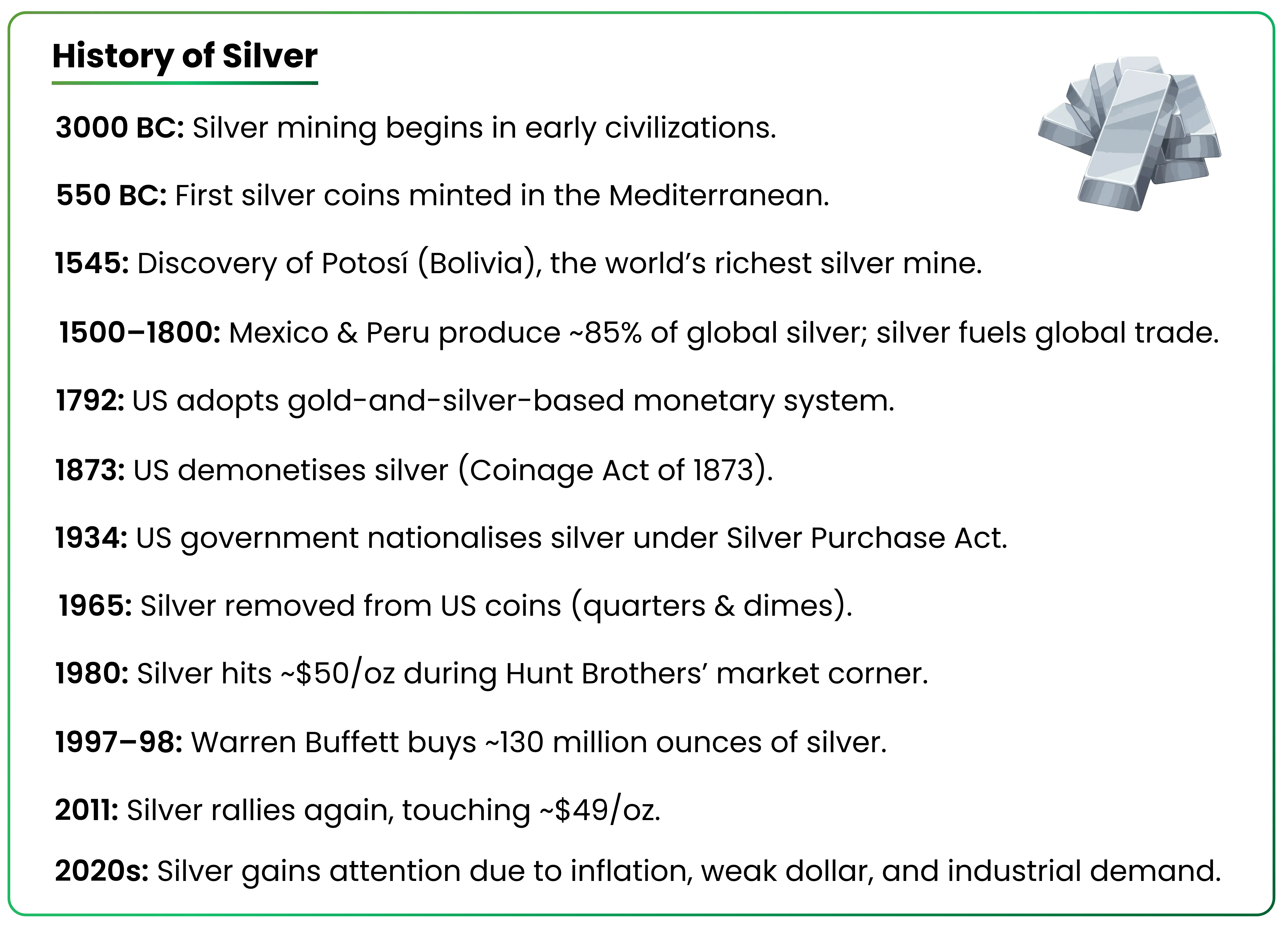
As early as 3000 BC, humans were actively mining silver. By 2500 BC, ancient civilisations had figured out how to extract it from lead using a process called cupellation, one of the earliest known metallurgical techniques.
By 550 BC, the first silver coins appeared in the eastern Mediterranean. The Greeks and later the Romans adopted silver as standard coinage, allowing trade to flourish across empires.
Silver was practical. Easier to divide than gold. Easier to carry value across long distances.
For centuries, silver was money.
When Empires Ran on Silver
Between 1500 and 1800, the world witnessed something unprecedented.
Mexico and Peru produced nearly 85% of the world’s silver. Massive discoveries like Potosí in Bolivia turned mountains into money-printing machines. At its peak in the early 1600s, Potosí was one of the richest places on earth.
Spanish silver coins, known as ‘pieces of eight,’ became the world’s first truly global currency. They travelled across Europe, the Americas, and Asia.
By some estimates, nearly 40% of all silver mined during this period ended up in China, where silver ingots became the backbone of the monetary system for centuries.
Silver didn’t just enable trade. It globalized it.
Know the history of Gold: Gold’s Evolution of Ancient Wealth to Modern Investment Shield

The Fall from Monetary Grace
Then came policy.
In the late 1800s, governments began choosing sides. Gold was crowned king.
The Coinage Act of 1873 in the U.S. effectively demonetised silver. The Gold Standard Act of 1900 sealed its fate. Silver was no longer the backbone of money. It was downgraded to a commodity.
Demand dropped. Prices fell.
But silver never disappeared. It simply changed roles.
From Money to Market Weapon
The 20th century showed what happens when silver demand meets speculation.
In the 1970s, the Hunt Brothers, oil billionaires from Texas, began aggressively buying silver. Their goal was simple: corner the market.
By January 1980, silver prices exploded to just under 50 dollars an ounce. Regulators stepped in. The bubble burst. The Hunt Brothers were eventually fined and declared bankrupt.
This episode remains central to understanding long-term cycles within the silver price history India 1980 to 2026.
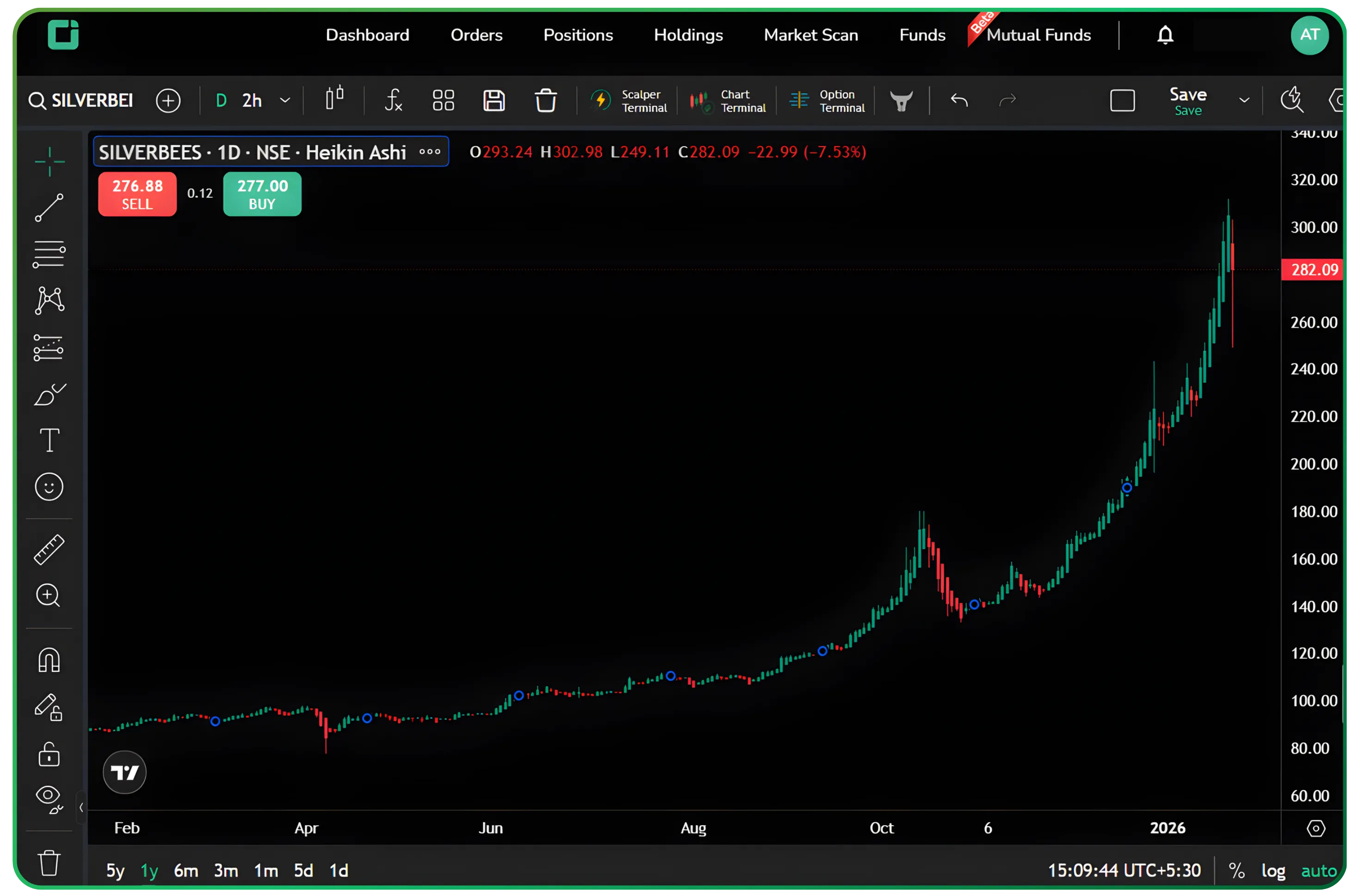
Silver ETF returns 2026 (Jan 22 2025 - Jan 22 2026)
Buffett, Asia, and the Return of Demand
In the late 1990s, a quieter accumulation took place.
Warren Buffett bought around 130 million ounces of silver, betting on long-term supply-demand imbalances. Around the same time, industrial use of silver was rising, especially in electronics and photography.
By 2010 and 2011, silver surged again, briefly touching levels last seen in 1980. This time, demand wasn’t just speculative. It was global, physical, and heavily driven by Asia.
Even today, when silver prices spike, it is often Asia buying the metal, not selling it.
Why Silver Is Back in Focus Today

Silver’s renewed relevance is driven less by emotion and more by utility.
The global push toward clean energy has sharply increased solar energy silver demand, as silver is a critical component in photovoltaic cells.
At the same time, EV silver consumption per vehicle is rising, as electric vehicles use significantly more silver than internal combustion engine cars due to electronics, power management systems, and charging infrastructure.
Another emerging driver is AI data center silver usage. Data centres require high-performance electrical components, cooling systems, and power transmission, all of which rely on silver’s conductivity.
Silver sits at a strange intersection.
It behaves like money in times of crisis.
It behaves like an industrial metal during economic growth.
And it behaves like a speculative asset when liquidity floods markets.
This dual nature makes silver volatile, misunderstood, and powerful.
It is cheaper than gold. More sensitive than gold. And historically, far more dramatic. (Source: Reuters)
Understand silver. Invest in Silver ETFs. Get started on CubePlus.
Disclaimer: The information provided in our blogs is for informational purposes only and should not be construed as financial, investment, or trading advice. Trading and investing in the securities market carries risk. Always conduct your own research and consult with a qualified financial advisor before making any investment decisions. Past performance is not indicative of future results. Copyrighted and original content for your trading and investing needs.
© 2026 — Tradejini. All Rights Reserved.
.webp%3Falt%3Dmedia%26token%3D0ead9799-20bc-4d1e-ae8f-d75ab18921b5&w=3840&q=75)