If you trade in the Indian financial markets, you have probably noticed several statutory charges appearing in your contract note such as brokerage, stamp duty, transaction charges, Securities Transaction Tax, GST, and more. Among these is a small but important fee: SEBI turnover charges.
What are turnover charges
Turnover charges are fees applied to the total turnover of your stock exchange transactions. Turnover simply refers to the value of your purchase or sale of securities.
Whenever you buy or sell securities, whether equity shares, debt instruments, futures, options, or currency, the exchange calculates your turnover and applies certain fees on it. For example, if you buy or sell shares of a company listed on the stock exchange, turnover charges will be calculated based on the value of those transactions.
Each of these entities performs crucial roles such as settlement, regulation, monitoring, and investor protection. Clearing corporations are responsible for the settlement process and play a role in the collection of regulatory fees. SEBI, as the regulatory authority, oversees the process of collecting turnover charges from market participants, including clearing corporations, mutual fund houses, and stockbrokers. The government also levies taxes and duties, such as Securities Transaction Tax (STT) and stamp duties, on securities transactions. The process of collecting and remitting turnover charges is an important part of regulatory compliance in the trading ecosystem, ensuring adherence to SEBI's requirements.
What are SEBI turnover charges?
The Securities and Exchange Board of India applies a small fee called SEBI turnover charges (also known as turnover fees). SEBI collects turnover charges from various market participants, including brokers, mutual fund houses (based on their assets under management), and clearing corporations. Clearing corporations pay a fixed amount annually as turnover charges. Most market participants are not exempt from SEBI turnover charges. These fees are used to support regulatory activities such as:
Monitoring securities markets
Ensuring fair trading rules
Protecting investors
Strengthening surveillance and compliance
Supporting clearing members and the settlement system
Although the fee is technically levied on brokers, it is passed on to clients through the contract note.
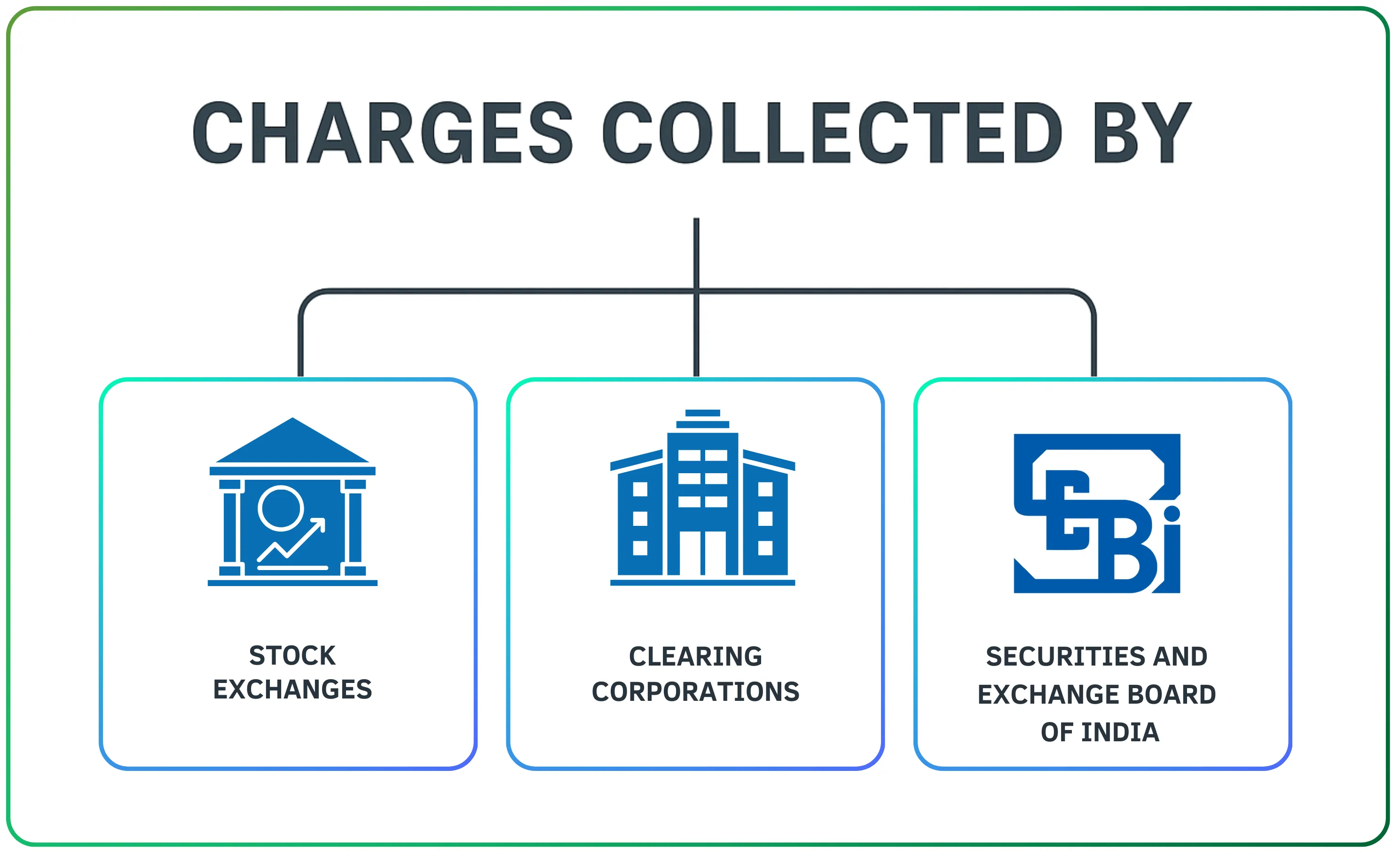
Each of these entities performs crucial roles such as settlement, regulation, monitoring, and investor protection.
How turnover charges calculated in trading
Turnover is calculated based on the traded price:
Turnover = Quantity × Price
This is applied separately on
Example:
If you buy 100 shares at ₹200:
- Turnover = 100 × 200 = ₹20,000You pay SEBI charges on ₹20,000.
If you sell them later at ₹250:
- Turnover = 100 × 250 = ₹25,000You again pay SEBI charges on ₹25,000.
Options Example:
When you execute an option, certain charges are calculated as a percentage of the settlement price. For instance, a fee of 0.125% of the settlement price is payable upon exercising options. The settlement price is used to determine these charges related to the exercise or settlement of options.
SEBI turnover charges are collected on both buy and sell sides.
How SEBI turnover fees are computed on each trade
Suppose you carry out these trades:
1. You buy 10,000 shares at ₹20
Turnover = ₹2,00,000
SEBI charge = 0.0001% of 2,00,000 = ₹0.20
2. You sell 3,000 shares intraday at ₹25
Turnover = 3,000 × 25 = ₹75,000
SEBI charge = 0.0001% of 75,000 = ₹0.075 (rounded to ₹0.08)
3. You sell remaining 7,000 shares at ₹30 (delivery)
Turnover = 7,000 × 30 = ₹2,10,000
SEBI charge = 0.0001% of 2,10,000 = ₹0.21
Total SEBI turnover fee = ₹0.20 + ₹0.08 + ₹0.21 = ₹0.49
SEBI turnover charges rates (updated as on 18 July 2022)
| Sr. No. | Nature of Securities | Rate of Fee |
|---|---|---|
| 1 | All sale and purchase transactions in securities other than debt securities | 0.0001% of the transaction value (₹10 per crore) |
| 2 | All sale and purchase transactions in debt securities | 0.000025% of the transaction value (₹2.5 per crore) |
How the Tradejini brokerage calculator helps you understand total trading costs
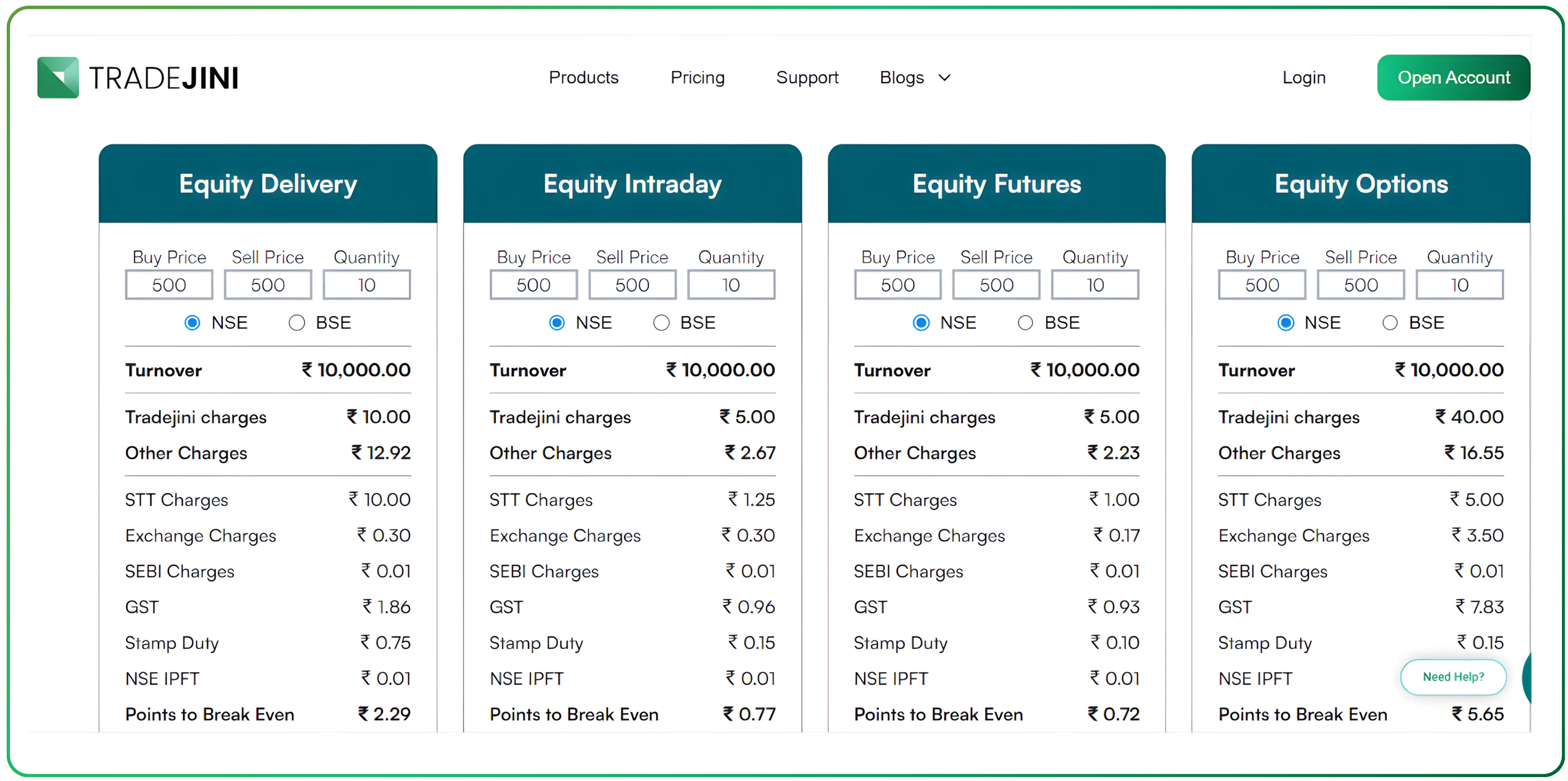
The Tradejini brokerage calculator gives traders a clear, instant breakdown of all costs involved in a trade. Instead of manually checking multiple charges, the calculator automatically displays everything in one place.
As shown in the image below, the calculator shows the breakup for Equity Delivery, Intraday, Futures and Options. This makes it easier to compare costs across segments before placing a trade.
Brokerage charges are a key component of total trading costs and should be considered alongside other statutory and transaction-related fees. They appear alongside other charges such as brokerage, transaction charges, stamp duty, GST components, Securities Transaction Tax, and exchange or clearing fees. Together, all these components add up to form the total cost of trading.
Role of clearing member in turnover charges
Clearing members play a pivotal role in the seamless execution and settlement of stock exchange transactions in India. Acting as intermediaries between brokers and the stock exchanges, clearing members are responsible for ensuring that all regulatory and statutory charges, including SEBI turnover charges are accurately collected and remitted.
When you buy or sell securities such as equity shares, debt securities, or other fixed income securities, your broker collects SEBI turnover fees as part of the overall transaction charges. These fees are then passed on to the clearing member, who is ultimately liable for remitting the total turnover charges to the stock exchange. The exchange, in turn, deposits these funds into the account of the Securities and Exchange Board of India (SEBI), supporting the regulatory authority’s oversight and investor protection functions in the Indian financial markets.
Clearing members must also handle other statutory charges, such as securities transaction tax, stamp duty under the Indian Stamp Act, service tax, and education cess, all of which are levied on various securities transactions. Their responsibilities extend to both the purchase and sale of securities, ensuring that all applicable fees are calculated based on the total turnover and remitted in compliance with SEBI regulations.
Accurate calculation and timely remittance of SEBI turnover charges and related fees are essential for maintaining the integrity of the securities markets. Clearing members rely on guidance notes issued by SEBI and other regulatory authorities to stay updated on the latest rules and procedures. By fulfilling these obligations, clearing members not only facilitate smooth settlement processes but also contribute to investor protection and the overall stability of the Indian securities ecosystem.
For market participants, understanding the role of clearing members in managing turnover charges and other statutory fees is crucial. It ensures transparency in costs, helps in compliance with regulatory requirements, and supports the efficient functioning of stock exchange transactions across India.
Why are SEBI turnover fees important?
Regulatory Funding
SEBI uses these fees to supervise markets, maintain rules, and ensure fair practices.
Investor Protection
Fraud detection, surveillance and transparency improve with these funds.
Market Efficiency
The charges help support exchange infrastructure and clearing systems.
Cost Awareness
Cost awareness is crucial for every trader. Understanding fees is especially important for those dealing in Futures, Options, High-volume intraday trading, Mutual fund transactions involving listed units, and Debt securities. Knowing these charges helps traders estimate the true cost of transactions and avoid unexpected deductions.
What are other charges based on turnover
Along with SEBI charges, traders may also encounter Exchange transaction charges, brokerage on trades, taxes such as Securities Transaction Tax, Stamp duty under the Indian Stamp Act, and GST components like education cess.
There may also be fees on option premium and brokerage on delivery and intraday trades. These are separate from SEBI charges but are also calculated based on turnover or traded value.
Additionally, certain securities transactions, such as those involving interest-bearing instruments or derivatives, may incur charges related to interest.
Conclusion
SEBI turnover charges play a major role in ensuring safe, transparent, and efficient operation of the Indian securities market. These small fees support strong regulation, investor protection and smooth functioning of exchanges and clearing systems. Understanding these charges helps investors calculate true trading costs, compare brokers effectively, and make informed financial decisions.
Disclaimer: The information provided in our blogs is for informational purposes only and should not be construed as financial, investment, or trading advice. Trading and investing in the securities market carries risk. Always conduct your own research and consult with a qualified financial advisor before making any investment decisions. Past performance is not indicative of future results. Copyrighted and original content for your trading and investing needs.
© 2025 — Tradejini. All Rights Reserved.
.webp%3Falt%3Dmedia%26token%3D0ead9799-20bc-4d1e-ae8f-d75ab18921b5&w=3840&q=75)