Options trading presents numerous opportunities for generating consistent income, but few strategies have sparked as much debate as option selling. While option buyers chase quick gains hoping for significant price movements, option sellers take the opposite approach, positioning themselves to benefit from the natural decay of option premiums over time. But the critical question remains: is option selling profitable in practice?
This comprehensive analysis examines the profitability of option selling, backed by real market data, regulatory insights, and proven strategies that can help traders understand whether this approach aligns with their financial goals and risk tolerance.
Understanding Option Selling: The Foundation of Success
Option selling, also known as option writing, involves selling call or put options to collect premium income upfront. When you sell options, you're essentially taking on the obligation to either buy or sell the underlying asset at a predetermined strike price if the option buyer chooses to exercise their right.
The fundamental appeal of option selling lies in its statistical advantage. Market research indicates that approximately 70% of options expire worthless, creating a built-in edge for sellers. This statistic forms the backbone of why experienced traders often say that "option sellers are the ones who win consistently in the long run.
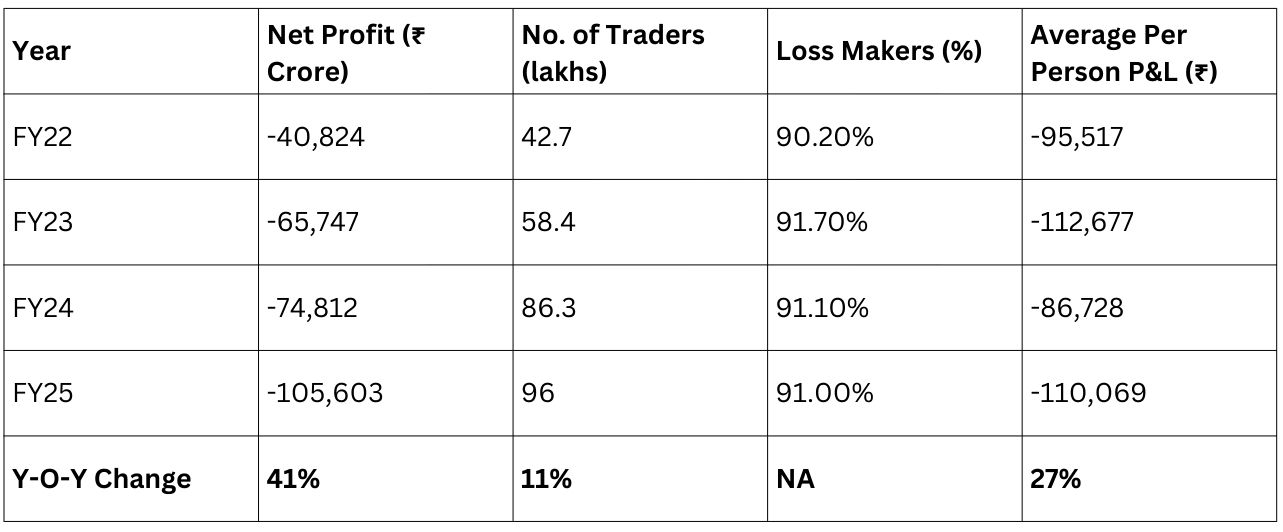
However, the reality of profitability is more nuanced. SEBI's 2025 study revealed that 91% of individual F&O traders incurred losses, with collective losses reaching ₹1.06 lakh crore in FY25. This stark contrast between theoretical probability and real-world results highlights the complexity of profitable option selling.
Option Sellers vs Option Buyers: The Fundamental Difference
The key difference between option sellers and option buyers lies in their risk-reward profiles and market outlook:
Option Sellers:
- Collect premium upfront from selling contracts
- Benefit when option expires worthless
- Face potentially unlimited risk (in naked strategies)
- Profit from time decay working in their favor
- Typically have higher win rates (60-80%)
- Generate consistent income in sideways markets
Option Buyers:
- Pay premium upfront for the right to buy/sell
- Need significant price movement to profit
- Risk is limited to premium paid
- Fight against time decay
- Lower win rates but unlimited profit potential
- Seek large directional moves
Curious about Jyoti CNC’s growth story in precision manufacturing? Read the complete analysis here.
How Option Expires Worthless Benefits Sellers
One of the most significant advantages option sellers enjoy is when option expires worthless. This scenario occurs when:
- Call options expire with the stock price below the strike price
- Put options expire with the stock price above the strike price
- Time decay erodes the option's extrinsic value to zero
When an option expires worthless, the seller retains the entire premium collected at the trade's initiation. This creates multiple opportunities for income generation as sellers can repeatedly collect premiums from options that lose value simply due to the passage of time.
Research on Bank Nifty movements from 2005 to 2020 reveals compelling statistics:
- 70% of the time, Bank Nifty stayed within a 1% range on a weekly basis
- This translates to a 70% success rate for appropriately positioned option sellers
- Out-of-the-money options have even higher probabilities of expiring worthless
Call Option Selling: Strategy and Profitability
Call option selling involves writing call contracts, taking on the obligation to sell the underlying stock at the strike price if the buyer exercises the option. This strategy works best when traders have a neutral to bearish outlook on the market.
Naked Call Selling
When you sell a call option without owning the underlying asset, you're engaging in naked call selling. While this strategy offers:
- Immediate income from premium collection
- Profit when stock price remains below the strike price
- Benefits from time decay and volatility contraction
The significant risk lies in unlimited losses if the stock price exceeds the strike price substantially. If the stock price rises dramatically, losses can mount quickly, making this approach unsuitable for most retail traders.
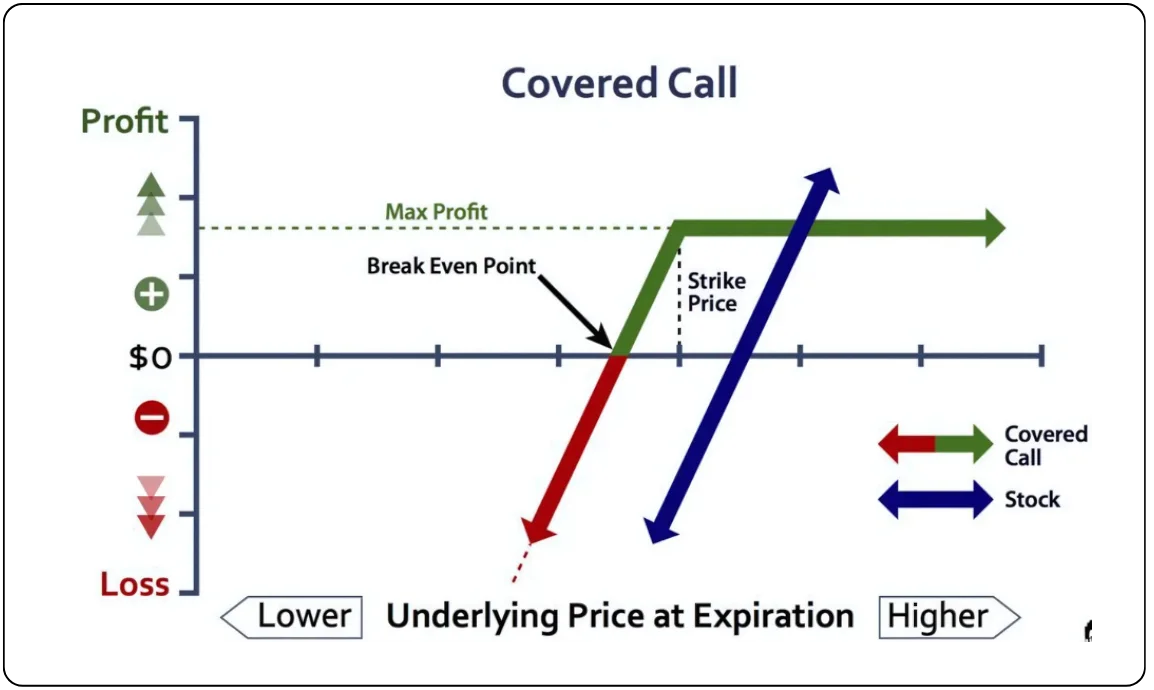
Covered Call Strategy
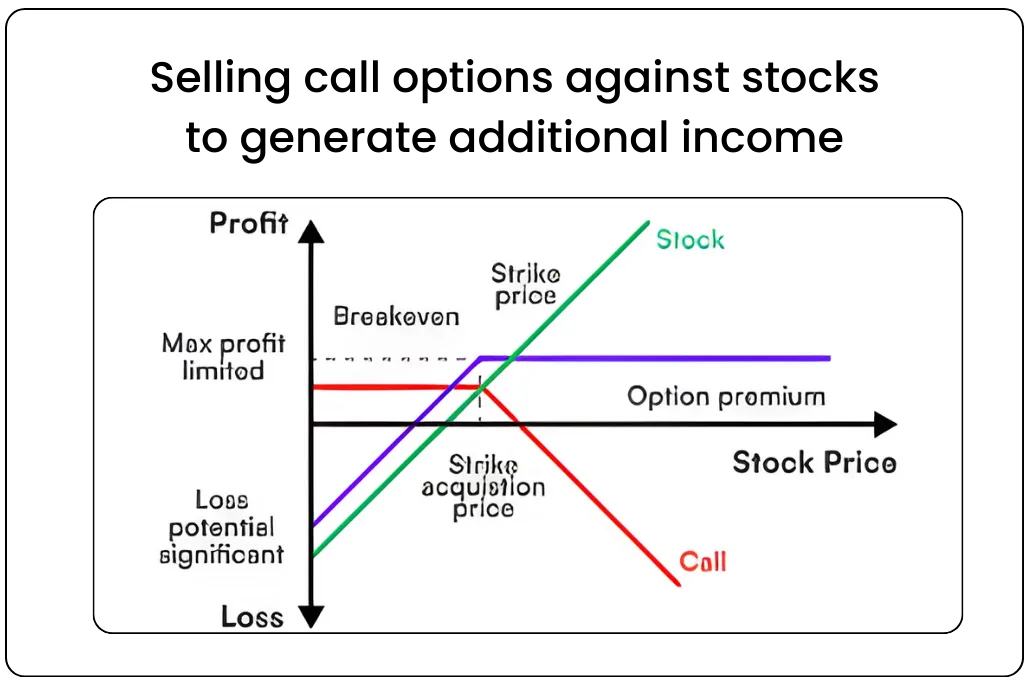
The covered call strategy represents a more conservative approach to call option selling. This strategy involves selling call options against stocks you already own, providing:
- Limited risk due to stock ownership providing natural hedge
- Additional income from premium income collection
- Downside protection equal to premium received
Example: If you own 100 shares of a stock at ₹95 and sell a ₹100 call for ₹5, you collect ₹500 premium while capping upside at ₹100 but providing ₹5 downside protection.
Historical data shows that covered call strategies can generate consistent returns of 8-12% annually, though they sacrifice unlimited upside potential for consistent income.
Curious about how India’s hospital sector is shaping the future of healthcare? Dive into our detailed industry report here.
Selling Options: Profitable Strategy Development
Developing a profitable strategy for selling options requires understanding several critical components:
Market Outlook Assessment
Your market outlook significantly influences strategy selection:
- Range bound markets: Ideal for iron condors and straddles
- Slightly bullish conditions: Favor cash-secured puts
- Neutral markets: Benefit various selling strategies
- High volatility periods: Offer higher premiums but increased risk
Strike Price Selection
Choosing the appropriate option strike price involves balancing:
- Probability of profit: Further out-of-the-money strikes have higher success rates
- Premium income: At-the-money options offer higher premiums
- Risk tolerance: Your comfort level with potential assignment
Time Management
Expiration date selection impacts profitability:
- 30-45 days to expiration: Optimal for most strategies
- 0-15 days: Higher time decay but increased gamma risk
- 60+ days: Lower time decay but more time for adverse moves
Options Trading: The Seller's Advantage
Options trading from the seller's perspective offers several structural advantages that contribute to profitable option selling:
Time Decay Advantage
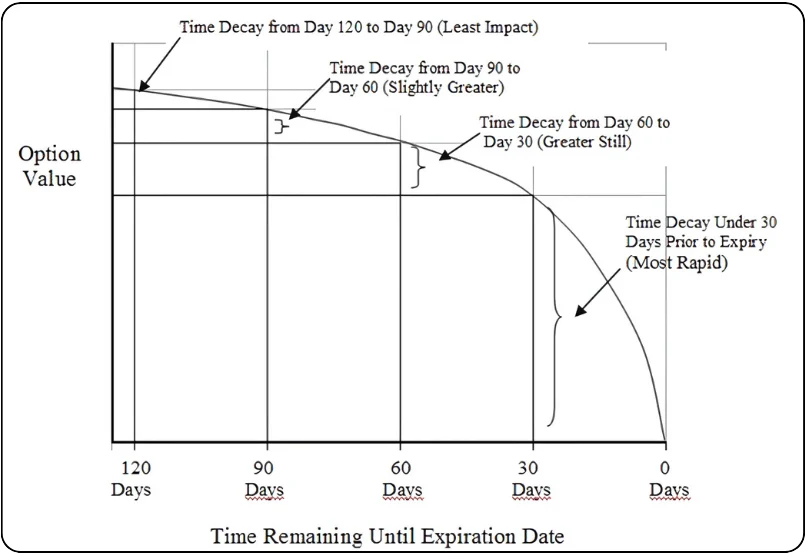
Time decay, measured by theta, works consistently in favor of sellers. As options approach their expiration date, they lose value at an accelerating rate, with the most rapid decline occurring in the final weeks before expiry. This creates multiple profit opportunities for sellers who can repeatedly collect premiums as options contracts expire worthless.
Statistical Edge
Market studies consistently show that option sellers benefit from favorable probability statistics:
- 66% of retail investors use simple, one-sided strategies that often fail
- Institutional investors using complex selling strategies achieve better results
- Selling volatility is identified as the most successful strategy for both retail and institutional participants
Premium Collection Mechanics
When selling options, traders receive immediate income through premium upfront collection. This cash flow advantage allows for:
- Immediate deployment of capital for other opportunities
- Compound growth through reinvestment of collected premiums
- Regular income stream independent of market direction
Option Buying vs Option Selling: Profitability Comparison
Comparing option buying vs option selling reveals significant differences in profitability patterns:
Option Buying Characteristics:
- Higher risk: Need significant price movements to overcome time decay
- Lower win rates: Typically 30-40% success rates
- Unlimited profit potential: No cap on gains if trade moves favorably
- Limited risk: Loss capped at premium paid
Option Selling Characteristics:
- Higher win rates: Often 60-80% success rates
- Limited profit potential: Gains capped at premium collected
- Consistent income: Regular cash flow from premium collection
- Higher risk management requirements: Need sophisticated strategies to limit downside
Studies show that retail traders predominantly engage in buying options, contributing to the high failure rate. Conversely, institutional investors and experienced traders favor selling strategies, achieving more consistent profitability.
Effective Risk Management Strategies
Effective risk management strategies form the cornerstone of profitable option selling. Without proper risk controls, even strategies with high win rates can lead to catastrophic losses.
Position Sizing Principles
Proper position sizing prevents single-trade disasters:
- Risk no more than 1-2% of total capital per trade
- Avoid overleveraging despite favorable probability statistics
- Maintain adequate capital for multiple simultaneous positions
- Scale position sizes based on strategy complexity and risk
Hedging Techniques
Hedging strategies transform unlimited risk into limited risk:
- Protective options: Buy further out-of-the-money options as insurance
- Spreads: Combine buying and selling to define maximum loss
- Portfolio-level hedges: Use index options to protect overall portfolio
- Dynamic hedging: Adjust protection based on changing market conditions
Stop-Loss Implementation
Contrary to popular belief, option sellers need systematic exit strategies:
- Premium-based stops: Exit when option premium doubles (200% rule)
- Underlying-based stops: Close positions when stock breaches key technical levels
- Time-based stops: Exit positions approaching expiration to avoid gamma risk
- Volatility-based stops: Adjust positions when implied volatility spikes
Market Conditions and Profitability Factors
Market conditions significantly influence option selling profitability. Understanding these dynamics helps traders optimize their approach:
Volatility Impact
Market volatility affects both premium income and risk:
- High volatility periods: Offer increased premium income but greater risk
- Low volatility environments: Provide lower premiums but more predictable outcomes
- Volatility contraction: Benefits sellers as inflated premiums deflate
- Volatility expansion: Can quickly turn profitable trades into losses
Looking for a detailed breakdown of Varroc Engineering’s business and financials? Explore the full analysis here
Market Direction Effects
Different market movements impact various selling strategies:
- Range bound markets: Optimal for iron condors and short straddles
- Trending markets: Require directional bias in strategy selection
- Volatile periods: Favor credit spreads over naked positions
Economic Factors
Broader economic conditions influence option selling success:
- Interest rate environment: Affects option pricing models
- Dividend schedules: Impact assignment probabilities
- Earnings seasons: Create volatility spikes affecting premiums
High-Probability Option Selling Strategies
Several option selling strategies offer high probability of success when implemented correctly:
Cash-Secured Put Strategy
Cash-secured puts represent a conservative approach to put option selling:
- Mechanics: Sell put options while maintaining cash to purchase underlying stock
- Risk profile: Limited risk as you're prepared to own the stock
- Income potential: Generate consistent income from premium collection
- Assignment handling: If assigned, you acquire stock at effective discount
Example: If you sell a ₹95 put for ₹3 premium and get assigned, your effective purchase price is ₹92, providing a 3.2% discount to the strike price.
Iron Condor Strategy
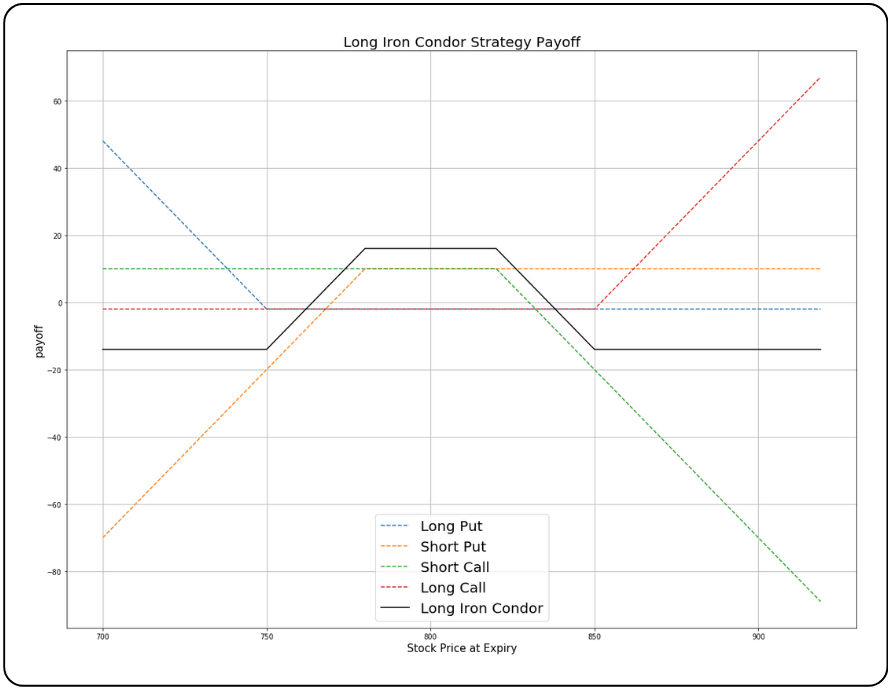
The iron condor combines two credit spreads creating a market-neutral strategy:
- Construction: Sell call and put options while buying further out-of-the-money options for protection
- Profit zone: Maximum profit occurs when underlying asset stays between short strikes
- Risk management: Limited risk defined by spread width minus premium collected
- Market suitability: Performs best in range bound markets with low volatility
Backtesting results show iron condors can achieve:
- 70-80% win rates when properly managed
- Average returns of 15-25% annually
- Maximum drawdowns typically under 20% with proper risk management
Credit Spreads
Credit spreads offer controlled exposure to option selling:
- Bull put spreads: Profit from sideways or rising markets
- Bear call spreads: Benefit from sideways or declining markets
- Margin efficiency: Require less capital than naked positions
- Defined risk: Known maximum loss at trade initiation
Market Price Dynamics and Timing
Understanding market price dynamics enhances option selling timing:
Entry Timing Optimization
Optimal entry points for selling options:
- High implied volatility periods: When premiums are inflated
- Post-earnings announcements: After volatility crush events
- Technical resistance/support levels: When price rejection is likely
- Economic uncertainty: When option premiums reflect fear premiums
Exit Strategy Implementation
Profitable option selling requires disciplined exits:
- Profit targets: Close trades at 25-50% of maximum profit
- Time-based exits: Close positions with 7-10 days to expiration
- Volatility-based exits: Adjust when implied volatility changes significantly
- Technical exits: Close when underlying breaches key levels
Capital Requirements and Market Access
Option selling strategies often require significant capital due to margin requirements:
Margin Considerations
SEBI's current margin framework requires:
- 100% upfront margin collection eliminates intraday leverage
- SPAN margins: Risk-based calculations for worst-case scenarios
- Exposure margins: Additional buffers typically 3-5% of contract value
- Extreme loss margins: Extra 2% on short positions during expiry
Capital Efficiency Strategies
Maximize capital efficiency through:
- Defined-risk spreads: Reduce margin requirements by 60-70%
- Portfolio margining: Offset correlated positions
- Cash management: Optimize cash deployment across strategies
- Scaling approaches: Start small and grow positions systematically
Institutional vs Retail Success Rates
Institutional investors demonstrate significantly higher success rates in option selling:
Institutional Advantages
Professional traders benefit from:
- Sophisticated risk management systems
- Diversification across multiple strategies and timeframes
- Advanced analytics for strategy optimization
- Capital adequacy to weather losing streaks
Retail Challenges
Individual traders face obstacles:
- Limited capital affecting strategy implementation
- Emotional decision-making undermining systematic approaches
- Inadequate risk management leading to catastrophic losses
- Knowledge gaps in strategy mechanics and Greeks
Technology and Execution Advantages
Modern technology enhances option selling profitability through:
Systematic Approaches
Algorithmic trading systems offer:
- Emotion-free execution based on predefined rules
- Consistent application of risk management principles
- Backtesting capabilities to validate strategy effectiveness
- Real-time monitoring of portfolio Greeks and risk metrics
Building Consistent Profitability
Achieving consistent profitability in option selling requires:
Systematic Framework Development
Profitable option selling demands structured approaches:
- Strategy selection criteria based on market conditions
- Position sizing algorithms for risk management
- Entry and exit rules for timing optimization
- Performance monitoring for continuous improvement
Education and Skill Development
Successful option sellers invest in:
- Greeks understanding for risk assessment
- Volatility analysis for premium evaluation
- Market cycle recognition for strategy adaptation
- Risk psychology for emotional control
Long-term Perspective
Profitable option selling requires patience and discipline:
- Accepting losing trades as part of the business
- Focusing on risk-adjusted returns rather than absolute gains
- Building capital gradually through compound growth
- Maintaining consistent execution across market cycles
Regulatory Environment and Compliance
SEBI's evolving regulations significantly impact option selling profitability:
Recent Regulatory Changes
October 2024 reforms introduced:
- Increased minimum contract values from ₹5-10 lakhs to ₹15-20 lakhs
- Higher lot sizes affecting position sizing
- Enhanced margin requirements impacting capital efficiency
- Stricter monitoring of retail participation
Compliance Considerations
Traders must ensure:
- Adequate capital for new margin requirements
- Proper documentation for tax reporting
- Strategy adaptation to regulatory constraints
- Risk disclosure understanding
Conclusion: The Path to Profitable Option Selling
Is option selling profitable? The answer is nuanced and depends on multiple critical factors. While the statistical advantage of 70% options expiring worthless provides a foundation, real-world profitability requires sophisticated execution.
Factors Supporting Profitability:
- Time decay advantage working consistently for sellers
- High probability statistics when properly managed
- Multiple income opportunities through various strategies
- Institutional success demonstrating viability with proper capital and risk management
Challenges to Profitability:
- 91% of retail F&O traders losing money according to SEBI data
- Unlimited risk potential in naked selling approaches
- High capital requirements after recent regulatory changes
- Complex risk management needs for consistent success
The Reality Check
For individual traders, profitability depends heavily on:
- Sufficient capital to weather inevitable losing streaks
- Comprehensive risk management including hedging and position sizing
- Market knowledge to select appropriate strategies and timing
- Emotional discipline to execute systematic approaches consistently
Professional institutional sellers demonstrate that option selling can generate consistent returns of 8-15% annually, but retail success rates remain concerning. Success requires treating option selling as a business with proper capital allocation, systematic risk management, and continuous education rather than seeking quick profits.
The Final Verdict
Option selling can be profitable for well-capitalized, disciplined practitioners with proper risk management strategies. However, it's not suitable for undercapitalized retail traders seeking easy money without adequate preparation. The statistical edge exists, but capturing it profitably requires sophisticated execution that most retail participants lack.
Aspiring option sellers should start with covered calls and cash-secured puts, build experience gradually, maintain strict risk controls, and never risk more than they can afford to lose. With proper preparation, education, and capital adequacy, option selling can indeed become a profitable strategy for generating consistent income in various market conditions.
The key lies not in whether option selling is profitable, but in whether you have the knowledge, capital, and discipline to implement it successfully over the long term.
Turn research into action — trade smarter on CubePlus.
Disclaimer: The information provided in our blogs is for informational purposes only and should not be construed as financial, investment, or trading advice. Trading and investing in the securities market carries risk. Always conduct your own research and consult with a qualified financial advisor before making any investment decisions. Past performance is not indicative of future results. Copyrighted and original content for your trading and investing needs.
© 2025 — Tradejini. All Rights Reserved.
.webp%3Falt%3Dmedia%26token%3D0ead9799-20bc-4d1e-ae8f-d75ab18921b5&w=3840&q=75)